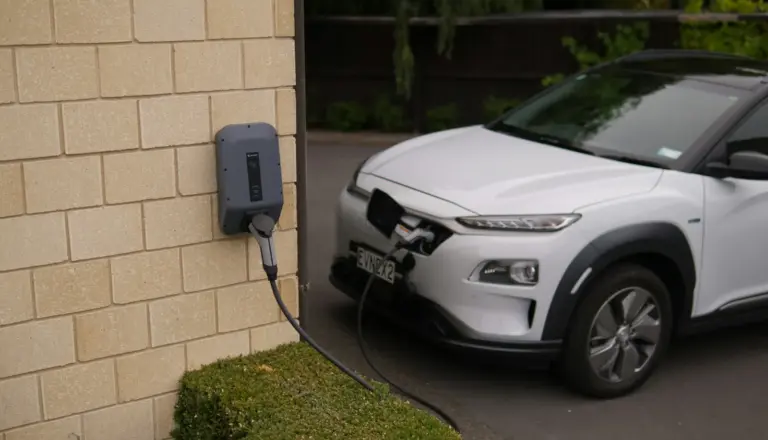

| Charger | Time | Range per hour |
|---|---|---|
| Level 1 1.4 kW | 34 h 43 min | 5 mi 8 km |
| Level 2 7.7 kW | 6 h 31 min | 27 mi 43 km |
| DC fast* 150 kW | 18 min | 583 mi 939 km |
Show the math
75 kWh × (80% − 20%) = 45 kWh45 kWh ÷ (1 − 10% loss) = 50 kWhmin(wall unit 240 V × 32 A = 7.68 kW, car 11.5 kW) = 7.68 kW50 kWh ÷ 7.68 kW = 6.51 h = 6 h 31 min45 kWh × 3.5 mi/kWh ÷ 0.90 = 175 mi (282 km). The 0.90 turns the EPA wall-to-wheels figure into a battery figure.6.91 kW into the battery × 3.5 ÷ 0.90 = 26.9 mi per hourShort answer: Charging a 75 kWh EV from 20% to 80% takes about 6 h 31 min on a 32 amp Level 2 charger, about 35 hours on a standard Level 1 outlet and about 18 minutes on a 150 kW DC fast charger. Time is the energy added divided by charging power, with about 10% extra energy for losses. The default example puts 45 kWh into the battery at 7.7 kW and adds about 175 miles of range.
Most wrong estimates come from two inputs: the charger rating when the car accepts less, and a battery size that includes capacity the car never uses. This page explains how the electric vehicle charging time calculator treats each charger level, what limits the speed, the math behind the result and what to expect from nine common EVs.
This article contains Amazon affiliate links. 33gears earns a commission on qualifying purchases. See our affiliate disclosure.
How to use the EV charging time calculator
How long each charger level takes
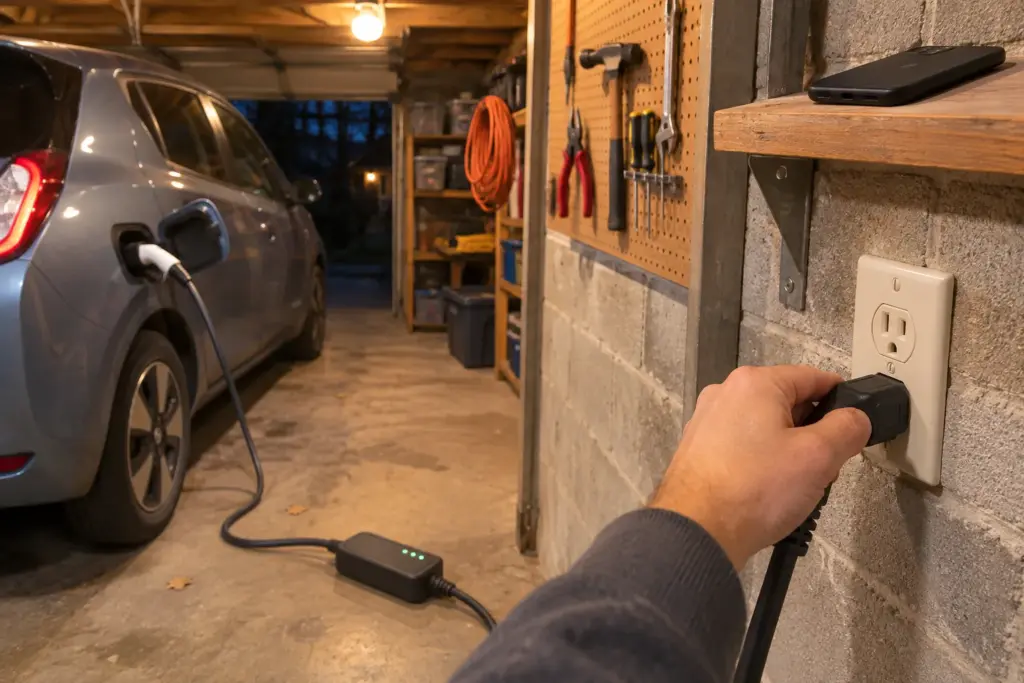
For a 75 kWh battery, 20% to 80% takes 34 h 43 min on Level 1, 6 h 31 min on a 32 amp Level 2 charger and 18 min on a 150 kW DC fast charger. Level 1 is a portable cord on a standard 120 volt outlet. Level 2 is a 240 volt charger at a home or a public station. DC fast chargers are high-power public stations that send direct current to the battery.
| Charger | Power (kW) | 20% to 80% | 0% to 100% |
|---|---|---|---|
| Level 1, 12 amps | 1.4 | 34 h 43 min | 57 h 52 min |
| Level 1, 16 amps | 1.9 | 26 h 3 min | 43 h 24 min |
| Level 2, 16 amps | 3.8 | 13 h 1 min | 21 h 42 min |
| Level 2, 32 amps | 7.7 | 6 h 31 min | 10 h 51 min |
| Level 2, 40 amps | 9.6 | 5 h 13 min | 8 h 41 min |
| Level 2, 48 amps | 11.5 | 4 h 20 min | 7 h 14 min |
| Level 2, 80 amps | 19.2 | 2 h 36 min | 4 h 20 min |
| DC fast, 50 kW | 50 | 54 min | 2 h 42 min |
| DC fast, 150 kW | 150 | 18 min | 54 min |
| DC fast, 250 kW | 250 | 11 min | 32 min |
The table is for a 75 kWh battery with 10% charging losses and a car that accepts the full power shown. Level 1 suits a short daily drive: a 10-hour overnight plug-in adds about 50 miles on Level 1 and about 270 miles on Level 2. With no 240 volt option and long daily distances, weigh the trade-offs in electric cars vs hybrid cars.
Miles of range added per hour by charger level
Level 1 adds about 5 miles of range per hour and Level 2 adds about 27 at 32 amps, for a car that uses 3.5 miles per kWh. The US Department of Energy gives about 5 and about 25 miles per hour as averages for the two levels.
Miles per hour scale with efficiency. On 32 amp Level 2, the Chevrolet Bolt adds about 27 miles per hour and the Rivian R1S Dual Large adds about 18. At a steady 150 kW, DC fast charging adds about 583 miles per hour, or roughly 10 minutes for 100 miles below 80%.
What sets your charging speed
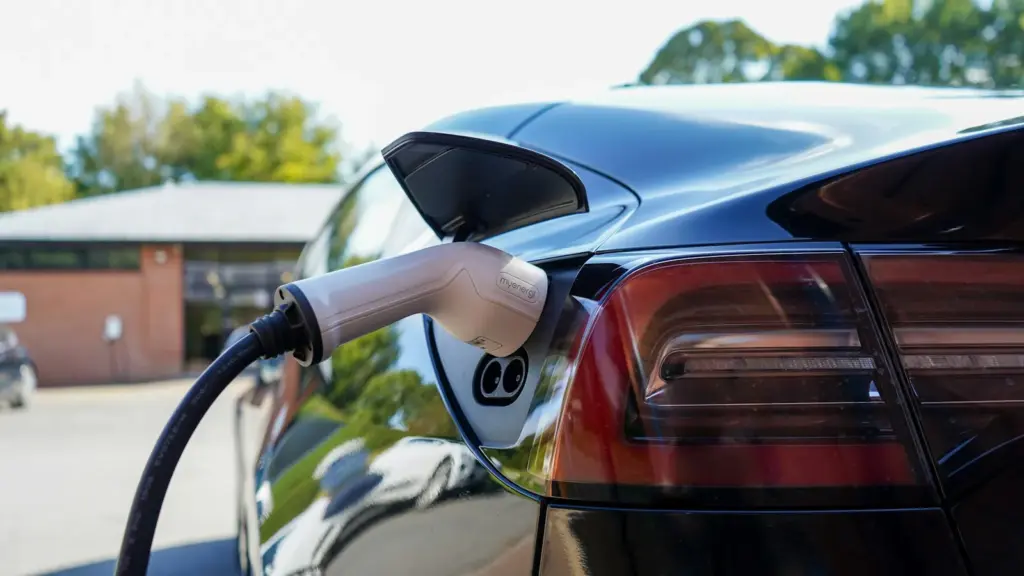
The car charges at the lower of two limits: what the charger supplies and what the car accepts. On AC (Level 1 and 2) the car’s onboard charger converts the power, and the presets in the calculator accept 7.2 to 11.5 kW. A Nissan Leaf S+ accepts 7.2 kW, so it charges at that rate on an 11.5 kW wall unit. On DC fast charging the limit is the lower of the station rating and the car’s maximum DC rate, so a car that accepts 250 kW charges at 150 kW on a 150 kW station.
The wall unit has a second limit, the breaker. A charger runs for hours, which the electrical code treats as a continuous load, so the breaker must be rated at 125% of the charger’s amps. In practice the charger draws 80% of the breaker rating. EC&M explains the rule under NEC Article 625.
| Breaker | Charger draw (80%) | Power at 240 volts |
|---|---|---|
| 40 amps | 32 amps | 7.7 kW |
| 50 amps | 40 amps | 9.6 kW |
| 60 amps | 48 amps | 11.5 kW |
Pick the charger to match the breaker you have, and to match the car: a unit above the car’s limit adds no speed. The calculator’s 80 amp row exceeds what any of the nine preset cars accepts on AC. A plug-in Level 2 charger with a NEMA 14-50 plug fits a 50 amp circuit and runs at up to 40 amps, which is 9.6 kW.
How to calculate EV charging time by hand
Time in hours equals battery kWh times the percentage to add, divided by charging efficiency, divided by the charging power in kW. Using the defaults (75 kWh, 20% to 80%, 32 amps, 3.5 miles per kWh):
DC fast charging skips the loss factor and the car’s onboard charger, because the rated power is at the battery. Time is the energy up to 80% divided by the power, plus the energy above 80% divided by one fifth of the power.
Usable battery capacity and charging losses
Enter usable capacity, the part of the pack the car lets you use. Total capacity is larger by an amount that varies by model, and entering it overstates both the energy and the time. Makers publish usable capacity for some cars and one headline figure for others. Use the spec for your trim and model year.
About 10% of the energy drawn from the wall never reaches the battery. The EPA and DOE put combined charging losses at 10%, and 16% for city driving, and an Idaho National Laboratory test measured about 9% on Level 2. That is why the default example draws 50 kWh from the wall to store 45 kWh.
Level 1 loses more. A Nissan study found four EVs used 7% to 15% more energy on Level 1 than on Level 2, so a loss near 12% suits a Level 1 session. Some press tests have measured 15% to 20%. Change the loss field to match.
Why charging slows after 80% and whether to stop there
Charging power falls as the battery fills, so the last 20% takes longer than the first 80% on a fast charger. The calculator approximates the drop as 20% of the charger power above 80%. That figure comes from Idaho National Laboratory measurements of one 2011 Leaf, so modern cars differ. At 150 kW, 20% to 80% takes 18 min and 0% to 100% takes 54 min.
At home the extra time matters less. On Level 2, 20% to 80% takes 6 h 31 min and 0% to 100% takes 10 h 51 min, so choose the target by the miles you need tomorrow. The calculator applies no AC taper near full, so the top end of a long AC session can run slower than shown. Battery-health guidance on daily 100% charging varies by maker and battery chemistry. Follow the owner’s manual.
EV charging time by car
On a 32 amp Level 2 charger, 20% to 80% takes from 5 h 39 min in the Chevrolet Bolt to 11 h 22 min in the Ford F-150 Lightning Extended Range. Battery size drives most of the gap. The Nissan Leaf S+ is limited by its 7.2 kW onboard charger. On DC, 10% to 80% runs from 13 min in the Tesla Model Y Long Range RWD to 37 min in the Ford F-150 Lightning Extended Range.
| Car | Battery (kWh) | Onboard AC (kW) | Max DC (kW) | Level 2, 32 amps, 20% to 80% | Level 2 miles per hour | DC, 10% to 80% |
|---|---|---|---|---|---|---|
| Tesla Model Y Long Range RWD | 75 | 11.5 | 250 | 6 h 31 min | 28 | 13 min |
| Chevrolet Equinox EV FWD | 85 | 11.5 | 150 | 7 h 23 min | 25 | 24 min |
| Ford Mustang Mach-E RWD Extended | 88 | 11 | 150 | 7 h 38 min | 25 | 25 min |
| Hyundai Ioniq 5 Long Range RWD | 84 | 10.9 | 257 | 7 h 18 min | 26 | 14 min |
| Kia EV6 Long Range RWD | 84 | 10.9 | 240 | 7 h 18 min | 26 | 15 min |
| Nissan Leaf S+ | 75 | 7.2 | 150 | 6 h 57 min | 24 | 21 min |
| Rivian R1S Dual Large | 109 | 11.5 | 215 | 9 h 28 min | 18 | 21 min |
| Ford F-150 Lightning Extended Range | 131 | 11.3 | 150 | 11 h 22 min | 16 | 37 min |
| Chevrolet Bolt | 65 | 11.5 | 150 | 5 h 39 min | 27 | 18 min |
Specs are for the trims named, model years 2025 to 2027, from maker sheets where published. A different trim or year changes the battery size. DC times assume a charger at or above the car’s maximum rate and are the calculator’s best-case estimates.
Why real charging takes longer than the estimate
Treat the result as a planning figure: the AC result matches published Level 1 and Level 2 ranges, and the DC result is the shortest time to expect. Four things add time.
- DC peak against average. The calculator holds the car’s peak rate to 80%, and real sessions start at the peak and fall. Hyundai lists about 20 minutes for 10% to 80% in the Ioniq 5, against 14 min here.
- AC near full. Ford’s own sheet for the F-150 Lightning gives a longer 15% to 100% AC time than the flat model does.
- Higher losses. A 10% loss is the default, and a Level 1 session or a hot or cold day can run above it.
- Cold weather. A cold battery accepts power more slowly, most visibly at a DC fast charger, and cold air raises energy use per mile. The calculator applies no cold adjustment, so allow extra time and expect fewer miles added in winter.
For the cost side of owning an EV, compare running costs in the EV vs gas calculator.
Time is one half of a charging stop; the EV charging cost calculator prices the same session at your state’s rate or a public charger’s price per kWh.
Frequently asked questions
A 32 amp Level 2 home charger takes about 6 h 31 min to charge a 75 kWh EV from 20% to 80%, and about 11 hours from empty to full. A standard 120 volt outlet takes about 35 hours for 20% to 80%.
It takes about 13 to 37 minutes for the nine cars in the calculator, at each car’s maximum rate. That is a best case, and real sessions usually run longer.
The car lowers the charging power as the battery fills, so the last 20% goes at a fraction of the speed of the first 80%. The calculator approximates the drop as one fifth of the charger power above 80%.
A Level 2 charger adds about 27 miles per hour at 32 amps and about 40 at 48 amps, for a car that uses 3.5 miles per kWh. The US Department of Energy cites about 25 miles per hour as an average.
A Level 1 charger adds about 5 miles per hour on a 12 amp circuit and about 6.7 on a 16 amp circuit.
Multiply the battery kWh by the percentage to add, divide by 0.9 for charging losses, then divide by the lower of the charger and car power in kW. For 75 kWh from 20% to 80% at 7.7 kW, that is 50 kWh divided by 7.7 kW, or about 6 h 31 min.
The calculator is best case on DC fast charging, because it holds the peak rate to 80% while a real session tapers from the start. Cold batteries, charging losses above 10% and the slowdown near full on AC add more time.
A Tesla Model Y Long Range RWD takes about 6 h 31 min for 20% to 80% on a 32 amp Level 2 charger, and about 13 min from 10% to 80% at a 250 kW DC fast charger in the best case. Other Tesla models differ with battery size.
Sources
- US DOE Alternative Fuels Data Center. Electric vehicle charging
- US DOE Alternative Fuels Data Center. Charging at home
- DOE and EPA. Charging an electric vehicle
- DOE and EPA. All-electric vehicles
- US EPA. Plug-in electric vehicle charging basics
- EC&M. The apprentice’s guide to Article 625
- Idaho National Laboratory. Charging efficiency of a plug-in vehicle
- Idaho National Laboratory. Battery charging characteristics
- Nissan. Level 1 and Level 2 charging energy use, EEI
- Hyundai. 2025 Ioniq 5 specifications
- Ford. 2025 F-150 Lightning technical specifications

James Kowalski
More from James KowalskiHow we reviewed this article
This article was researched against manufacturer records and editorially reviewed before publishing. We accept no payment for coverage. Some guides contain affiliate links; see our affiliate disclosure.