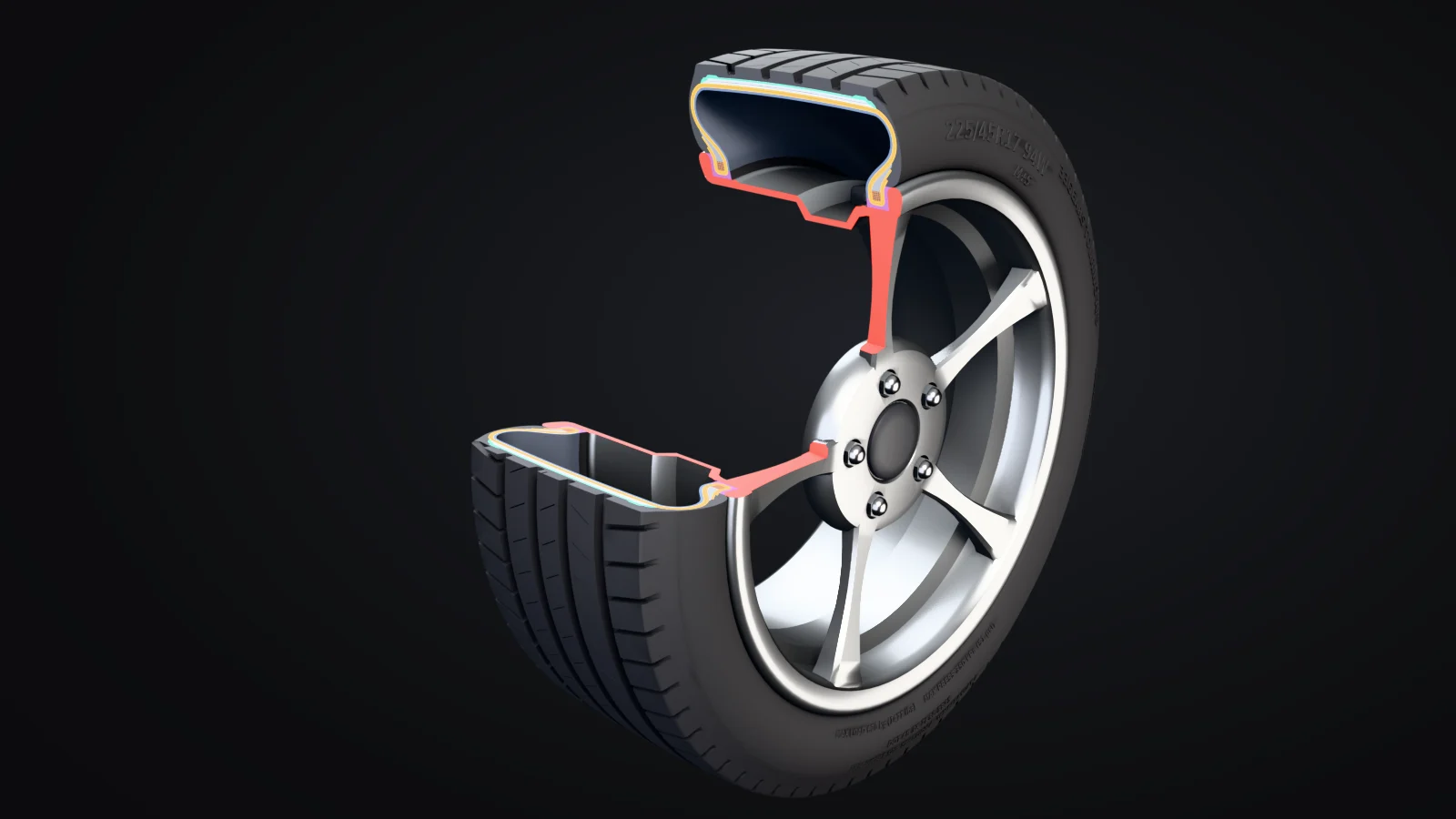
This car tire 3D model is a cutaway of a 225/45R17 94W all-season radial tire on a 17 x 7.5 inch alloy wheel. A wedge is cut out of the front of the tire, so the car tire cross section shows every layer in its own colour, from the inner liner to the tread. Drag to turn the wheel, pinch or hold Ctrl and scroll to zoom, and tap any layer to read what it does. The Layers button builds the tire one layer at a time, in the order a tire factory builds it. The Read the sidewall chips decode the numbers moulded into the rubber, and the Valve and TPMS view shows the parts that most tire diagrams leave out.
Tire cross section: what the model shows
A tire cross section cuts the tire open across its width so the layers can be seen in a stack. Unlike a flat tire diagram, you can turn this one and look at the cut from any side. In the cut face, rubber is dark grey, the inner liner is blue, the body ply is yellow, the bead is copper, the bead filler is light grey, the chafer is purple, the steel belts are silver and the cap ply is green. The alloy wheel is cut too and shows in red.
The tire is generic: a typical all-season passenger radial, not any one brand's. Layer thicknesses are drawn up to 1.5 times real size so every layer stays visible; the order of the layers is exact. The valve stem, TPMS sensor and lug nuts are never cut.
- Tap a layer to open its card and see where it sits.
- Layers hides everything and adds the tire back in 7 steps: inner liner, body ply, beads, sidewalls, steel belts, cap ply and tread.
- Read the sidewall has a chip for each part of 225/45R17 94W, plus the DOT code, UTQG grades, max load, max pressure and M+S mark.
The numbers on this tire: 225 mm section width, 101 mm sidewall height, a 634 mm (25.0 in) overall diameter and a 10/32 in (7.9 mm) new tread depth. The sections below explain each one. If you want to see what the wheel is bolted to, the car engine 3D model uses the same viewer.
How to read tire size
A tire size such as 225/45R17 94W packs six facts into one line. Read it left to right. The model has a separate part for each piece, and the links below jump to it.
- 225 is the section width. It is the nominal width of the tire in millimetres, sidewall to sidewall. Show the 225.
- 45 is the aspect ratio. The sidewall height is 45% of the width: 225 x 0.45 = 101 mm. A lower number means a shorter sidewall. Show the 45.
- R means radial. The body ply cords run straight across from bead to bead. A B marks a bias belt and a D a diagonal tire. Show the R.
- 17 is the rim diameter in inches. This is the wheel size the tire fits (431.8 mm). Show the 17.
- 94 is the load index. It is a code for the most weight one tire can carry: 94 means 670 kg (1,477 lb). Show the 94.
- W is the speed rating. W means 168 mph (270 km/h). Show the W.
Tap the tire size in the model to see where the line sits on the sidewall. It is the same string you type when you shop for tires, and the tire size chart below turns it into physical dimensions.
P-metric, Euro-metric and LT sizes
A leading P, as in P225/45R17, marks a P-metric passenger tire built to the US Tire and Rim Association load standards. With no letter in front, the tire follows the European ETRTO standard (Euro-metric); each system uses its own load and inflation table. LT means light truck. LT sizes put the letters at the end of the code, can give the width in inches and add a load range letter. The numbers read the same way in all three systems.
Tire size chart: overall diameter, sidewall height and revs per mile
A tire size chart converts the size code into dimensions. Overall diameter is the rim diameter plus two sidewalls, so:
diameter (mm) = rim (in) x 25.4 + 2 x width (mm) x aspect ratio / 100
revolutions per mile = 63,360 / (3.1416 x diameter in inches)
There are 63,360 inches in a mile. For 225/45R17 the sidewall is 225 x 0.45 = 101.25 mm and the diameter is 17 x 25.4 + 2 x 101.25 = 634.3 mm, which is 24.97 in and about 808 revolutions per mile. Every row below comes from those two formulas.
| Tire size | Overall diameter (in) | Overall diameter (mm) | Sidewall height (mm) | Revs per mile |
|---|---|---|---|---|
| 185/65R15 | 24.5 | 622 | 120 | 824 |
| 195/65R15 | 25.0 | 634 | 127 | 807 |
| 205/55R16 | 24.9 | 632 | 113 | 811 |
| 205/60R16 | 25.7 | 652 | 123 | 785 |
| 215/60R16 | 26.2 | 664 | 129 | 771 |
| 215/55R17 | 26.3 | 668 | 118 | 767 |
| 225/45R17 | 25.0 | 634 | 101 | 808 |
| 225/60R17 | 27.6 | 702 | 135 | 730 |
| 225/65R17 | 28.5 | 724 | 146 | 707 |
| 235/65R17 | 29.0 | 737 | 153 | 695 |
| 265/70R17 | 31.6 | 803 | 186 | 638 |
| 225/55R18 | 27.7 | 705 | 124 | 727 |
| 235/45R18 | 26.3 | 669 | 106 | 766 |
| 235/60R18 | 29.1 | 739 | 141 | 693 |
| 245/40R18 | 25.7 | 653 | 98 | 784 |
| 255/55R18 | 29.0 | 738 | 140 | 694 |
| 265/65R18 | 31.6 | 802 | 172 | 639 |
| 245/45R19 | 27.7 | 703 | 110 | 729 |
| 255/40R19 | 27.0 | 687 | 102 | 746 |
| 275/55R20 | 31.9 | 810 | 151 | 632 |
Real revolutions per mile run a little higher than these figures, because a loaded tire flattens at the bottom and its rolling radius is smaller than half the diameter. A replacement size with a different overall diameter changes your speedometer reading, so keep the new diameter close to the original. The rim diameter must match your wheel exactly: the 17 in the model is the number that has to agree.
Tire load index and speed rating charts
The two-part code after the size, 94W here, is the service description. The tire load index is the first part, the speed rating the second. Open the load index or the speed rating in the model.
Load index chart (75 to 110)
The load index is the most weight one tire can carry. Multiply by four to compare it with a car: four 94 tires carry 2,680 kg (5,908 lb) in total. Tires marked XL (extra load) are built for a higher inflation pressure than a standard-load tire of the same size, which raises the load they carry.
| Load index | kg per tire | lb per tire |
|---|---|---|
| 75 | 387 | 852 |
| 76 | 400 | 882 |
| 77 | 412 | 908 |
| 78 | 425 | 937 |
| 79 | 437 | 963 |
| 80 | 450 | 992 |
| 81 | 462 | 1,019 |
| 82 | 475 | 1,047 |
| 83 | 487 | 1,074 |
| 84 | 500 | 1,102 |
| 85 | 515 | 1,135 |
| 86 | 530 | 1,168 |
| 87 | 545 | 1,201 |
| 88 | 560 | 1,235 |
| 89 | 580 | 1,279 |
| 90 | 600 | 1,323 |
| 91 | 615 | 1,356 |
| 92 | 630 | 1,389 |
| 93 | 650 | 1,433 |
| 94 | 670 | 1,477 |
| 95 | 690 | 1,521 |
| 96 | 710 | 1,565 |
| 97 | 730 | 1,609 |
| 98 | 750 | 1,653 |
| 99 | 775 | 1,709 |
| 100 | 800 | 1,764 |
| 101 | 825 | 1,819 |
| 102 | 850 | 1,874 |
| 103 | 875 | 1,929 |
| 104 | 900 | 1,984 |
| 105 | 925 | 2,039 |
| 106 | 950 | 2,094 |
| 107 | 975 | 2,149 |
| 108 | 1,000 | 2,205 |
| 109 | 1,030 | 2,271 |
| 110 | 1,060 | 2,337 |
Tire speed rating chart (L to Y)
The speed rating is the maximum speed the tire is rated for. Parenthesised ratings such as (W) and (Y) mean the tire can exceed the listed speed, with the maker setting the limit.
| Speed rating | km/h | mph |
|---|---|---|
| L | 120 | 75 |
| M | 130 | 81 |
| N | 140 | 87 |
| P | 150 | 94 |
| Q | 160 | 100 |
| R | 170 | 106 |
| S | 180 | 112 |
| T | 190 | 118 |
| U | 200 | 124 |
| H | 210 | 130 |
| V | 240 | 149 |
| Z | over 240 | over 149 |
| W | 270 | 168 |
| (W) | over 270 | over 168 |
| Y | 300 | 186 |
| (Y) | over 300 | over 186 |
Parts of a tire
A tire is a stack of rubber and cord layers. These are the parts of a tire you can tap in the model, from the outside in.
Tire tread
The tread is the rubber that touches the road. It carries the grooves that move water away and the ribs and blocks that grip. On this tire it is a cap of tread rubber with a thin undertread beneath, 10/32 in (7.9 mm) deep when new. Show the tread.
Grooves and sipes
Grooves are the wide channels that run around the tire. Sipes are thin slits cut across the ribs and blocks. Grooves carry water out of the contact patch, and sipes let water escape sideways, which reduces hydroplaning. This tire has four main grooves. Find the grooves.
Shoulder
The shoulder is the edge of the tread where it meets the sidewall. Excess wear on both shoulders points to low pressure. Show the shoulder.
Tire sidewall
The tire sidewall is the side of the tire between the tread and the bead. It is mostly rubber with cord reinforcement. It shields the layers inside from cuts and abrasion, flexes as the tire rolls and carries every marking you read when you decode a tire. Show the sidewall.
Steel belts
Steel belts are layers of steel cord bonded in rubber, laid directly under the tread. They give the tread a flat, stable base and protect the casing. Passenger tires usually have two or three; this model has two, 180 mm and 170 mm wide, so the belt stack stops short of the shoulder. Show the belts.
Cap ply
The cap ply is a textile layer wrapped over the steel belts. It helps the tire keep its shape at speed, and it is common on performance and higher-quality all-season tires. Here it is nylon. Show the cap ply.
Body ply
The body ply is the cord layer that forms the tire's carcass. Its cords run bead to bead and carry the load of the inflated tire. This model uses two polyester plies, turned up around each bead. Show the body ply.
Inner liner
The inner liner is the air-tight rubber layer on the inside of the tire, a halobutyl compound with low air permeability. It does the job the inner tube did on older tires. Show the inner liner.
Tire bead
The tire bead is a band of high-strength steel wire encased in rubber at the inner edge of each sidewall. Air pressure pushes the bead against the rim, which seals the tire and holds it on the wheel. A tire has two beads. Show the bead.
Bead filler
The bead filler (or apex) is a triangle of rubber above the bead. It stiffens the bead seat and affects wear life, steering response and comfort. Show the bead filler.
Chafer
The chafer is a strip of rubber around the bead that protects the casing where it meets the rim. Show the chafer.
Radial tire vs bias ply tire
The R in 225/45R17 is the construction code. In a radial tire the body ply cords run at 90 degrees to the direction of travel, and belts under the tread stiffen the crown. The sidewall can flex for ride comfort while the belts keep the tread flat for wear and grip.
A bias-ply tire lays its cords diagonally in crossing layers, typically at 30 to 40 degrees from the direction of travel. Adding strength meant adding plies, and plies rubbing against each other as the tire flexed made heat. The radial tire avoids that. Compared with bias-ply, a radial tire has less rolling resistance, a softer ride, longer tread life and a wider footprint. Michelin developed the first radial car tire in 1946, and radials had reached 100% of the North American market by 1976. That is why the R on the sidewall is on nearly every car tire you will meet.
Tire tread depth, wear bars and wear patterns
Tire tread depth is measured in 32nds of an inch. A new tread on this tire is 10/32 in (7.9 mm) deep. Tread wear bars are raised bars on the floor of the main grooves, 1.6 mm (2/32 in) high; US safety standard FMVSS 109 requires an indicator at that depth. When the tread wears level with the bars, the tire is at its minimum depth. Find a wear bar.
- 2/32 in (1.6 mm) is the legal minimum in most US states. Replace the tire.
- Penny test: put a penny in a groove with Lincoln's head pointing down. If you can see all of his head, you are at or below 2/32 in.
- Quarter test: do the same with a quarter and Washington's head. If you see space above his head, you are below 4/32 in.
- 4/32 in (3 mm): Tesla's service documentation says tires below this depth are more likely to hydroplane in the wet and should not be used.
- 5/32 in (4 mm): the same document says tires below this depth do not perform well in snow and slush. For winter driving, see the benefits of winter tires and all-season tires vs summer tires.
Tire wear patterns show what is wrong before the tread is gone:
- Center wear: overinflation.
- Wear on both edges: underinflation or a slow leak.
- Wear on one edge: misalignment.
- Feathering or scalloping: separated belts, worn suspension parts or skipped tire rotations.
Rotate the tires on the schedule in your owner's manual. If you drive in snow country, the tire chain size finder shows which chains fit your tire size.
The wheel, valve stem and TPMS sensor
The tire sits on a wheel, here a 17 x 7.5 inch five-spoke alloy with a 5 x 114.3 mm bolt circle and a 45 mm offset. Alloy wheels are made from aluminium or magnesium alloys, and most are cast. The rim is deep in the centre and shallow at its outer edges. That deep centre, the drop centre, gives the tire bead room to slip over the flange when the tire is mounted. Once the tire is inflated, air pressure pushes each bead axially outward against the rim flange, which keeps it on the rim.
Wheel offset (ET) is the distance between the wheel's centreline and the face that bolts to the hub, in millimetres. Zero offset puts the mounting face on the centreline. Positive offset puts it nearer the front face of the wheel and negative offset toward the back. The five lug nuts clamp that face to the hub.
Tire valve stem
The tire valve stem is the fill point. Virtually all car tires use a Schrader valve, a spring-loaded poppet valve threaded into the stem. A rubber snap-in stem is pulled through the rim hole and is rated to roughly 60 to 65 psi. A metal clamp-in stem is tightened with a nut and suits higher pressures and speeds; this model has a clamp-in stem. Rubber stems can crack over time, so they are replaced with each new set of tires.
TPMS sensor
A direct TPMS sensor is a battery-powered unit inside the tire, most often mounted on the inside of the valve stem. It measures pressure and sends it to the car. Indirect systems have no pressure sensors and estimate low pressure from wheel-speed signals. Show the TPMS sensor.
US standard FMVSS 138 requires a TPMS on passenger cars and light trucks up to 10,000 lb gross vehicle weight. Every vehicle built on or after September 1, 2007 must comply, which is why a tire pressure sensor is standard on 2008 model year cars and newer. The warning light must come on within 20 minutes once a tire is 25% below the recommended cold pressure. The sensor battery lasts 5 to 10 years and is sealed in, so a dead sensor is replaced as a unit.
Run-flat tires
Run-flat tires are built like the tire in this model, with a much thicker sidewall. The extra rubber carries the weight of the car after a puncture, so you can keep driving. The typical figure is about 50 miles (80 km) at around 50 mph (80 km/h). The thicker sidewall also gives a harsher ride, a 20% to 40% weight penalty and more rolling resistance, and a run-flat can cost more than double a standard tire. Repair may be impossible after a puncture in the sidewall or at the edge of the tread. Our run-flat tires vs regular tires comparison covers when they make sense.
Tire sidewall markings beyond the size
Besides the size line, the sidewall carries four more marks, one chip each in the model.
- DOT code. The tire identification number begins with DOT and ends with four digits for the week and year of manufacture. 3925 means week 39 of 2025.
- UTQG grades. Treadwear, traction and temperature. This tire reads TREADWEAR 500, TRACTION A, TEMPERATURE A. Treadwear is a multiple of 20 compared with a reference tire graded 100, so a 500 tire is rated to wear five times as well in the test. Traction runs AA, A, B, C for wet braking. Temperature runs A, B, C for heat resistance.
- Max load and max pressure. 670 kg (1,477 lb) and 350 kPa (51 psi) on this tire. The maximum pressure is a limit for the tire, not the pressure to run. Use the figure on the placard in the driver's door jamb. Under-inflated tires lower gas mileage by about 0.2% for every 1 psi drop in the average pressure of all tires.
- M+S. Mud and snow. It means the tire meets the Rubber Manufacturers Association all-season definition. It is not the same as the three-peak mountain snowflake mark, which rates a tire for severe snow.
Frequently asked questions about tires
How do you read a tire size?
Read it left to right. In 225/45R17 94W, 225 is the section width in millimetres, 45 is the sidewall height as a percentage of the width, R is radial construction, 17 is the rim diameter in inches, 94 is the load index and W is the speed rating. The walkthrough above links each piece to the model.
What does 94W mean on a tire?
94W is the service description. 94 is the load index: one tire can carry 670 kg (1,477 lb). W is the speed rating: 168 mph (270 km/h).
What is a tire size chart?
A tire size chart lists tire sizes next to their dimensions. The chart above gives overall diameter, sidewall height and revolutions per mile for 20 common passenger sizes, computed from the width, aspect ratio and rim diameter.
What does the DOT code on a tire mean?
The DOT code is the tire identification number. It holds a plant code, a manufacturer's code and a four-digit date code. The date code is the week and year of manufacture, so 3925 means week 39 of 2025.
How old is too old for a tire?
The tire maker sets the limit. Goodyear and Cooper say not to use tires for more than six years from the date of manufacture or from when they were mounted. Michelin says to have tires inspected every year after five years of service and to replace them ten years after manufacture. The date is in the last four digits of the DOT code.
What is the max PSI on a tire and what should I run?
The max PSI moulded on the sidewall is the tire's limit, not a target. FuelEconomy.gov says not to use it. Run the recommended cold pressure from the placard on the driver's side B-pillar or door jamb, or from your owner's manual. For passenger cars, 32 to 35 psi cold is the typical advice.
What are steel belted radial tires?
Steel belted radial tires have body ply cords running at 90 degrees to the direction of travel, plus two or three layers of steel cord under the tread. The ply lets the sidewall flex and the steel belts keep the tread flat.
What is the bead of a tire?
The bead is the steel wire band in the inner edge of each sidewall. It seats against the wheel's rim flange and makes the airtight seal. A bead filler sits above it and a chafer covers it where the rim touches.
What is a TPMS sensor?
A TPMS sensor is a small battery-powered pressure sensor, most often mounted on the valve stem inside the tire. It reports pressure to the car, which lights a dashboard warning when a tire drops 25% below the recommended cold pressure. Vehicles built since September 1, 2007 must have a TPMS. The sensor battery lasts 5 to 10 years.
How deep should tire tread be?
New tread on this tire is 10/32 in. The legal minimum in most states is 2/32 in, which is where the wear bars show. For wet roads, plan to replace at 4/32 in, and at 5/32 in for snow. Check with a depth gauge or the penny and quarter tests.