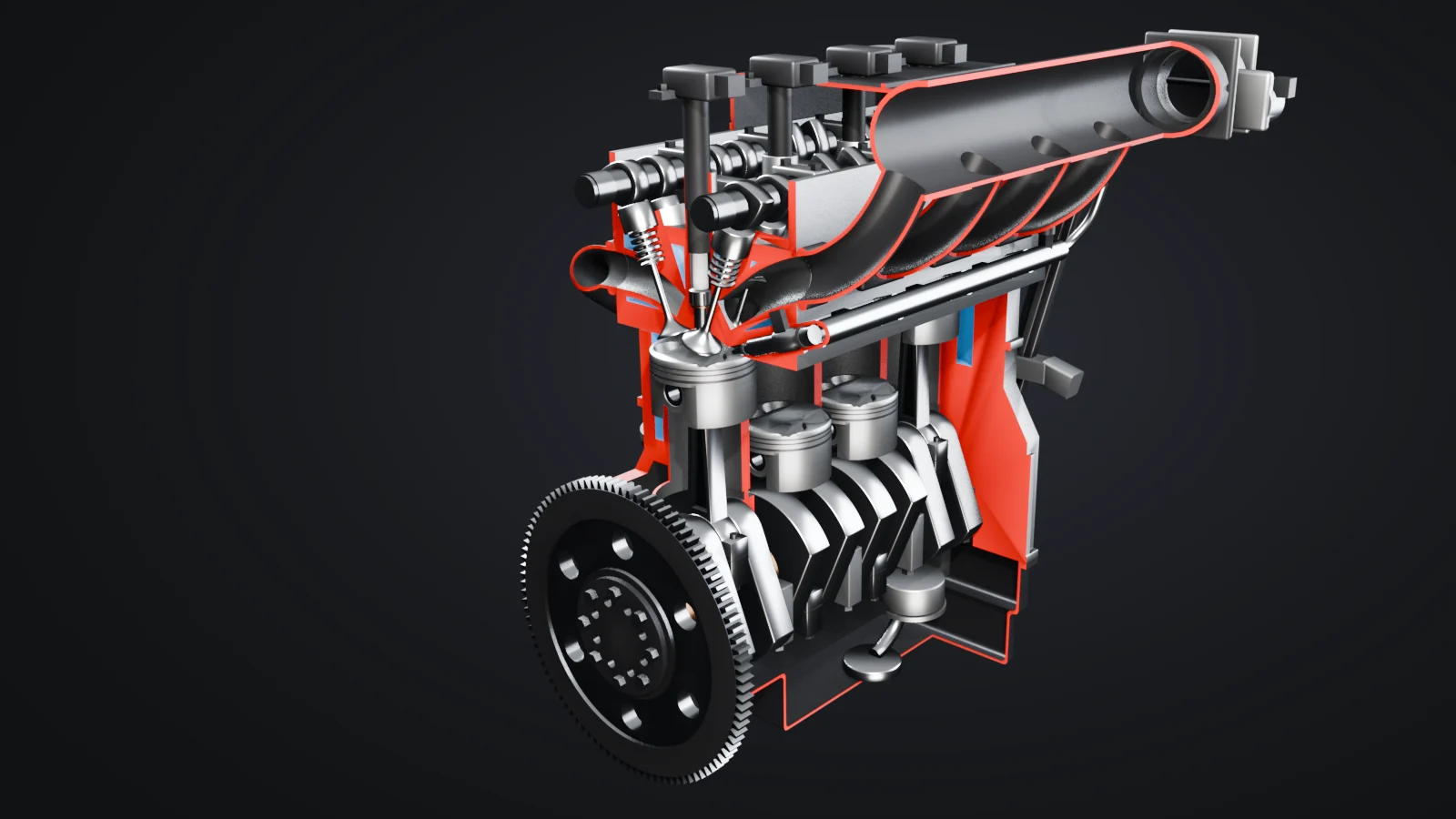
This car engine 3D model is an animated cutaway of a 2.0 L inline-4 petrol engine with dual overhead camshafts, 16 valves and direct fuel injection. Unlike a flat engine diagram, it moves: the pistons, connecting rods, crankshaft, camshafts and valves run at the speed you choose, and you can stop at any point in the cycle. Drag to turn the engine, pinch or hold Ctrl and scroll to zoom, and tap any part to read what it does. The 4-stroke steps button walks cylinder 4, the one cut open at the flywheel end, through intake, compression, power and exhaust one stroke at a time.
Car engine cross section: what the model shows
An engine cross section cuts the engine open along the line of its cylinders so you can see inside. This one shows all four pistons and connecting rods, the crankshaft, both camshafts, the intake and exhaust valves, a spark plug tip inside a combustion chamber and a fuel injector. Moving parts are never cut.
The engine is generic. It is a typical mid-range modern design, not any one brand's engine, and the numbers in it are typical values. The car engine parts section below links each part to its place in the model.
How a car engine works: the four strokes
A car engine is an internal combustion engine: it burns fuel inside the cylinders and turns the pressure of the burning gas into rotation. Almost every petrol car engine does this with the 4 stroke engine cycle, which repeats four steps in each cylinder. A stroke is one full trip of the piston, either up or down.
- Intake. The piston moves down from the top of the cylinder (top dead center). The intake valves are open, so air flows in. In this direct injection engine the injector also sprays fuel into the cylinder during this stroke.
- Compression. Both valves close and the piston moves back up. It squeezes the air and fuel into a space one twelfth the size (this engine's compression ratio is 12:1).
- Power. Just before the piston reaches the top, the spark plug fires. The mix burns and the hot gas pushes the piston down hard. This is the only stroke that produces work.
- Exhaust. The exhaust valves open and the piston moves up again, pushing the burnt gas out through the exhaust port.
One cycle takes two full turns of the crankshaft, or 720 degrees. The camshafts turn at half crankshaft speed, so each valve opens once per cycle. In a real engine the spark fires slightly before top dead center, and earlier as rpm rises, to give the fuel time to burn. The model fires it at the top so you can see it clearly.
With four cylinders, the cycles are staggered by 180 degrees, so one cylinder is always on its power stroke or about to start. The firing order is 1-3-4-2, and the flywheel carries the crankshaft through the gaps. Turn on Flow to see air entering and burnt gas leaving. In short, an engine takes in air and fuel, burns them under control and delivers rotation.
Only a minority of the fuel's energy ends up moving the car. According to fueleconomy.gov, 14% to 20% of the fuel energy reaches the wheels in city driving and 22% to 30% on the highway. Most of the rest is lost as heat in the engine.
Car engine parts
These are the main engine parts in the model, in roughly the order air and fuel travel through them. Each starts with a one-line definition, then what the part does in this engine.
Engine block
The engine block is the main casting that holds the cylinders, the crankshaft and the coolant passages. Blocks are cast from iron or an aluminium alloy; aluminium is lighter and moves heat to the coolant faster, while iron is durable and expands less. Here the four cylinders sit in a straight line, 96 mm apart, with the crankshaft below them. See it in the model.
Cylinder head
The cylinder head is the casting on top of the block that forms the roof of each combustion chamber. It holds the intake and exhaust ports, the 16 valves, both camshafts, the spark plugs and the injectors. A head gasket seals the joint with the block. An inline-4 needs one head, where a V engine needs two. Show the cylinder head.
Pistons and piston rings
A piston is the plug that slides up and down in each cylinder and takes the force of combustion on its top. Pistons are usually cast or forged from aluminium alloy. Piston rings sit in grooves around it; automotive pistons typically carry three, two compression rings that seal the gas in and one oil control ring that limits the oil film on the wall. With an 86 mm stroke, each piston at 6,000 rpm goes up and down 100 times a second. Find the pistons.
Connecting rods
A connecting rod is the steel link between a piston and the crankshaft. The small end holds the wrist pin, which joins it to the piston, and the big end wraps around a crankpin on a plain bearing. The rods here are 145 mm long. Watch a rod swing.
Crankshaft
The crankshaft is the shaft that converts the up-and-down motion of the pistons into rotation. Each connecting rod attaches to a crankpin offset from the centre line, and the offset is half the stroke (43 mm here). Counterweights cancel part of the vibration from the moving parts, and forged steel is the usual material. The flywheel sits at one end and the timing sprocket at the other. Jump to the crank.
Camshafts
A camshaft is a rotating shaft with egg-shaped lobes that push the valves open. This DOHC engine has two, one above the intake valves and one above the exhaust valves. Each lobe presses its valve open and a spring closes it. The lobe shape sets how far the valve lifts and for how long. Each camshaft turns at half crankshaft speed, so a valve opens once every two crank turns. Spot the camshafts.
Intake and exhaust valves
Valves are the poppet-shaped plugs that open and close the ports into each cylinder. With four valves per cylinder, two intake and two exhaust, the engine has 16 in total, which is where "16-valve" comes from. The intake valves let air in; the exhaust valves let burnt gas out. In the model, valve lift peaks at 9.5 mm. Show the valves.
Timing chain vs timing belt
A timing chain or timing belt links the crankshaft to the camshafts so the valves open in step with the pistons. This engine uses a steel timing chain that runs inside the engine in oil. A timing belt is a toothed rubber belt that runs outside the engine, usually behind a cover. Belts are quieter but wear out on a schedule; replacement intervals run from about 60,000 miles (or 4 years) to 150,000 miles (or 10 years), depending on the engine. Chains are intended to last the life of the engine, though a worn or poorly oiled chain can stretch and rattle. A tensioner keeps either one tight. In many engines a failed belt or chain lets the valves hit the pistons. Follow the chain.
Spark plugs and ignition coils
A spark plug is the device that ignites the compressed air-fuel mix with an electric spark. It has a centre electrode, a ground electrode and a ceramic insulator, and the gap between the electrodes is usually between 0.6 and 1.8 mm. An ignition coil is a transformer that raises the battery's 12 volts to the 12,000 to 25,000 volts or more that the plug needs. This engine has one coil mounted directly on each plug (coil-on-plug), so a failed coil affects one cylinder only. Locate a plug.
Fuel injectors: direct vs port injection
A fuel injector is an electrically operated valve that sprays a metered amount of fuel. In port injection the injector sits in the intake manifold and sprays fuel at the back of the intake valve at about 6 bar. In direct injection, used in this engine, it sits in the cylinder head and sprays at much higher pressure straight into the combustion chamber; Bosch systems work at up to 350 bar. Direct injection allows higher compression ratios; the drawback is carbon build-up on the intake valves, which no fuel washes. See the injector.
Intake and exhaust manifolds
The intake manifold is the branched duct that carries air from the throttle body to each cylinder, and the exhaust manifold is the one that collects burnt gas from each cylinder into a single pipe. Air first passes the throttle body, where a butterfly valve opens as you press the accelerator. The intake manifold splits the air into four runners. On the other side, the exhaust manifold, generally cast iron or stainless steel, merges four ports into one outlet toward the catalytic converter. Trace the air path.
Oil pan and oil pump
The oil pan holds the engine's oil, and the oil pump pushes it through the filter to the bearings, piston undersides and camshafts. This engine uses a wet sump, so the oil sits in the pan under the crankshaft. Pressure rises about 10 psi per 1,000 rpm and typically peaks around 55 to 65 psi; at normal operating temperature it usually falls between 30 and 45 psi. A relief valve limits the maximum. View the oil pump.
Water jacket and cooling
The water jacket is the set of hollow passages in the block and head through which coolant flows. A water pump circulates the coolant between the engine and the radiator, and a thermostat keeps it in the engine until it is warm. Cylinder walls are typically held near 90 degrees Celsius. Show the coolant passages.
Flywheel
The flywheel is a heavy disc on the end of the crankshaft that smooths the engine's power pulses. It absorbs energy during each power stroke and returns it while the other cylinders compress and exhaust. The clutch or torque converter connects to it, and the starter motor turns it to start the engine. Find the flywheel.
Inline-4 vs V6 vs V8
Cylinder layout changes size, smoothness and cost. An inline-4 is the simplest: one head, one row of cylinders, typically 1.3 to 2.5 L in production cars. Because its pistons move in pairs it is perfectly balanced for primary forces, but it has a secondary imbalance that causes an up-and-down vibration at twice crankshaft speed; some larger fours add two balance shafts to cancel it.
A V6 engine splits six cylinders into two banks of three. It is shorter than an inline-6, so it fits across the front of a transverse front-wheel-drive car, and its torque is smoother than a four's. Modern V6 engines are usually 2.5 to 4.0 L. For how it compares with an inline-6, see inline-6 vs V6 engine.
A V8 engine has two banks of four cylinders on a shared crankshaft, typically 3.5 to 6.4 L, and is common in rear-wheel-drive cars with a longitudinal engine because of its size. Most road V8s use a cross-plane crankshaft with perfect primary and secondary balance.
Specs of the modeled engine
| Spec | Value |
|---|---|
| Layout | Inline-4, DOHC, 16 valves |
| Displacement | 1,998 cc (2.0 L) |
| Bore x stroke | 86 mm x 86 mm |
| Connecting rod length | 145 mm (centre to centre) |
| Bore spacing | 96 mm |
| Compression ratio | 12:1 |
| Fuel system | Direct injection (gasoline) |
| Aspiration | Naturally aspirated |
| Valve drive | Timing chain |
| Ignition | Coil-on-plug |
| Firing order | 1-3-4-2 |
| Valve lift (model) | 9.5 mm |
| Model speed range | 800 to 6,500 rpm |
Displacement follows from the bore and stroke: each cylinder displaces 499.5 cc, and four make 1,998 cc.
Frequently asked questions
How many parts are in a car engine?
There is no standard count, because the total depends on what is included: bolts, bearings, seals and sensors add up fast. This model labels 29 parts and regions, which covers the major components that move or define the engine's operation.
What is the difference between a timing belt and a timing chain?
A timing belt is a toothed rubber belt outside the engine; a timing chain is a steel chain inside the engine, lubricated by its oil. Both keep the camshafts in step with the crankshaft. Belts are quieter but need replacing every 60,000 to 150,000 miles depending on the engine. Chains are intended to last the life of the engine.
What does a camshaft do?
A camshaft opens the engine's valves. Its lobes push each intake or exhaust valve open at the right moment in the cycle, and the valve springs close them again. The camshaft turns at half crankshaft speed, so each valve opens once every two turns of the crank.
What is the compression stroke?
The compression stroke is the second stroke of the four-stroke cycle. Both valves are closed and the piston moves up, squeezing the air and fuel into a much smaller space. In this engine the mix is compressed to one twelfth of its original volume before the spark fires.
Why do many cars have four cylinders?
An inline-4 is compact, needs only one cylinder head and is cheaper to build than a V6 or V8, and four-cylinder engines in production cars typically displace 1.3 to 2.5 L. Its main downside is a vibration at twice crankshaft speed, which balance shafts can cancel.
What does firing order 1-3-4-2 mean?
The firing order is the sequence in which the cylinders fire. In 1-3-4-2 the spark goes to cylinder 1, then 3, then 4, then 2, numbered from the timing-chain end. Each cylinder fires 180 degrees of crankshaft rotation after the previous one, since 720 degrees divided by four cylinders is 180.
What is direct injection?
Direct injection sprays fuel straight into the combustion chamber instead of into the intake manifold. It needs a high-pressure pump and runs at pressures up to 350 bar on Bosch systems, compared with about 6 bar for port injection. It allows higher compression ratios, but carbon deposits can build up on the intake valves because no fuel washes them.
How efficient is a car engine?
Most of the fuel's energy is lost as heat. According to fueleconomy.gov, only 14% to 20% of the energy in the fuel reaches the wheels in city driving and 22% to 30% on the highway. Engine losses, mainly heat, take 64% to 75%, and the rest goes to the drivetrain, idling and accessories.