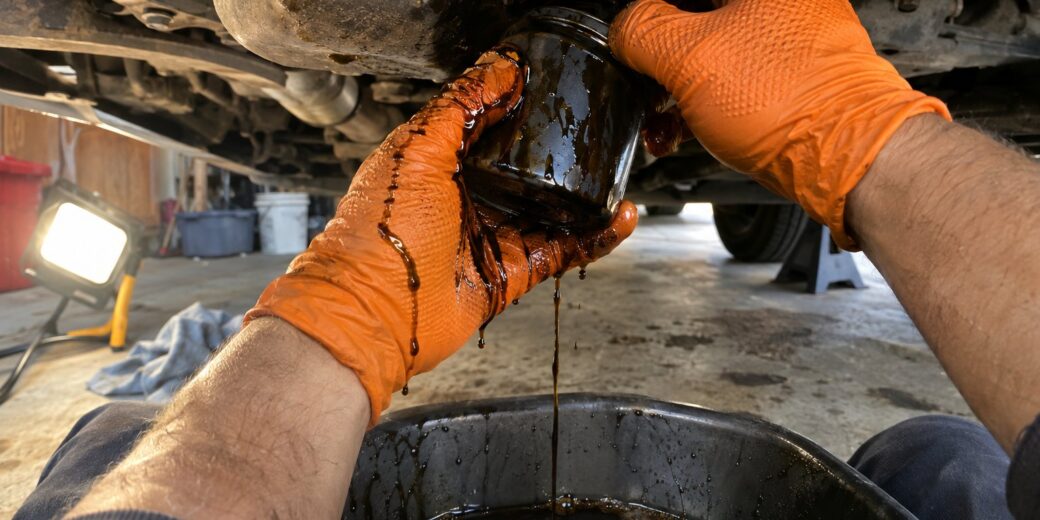
The best nitrile gloves for mechanics are the Gloveworks HD orange 8 mil gloves: thick enough to survive an oil change and a brake job, textured enough to grip a slick drain plug and orange so you see a tear the moment it happens. If you want black, the TitanFlex 8 mil is the same class of glove. For detail work where feel matters more than toughness, a 5 to 6 mil glove like the Microflex MidKnight is the better tool. And for brake cleaner and carb cleaner, no thin disposable lasts more than a few minutes, which is why this guide also covers a splash glove and a reusable chemical glove for the parts washer.
As an Amazon Associate we earn from qualifying purchases. Disclosure
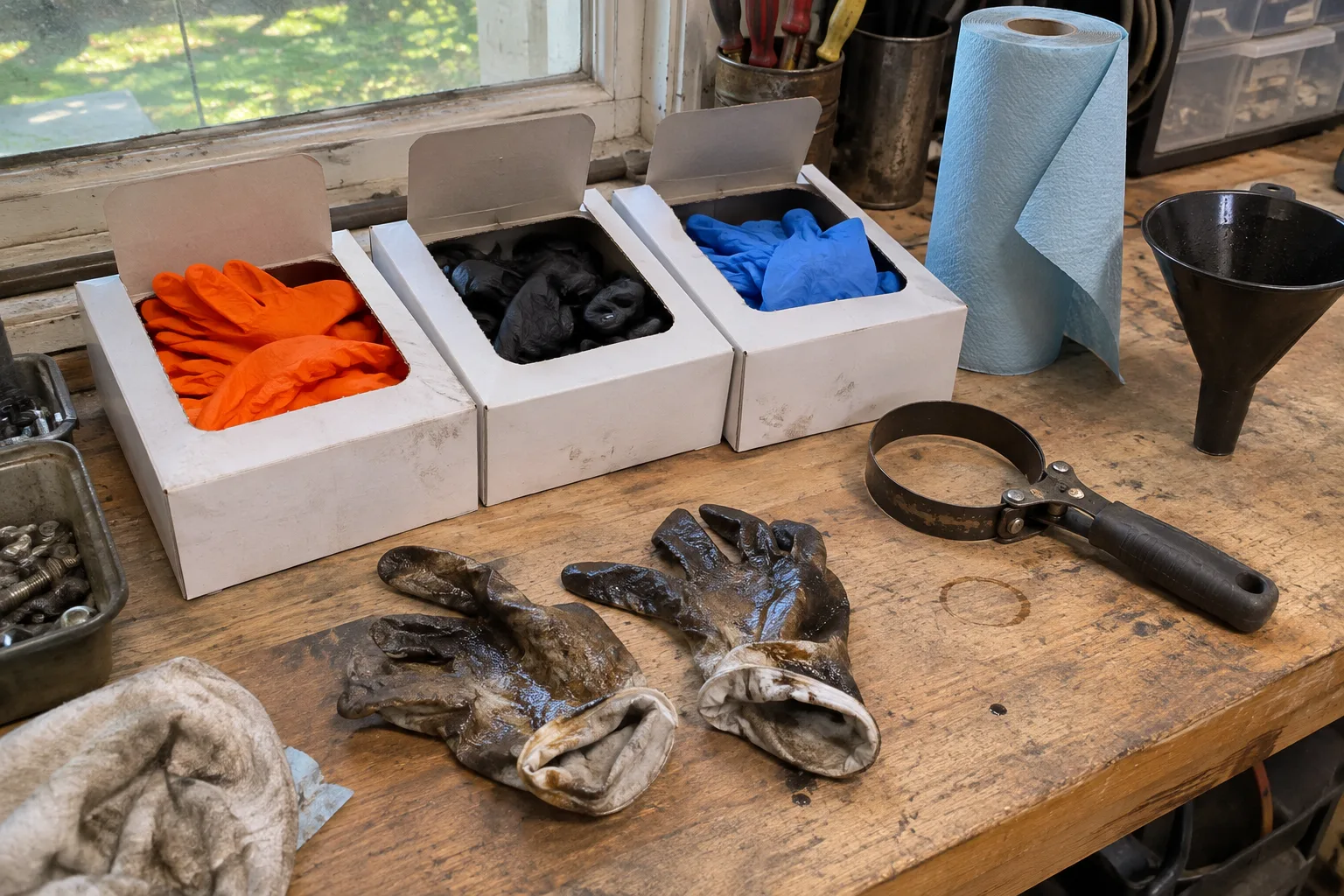
The first thing a new tech learns in a busy shop is where the glove boxes live. Ours sat on a shelf above the parts washer in three colors: blue 4 mil for the service writers and quick checks, black 6 mil for general work, and orange 8 mil for anything with a drain pan under it. Nobody wrote that rule down. It came from years of torn fingertips. A 4 mil glove split on the first hose clamp, so the techs stopped using it in the bays. An 8 mil glove made it hard to pick a cotter pin out of a castle nut, so nobody wore it for electrical work. The guide follows the same logic: pick the thickness for the job, then pick the brand. Every glove below was in stock on Amazon in November 2026, and the chemical numbers come from published permeation data, not from the box.
Quick picks
| Glove | Thickness | Best for |
|---|---|---|
| Gloveworks HD Orange | 8 mil | Best overall: oil changes, brakes, suspension |
| TitanFlex Black 8 mil | 8 mil | Best black heavy-duty glove |
| Venom Steel | 6 mil, 2 layers | Shows a tear before you get greasy |
| Gloveworks Black 6 mil | 6 mil | Best all-day middle weight |
| Microflex MidKnight MK-296 | Medium | Best feel for electrical and small parts |
| Gloveworks Industrial Black 5 mil | 5 mil | Best value for quick jobs |
| Adenna Dark Light | 9 mil | Rough work around sharp edges |
| Ansell TouchNTuff 92-600 | 4.7 mil | Chemical splash, with published lab data |
| Showa 730 | 15 mil reusable | Parts washer and solvent soaking |
How thick should mechanic nitrile gloves be?
For most car work, 6 to 8 mil. Glove thickness is measured in mils, and one mil is a thousandth of an inch (0.0254 mm). A standard medical exam glove is 3 to 4 mil. That is fine for checking fluids, but it tears on hose clamps, safety wire and the edge of a heat shield. Thicker gloves resist punctures and solvents longer, and they cost you feel in the fingertips.
| Thickness | What it feels like | Use it for |
|---|---|---|
| 3 to 4 mil | Like bare skin, tears easily | Checking fluids, interior detailing, quick looks under the hood |
| 5 to 6 mil | Good feel, survives most jobs | Electrical work, sensors, small fasteners, general service |
| 7 to 8 mil | Noticeably thicker, very tough | Oil changes, brakes, suspension, cooling system, transmission pans |
| 9 to 10 mil | Stiff, like a thin rubber glove | Rusty parts, exhaust work, sharp sheet metal, heavy cleanup |
| 15 mil and up (reusable) | A dishwashing glove built for solvents | Parts washer, soaking parts, long solvent contact |
Check where the number is measured. Most makers quote thickness at the fingertip, which is the thickest point of a disposable glove. The palm is often 1 to 2 mil thinner. Two gloves sold as “8 mil” can feel different for that reason.
Do nitrile gloves protect against brake cleaner, gas and oil?
Against motor oil, gear oil, diesel, grease and antifreeze, yes. Against brake cleaner and carb cleaner, only for a minute or two. That gap matters more than any brand choice in this guide.
Lab permeation tests measure how long a chemical takes to pass through a glove. Kimberly-Clark’s chemical resistance guide for its thin nitrile exam gloves gives these breakthrough times:
| Chemical | Where you meet it | Breakthrough |
|---|---|---|
| Ethylene glycol | Antifreeze | More than 480 minutes |
| Propylene glycol | “Pet safe” antifreeze | More than 480 minutes |
| Diesel fuel | Diesel, some degreasers | 160 minutes |
| Heptane | Non-chlorinated brake cleaner, gasoline | 145 minutes |
| Mineral spirits | Parts washer solvent | 105 minutes |
| Kerosene | Cleaning solvent | 82 minutes |
| Isopropyl alcohol | Electrical cleaner, surface prep | 29 minutes |
| Hexane | Brake cleaner, some degreasers | 16 minutes |
| Ethanol | E85, some fuel additives | 7 minutes |
| Tetrachloroethylene | Chlorinated brake cleaner | 3 minutes |
| Acetone | Brake and carb cleaner, gasket removal | 1 minute |
| Xylene | Carb cleaner, paint thinner | 1 minute |
| Methanol | Washer fluid, carb cleaner | Under 1 minute |
Most aerosol brake cleaners blend several of these. A non-chlorinated can is often acetone, heptane and toluene, and a chlorinated can is mostly tetrachloroethylene. The fast solvent in the mix sets the clock, so treat any brake or carb cleaner as a one-to-three-minute exposure for a thin glove. Thicker gloves buy time in proportion to their thickness, but an 8 mil disposable is still a splash glove, not a soaking glove.
The shop rule that follows from this is simple. When brake cleaner soaks a glove, change it. Do not wait until you feel the cold on your skin, because by then the solvent has already crossed. Keep the spray pointed away from your hands, and use a reusable 15 mil glove like the Showa 730 for the parts washer.
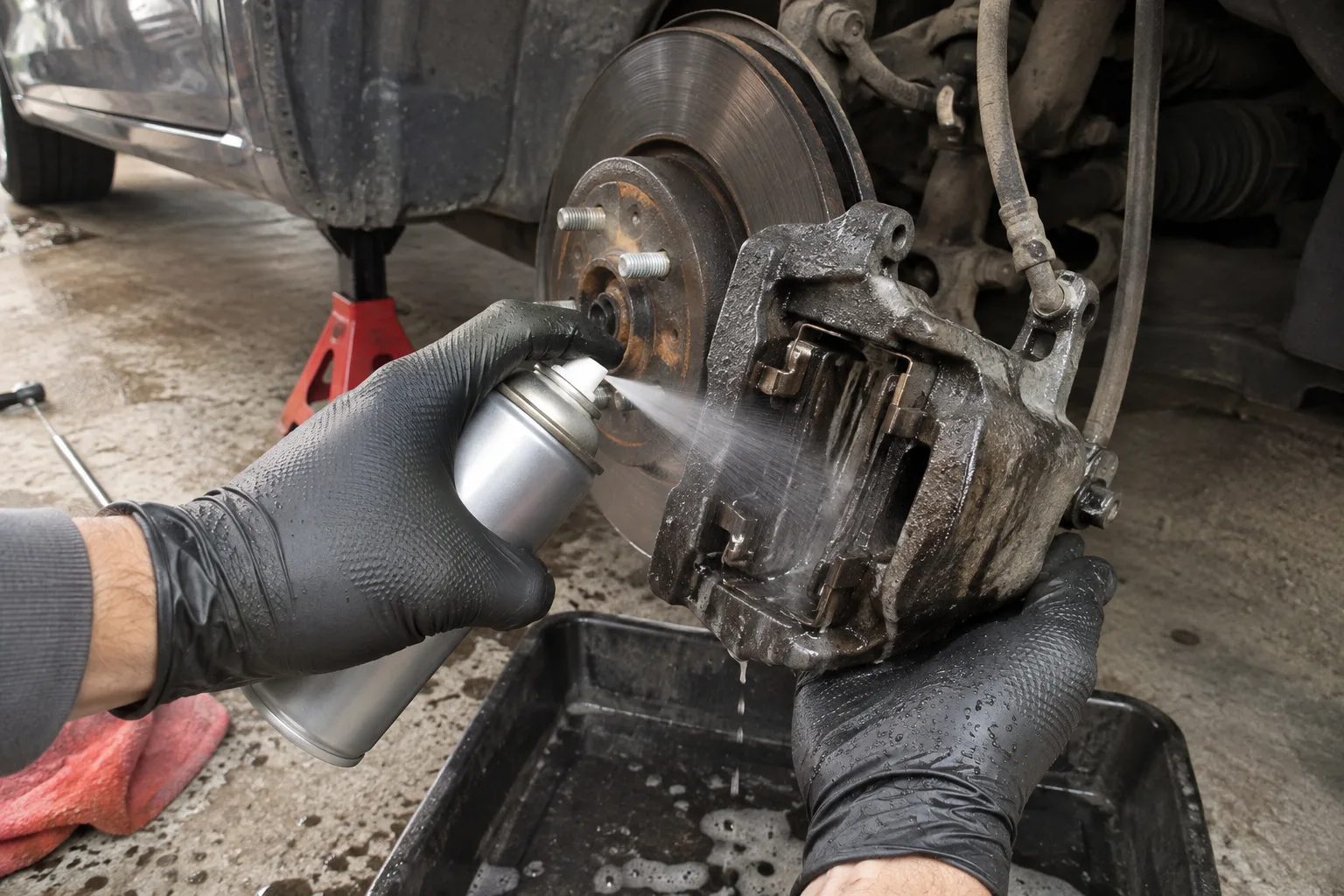
Best heavy-duty nitrile gloves for mechanics
These are the 7 to 10 mil gloves for the jobs that end with your hands in a drain pan: oil and filter changes, brake jobs, suspension, cooling systems and transmission service.
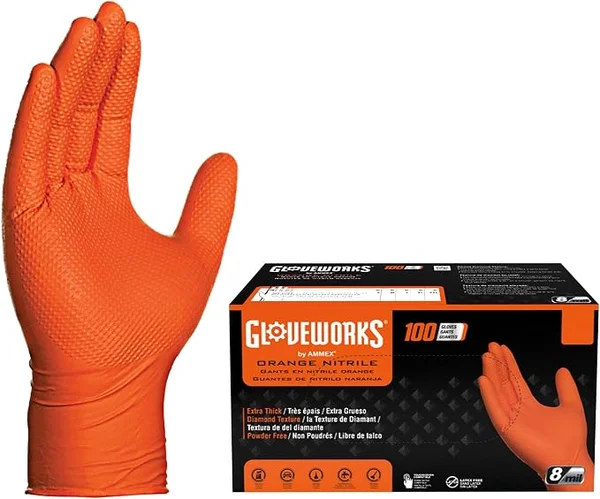
Best overall
1. Gloveworks HD Orange Nitrile Gloves, 8 mil
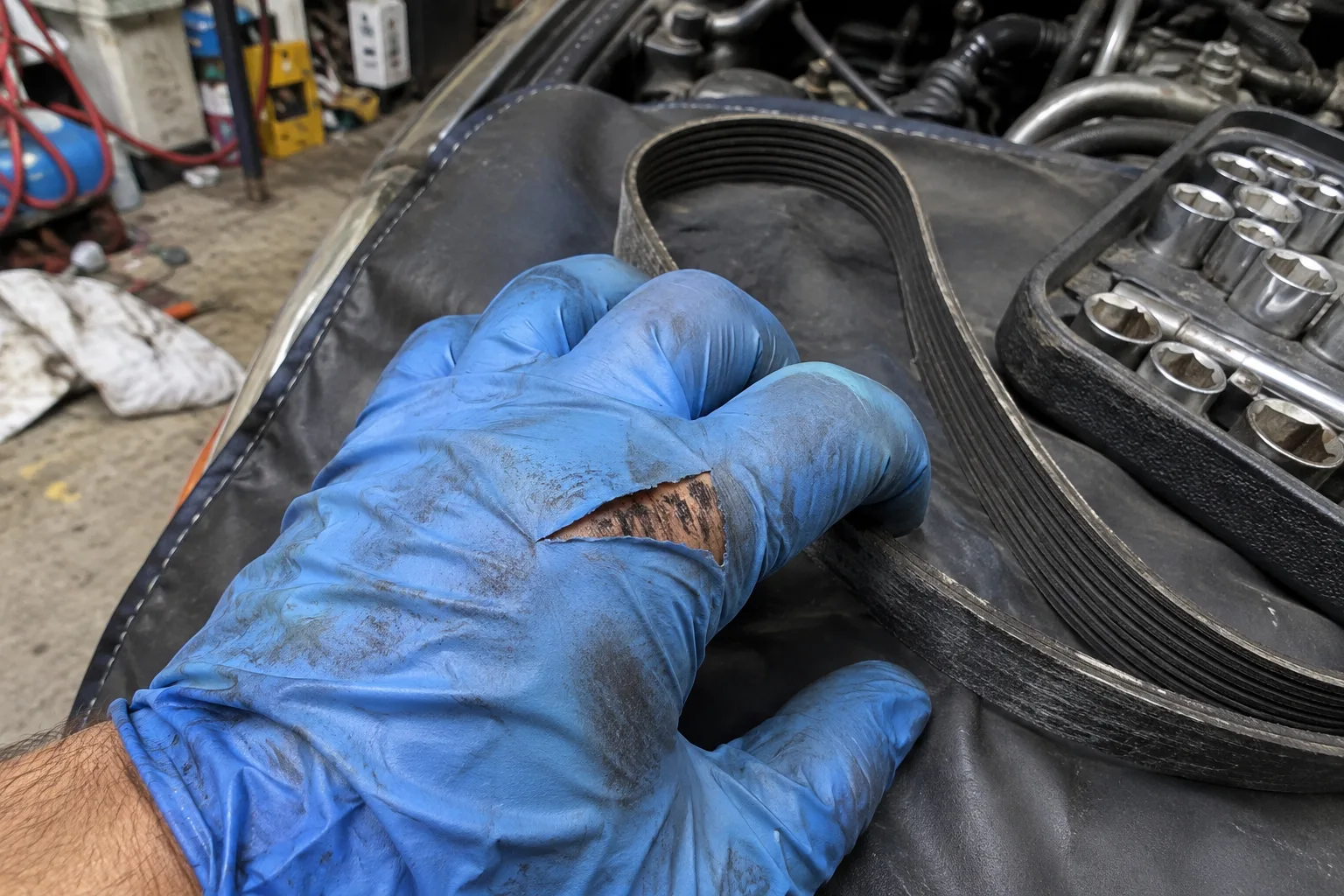
The orange Gloveworks HD is the glove you see in more independent shops than any other, and on Amazon it carries close to 20,000 ratings at 4.7 stars. The raised diamond texture covers both sides of the hand, so it grips an oily filter or a drain plug in either direction. At 8 mil it survives hose clamps and the edges of splash shields, and Gloveworks rates it at three times the puncture resistance of latex. The bright orange makes grease, brake fluid and tears easy to see, so you know when to change pairs. It runs from small to XX-large.
- 8 mil nitrile, latex and powder free
- Raised diamond grip on palm and back
- Rated for petroleum products and carb fluids (splash)
- 100 gloves per box
Good: Tough enough for a full brake job; excellent wet grip; tears are obvious. Not great: Too thick for small electrical connectors; runs slightly large for some hands.
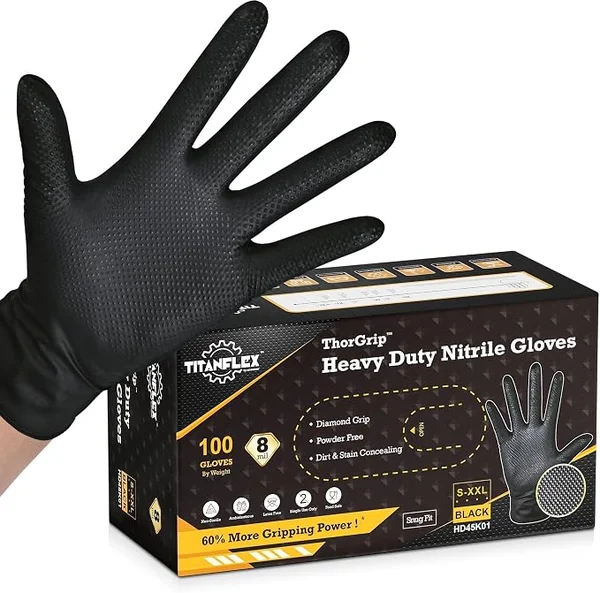
Best black heavy-duty glove
2. TitanFlex Thor Grip Black Nitrile Gloves, 8 mil
If you want the 8 mil diamond-grip glove in black, this is the one to buy. TitanFlex’s Thor Grip texture covers the fingers and palm, and the gloves have more than 6,000 ratings at 4.8 stars, among the best scores of any glove in this class. Black hides grease, which customers notice when you hand back the keys, and it hides tears too, so check your fingertips between jobs. TitanFlex also sells the same glove in orange.
- 8 mil nitrile
- Raised diamond texture on fingers and palm
- Rated for grease, gasoline and petroleum fluids (splash)
- 100 gloves per box
Good: Very tough; strong grip on oily parts; clean look. Not great: Black hides small tears; thick fingertips on fine work.
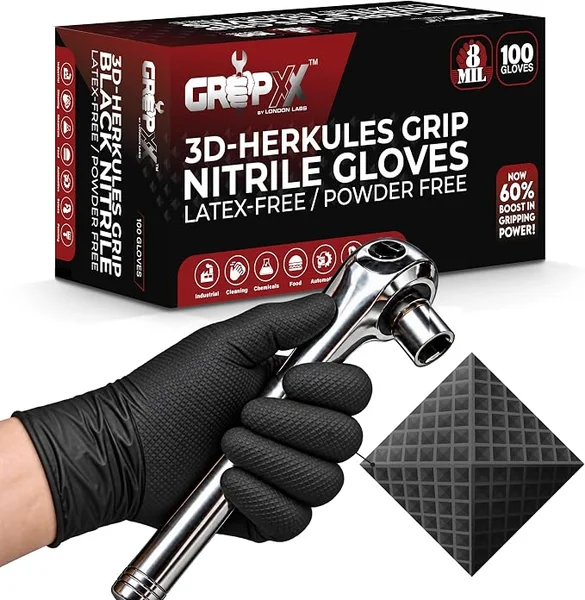
Best grip texture
3. GRIPXX Herkules Grip Black Nitrile Gloves, 8 mil
GRIPXX uses a taller 3D diamond pattern than most 8 mil gloves, which helps on round, oily parts such as oil filters, ball joints and wet ratchet handles. The rest of the spec matches the class leaders: 8 mil, latex and powder free, 100 per box. It has fewer reviews than the Gloveworks and TitanFlex gloves, but the ratings are just as high.
- 8 mil nitrile
- Raised 3D diamond texture
- Latex and powder free
- 100 gloves per box
Good: Very strong grip on round parts; durable. Not great: The texture feels coarse on fine work; smaller review base.
Best with a chemical rating
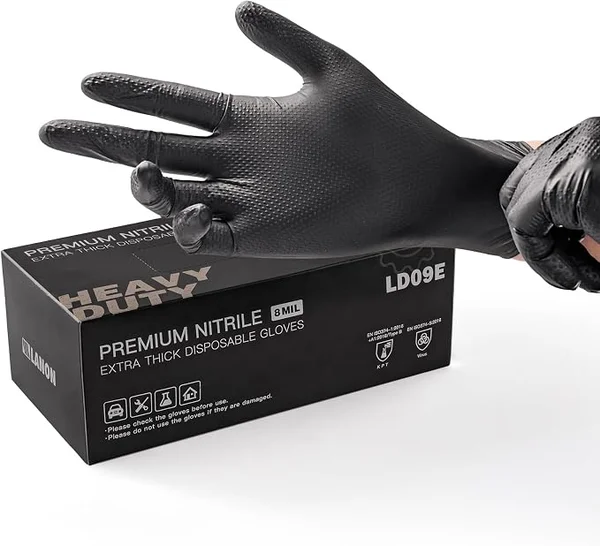
4. LANON Black Nitrile Gloves, 8 mil, EN ISO 374
Most disposable gloves say “chemical resistant” without proof. LANON tests this glove to EN ISO 374, the European standard for chemical protection, which means it has passed a permeation test against specific chemicals rather than relying on marketing language. That is useful if you work in a shop with a safety program that asks for rated PPE. The diamond texture runs over the whole glove. Sizes are medium, large and XL only.
- 8 mil nitrile
- Tested to EN ISO 374
- Full diamond texture
- Pull-out dispenser box
Good: Documented chemical rating; tough and grippy. Not great: No small or XXL sizes; the rating is still for splash contact, not soaking.
Thickest disposable with a big following
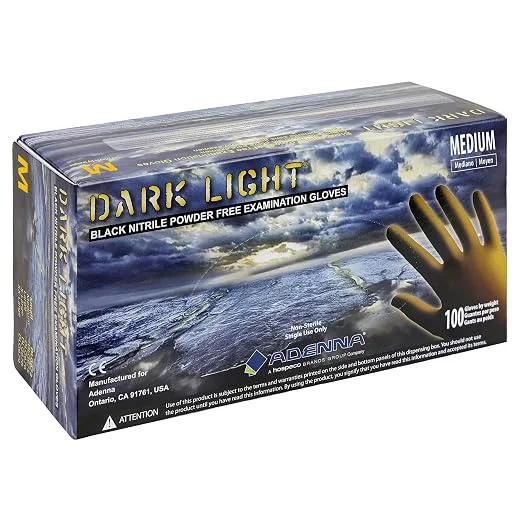
5. Adenna Dark Light Black Nitrile Gloves, 9 mil
The Adenna Dark Light has been a mechanic favorite for years, with more than 7,000 ratings. At 9 mil in the fingers it is one of the thickest exam-grade gloves on Amazon, and it handles jobs that shred lighter gloves: rusty exhaust hangers, sheet metal and suspension work on old cars. The fingers are textured, and it is exam grade, so it is made to tighter pinhole standards than many industrial gloves.
- 9 mil fingers
- Exam grade, latex and powder free
- Textured fingertips
- 100 gloves per box
Good: Very puncture resistant; lasts through long jobs. Not great: Stiff; hands sweat more in thick gloves.
Thickest pick
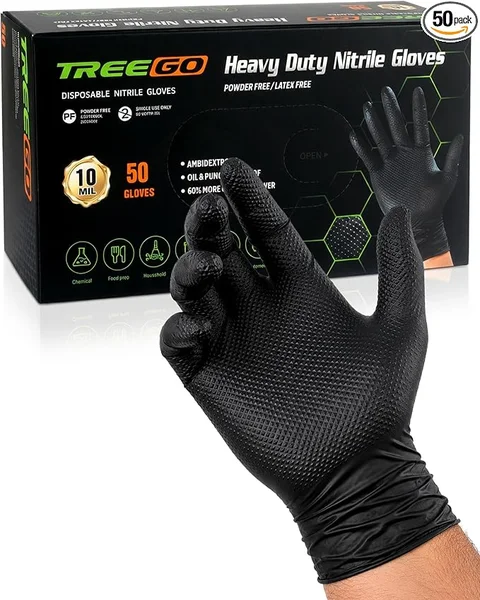
6. TREEGO Heavy Duty Black Nitrile Mechanic Gloves, 10 mil
TREEGO’s 10 mil glove is close to a thin reusable glove in feel. It is the right choice for heavy cleanup, scraping old gaskets, handling rusty parts and pulling apart a greasy front end. TREEGO makes it to the ASTM D6319 nitrile exam glove standard. The box holds 50 gloves rather than 100, so compare cost per glove.
- 10 mil nitrile
- Made to ASTM D6319
- Diamond texture
- 50 gloves per box
Good: The toughest disposable here. Not great: Poor feel for small parts; 50 per box.
Best 7 mil glove
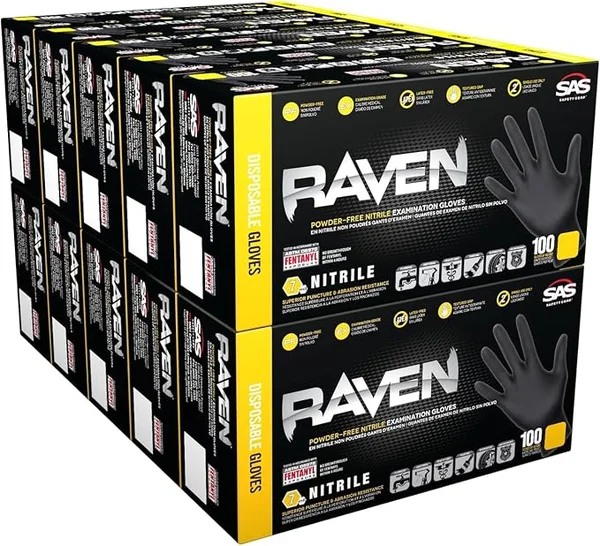
7. SAS Safety Raven Black Nitrile Gloves, 7 mil
The Raven sits between the 6 mil and 8 mil gloves, and that is its appeal: it is tough enough for an oil change but keeps more feel than an 8 mil glove. SAS has made Raven gloves for automotive shops for years, and the black finish hides grease. Check the listing size before you order, because some Raven listings are a single box and some are a case.
- 7 mil nitrile
- Latex and powder free
- Textured
- Single box and case listings
Good: A good balance of toughness and feel. Not great: Light texture, so wet grip is weaker than diamond-pattern gloves.
Best 5 to 6 mil nitrile gloves for general work
These middle-weight gloves are what most techs wear for the rest of the day: diagnostics, sensors, interior work, electrical connectors and small fasteners. They tear sooner than 8 mil gloves, but you can feel a washer between your fingertips.
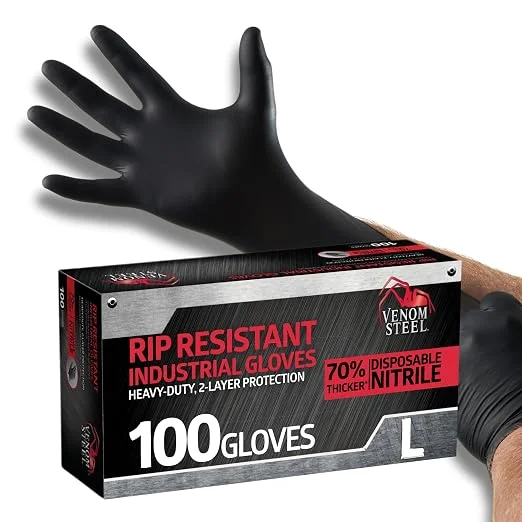
Best for spotting tears
8. Venom Steel Industrial Nitrile Gloves, 6 mil, two layers
Venom Steel builds its glove from two layers: black outside and white inside. When the outer layer tears, the white shows through, so you know before grease reaches your skin. At 6 mil it is lighter than the 8 mil gloves, with better feel for general work, and with more than 12,000 ratings at 4.7 stars it is one of the most reviewed mechanic gloves on Amazon.
- 6 mil nitrile in two layers
- White inner layer shows breaks
- Fully textured
- 100 gloves per box
Good: Tear warning; good feel; widely available. Not great: Lighter texture than diamond gloves; less puncture resistant than 8 mil.
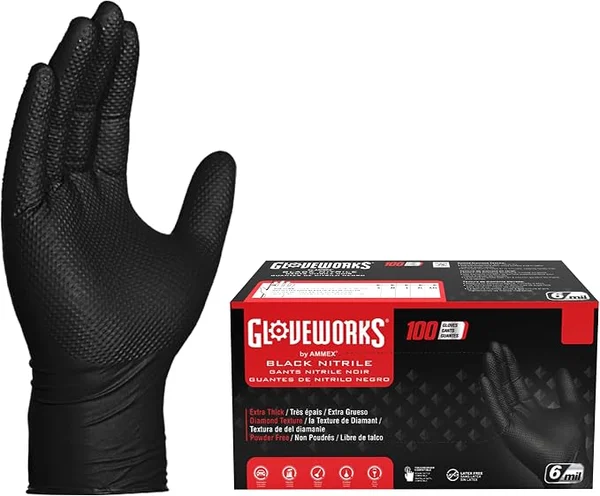
Best all-day middle weight
9. Gloveworks Black Nitrile Gloves, 6 mil
This is the 6 mil version of the Gloveworks HD, with the same raised diamond texture in black. It is the glove for long days of mixed work, when you take gloves on and off all day and an 8 mil glove feels like too much. It has more than 13,000 ratings and comes in medium through XX-large.
- 6 mil nitrile
- Raised diamond texture
- Medium to XX-large
- 100 gloves per box
Good: Strong grip for a 6 mil glove; good feel. Not great: No small size; tears on sharp edges sooner than 8 mil.
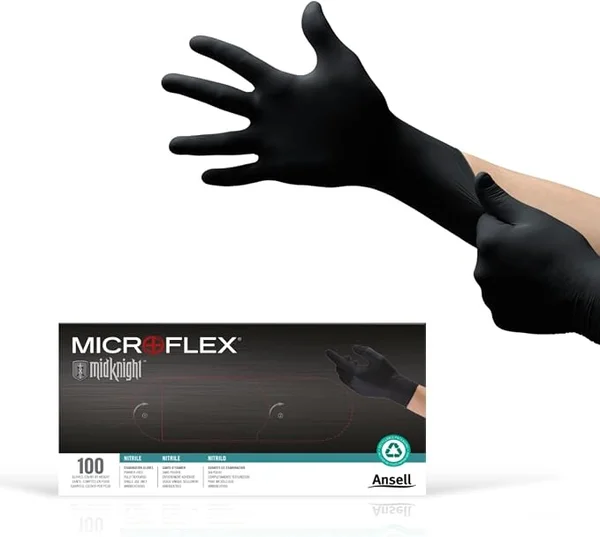
Best feel for detail work
10. Ansell Microflex MidKnight MK-296 Black Nitrile Gloves
The MidKnight comes from Ansell, one of the largest glove makers in the world, and Ansell lists automotive work first among its uses. It is fully textured and fits closely, which gives it the best fingertip feel in this group: good for wiring repairs, sensors, trim clips and small hardware. It comes in six sizes from extra small to XX-large, which makes it the best pick here for smaller hands.
- Fully textured black nitrile
- Six sizes, XS to XXL
- Latex and powder free
- 100 gloves per box
Good: Precise fit and feel; wide size range; a major maker. Not great: Not a brake-job glove; tears on sharp metal.
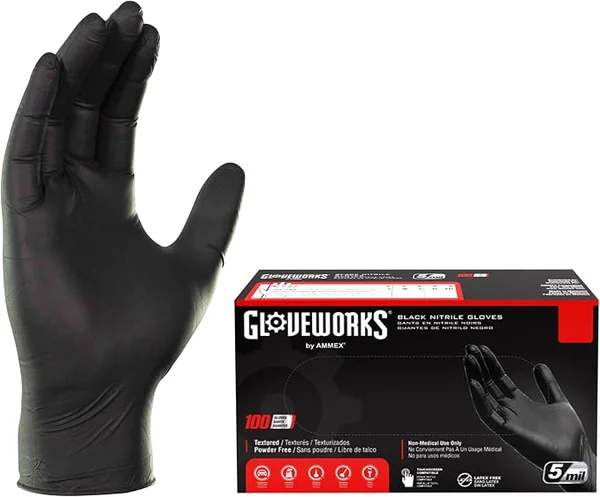
Best value
11. Gloveworks Industrial Black Nitrile Gloves, 5 mil
With almost 39,000 ratings, this is the most reviewed glove in this guide. It is a 5 mil glove with a light texture, made for quick jobs that need a clean pair: checking fluids, topping off oil, moving a dirty part or protecting a customer’s interior. Gloveworks rates it for grease, gasoline and petroleum products and for longer wear than a 3 mil glove.
- 5 mil nitrile
- Lightly textured
- Rated for petroleum products (splash)
- 100 gloves per box
Good: Low cost per glove; good feel; huge review base. Not great: Tears during heavy work; light texture slips on wet oil.
Best exam-grade pick
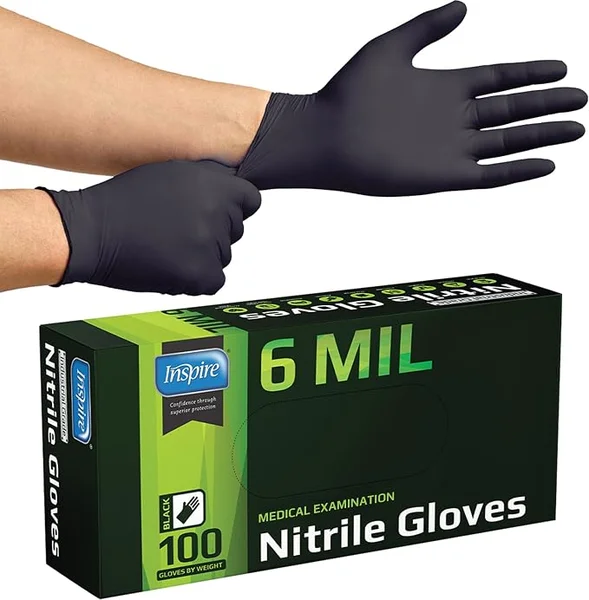
12. Inspire Black Nitrile Gloves, 6 mil
Inspire’s 6 mil glove is made to both medical exam and industrial standards, and it has more than 17,000 ratings. It is a good fit for people who use one box for everything: car work, cleaning and the kitchen. The texture is lighter than a diamond glove, so grip on oily parts is fair rather than great.
- 6 mil nitrile
- Exam grade and industrial use
- Textured
- 100 gloves per box
Good: Comfortable; consistent quality; good all-round box. Not great: Weaker grip on oily parts than diamond-textured gloves.
Best from Mechanix Wear
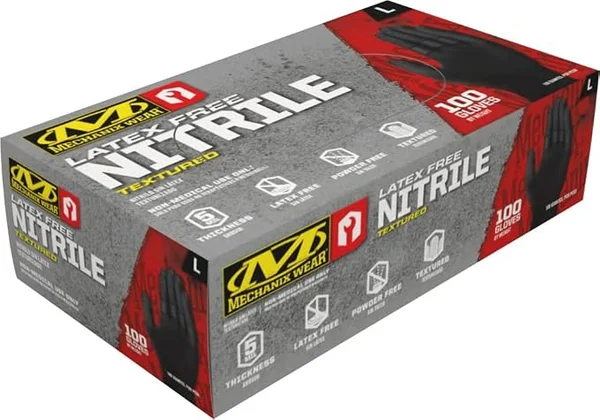
13. Mechanix Wear Nitrile Disposable Gloves, 5 mil
Mechanix Wear is best known for its reusable synthetic gloves, and it also sells a disposable line. The 5 mil glove has a grain texture on the palm and fingers and a rolled cuff. It works well as the inside glove when you wear a reusable Mechanix glove over it for jobs that are both greasy and sharp. Its rating is a little lower than the class leaders at 4.3 stars.
- 5 mil nitrile
- Grain texture on palm and fingers
- Rolled cuff
- 100 gloves per box
Good: Fits well under a reusable glove; trusted brand. Not great: Lower rating than other 5 to 6 mil gloves.
Best nitrile gloves for solvents and the parts washer
The table above showed why: brake cleaner, carb cleaner and gasoline pass through thin gloves quickly. These two gloves are built for chemical contact.
Best chemical splash glove
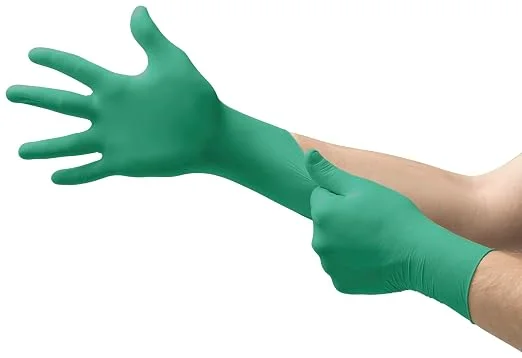
14. Ansell TouchNTuff 92-600 Nitrile Gloves
The TouchNTuff 92-600 is thin, about 4.7 mil, but Ansell formulates it for splash protection and publishes permeation data for it. That makes it the glove to wear when you know what chemical you are using and want to check the numbers. It also meets FDA rules for food contact. It is smooth with textured fingertips, so grip on a greasy part is weaker than with a diamond glove. Wear it for spraying cleaners and handling solvents, not for heavy mechanical work.
- About 4.7 mil nitrile
- Published chemical permeation data
- Textured fingertips
- 100 gloves per box
Good: Documented chemical performance; good feel. Not great: Thin; weak grip on oil; tears on sharp metal.
Best for the parts washer
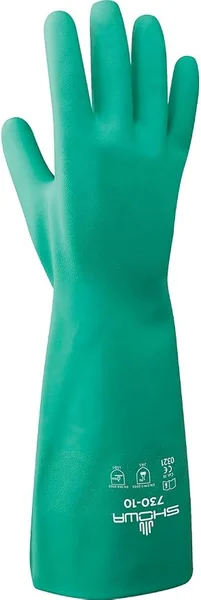
15. Showa 730 Reusable Nitrile Chemical Gloves, 15 mil
When you are scrubbing parts in a solvent tank for twenty minutes, a disposable glove is the wrong tool. The Showa 730 is a 15 mil reusable nitrile glove with a 13-inch cuff that keeps solvent off your forearms. A cotton flock lining absorbs sweat and makes the glove easier to take off, and the textured finish holds wet parts. It carries a CE Category III rating, the highest European class for chemical gloves. Rinse it, dry it and use it again.
- 15 mil nitrile
- 13-inch gauntlet cuff
- Cotton flock lining
- CE Cat III rated
Good: Real protection for long solvent contact; reusable; covers the forearm. Not great: Too bulky for wrench work; wash and dry between uses.
A popular mechanic glove that is not nitrile
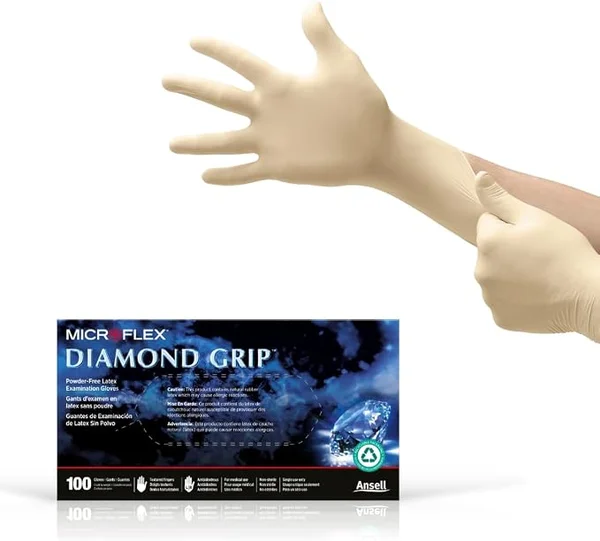
Search for mechanic disposable gloves and you will see the Ansell Microflex Diamond Grip near the top. It is a good glove, and many professional techs prefer it, but it is latex, not nitrile. Latex stretches more and tears less on snags. It also breaks down faster in oil, gasoline and most solvents, and it can trigger allergies in the wearer and in anyone else who handles the parts. If you want nitrile, check the material line on the listing before you buy.
Latex, not nitrile
16. Ansell Microflex Diamond Grip MF-300 (latex)
The Diamond Grip has a textured surface and a fit that many techs love, and it has more than 3,000 ratings at 4.7 stars. Buy it if you have no latex allergy, you mainly do mechanical work and you want a glove that tears less often. For oil, fuel and solvent work, choose one of the nitrile gloves above.
- Latex
- Diamond texture
- Six sizes
- 100 gloves per box
Good: Stretchy, comfortable and resists snags. Not great: Latex: poor against oil and fuel; allergy risk.
How to choose nitrile gloves for car work
Thickness
Match the thickness to the job. Use 8 mil for fluids and sharp parts, 5 to 6 mil for electrical work and detail jobs and 3 to 4 mil only for quick checks. Many techs keep two boxes in the bay.
Texture
Raised diamond texture grips oily parts far better than a smooth or lightly textured glove. If your hands are always wet with oil, it is worth the small loss in feel.
Color
Orange and other bright colors show tears and fluid leaks. Black hides grease, which looks cleaner when you deal with customers. Two-layer gloves like the Venom Steel give you a black glove with a tear warning.
Size and fit
A glove that is too big bunches at the fingertips and catches on parts. A glove that is too small tears at the base of the thumb. Most makers size by the width of the palm: about 7.5 to 8 inches around for a medium, 8.5 to 9 for a large and 9.5 to 10 for an XL. If you sit between sizes, go up for thick gloves and down for thin ones.
Exam grade or industrial
Exam-grade gloves are made to tighter pinhole standards (ASTM D6319 in the U.S.). Industrial gloves skip some of that testing. For car work both are fine, but exam grade means fewer bad gloves in a box.
Cuff length
Most disposable gloves stop at the wrist, about 9.5 inches long. When you reach up into an engine bay or under a car, fluid runs down your forearm. Push your sleeves up or wear a long-cuff reusable glove for jobs like draining a transmission.
Tips for wearing nitrile gloves in the shop
- Change gloves after solvent contact. Brake cleaner and carb cleaner pass through thin nitrile in minutes. Soaked glove, new glove.
- Double up for dirty jobs. Wear two thin gloves and peel off the outer one when it gets greasy. You keep a clean pair underneath for touching the interior or the paint.
- Take them off the right way. Pinch the outside of one cuff and peel it off inside out, ball it in the other hand, then slide a clean finger under the second cuff and peel it over the first. That keeps used oil off your skin.
- Do not reuse disposables. Solvents weaken nitrile even when it looks fine, and pulling on a used glove pushes old oil onto your skin.
- Store boxes away from heat and sunlight. Nitrile ages faster in heat and UV light. A box on the dashboard or next to the shop heater turns brittle sooner.
- Look after your hands. Sweat and frequent glove changes dry out skin. A hand cream made for mechanics at the end of the day prevents cracks.
Disposable nitrile is one half of a mechanic’s glove kit. For sharp, heavy work where no fluids are involved, a reusable glove protects better. Our best mechanic gloves guide covers reusable, impact and cut-resistant options, and the best winter work gloves guide covers cold garages, where many techs wear a thin liner under their nitrile. If you are shopping for the mechanic in your life, a few boxes of good gloves make a practical addition to the stocking stuffers for mechanics list.
FAQ
What are the best nitrile gloves for mechanics?
The Gloveworks HD orange 8 mil gloves are the best all-round choice for car work: thick, textured and easy to check for tears. The TitanFlex 8 mil is the best black option, and the Venom Steel 6 mil two-layer glove is the best middle-weight pick.
What mil nitrile gloves do mechanics use?
Most mechanics use 6 to 8 mil nitrile gloves. Eight mil handles oil changes, brakes and sharp parts, and 5 to 6 mil gives better feel for electrical work and small fasteners. Standard 3 to 4 mil exam gloves tear too easily for most shop work.
Do nitrile gloves protect against brake cleaner?
Only briefly. Brake cleaners contain acetone, heptane, toluene or tetrachloroethylene, and thin nitrile lets acetone through in about 1 minute and tetrachloroethylene in about 3, according to Kimberly-Clark’s permeation data. Change gloves as soon as they get soaked, and use a thick reusable nitrile glove for long solvent contact.
Are nitrile gloves resistant to gasoline?
Nitrile resists gasoline better than latex or vinyl, but thin disposable nitrile is still a splash barrier. Gasoline contains aromatic compounds such as xylene, which passes through thin nitrile in about a minute in lab tests. Change gloves after a spill and avoid soaking your hands in fuel.
Are nitrile gloves oil resistant?
Yes. Nitrile resists motor oil, gear oil, grease, diesel and hydraulic fluid well, which is why it replaced latex in most auto shops. Latex swells and weakens in petroleum oils.
Is 8 mil too thick for mechanic work?
Not for most jobs. Eight mil is the standard heavy-duty thickness for oil changes, brakes and suspension work. It is too thick for small electrical connectors and fine hardware, where a 5 to 6 mil glove is easier to work in.
Why do mechanics wear black nitrile gloves?
Black gloves hide grease and dirt, so they look cleaner during a job and when dealing with customers. The trade-off is that black also hides tears. Orange gloves show tears and leaks, and two-layer gloves like the Venom Steel show a white layer when the black one breaks.
Are nitrile gloves better than latex for mechanics?
For most car work, yes. Nitrile resists oil, fuel and many solvents better than latex, is rated by glove makers at about three times the puncture resistance, and does not cause latex allergies. Latex is stretchier and more comfortable, which is why some techs still prefer gloves like the Microflex Diamond Grip for dry mechanical work.
Can you reuse disposable nitrile gloves?
No. Solvents and oils weaken nitrile even when the glove looks intact, and pulling a used glove back on pushes old contaminants against your skin. For reuse, buy a thick reusable nitrile glove like the Showa 730.
How do I know what size nitrile glove to buy?
Measure around your palm just below the knuckles, without the thumb. Roughly 7.5 to 8 inches is a medium, 8.5 to 9 inches is a large and 9.5 to 10 inches is an XL. Each brand’s chart differs a little, so check the listing.
Sources
- Kimberly-Clark Professional, Nitrile Gloves Chemical Resistance Guide (permeation breakthrough times for thin nitrile exam gloves).
- ASTM International, ASTM D6319, Standard Specification for Nitrile Examination Gloves.
- OSHA, Personal Protective Equipment.
- Product specifications from the Amazon listings and maker pages for each glove, checked November 2026.

James Kowalski
More from James KowalskiHow we reviewed this article
This article was researched against manufacturer records and editorially reviewed before publishing. We accept no payment for coverage. Some guides contain affiliate links; see our affiliate disclosure.