Key Takeaways
- The DJI Osmo Action 5 Pro is the best camera for a motorcycle helmet for most riders: 146 grams, long runtime and strong low-light video.
- The Insta360 Ace Pro 2 has the best built-in audio, and the GoPro HERO13 Black fits the most mounts.
- A chin mount gives the most natural view on a full-face helmet. Use a side mount on most modular helmets.
- Built-in mics struggle at speed. A small wireless mic inside the chin bar fixes most wind noise.
- FMVSS 218 limits rigid projections outside a helmet to 0.20 inch, so removable clamp or strap mounts are the cleanest choice.
- 360 cameras work better on the bike than on your helmet.
Affiliate links: as an Amazon Associate we earn from qualifying purchases. Picks are based on manufacturer specifications, published reviews and rider reports. Amazon changes prices daily, so this guide does not list them.
The best camera for a motorcycle helmet for most riders is the DJI Osmo Action 5 Pro. It weighs 146 grams, records for hours on one battery and handles dawn and dusk better than most action cameras its size. Riders who care most about sound straight out of the camera should buy the Insta360 Ace Pro 2. Riders who own a drawer full of GoPro mounts should stay with the GoPro HERO13 Black.
A helmet camera has a harder job than a normal action camera. It sits on your head, takes wind at highway speed and has to work with gloves on. Weight, mic design and battery life matter more here than peak resolution, so this guide ranks cameras on those points. It also covers chin, side and top mounts, wind noise, helmet laws and what riders on Reddit and motovlog forums run.
Quick picks
| Camera | Best for | Weight | |
|---|---|---|---|
| DJI Osmo Action 5 Pro | Best overall | 146 g | Check on Amazon |
| GoPro HERO13 Black | Mount choice, simple editing | 154 g | Check on Amazon |
| Insta360 Ace Pro 2 Motorcycle Bundle | Built-in audio | About 177 g | Check on Amazon |
| Insta360 X5 Motorcycle Bundle | 360 video | 199 g | Check on Amazon |
| DJI Osmo Action 6 | Night riding | 149 g | Check on Amazon |
| DJI Osmo Action 4 | Value | 145 g | Check on Amazon |
| DJI Osmo Nano | Smallest full-quality camera | About 52 g | Check on Amazon |
| Insta360 GO 3S In-Helmet Bundle | Rider’s-eye view | 39 g | Check on Amazon |
| Sena 50C | Intercom and camera in one | Not published | Check on Amazon |
| Drift Ghost XL | All-day recording | About 130 g | Check on Amazon |
| AKASO Brave 7 LE | Lowest cost | Not published | Check on Amazon |
What makes a good helmet camera
Five things separate a good helmet camera from a good action camera.
- Weight. Every gram sits away from the center of your head and adds strain on your neck at speed. Under 160 grams is comfortable on a chin mount. Above 190 grams, the camera starts to pull.
- Profile. A low, compact body catches less wind and sticks out less in a slide. The Insta360 X5 is 124 mm tall. The DJI Osmo Action 5 Pro is about 44 mm.
- Audio. Built-in mics struggle above 40 mph, and they get worse when you turn your head. A physical wind guard helps. A separate mic inside the helmet helps more.
- Battery. A 90-minute camera covers a canyon run. A touring day on a bike like the Suzuki V-Strom 800DE needs two hours or more per charge, a swappable battery or a USB cable run to the bike.
- Glove control. You want to start recording by feel or by voice. Small touch targets and short button travel are hard to use in winter gloves.
Stabilization is close to solved on the DJI, GoPro and Insta360 cameras here. Each one keeps the horizon steady through a lean in the wide modes riders use.
Best cameras for a motorcycle helmet
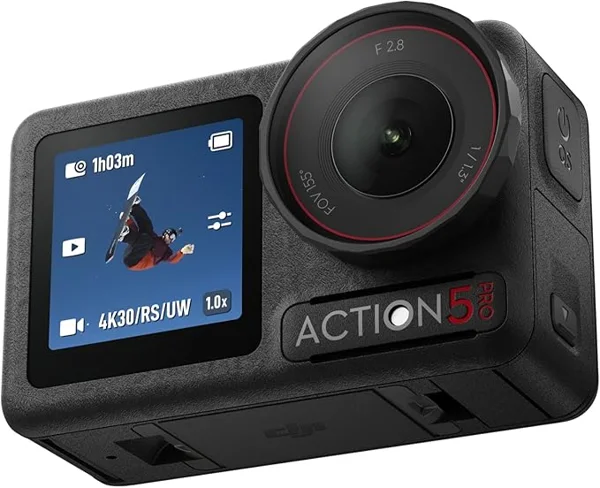
1. DJI Osmo Action 5 Pro
Best camera for a motorcycle helmet overall
The Action 5 Pro gets the balance right for a helmet. At 146 grams it is lighter than the HERO13 and the Ace Pro 2, and its 1950 mAh battery is rated for 240 minutes, tied with the Action 6 for the longest runtime among the flagships. 9to5Toys’ moto comparison recorded about three hours at 4K 24 fps, against roughly 1 hour 39 minutes for the Ace Pro 2, and the reviewer chose the DJI as the camera to keep on the helmet.
Its 1/1.3-inch sensor stays clean into dusk, and dual screens make framing easy before a ride. The magnetic quick release takes the camera off the mount in a second. The weak spot is wind: the built-in mics get loud when you turn your head. It pairs directly with DJI wireless mics, so that problem has a clean fix.
- Pros: light, long runtime, strong low light, direct DJI Mic pairing.
- Cons: wind noise on head turns, standard mounts need the included magnetic adapter.
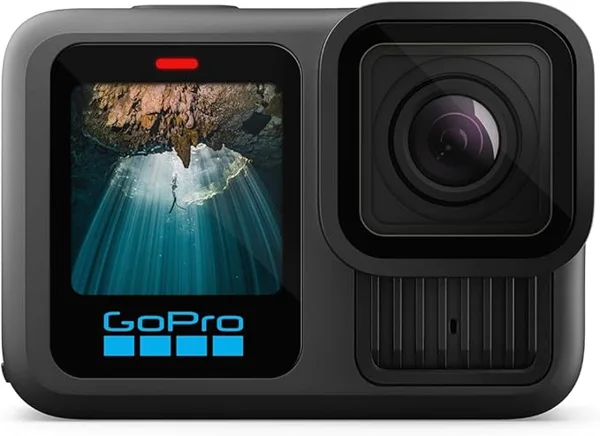
2. GoPro HERO13 Black
Best for mount choice and simple editing
The HERO13 has built-in mounting fingers, so it fits nearly every chin strap, clamp and adhesive base sold for motorcycles. Its footage also drops straight into any editor with no reframing step. That makes it the easy choice for a first helmet camera. It records 5.3K at 60 fps and weighs 154 grams with the battery.
The 1900 mAh Enduro battery lasts about 80 to 90 minutes at 5.3K, according to It’s Better on the Road. It is removable, so carrying a spare pair with a charger solves a long day. Low light trails the DJI cameras here, and voice control often fails in helmet buffeting.
- Pros: huge mount range, no adapter, swappable battery, easy files.
- Cons: weaker in low light, wind noise on head turns.
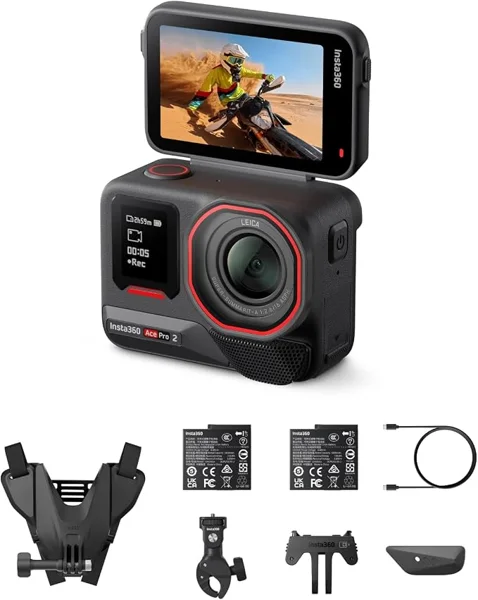
3. Insta360 Ace Pro 2 Motorcycle Bundle
Best built-in audio
The Ace Pro 2 is the camera to buy if you want usable sound with no extra mic. Its clip-on wind guard adds foam in a hard shell over the front microphone. In the 9to5Toys ride test it sounded good up to 70 mph, and head turns were far more usable than on the GoPro or DJI. The same test gave it the best image of the three.
The costs are size and runtime. It weighs about 177 grams, and it lasted roughly 1 hour 39 minutes at 4K, so plan on the second battery in this bundle. The reviewer also had trouble pressing the shutter in gloves.
- Pros: best stock audio, strong image, two batteries, flip screen.
- Cons: bulkier on a chin bar, shorter runtime, shutter is awkward in gloves.
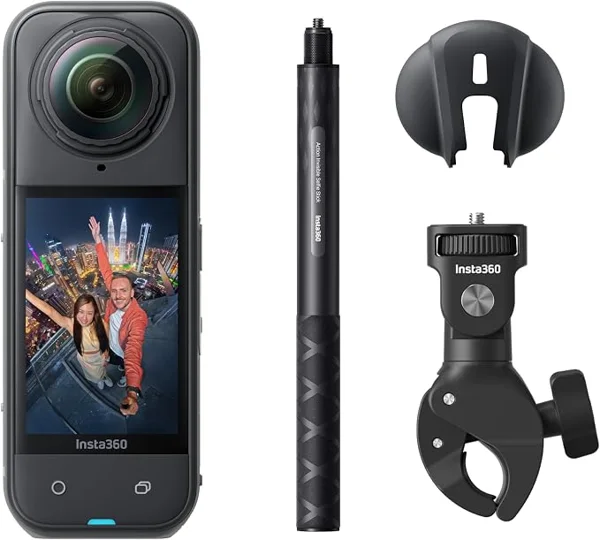
4. Insta360 X5 Motorcycle Bundle
Best 360 camera for motorcycle riders
The X5 records everything around it at 8K 30 fps, so you choose the angle after the ride. Its wind reduction drew strong praise from Canyon Chasers (sponsored by Insta360) and from Bennetts BikeSocial. Lenses are replaceable, which matters when a camera sits exposed on a bike.
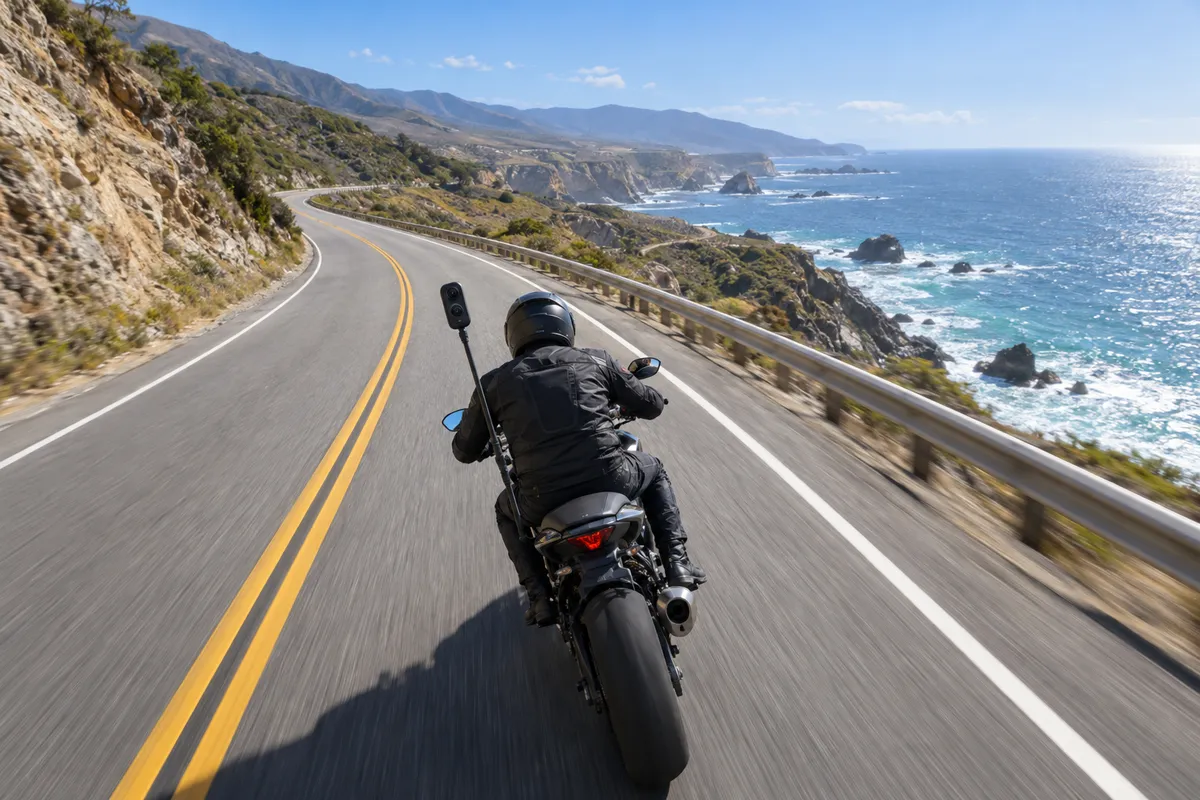
It works better on the bike than on your head. At 199 grams with the lens 114 mm above the mount, it is the heaviest and tallest camera here, and your helmet blocks part of the sphere. Use the bundle’s clamp and invisible selfie stick for third-person shots, and pair it with a small camera on the helmet. Bennetts recorded 102 minutes at 8K 25 fps, and files run close to 100 GB an hour. If you do want a 360 on your helmet, the Insta360 X4 Air weighs 165 grams.
- Pros: pick angles after the ride, strong wind reduction, replaceable lenses.
- Cons: tall and heavy for a helmet, big files, extra editing work.
5. DJI Osmo Action 6
Best helmet camera for night riding
The Action 6 pairs a square 1/1.1-inch sensor with an f/2.0 to f/4.0 variable aperture. Engadget called it the best action camera on the market for night shooting and found its footage considerably cleaner than the Action 5 Pro’s. At 149 grams it costs you almost nothing in weight.
It uses the same 1950 mAh battery, with about two hours of 4K per charge, and it connects to two DJI mics at once. Buy it over the Action 5 Pro if you commute after dark or film city rides. For daytime canyon footage, the older camera gives up very little.
- Pros: cleanest night footage here, light, two-mic support.
- Cons: costs more than the Action 5 Pro, limited manual aperture control.
6. DJI Osmo Action 4
Best value helmet camera
The Action 4 shares the 1/1.3-inch sensor size of the Action 5 Pro at a lower price, and it weighs 145 grams. Battery life drops to a rated 160 minutes and the hardware is a generation older. Those are fair losses for a camera that spends the ride on your chin bar. This Essential Combo is the sensible buy for a first helmet setup.
- Pros: large sensor for the money, light, shares DJI’s magnetic mounts.
- Cons: shorter runtime, built-in mics need the same wind help as other DJI models.
7. DJI Osmo Nano
Best small camera for a motorcycle helmet
The Nano’s camera module weighs about 52 grams and still carries a 1/1.3-inch sensor, with 4K at 60 fps and a 143-degree view. That gives you nearly the image of a full action camera at a third of the weight on your helmet. This combo has 128 GB of built-in storage, so there is no card to lose.
Battery life is the trade. DJI rates about 90 minutes in the module at 1080p, and one reviewer expects closer to half that in real use. The Vision Dock extends it but adds about 72 grams, so plan on charging between stops. Reviewers also found the clip accessories fiddly, so add a tether on any helmet mount.
- Pros: very light, strong sensor for the size, built-in storage.
- Cons: short runtime on the helmet, no swappable battery.
8. Insta360 GO 3S Motorcycle In-Helmet POV Bundle
Best rider’s-eye view
This 39-gram camera goes inside the helmet on a dedicated mount, so the footage shows the view through your visor. The shell shields the mic from direct wind, and nothing hangs off the outside of the helmet. The Action Pod carries the charge, with up to 140 minutes rated in the pod, and it doubles as a remote and screen. The bundle includes a mic wind muff.
It comes with two real limits. The camera runs for far less time on its own than the pod does. It also places a hard object inside the shell, and the federal helmet standard does not allow rigid projections there on a certified helmet. Check how it sits against your face and liner before you ride, and do not use it with goggles, which one retailer warns against.
- Pros: true eye-level view, sheltered mic, nothing on the shell.
- Cons: hard object inside the helmet, short camera-only runtime.
9. Sena 50C
Best intercom and camera in one unit
The 50C replaces your comm unit and your camera with one slim box on the side of the helmet. It records 4K at 30 fps with a 120-degree view, and voice commands start recording with no hand off the bars. Sena rates 1 hour 40 minutes of video and 12 hours of mesh intercom. webBikeWorld notes that stabilization is limited to 1080p.
Buy it for tidiness, because its image sits behind the DJI and Insta360 cameras above. The helmet mic records your voice directly, which other setups need a separate mic to do.
- Pros: no second device, voice control, Mesh intercom, clean voice capture.
- Cons: limited stabilization, fixed side angle, one-brand system.
10. Drift Ghost XL
Best for all-day recording
The Ghost XL is a bullet-shaped side-mount camera with a rated 9 hours of 1080p recording. Its lens rotates to level the shot, and loop recording overwrites old footage like a dash cam. That suits commuters and tourers who want a record of every mile and do not plan to edit it. It records only 1080p, so skip it for YouTube.
- Pros: longest runtime here, loop recording, low-drag shape.
- Cons: 1080p only, side angle puts the helmet in the frame.
11. AKASO Brave 7 LE
Best cheap camera for a motorcycle helmet
The Brave 7 LE is the lowest-cost camera here worth mounting on a helmet. This kit includes a 64 GB card, two batteries, a wrist remote and GoPro-style mounts, and the camera itself is rated IPX7 for rain. It records 4K at 30 fps with electronic stabilization.
Expect noisier footage after dusk and weaker stabilization on broken roads than the DJI and GoPro cameras deliver. The remote is the most useful part of the kit: strap it to your wrist and you can start recording in gloves.
- Pros: complete kit, wrist remote, rain rated without a case.
- Cons: weaker stabilization, poor low light, 30 fps limit at 4K.
Cameras that did not make the list
- GoPro Mission 1 Pro. Its 1-inch sensor leads the field on image quality, and PetaPixel rates it highly. At about 207 grams it is too heavy for a chin bar, and it costs far more than the HERO13.
- DJI Osmo 360. A strong bike-mounted 360 with a low center of gravity, but Canyon Chasers called its motorcycle audio awful and Bennetts recorded overheating on a desk test. The X5 is the safer buy for riders.
- GoPro MAX2. A workable 360 for GoPro owners. It has the same helmet problem as every 360: height, weight and a rider in the middle of the shot.
- Insta360 GO Ultra. At 53 grams it matches the DJI Nano on weight but costs more and ships with no storage. Reviewers noticed the extra weight in hat and clip mounts.
Where to mount a camera on a motorcycle helmet
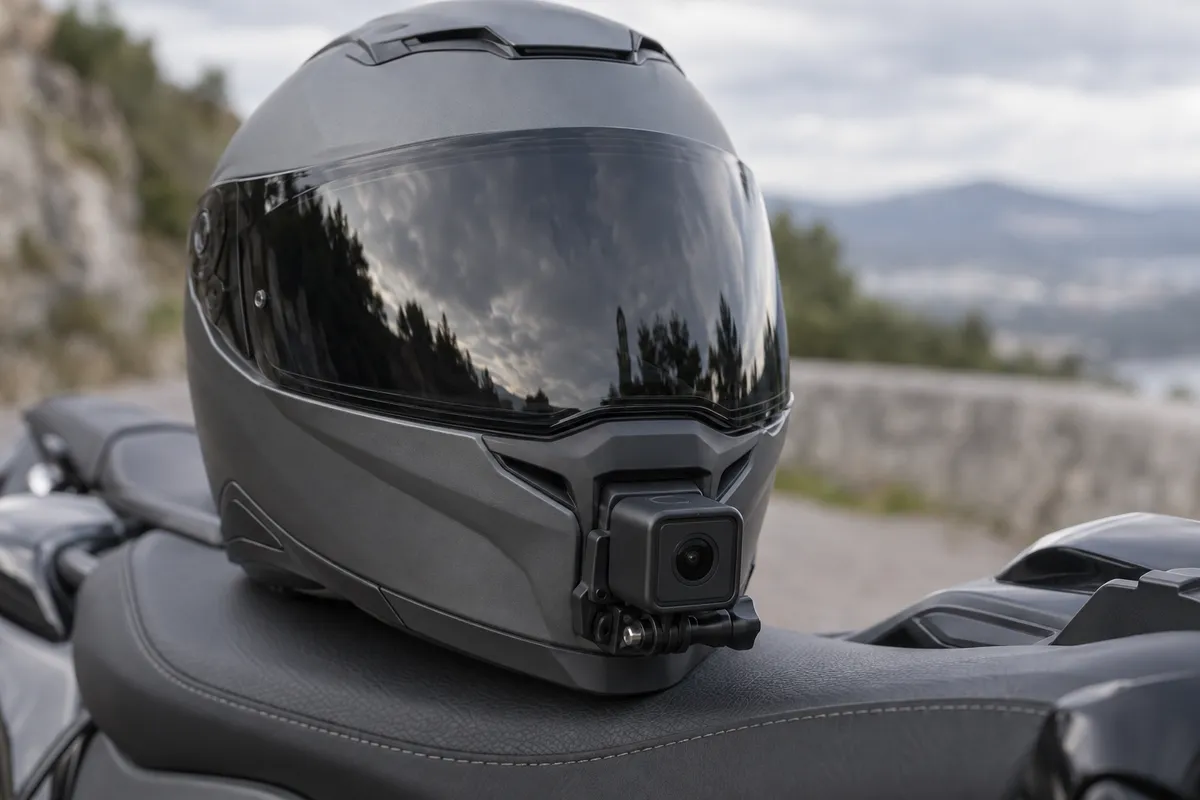
The chin bar is the best spot on a full-face helmet. It sits close to your eye line, shows the bars and instruments and keeps the camera low. In a Motovlog.com mount thread, about two-thirds of riders who stated a preference chose the chin.
| Position | View | Downside | Best for |
|---|---|---|---|
| Chin | Close to your eye line, shows the bars | Straps can hold the visor open a crack and add wind noise | Full-face helmets, motovlogs |
| Side | Offset, helmet in frame | More drag, more airflow on one side | Modular helmets, bullet cameras |
| Top | High, sees over traffic | Most strain on your neck, highest snag risk | Dirt bikes, short rides |
| Inside helmet | Through the visor | Hard object inside the shell, short runtime | GO 3S riders who accept the trade-off |
A modular helmet needs a little more thought. A strap across the chin bar can block the flip mechanism, and clamp mounts fit some flip-ups better than others. Owners report one clamp blocking the release switch and another letting air in on a Shoei Neotec 2. A side mount is the simpler answer on most modulars.
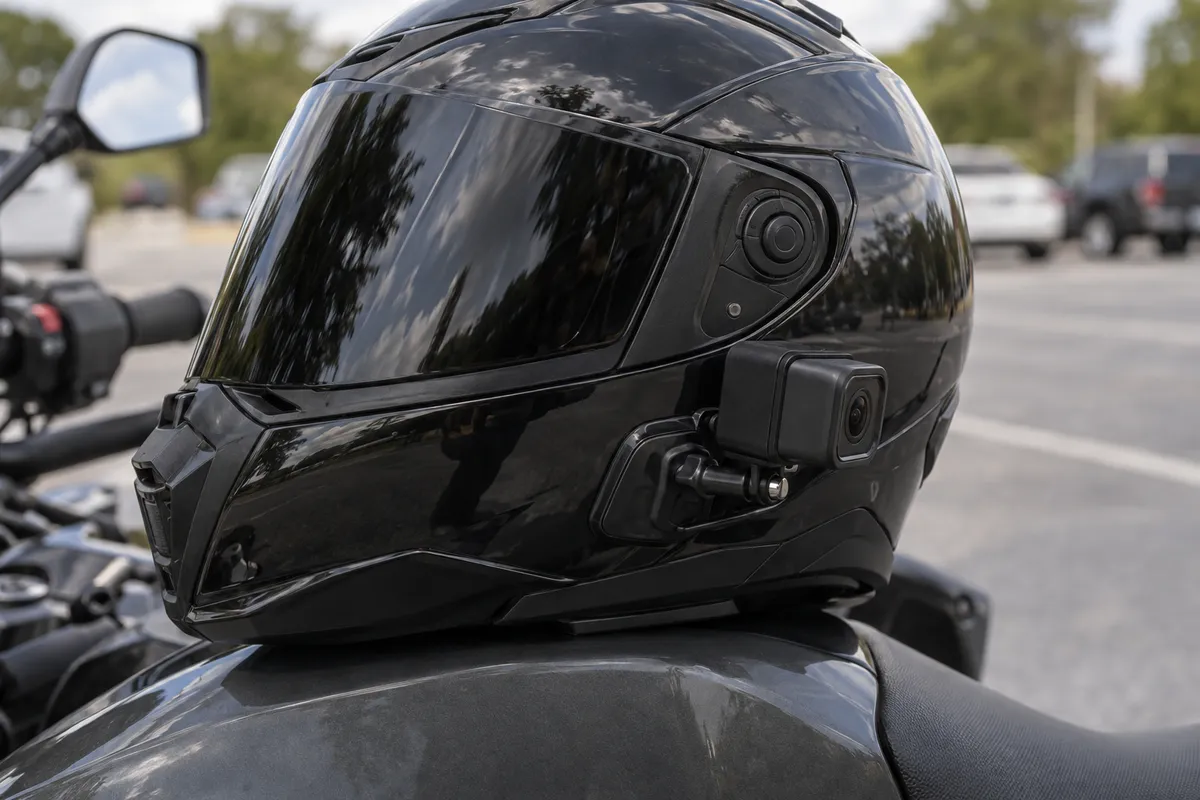
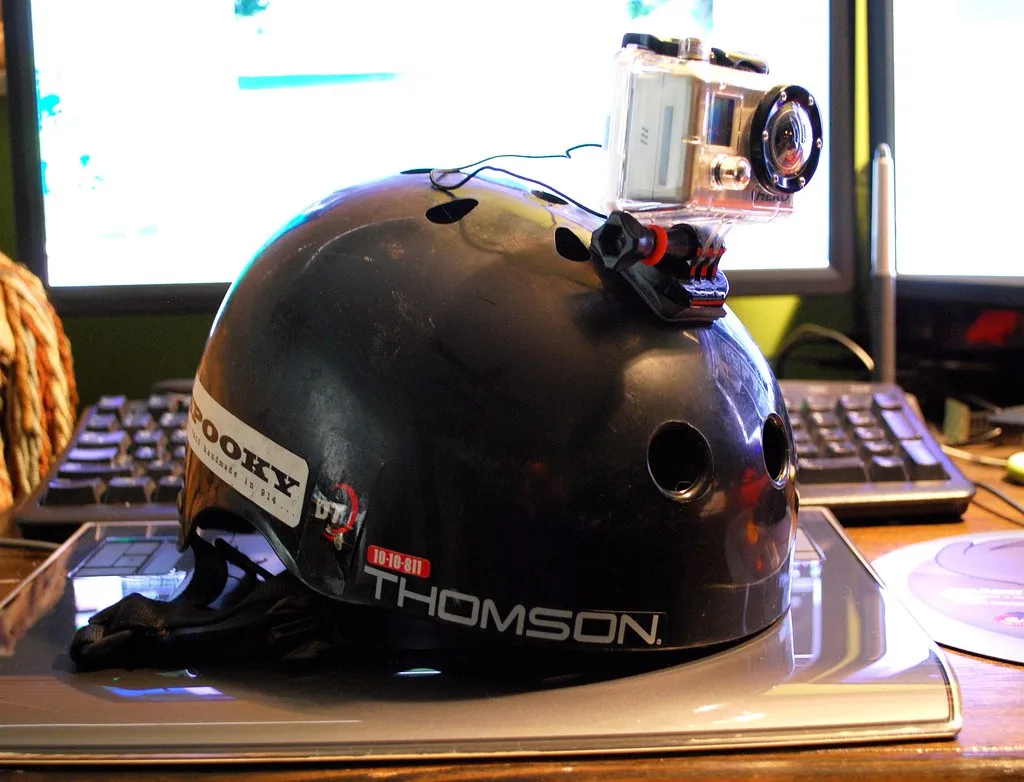
Open-face and half helmets have no chin bar. Use a side mount, a chest harness or a mount on the bars. A top mount does the job on a dirt bike helmet at trail speed, but the old rig below shows why riders moved away from it for road use: the camera sits high and far from the center of your head.
How to attach a camera to your helmet
Three mount types cover nearly every setup.
- Clamp. The Dango Design Gripper Mount uses a spring jaw on chin bars up to 2.5 inches thick and needs no adhesive, so it moves between helmets. It is the most expensive option and the fit varies by helmet, so check the seal around the chin vent after fitting. One r/gopro rider recommended it for this reason.
- Chin strap kit. A TELESIN strap mount wraps around the chin bar and costs little. It sits close to the shell, but the strap can stop the visor from sealing fully.
- Adhesive. Curved adhesive bases are the lowest-profile option and the most permanent. Use them on a side mount or on a helmet you plan to keep.
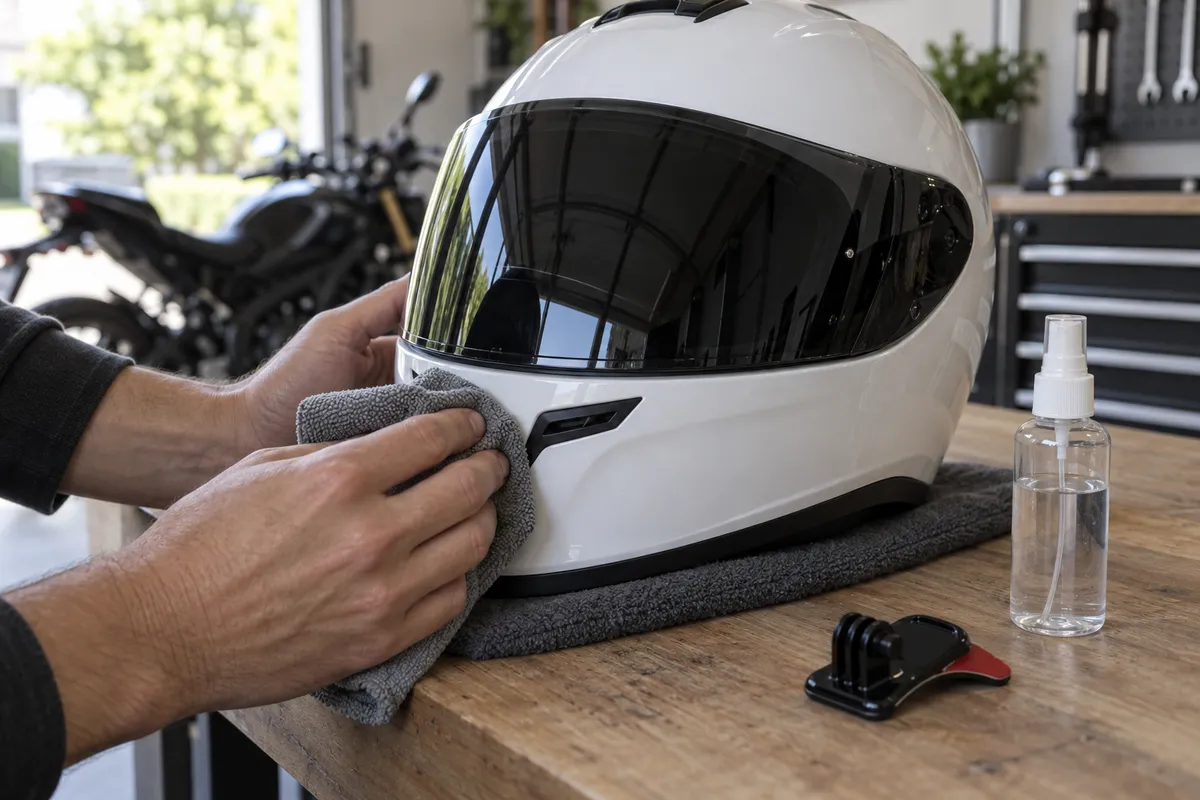
Adhesive mounts fail from poor prep. Follow these steps on any shell:
- Clean the area with a 70/30 mix of isopropyl alcohol and water, then let it dry.
- Choose a curved base that matches the shell. A flat base on a curved surface loses contact at the edges.
- Warm the base and shell to between 70 and 100°F, then press hard for 30 seconds.
- Leave it for 24 hours, which Ulanzi puts at about 90% of bond strength for common 3M VHB tape. Full strength takes 72 hours.
- Check that the visor still travels fully and that the camera clears the chin strap and your shoulders on a head turn.
- Add a tether to the helmet’s D-rings or chin strap so a failed mount does not drop the camera into traffic.
Never drill a helmet or use solvents on it. Both damage the shell, and solvents can weaken polycarbonate without leaving a visible mark.
How to reduce wind noise
The built-in mic is the weakest part of every helmet camera. Sound from the camera’s own mic at speed is mostly wind, so the fix is to move the mic out of the airflow.
- Put a mic inside the helmet. A DJI Mic Mini is small enough to tuck inside the chin bar, and it pairs directly with the Action 5 Pro and Action 6 without a receiver. Bennetts points to the same placement.
- Cover it. Riders on Motovlog.com keep arriving at the same setup: mic inside the chin bar with a fuzzy windscreen on it.
- Keep the level low. Wind buffeting clips the signal. One rider sets the mic to -12 dB and records a safety track.
- Close the helmet. A chin curtain cuts wind inside the helmet, though it also removes some engine sound. A quiet full-face helmet does more for your audio than any filter.
- Turn on wind reduction. Use it for built-in mics. Check that your mic path supports it, because older GoPro models disabled it when an external mic was connected.
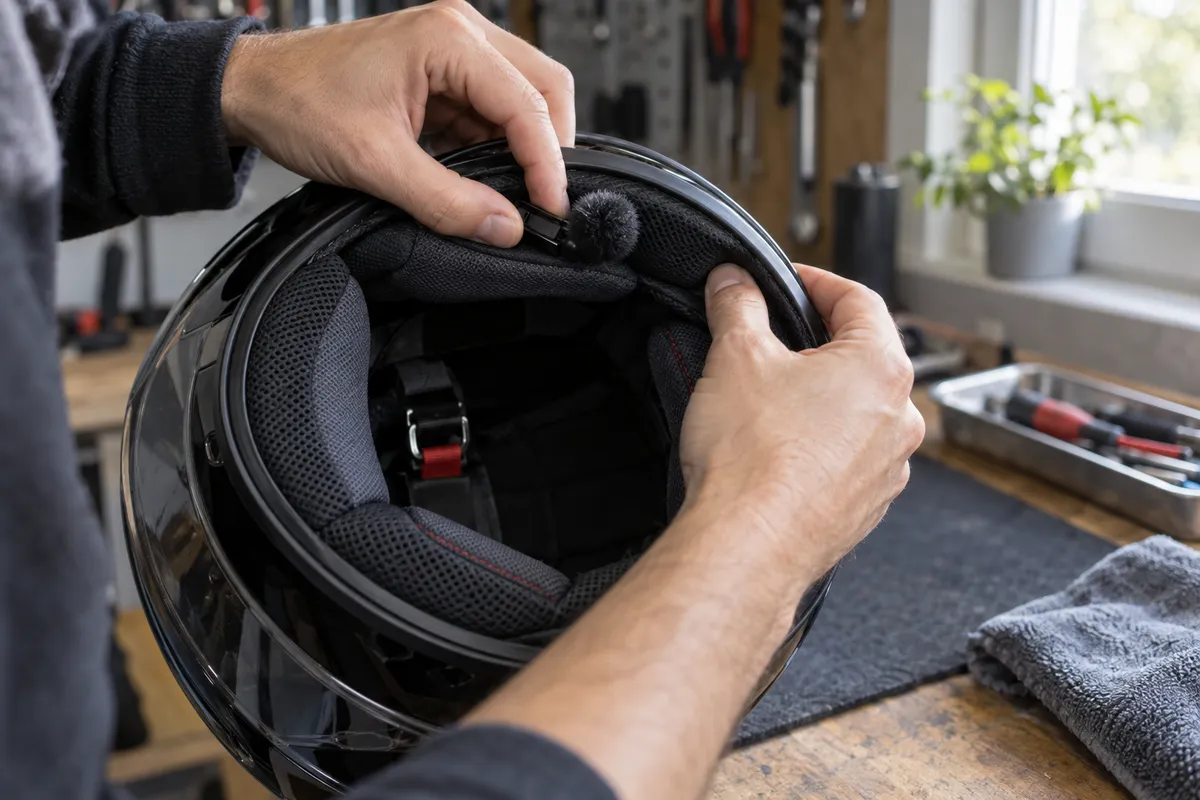
To capture exhaust note as well, leave the camera’s own mic recording and mix the two tracks. On many bikes, a separate mic in a tail bag or on the rear fender picks up the engine better. A sharp double honk at the start of each clip gives you a sync point in the edit.
What riders on Reddit and forums recommend
Riders on Reddit and motovlog forums keep repeating a few points. These come from an r/gopro chin mount thread and the Motovlog.com audio and mount threads.
- Do not put a 360 on your helmet. An r/gopro motovlogger runs a GoPro on the helmet and a 360 on the bike, because a helmet-mounted 360 loses much of its view to the rider’s body and is bulkier for less quality.
- Plan the audio before you buy. The same rider prefers a wired mic for sound quality and to avoid another battery to charge. Budget for a mic when you budget for a camera.
- The chin mount wins. Forum riders prefer it for POV and sense of speed, and they report side mounts as draggy and crowded.
- Clamps are popular with helmet swappers. The Dango Gripper comes up because it leaves no adhesive on the shell.
- Older GoPros still work. A HERO9 or HERO10 on a chin mount remains a common setup. Buying used is a reasonable way in if you want to see whether you will keep filming.
Is it legal to put a camera on a motorcycle helmet?
In the US, helmet cameras sit in a gray area. Federal law does not name them, but the standard behind the DOT sticker limits what can stick out of a helmet. FMVSS 218 says a helmet “shall not have any rigid projections inside its shell”, and that rigid projections outside the shell must be limited to those required for essential accessories and “shall not protrude more than 0.20 inch (5 mm)”.
That rule binds helmet makers selling certified helmets, not riders adding a camera. It still matters in states with mandatory helmet laws, because those laws require a compliant helmet. An action camera sticks out far more than 5 mm, so an officer can argue the helmet no longer complies. SlashGear reports that California riders can be ticketed on this basis, while other states leave it to officer discretion.
Practical steps reduce the risk:
- Use a removable mount such as a clamp or strap on a helmet you want to keep unmodified.
- Read your helmet maker’s manual. Many warn against stickers, adhesives and paint on the shell.
- Check your state’s helmet law, and any country you tour in. Rules vary, and the FIM banned helmet cameras at its events in 2014.
- Mount the camera on the bike or on your chest if your state or track forbids helmet mounts.
Are helmet cameras safe?
The best public evidence is limited. A 2015 Transport Research Laboratory study for the BBC found that cameras on climbing helmets did not increase head injury risk in its test configurations. Cameras broke away in about 40% of the tests. Visordown reported a small increase in force transfer in angled impacts. TRL did not test motorcycle helmets at motorcycle impact energy, and it warned against applying the results to every helmet and camera.
The practical reading is simple. Keep the camera small and low, use a mount that can break away and avoid high top mounts. Rider behavior and helmet use still matter far more than any accessory. A lighter camera also puts less mass on the shell.
Helmet camera or motorcycle dash cam?
Buy a dash cam if your main goal is evidence. Buy a helmet camera if your main goal is video people will want to watch.
A dash cam such as the INNOVV K6 wires to the bike, starts with the ignition and records front and rear in a loop. It uses a G-sensor to lock crash footage, and you never have to remember to press record. A helmet camera shows where you were looking but runs on a battery and only records what you start. It’s Better on the Road makes the same split between commuters and creators.
If you want a helmet camera for evidence, enable loop recording, keep the resolution at 1080p and start it before you pull out. Check your state’s rules on recording audio in public if you plan to use footage in a claim.
Camera for a bike helmet: bicycles and motorbikes
Riders in the UK and India often say “bike” for a motorcycle, and every pick above applies. For a bicycle helmet, the priorities change. A vented helmet has no chin bar, it weighs less and you feel extra weight at the end of a long ride.
Stay under 100 grams on a bicycle helmet if you can. The DJI Osmo Nano and the 86-gram GoPro HERO both fit. A strap through the vents moves the camera between helmets with no adhesive. For full-size cameras on a mountain bike full-face helmet, the chin mount advice above carries over. Cycling Weekly names the HERO13 as its top pick for cyclists.
Accessories worth buying
- A fast microSD card. A 256 GB SanDisk Extreme holds a full riding day at 4K. Use a V30 card or faster, because vibration-heavy 4K footage uses a high bitrate.
- A wireless mic. The DJI Mic Mini above works best with DJI cameras. GoPro owners need a receiver or a Bluetooth pairing check first.
- A bike mount kit. The Insta360 Motorcycle Bundle adds a bar clamp and flexible adhesive mount, so you can film a second angle.
- A USB power source. A cable to a bike USB port lets most cameras run all day, but the camera loses some water resistance with the port door open. Use a tank bag power bank in dry weather.
Best settings for a helmet camera
- Resolution: 4K at 60 fps gives smooth motion at a manageable file size. Drop to 1080p for evidence recording.
- Field of view: Use the widest linear or standard wide mode that keeps the horizon level. Narrow modes exaggerate head movement.
- Stabilization: Use the standard mode with horizon leveling for road riding.
- Aim: Set the lens so the bars or instrument cluster sit at the bottom edge of the frame in your normal riding posture.
- Start early: Set the record button or voice command before you put your gloves on, and do not adjust the camera at speed.
FAQ
What is the best camera for a motorcycle helmet?
The DJI Osmo Action 5 Pro is the best choice for most riders because of its 146-gram weight, long runtime and strong low-light image. Choose the Insta360 Ace Pro 2 for built-in audio or the GoPro HERO13 Black for mount compatibility.
What camera do motovloggers use?
Most motovloggers use a compact action camera from DJI, GoPro or Insta360 on a chin mount, with a separate mic inside the helmet. Many add an Insta360 X-series 360 camera on the bike for extra angles.
Where is the best place to mount a camera on a motorcycle helmet?
The chin bar is the best place on a full-face helmet. It sits near your eye line, shows the bars and keeps the camera low. Use a side mount on a modular or open-face helmet.
Is it illegal to have a camera on a motorcycle helmet?
No US federal law names helmet cameras, but FMVSS 218 limits rigid projections outside a shell to 0.20 inch, and states with helmet laws may treat a mounted camera as non-compliant. Enforcement varies by state, so check your local rules.
Does a helmet camera void the DOT certification?
Drilling or solvent damage changes the helmet and should be treated as voiding it. Adhesive and clamp mounts are less clear. A clamp or strap leaves the shell unchanged, which makes it the safest choice for a helmet you want to keep in original condition.
How do I stop wind noise on a helmet camera?
Move the mic out of the wind. A small wireless mic inside the chin bar with a fuzzy windscreen removes most of it, and a quiet full-face helmet removes more. Keep the mic level low so buffeting does not clip.
How heavy is too heavy for a helmet camera?
Under 160 grams is comfortable on a chin mount for most riders. Above about 190 grams, as with the Insta360 X5 or GoPro Mission 1 Pro, the camera adds noticeable strain and is better mounted on the bike.
Can I use a 360 camera on a motorcycle helmet?
Yes, with a chin or top mount, but it is rarely the best position. A 360 is tall, and your helmet and body block part of the view. Most riders get better results by mounting it on the bike with an invisible selfie stick.
How long does a helmet camera battery last?
Expect 80 to 180 minutes depending on the camera and resolution. The DJI Osmo Action 5 Pro ran about three hours at 4K 24 fps in one ride test, while the GoPro HERO13 Black lasts about 80 to 90 minutes at 5.3K.
Is a GoPro or Insta360 better for a motorcycle helmet?
The GoPro HERO13 is easier to mount and edit. The Insta360 Ace Pro 2 sounds better with its wind guard and has a stronger image. The Insta360 X5 is a better bike-mounted camera than a helmet camera.
Can I record from my intercom on a helmet camera?
The Sena 50C does this because the camera is built into the intercom. With a separate camera, most riders record intercom audio on a separate device, because most comm systems do not feed a clean signal into an action camera.
Sources & References
- 9to5Toys, Insta360 Ace Pro 2 vs Osmo Action 5 Pro vs GoPro HERO13 for moto vlogging: https://9to5toys.com/2024/10/22/insta360-ace-pro-2-moto-vlogging/
- Bennetts BikeSocial, DJI Osmo 360 review: https://www.bennetts.co.uk/bikesocial/reviews/products/motorcycle-technology/dji-osmo360-review
- Canyon Chasers, Insta360 X5 vs DJI Osmo 360 for motorcycle riders: https://www.canyonchasers.net/2025/08/insta360-x5-vs-dji-osmo-action-360-which-camera-is-better-for-motorcycle-riders/
- It's Better on the Road, best motorcycle helmet cameras: https://itsbetterontheroad.com/gear/best-motorcycle-helmet-camera/
- It's Better on the Road, Insta360 X5 vs GoPro HERO13: https://itsbetterontheroad.com/gear/insta360-x5-vs-gopro-hero-13/
- Engadget, DJI Osmo Action 6 review: https://www.engadget.com/cameras/dji-osmo-action-6-review-an-action-camera-that-excels-in-low-light-143027343.html
- webBikeWorld, best motorcycle cameras: https://webbikeworld.com/best-motorcycle-cameras/
- J. J. Keller, text of FMVSS 218: https://jjkellercompliancenetwork.com/regsense/571-218-standard-no-218-motorcycle-helmets
- SlashGear, are GoPro cameras on motorcycle helmets legal: https://www.slashgear.com/1976101/are-gopro-cameras-on-motorcycle-helmets-legal-what-bikers-should-know
- Transport Research Laboratory, PPR759 Safety Testing of Helmet-Mounted Cameras: https://trl.co.uk/uploads/trl/documents/PPR759%20-%20Safety%20Testing%20of%20Helmet-Mounted%20Cameras.pdf
- Visordown, helmet cameras may be safer than previously thought: https://www.visordown.com/news/general/helmet-cameras-may-be-safer-previously-thought
- Ulanzi, chin vs side vs visor placement: https://www.ulanzi.com/blogs/knowledges/helmet-camera-mount-chin-side-visor
- Motovlog.com, camera mount preference thread: https://motovlog.com/threads/camera-mount-preference.16401/
- Motovlog.com, setup for capturing the best sound while riding: https://motovlog.com/threads/setup-for-capturing-the-best-sound-while-riding.20443/

James Kowalski
More from James KowalskiHow we reviewed this article
This article was researched against manufacturer records and editorially reviewed before publishing. We accept no payment for coverage. Some guides contain affiliate links; see our affiliate disclosure.