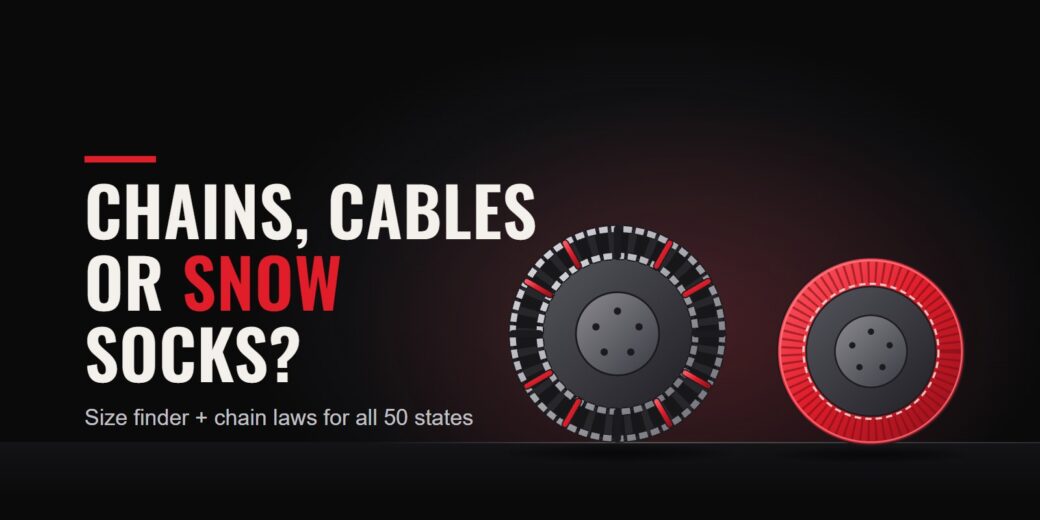
Tire chains are sized by your tire’s width, aspect ratio and rim diameter, but you buy them by the maker’s part number, so the size you need is a code on the maker’s fit chart. Whether you need chains at all depends on the road: most states require them only where a sign says so, and all-wheel drive does not always exempt you.
Enter the size printed on your tire sidewall below, answer four questions about your car and trip, and press Show results. The finder picks chains, cables or socks, says which axle they go on, shows what your state requires and lists products to search for. The explanation follows the results.
Tire chain size finder
Type the size as printed on the sidewall.
Where is it on my tire?

Limited means the manual says Class S or low-profile chains only. No chains allowed means the manual forbids them.
Add the size from your tire sidewall. The answer updates as you change the other questions.
Some links on this page are affiliate links. If you buy through them we may earn a commission at no extra cost to you. See our affiliate disclosure.
| Pick | Product | Amazon |
|---|---|---|
| Best overall | Auto-Trac LT | Search on Amazon |
| Best low-clearance chain | Super Z6 | Search on Amazon |
| Best self-tightening for cars | Auto-Trac Passenger | Search on Amazon |
| Best snow sock | AutoSock HP645 | Search on Amazon |
| Best for zero clearance | K-Summit | Search on Amazon |
| Best premium self-tensioning | König CG-9 | Search on Amazon |
| Best budget ladder chain | Quik Grip PL | Search on Amazon |
| Best budget cable chain | Radial Chain | Search on Amazon |
| Best for heavy use | Z-Chain | Search on Amazon |
| Best sock for wide size range | ISSE Classic | Search on Amazon |
| Best thicker sock | ISSE Super | Search on Amazon |
| Best for full-size trucks | Super Z Heavy Duty | Search on Amazon |
| Best for ice and off-road | Quik Grip V-Bar LT | Search on Amazon |
| Best for wide off-road tires | Quik Grip Wide Base | Search on Amazon |
| Best budget light-truck cable | Radial Chain LT | Search on Amazon |
Chains vs cables vs socks: what each one does
All three devices put something between the tire and the snow that bites better than rubber. They differ in grip, clearance, effort and wear. Every type has a 30 mph limit, and some makers set it lower.
Link chains
Steel link chains give the best grip on snow and especially on ice. They need the most wheel-well clearance and take 10 to 20 minutes to fit the first time, under 5 with practice. Self-tensioning designs tighten as you drive. Every state with chain controls accepts them.
Cable chains
Cable chains replace the links with steel cable and alloy cross members. They are lighter, quieter and easier to fit, and many models clear tighter wheel wells than link chains. Grip is lower. In one published test, a link chain took 3.7 seconds to go from 5 to 10 mph on snow against 6.3 seconds for a cable, and braking from 20 to 5 mph took 44 feet against 69. Cables suit a car you chain once or twice a winter.
Snow socks
Snow socks are fabric covers that slip over the tire. They fit in about 3 minutes by the makers’ claim, clear almost any wheel well and do not scratch alloy wheels. They work well on packed snow. On ice they grip less: one road test found a sock could not find solid footing. They wear out quickly on bare pavement, so take them off when the snow ends. Colorado and Washington approve them as an alternative device. California leaves it to the officer.
Which one is right
Choose by clearance first, then by how often you will use them. With roomy wheel wells, link chains suit a few trips a season and heavy-duty link chains suit daily winter driving. Cables suit emergencies. Socks suit tight wheel wells and short trips. If you drive in snow every week, winter tires with the three-peak mountain snowflake mark are the better answer. Our guide to winter tires covers that choice.
How to find your chain size
Amazon titles use the maker’s part numbers, not tire sizes. A listing for the Security Chain Super Z6 reads “SZ143”, not “225/45R17”. The same code covers a range of tire sizes with similar diameter and width. The process has four steps.
- Read your tire size. It is printed on the sidewall, for example P225/45R17 91H. 225 is the width in millimeters, 45 is the sidewall height as a percentage of the width, R means radial and 17 is the wheel diameter in inches. The letters before the width are P for passenger, LT for light truck and ST for trailer. ST tires are not for drive wheels. Truck flotation sizes read differently: 33×12.50R15 is overall diameter, section width and rim, in inches. If you changed tire size, our gear ratio calculator shows the new diameter.
- Check your manual. Look under snow chains or traction devices. It says whether chains are allowed, which axle they go on and how much clearance they need.
- Find your size on the maker’s fit chart. Peerless and Security Chain, Konig and Thule, and AutoSock each publish a chart that takes width, aspect ratio and rim.
- Order that code. Search the product on Amazon, then pick the listing whose code the chart gave you.
This is why the links on this page search the product name and not your tire size: a size in the search can hide the right listing, because titles carry codes. The finder adds one separate link that searches the device type with your tire size. Use it to browse, then confirm the code on the chart. Never let air out of a tire to test the fit.
Clearance and SAE classes S, U and W
SAE J1232 is the standard that classifies traction devices by the clearance they need. A vehicle must provide at least that much room between the tire and the body, suspension and brake lines. A device’s class is the clearance it needs, so a car with Class U clearance can take Class S or Class U devices.
| Class | Tread-face clearance | Sidewall clearance | Typical devices |
|---|---|---|---|
| S | 1.46 in (37 mm) | 0.59 in (15 mm) | Low-profile chains and cables, for restricted wheel wells |
| U | 1.97 in (50 mm) | 0.91 in (23 mm) | Regular passenger chains, including lug-reinforced |
| W | 2.50 in (64 mm) | 1.50 in (38 mm) | Light-truck chains |
Your manual may say “SAE Class S only” or “chains up to 10 mm at the sidewall”. If it does, treat that as the limit. If you cannot find it, measure the gap between the tire and the nearest part of the body or suspension. Under 1 inch, assume Class S.
Socks are not formally classed in J1232, but they are sold for restricted wheel wells. Plain ladder chains and many cables need Class U, while some cables, such as the Super Z6, clear Class S. Check the model, not the word “cable”.
Low-profile tires and AWD
Low-profile tires
No industry standard defines “low profile” for chains. The finder flags an aspect ratio of 40 or below, or a rim of 19 inches or larger, because that is where chain restrictions start in the owner’s manuals we found. Manuals commonly say Class S devices only, one axle only or the maker’s own chain only for these sizes. A few say no chains. Rims of 21 inches or larger have few options: a chain or cable the vehicle maker lists, or socks.
Your manual outranks a retailer’s fit chart. A chain that fits can still damage the car if the manual forbids it. If the manual says no chains, use winter tires, and use socks only if the manual allows textile devices.
Do I need chains with AWD?
AWD helps you get moving. It does not help you stop or turn. The law treats AWD as a partial exemption that depends on the tires, the state and the sign.
- AWD with snow-tread or mountain-snowflake tires on all four wheels meets California R1 and R2, Colorado’s Traction Law and several lower levels elsewhere. You still need to carry chains in California and Washington.
- AWD never beats an “all vehicles” order. California R3, Colorado’s Chain Law and Washington’s “chains on all vehicles” have no AWD exemption.
- On all-season tires without the three-peak mountain snowflake mark, AWD may not qualify. Our guide to all-season tires explains the markings.
State-by-state details are in the chain law section below.
The best snow chains and socks for 2026
The cards below cover devices from Peerless and Security Chain, Thule and Konig, AutoSock and ISSE: named makers with published fit information. Unbranded sets with no maker, clearance class or chain-law claim are left out. Each card shows type, SAE class, clearance, rim range and a price tier of budget, mid or premium.
Each link opens an Amazon search for the product. Match your tire size to the maker’s chart and pick the listing with that code. An Amazon listing that says “approved in Europe” or lists an EU standard does not confirm approval under a US state’s chain-control rule. Where we found no US approval claim, the card says so.
Best overall: Peerless Auto-Trac Light Truck/SUV Tire Traction Chain (Set of 2)
Some links on this page are affiliate links. If you buy through them we may earn a commission at no extra cost to you. See our affiliate disclosure.

Best overall
Best for: One chain for a car, SUV or pickup that you do not want to re-tighten.
- Type
- Self-tensioning chain
- SAE class
- Class S
- Min. clearance
- 15 mm
- Rim sizes
- Not listed
- Fits
- Passenger, Light truck
- Self-tensioning
- Yes
- Install time
- Not listed
- Max speed
- 30 mph
- Material
- Manganese alloy steel cross members, steel link chain
- Pattern
- Diamond
- Price
- Mid
Peerless states it meets SAE Class S clearance on SUVs, pickups and cars. No state-approval claim found; standard link chain is the baseline chain-control device.
A ratchet tightens the chain as you drive, so there is no stop to re-tighten. Peerless says it meets Class S clearance on cars, SUVs and pickups. Diamond pattern link chain.
Pros
- Self-tightening, no tensioners to fit
- Class S clearance per Peerless
- Link chain grips ice better than a cable
Cons
- Sold by part number, so you must match your tire to the Peerless chart
- Mid price tier, above a basic ladder chain
- Amazon listing doesn't confirm US chain-law approval
Amazon lists many part numbers (0231705 to 0232805) by size code, not by tire size; the reader must match a code to the Peerless size chart. Maker says chain tensioners should NOT be used.
Best low-clearance chain: Security Chain Company Super Z6 Cable Tire Chain (Set of 2)

Best low-clearance chain
Best for: Cars and crossovers with very tight wheel wells.
- Type
- Class S chain
- SAE class
- Class S
- Min. clearance
- 6 mm
- Rim sizes
- Not listed
- Fits
- Passenger
- Self-tensioning
- No
- Install time
- Not listed
- Max speed
- Not listed
- Material
- Steel cable with alloy cross members, built-in rubber tensioners
- Pattern
- Diagonal
- Price
- Mid
Peerless says the Super Z6 needs 6.3 mm of space at the inner sidewall, against 15 mm for a typical Class S product. It is a cable chain with built-in rubber tensioners.
Pros
- Needs only 6.3 mm of clearance per Peerless
- Built-in rubber tensioners
- Fits without moving the car
Cons
- Cable design, so less bite on hard ice than link chain
- Many size codes (SZ131, SZ143, SZ429, SZ435), so check the chart
- Rubber tensioners wear out
Maker page does not state a max speed (null). Peerless lists it for passenger, pickup and SUV sizes. Amazon title says Pickups and SUVs; the Peerless product category is passenger.
Best self-tightening for cars: Peerless Auto-Trac Passenger Tire Traction Chain (Set of 2)
Best self-tightening for cars
Best for: Passenger cars that need a self-tightening link chain.
- Type
- Self-tensioning chain
- SAE class
- Class S
- Min. clearance
- 15 mm
- Rim sizes
- Not listed
- Fits
- Passenger
- Self-tensioning
- Yes
- Install time
- Not listed
- Max speed
- 30 mph
- Material
- Manganese alloy steel cross members, steel link chain
- Pattern
- Diamond
- Price
- Mid
The passenger version of Auto-Trac uses the same ratcheting self-tightener as the truck version. Peerless lists it as Class S.
Pros
- Self-tightening and self-centering
- Class S per Peerless
- Link chain grips ice better than a cable
Cons
- 30 mph limit
- Part numbers are size codes, so check the chart before ordering
- Amazon search returns both passenger and light-truck codes, so confirm which one your size takes
Amazon search for Peerless Auto-Trac returns the passenger 0155xxx and the LT 0231xxx-0232xxx listings together. Which one fits a given tire is a size-chart question.
Best snow sock: AutoSock for Passenger Vehicles HP645 Snow Socks (Pack of 2)

Best snow sock
Best for: Tight clearance, occasional snow and states that accept socks.
- Type
- Snow sock
- SAE class
- Class S
- Min. clearance
- Not listed
- Rim sizes
- Not listed
- Fits
- Passenger
- Self-tensioning
- Not listed
- Install time
- 3 min
- Max speed
- 30 mph
- Material
- Textile (woven polyester-type fabric; maker does not name the fiber on pages read)
- Pattern
- Textile webbing
- Price
- Mid
Amazon listing: 'Approved across the U.S. with traction laws.' Washington State Patrol approved AutoSock for passenger cars in 2012 (AutoSock UK announcement). Not accepted at Caltrans R3 per some sources, unverified.
A fabric cover that slips over the tire. AutoSock claims a 3-minute install, and the listing says up to 30 mph. The Amazon listing says approved across the US. Washington State Patrol approved AutoSock for cars in 2012.
Pros
- About 3 minutes to fit, per the maker
- No metal, so no wheel damage and little clearance needed
- Accepted as a chain alternative in Colorado and Washington
Cons
- Wears quickly on dry pavement
- Grips less on ice than steel chains
- California leaves socks to the officer, and sources disagree on R3
Models are HP600/645/685/695/697 by size; Amazon lists each separately. SAE Class S label came from a search summary, not read on the maker page. Install time (3 min) from autosock.com. Maker durability test: EN 16662-1 requires 120 km on dry asphalt.
Best for zero clearance: Thule K-Summit Snow Chains (K44, set of 2)
Best for zero clearance
Best for: Crossovers where the manual allows chains but the wheel well has almost no room.
- Type
- Class S chain
- SAE class
- Class S
- Min. clearance
- 0 mm
- Rim sizes
- 14 to 20 in
- Fits
- Passenger
- Self-tensioning
- Yes
- Install time
- Not listed
- Max speed
- Not listed
- Material
- Not listed
- Pattern
- Not listed
- Price
- Mid
Certified Ö-Norm V5117 and EN 16662-1 (König says it fulfils any winter-equipment requirement worldwide). That is an EU standard claim, not a US state approval.
Konig's external-fit chain attaches at the wheel bolts and puts nothing behind the wheel. The Amazon listing says no clearance is needed behind the wheel and warns against off-road use.
Pros
- Nothing behind the wheel
- Tightens automatically as you drive, per Konig
- Does not touch alloy rims, per the listing
Cons
- Fits only on the original wheel nuts or bolts, not anti-theft ones
- Not for off-road use
- Certified to EU standards. Amazon listing doesn't confirm US chain-law approval
K44 listing covers rims 14-20 inch (derived from the tire sizes listed). The Class S label comes from a König page quoted in secondary notes; the K-Summit XL page reads EN 16662 Class 0/12 mm. Several K-Summit models (K33, K34, K44) exist on Amazon.
Best premium self-tensioning: Thule/König CG-9 Snow Chains (set of 2)
Best premium self-tensioning
Best for: Drivers who want a self-tensioning chain with alloy-wheel protection.
- Type
- Self-tensioning chain
- SAE class
- Not listed
- Min. clearance
- 9 mm
- Rim sizes
- Not listed
- Fits
- Passenger
- Self-tensioning
- Yes
- Install time
- Not listed
- Max speed
- Not listed
- Material
- Not listed
- Pattern
- Symmetrical diamond
- Price
- Mid
Certified Ö-Norm V5117 and EN 16662-1 (EN class 9 mm). EU standard claim, not a US state approval.
Konig's tensioning device centers and tightens the chain as you drive. It needs 9 mm of clearance and has composite parts where the chain meets the wheel.
Pros
- Needs 9 mm of clearance per Konig
- Wheel-Shield protects alloy wheels
- Tightens itself, so no extra stops
Cons
- Each listing covers one size code (106, 060), so pick the code from the chart
- Rated by the EU class, not SAE, so compare against your manual's figure
- Amazon listing doesn't confirm US chain-law approval
SAE class left null: König uses the EN 16662-1 clearance class (9 mm). Adding a tire size to a CG-9 search sometimes drops it from the first page; the plain 'Thule CG-9 Snow Chains' query is safer.
Best budget ladder chain: Security Chain Company Quik Grip Type PL Passenger Vehicle Tire Traction Chain (Set of 2)

Best budget ladder chain
Best for: Occasional use on a car, on a budget.
- Type
- Ladder chain
- SAE class
- Class S
- Min. clearance
- 15 mm
- Rim sizes
- Not listed
- Fits
- Passenger
- Self-tensioning
- No
- Install time
- Not listed
- Max speed
- Not listed
- Material
- Case-hardened steel twist links
- Pattern
- Ladder
- Price
- Budget
Peerless calls the Type PL the only ladder-style link chain that meets Class S. It is a plain twist-link chain that handles fresh or packed snow. Tensioners are required and sold separately.
Pros
- Class S ladder chain per Peerless
- Budget price tier
- Carrying case included
Cons
- Tensioners are not included and must be bought
- Ladder pattern gives a rougher ride
- Slower to fit than a self-tensioning chain
Amazon lists QG1118, QG1122 etc. by size code. Rating 4.0 stars (252 reviews) is shared with the QG1840 listing.
Best budget cable chain: Security Chain Company Radial Chain Cable Traction Tire Chain (SC1032 family, set of 2)

Best budget cable chain
Best for: A cheap emergency set for a car with limited space.
- Type
- Cable chain
- SAE class
- Class S
- Min. clearance
- 15 mm
- Rim sizes
- Not listed
- Fits
- Passenger
- Self-tensioning
- No
- Install time
- Not listed
- Max speed
- Not listed
- Material
- All steel; alloy cross members, traction coils
- Pattern
- Ladder
- Price
- Budget
A basic cable chain. It is light, rides smoothly and meets Class S per Peerless. Peerless says not to use tensioners with it.
Pros
- Class S per Peerless
- Light and simple to mount
- Budget price tier
Cons
- Less traction than link or diagonal-bar designs
- Can loosen, with no built-in tensioner
- Built for light use, not for daily winter driving
SC1032, SC1034, SC1036, SC1038 are size codes. Peerless says tensioners should NOT be used with Radial Chain.
Best for heavy use: Security Chain Company Z-Chain Extreme Performance Cable Tire Traction Chain (Z-579 family, set of 2)
Best for heavy use
Best for: Frequent winter drivers who want a durable chain that still meets Class S.
- Type
- Class S chain
- SAE class
- Class S
- Min. clearance
- 15 mm
- Rim sizes
- Not listed
- Fits
- Passenger, Light truck
- Self-tensioning
- No
- Install time
- Not listed
- Max speed
- Not listed
- Material
- Manganese alloy cross members on steel cable
- Pattern
- Diagonal
- Price
- Premium
Z-Chain was designed for police and fire fleets. It meets Class S, needs no tensioners and ships with waterproof gloves. It is a cable chain with diagonal alloy cross members.
Pros
- Class S clearance per Peerless
- No tensioners needed
- Diagonal alloy cross members built for heavy use
Cons
- Premium price tier
- Cable base, so it is slower to fit than socks
- Many size codes (Z-563, Z-571, Z-575, Z-579, Z-583), so check the chart
Peerless has a separate light-truck Z-Chain page, so lt is set true. Prices differ widely between listings and by seller; the tier rests on one USD price ($158.82 on Z-571) and Mexican-peso prices on other codes.
Best sock for wide size range: ISSE Classic Snow Socks for Tires
Best sock for wide size range
Best for: Cars, trucks and 4x4s with restricted wheel-well space, for emergency use.
- Type
- Snow sock
- SAE class
- Not listed
- Min. clearance
- Not listed
- Rim sizes
- 14 to 23 in
- Fits
- Passenger
- Self-tensioning
- Not listed
- Install time
- 3 min
- Max speed
- 25 mph
- Material
- Textile, tribologic ACTIV3D braiding
- Pattern
- Textile weave
- Price
- Mid
Secondary sources report ISSE socks are approved in CA, CO and WA; those pages blend ISSE with AutoSock and were not confirmed on an official state list.
A textile cover that goes on in about 3 minutes without tools. ISSE gives a 2-year guarantee and says it has no metal parts.
Pros
- About 3 minutes to fit, per the listing
- 2-year guarantee, per the listing
- Wide size range, from 14-inch to 23-inch rims across the listing
Cons
- Not for bare pavement
- Mid price tier for a fabric cover
- 25 mph on most sizes, lower than the 30 mph of other devices
- State approvals come from secondary sources only
Rim range comes from the tire sizes shown in the variation listing (R14 to R23), which may span several ISSE size codes; the visible text was truncated. Max speed conflicts between sources (25 mph vs 30 mph for size 74). Price taken from the Size 70 variation ($117.91).
Best thicker sock: ISSE Super Snow Socks for Tires
Best thicker sock
Best for: Sock buyers who want more wear life than the Classic.
- Type
- Snow sock
- SAE class
- Not listed
- Min. clearance
- Not listed
- Rim sizes
- 14 to 23 in
- Fits
- Passenger
- Self-tensioning
- Not listed
- Install time
- 3 min
- Max speed
- 25 mph
- Material
- Textile, tribologic ACTIV3D braiding, thicker than Classic
- Pattern
- Textile weave
- Price
- Mid
Same as ISSE Classic: secondary sources report CA, CO and WA approval; not confirmed on an official list.
The heavier-duty ISSE fabric. One source says it is about three times thicker than the Classic. The listing repeats the Classic's 3-minute install and 2-year guarantee.
Pros
- Thicker fabric than the Classic, per one report
- About 3 minutes to fit, per the listing
- Sold by accessory sellers for Tesla owners
Cons
- Mid price tier, above the Classic
- 25 mph on most sizes
- Still wears quickly on bare pavement
Thickness claim ('three times thicker') comes from a fleetmaintenance.com article summary, not from the listing. Rim range copied from the shared variation listing text.
Best for full-size trucks: Security Chain Company ZT837 Super Z Heavy Duty Traction Tire Chains for Full Size Trucks and SUVs (Set of 2)

Best for full-size trucks
Best for: Half-ton and larger pickups and SUVs that still need Class S clearance.
- Type
- Truck chain
- SAE class
- Class S
- Min. clearance
- 15 mm
- Rim sizes
- Not listed
- Fits
- Light truck
- Self-tensioning
- No
- Install time
- Not listed
- Max speed
- Not listed
- Material
- Not listed
- Pattern
- Not listed
- Price
- Premium
The Amazon listing says it meets Class S and has built-in rubber tensioners, so there is no stop to re-tighten. It is one of the most expensive chains in this guide.
Pros
- Class S clearance on a full-size truck chain, per the listing
- Built-in rubber tensioners
- Listing claims better ABS and AWD compatibility than basic chains
Cons
- Premium price tier
- Only 68 reviews when we checked
- Maker family not confirmed (the ZT8 numbering suggests Super Z8)
ZT8xx numbering suggests the Super Z8 family (about 8 mm clearance) but no source read confirms it, so min_clearance_mm uses the Class S figure. Pattern and material not stated in the bullets read.
Best for ice and off-road: Security Chain Company Quik Grip V-Bar Light Truck Tire Traction Chain (QG2829 family, set of 2)

Best for ice and off-road
Best for: 4WD trucks on ice, in plowing and off-road work.
- Type
- Diamond chain
- SAE class
- Not listed
- Min. clearance
- Not listed
- Rim sizes
- Not listed
- Fits
- Light truck
- Self-tensioning
- No
- Install time
- Not listed
- Max speed
- Not listed
- Material
- Steel link with V-bar reinforcement
- Pattern
- V-bar ladder
- Price
- Mid
An aggressive link chain with V-bars. Peerless says it is used for plowing, off-road work, hunting and utility work. It does not meet Class S and tensioners are needed.
Pros
- V-bars bite into ice and packed snow
- Built for heavy-duty light trucks, per Peerless
- Cheaper than most Class S truck chains
Cons
- Does not meet SAE Class S
- Tensioners are needed and usually not included
- Rough ride
Peerless QG2800 page: Meets Class S = No; Tensioners required = Yes. SAE class left null because Peerless says only 'not S' (U or W not stated). QG2819 price was $99.95 on the QG2829 listing; the QG2819 listing showed MXN 2,427. Wide V-Bar variant lists max 20 mph (Peerless); the 2800 page states no speed.
Best for wide off-road tires: Security Chain Company Quik Grip Wide Base Type CAM-DH Light Truck Tire Traction Chain (QG3210CAM family, set of 2)
Best for wide off-road tires
Best for: Lifted or wide-tire 4x4s and flotation sizes such as 33x12.50R15.
- Type
- Truck chain
- SAE class
- Not listed
- Min. clearance
- Not listed
- Rim sizes
- Not listed
- Fits
- Light truck, Flotation
- Self-tensioning
- No
- Install time
- Not listed
- Max speed
- Not listed
- Material
- Steel link
- Pattern
- Ladder
- Price
- Mid
Peerless says the Wide LT line is for 4-wheel-drive and sport utility vehicles on rugged terrain and moderate off-road snow and mud. The CAM version tightens with a lock instead of tensioners.
Pros
- Made for wide-base tires and 4x4s, per Peerless
- CAM lock tightens without separate tensioners
- Several size codes (QG3210CAM, QG3229CAM, QG3235)
Cons
- Does not meet SAE Class S
- Needs a CAM tool to tighten
- Few reviews on some codes, and flotation coverage is unconfirmed on the maker page
Flotation coverage is not stated on the Peerless Wide LT page read; the 33x12.50R15 example comes from a secondary note and the Amazon search returned QG3210CAM, QG3229CAM, QG3235 for that size. Confirm size on the maker's chart. Peerless Wide V-Bar LT variant lists max 20 mph.
Best budget light-truck cable: Security Chain Company Radial Chain LT Cable Tire Traction Chain for Light Trucks (TC2212MM family, set of 2)
Best budget light-truck cable
Best for: Light trucks, vans and RVs that need a basic cable chain.
- Type
- Cable chain
- SAE class
- Not listed
- Min. clearance
- Not listed
- Rim sizes
- Not listed
- Fits
- Light truck
- Self-tensioning
- No
- Install time
- Not listed
- Max speed
- Not listed
- Material
- All steel; alloy cross members
- Pattern
- Ladder
- Price
- Mid
Peerless calls this its basic winter traction product for light trucks, vans and RVs. The Peerless spec table says it does not meet Class S.
Pros
- Peerless says it installs in minutes and removes easily
- Lightweight cable chain
- Fits light-truck, van and RV tires
Cons
- Does not meet SAE Class S per Peerless, though the Amazon bullets mention low clearance
- Basic traction, with less bite on ice than link chain
- Amazon listing doesn't confirm US chain-law approval
The Amazon bullets mention low operating space requirements while the Peerless spec table says Meets Class S = No. Spec table is used. Peerless says tensioners should NOT be used. Price tier is a guess from a peso price.
Some links on this page are affiliate links. If you buy through them we may earn a commission at no extra cost to you. See our affiliate disclosure.
| Product | Pick | Type | SAE class | Min. clearance | Rim sizes | Install | Max speed | Price | Amazon |
|---|---|---|---|---|---|---|---|---|---|
| Auto-Trac LT | Best overall | Self-tensioning chain | Class S | 15 mm | Not listed | Not listed | 30 mph | Mid | Search on Amazon |
| Super Z6 | Best low-clearance chain | Class S chain | Class S | 6 mm | Not listed | Not listed | Not listed | Mid | Search on Amazon |
| Auto-Trac Passenger | Best self-tightening for cars | Self-tensioning chain | Class S | 15 mm | Not listed | Not listed | 30 mph | Mid | Search on Amazon |
| AutoSock HP645 | Best snow sock | Snow sock | Class S | Not listed | Not listed | 3 min | 30 mph | Mid | Search on Amazon |
| K-Summit | Best for zero clearance | Class S chain | Class S | 0 mm | 14 to 20 in | Not listed | Not listed | Mid | Search on Amazon |
| König CG-9 | Best premium self-tensioning | Self-tensioning chain | Not listed | 9 mm | Not listed | Not listed | Not listed | Mid | Search on Amazon |
| Quik Grip PL | Best budget ladder chain | Ladder chain | Class S | 15 mm | Not listed | Not listed | Not listed | Budget | Search on Amazon |
| Radial Chain | Best budget cable chain | Cable chain | Class S | 15 mm | Not listed | Not listed | Not listed | Budget | Search on Amazon |
| Z-Chain | Best for heavy use | Class S chain | Class S | 15 mm | Not listed | Not listed | Not listed | Premium | Search on Amazon |
| ISSE Classic | Best sock for wide size range | Snow sock | Not listed | Not listed | 14 to 23 in | 3 min | 25 mph | Mid | Search on Amazon |
| ISSE Super | Best thicker sock | Snow sock | Not listed | Not listed | 14 to 23 in | 3 min | 25 mph | Mid | Search on Amazon |
| Super Z Heavy Duty | Best for full-size trucks | Truck chain | Class S | 15 mm | Not listed | Not listed | Not listed | Premium | Search on Amazon |
| Quik Grip V-Bar LT | Best for ice and off-road | Diamond chain | Not listed | Not listed | Not listed | Not listed | Not listed | Mid | Search on Amazon |
| Quik Grip Wide Base | Best for wide off-road tires | Truck chain | Not listed | Not listed | Not listed | Not listed | Not listed | Mid | Search on Amazon |
| Radial Chain LT | Best budget light-truck cable | Cable chain | Not listed | Not listed | Not listed | Not listed | Not listed | Mid | Search on Amazon |
Chain laws by state
The law and the advice differ. Seven states run chain-control systems that apply to passenger cars: a sign or posted road condition turns a requirement on for one stretch of road until it is lifted. Seven more have rules on specific passes or on trucks, and 37 have no chain-control system. The table below covers all 50 states and DC, with the control level, whether socks are accepted, the studded tire rule and a source link.
Rules change by season and by road. Check the state transportation department before you drive. The links below go to the official pages.
California
Caltrans posts R1, R2 or R3 on mountain roads such as I-80 over Donner Summit and US-50 over Echo Summit. R1 requires chains, except for cars and light trucks under 6,000 lb with snow tires on at least two drive wheels. R2 requires chains, except for 4WD and AWD vehicles with snow-tread tires on all four wheels, which must still carry chains. R3 requires chains or a traction device on every vehicle. Speed is limited to 25 or 30 mph, and you may not fit chains in a traffic lane. For socks the officer decides: CHP publishes no approved list, and sources disagree on socks at R3. At R3, carry chains. Caltrans chain controls.
Colorado
CDOT runs two laws. The Traction Law (Code 15) requires winter-rated tires with at least 3/16 inch of tread: mountain-snowflake, M+S or a maker’s all-weather rating. Without them you need chains or an approved alternative device on two or more drive tires. The Passenger Vehicle Chain Law (Code 16) is the last step before closure: every vehicle needs chains or an approved alternative device, AWD included. The fine is $100 plus a $33 surcharge, or $500 plus $157 if you block a lane. CDOT approves socks including AutoSock, EasySox, ISSE and Alpha Trax. CDOT traction and chain laws.
Washington
Washington requires chains only when signs say so. Under “traction tires required”, cars need mountain-snowflake tires with at least 1/8 inch of tread. Under “chains required”, cars chain the drive axle, except that AWD and 4WD vehicles under 10,000 lb may carry chains instead. Under “chains required on all vehicles”, everyone fits them. Studded tires do not satisfy a chain requirement, and the fine is $500. WAC 204-24-050 accepts socks on the State Patrol’s approved list. “Carry chains in the Cascades” is advice, not law, but conditions on I-90, US-2 and US-12 change fast. WAC 204-24-050.
Oregon
ODOT signs have four levels: carry chains or traction tires, use them, chains required, and conditional closure. Cars that are not towing may use traction tires, studded or mountain-snowflake, instead of chains. Light AWD and 4WD vehicles under 6,500 lb unladen can be exempt if they carry chains, have traction tires on all wheels and are not towing. ODOT describes socks as a short-stretch option. Check TripCheck before a pass. ODOT winter tires.
Nevada
When NDOT signs it, vehicles of 10,000 lb or less need chains, a traction device or snow tires with at least 3/16 inch of tread. When chains are required, all vehicles need them except 4WD and AWD with snow tires on all wheels, which must carry chains. On SR-431, SR-207 and part of US-50 near Tahoe, the stricter rule allows chains only, or 4WD and AWD with snow tires. We could not confirm whether NDOT accepts socks. NDOT requirement descriptions.
Utah
UDOT’s Traction Law applies when the canyon signs flash. Under Class II, all vehicles need traction devices on two drive tires, M+S or snow tires, or four-wheel drive. In the Cottonwood Canyons (SR-190 and SR-210), Class III requires at least 5/32 inch of tread, with M+S or mountain-snowflake tires on all wheels for AWD and 4WD, and mountain-snowflake tires or devices on two drive wheels for 2WD. UDOT lists snow socks as acceptable. UDOT Traction Law.
Wyoming
WYDOT can set Level 1 or Level 2 on specific sections such as I-80 near Elk Mountain. Level 1 limits travel to vehicles with chains, adequate snow tires or AWD. Level 2 requires chains, or AWD with M+S or all-weather tires. The fine is $250, or $750 if the violation closes the highway. Do not stop in the driving lane to fit chains. The WYDOT page does not mention socks. WYDOT chain law.
States with occasional rules
Idaho posts chain signs on specific passes such as Lookout and Lolo. In Montana, the state can require chains or approved traction devices on drive wheels on dangerous passes. Vermont can order only vehicles over 26,000 lb to chain up. Pennsylvania’s storm restrictions mostly hit trucks, buses, RVs and cars towing trailers. Georgia requires chains, 4WD with adequate tires or all-weather snow tires only after a declared winter emergency. Nebraska has no posted system and permits chains when needed. In DC, vehicles on snow emergency routes need chains or effective snow tires during a declared emergency.
The 37 states with no chain control
These states have no chain-control system we could find. Their laws permit chains when needed for safety on snow or ice, and nothing requires you to carry them. Some limit the season: Oklahoma allows chains only from November 1 to April 1. Many restrict studded tires, which the table lists. In these states, carrying chains in a storm is advice, not law.
Showing 51 of 51 states
| State | Chain control | Socks OK? | Studs | What it says | Source |
|---|---|---|---|---|---|
| Alabama | None | Unclear | Restricted | No. Alabama has no chain-control system and does not require chains; they are legal when conditions make them necessary for safety. | Source |
| Alaska | None | Unclear | Seasonal: Sep 16 – Apr 30 | No. Alaska has no chain-control system; chains and studs are legal in winter, and the main rule is the summer removal deadline. | Source |
| Arizona | None | Unclear | Seasonal: Oct 1 – May 1 | No. Arizona has no routine chain requirement; chains are legal when needed, and ADOT closes roads for snow instead of requiring chains. | Source |
| Arkansas | None | Unclear | Seasonal: Nov 15 – Apr 15 | Arkansas has no chain-control system. Chains are legal when needed for safety; studded tires are legal Nov 15 through Apr 15. | Source |
| California | Chain controls | Unclear | Seasonal: Nov 1 – Apr 30 | Yes, in the Sierra and other mountain passes: when Caltrans posts R-1, R-2 or R-3 you must carry and use chains (or a CHP-approved traction device) unless your vehicle qualifies for an exemption. Controls depend on weather, not the calendar. | Source |
| Colorado | Chain controls | Yes | Allowed | Yes in the mountains. CDOT can enforce Code 15 or Code 16 on any state highway; Code 16 requires chains or an approved sock-type device on every vehicle. | Source |
| Connecticut | None | Unclear | Seasonal: Nov 15 – Apr 30 | Connecticut has no chain requirement. Chains are allowed when snow or ice makes them necessary. | Source |
| Delaware | None | Unclear | Seasonal: Oct 15 – Apr 15 | No. Delaware has no chain-control system; chains are legal when snow or ice makes them necessary, and studs are legal Oct 15 – Apr 15. | Source |
| District of Columbia | Some routes | Unclear | Seasonal: Oct 15 – Mar 15 | Chains are not generally required in DC. During a declared snow emergency, vehicles on snow emergency routes need chains or effective snow tires, and parking there is banned. | Source |
| Florida | None | Unclear | Allowed | No. Florida has no chain law and no winter traction requirement; you will essentially never need chains there. | Source |
| Georgia | Some routes | Unclear | Restricted | Only after a declared winter state of emergency: signs then require chains, 4WD with adequate tires, or all-weather-rated snow tires. Commercial vehicles with four or more drive wheels must chain at least four drive tires; buses two. | Source |
| Hawaii | None | Unclear | Not allowed | No. Hawaii has no chain requirement; chains are legal and studs are limited to Mauna Kea roads. | Source |
| Idaho | Some routes | Yes | Seasonal: Oct 1 – Apr 30 | Not routinely for cars. Chains are required on specific passes only when signed, and the formal statute text covers commercial trucks; carry chains for winter mountain trips. | Source |
| Illinois | None | Unclear | Not allowed | No. Illinois has no chain-control system and no requirement to carry chains. Chains are legal when snow or ice makes them necessary, and studs are banned for almost everyone. | Source |
| Indiana | None | Unclear | Seasonal: Oct 1 – May 1 | No. Indiana has no chain-control system. Counties issue travel advisories, watches and warnings that restrict travel but do not require chains. Chains are legal when needed for safety. | Source |
| Iowa | None | Unclear | Seasonal: Nov 1 – Apr 1 | Iowa has no chain-control system. Chains are legal when roads are slick, and studded tires are legal Nov 1 through Apr 1. | Source |
| Kansas | None | Unclear | Seasonal: Nov 1 – Apr 1 | Kansas has no chain-control system. Chains are legal when roads are slick, and studded tires are legal Nov 1 through Apr 1. | Source |
| Kentucky | None | Unclear | Allowed | No. Kentucky has no chain-control system and no carry requirement. Chains are legal, but KRS 189.190 limits chain construction and use on roads that are not iced. | Source |
| Louisiana | None | Unclear | Not allowed | No. Louisiana has no chain-control system and does not require chains; they are legal when ice or slick conditions call for them. | Source |
| Maine | None | Unclear | Seasonal: Oct 2 – Apr 30 | Maine has no chain requirement. Studded tires are legal Oct 2 through Apr 30. | Source |
| Maryland | None | Unclear | Restricted: Nov 1 – Mar 31 | No. Maryland has no chain-control system; chains are legal when needed for snow or ice. Studs are banned except for vehicles registered in five western and central counties from Nov 1 – Mar 31. | Source |
| Massachusetts | None | Unclear | Seasonal: Nov 2 – Apr 30 | Massachusetts does not require chains for cars. Municipalities declare snow emergencies, but those cover parking, not chains. | Source |
| Michigan | None | Unclear | Not allowed | No. Michigan has no chain-control system and no carry requirement. Chains are legal when snow or ice makes them necessary, and studs are banned for most drivers. | Source |
| Minnesota | None | Unclear | Not allowed | Minnesota has no chain-control system. Chains are legal when needed for safety, but studded tires are banned for residents. | Source |
| Mississippi | None | Unclear | Not allowed | No. Mississippi has no chain-control system and does not require chains; they are allowed when snow or ice makes them necessary. | Source |
| Missouri | None | Unclear | Seasonal: Nov 1 – Mar 31 | Missouri has no chain-control system. Chains are legal when needed, and studded tires may be used Nov 1 through Mar 31. | Source |
| Montana | Some routes | Unclear | Seasonal: Oct 1 – May 31 | Rarely for cars; MDT can require chains or traction devices on drive wheels on dangerous passes. Carry chains for winter mountain travel; trucks must carry them Oct-Apr. | Source |
| Nebraska | Some routes | Unclear | Seasonal: Nov 1 – Apr 1 | Nebraska has no posted chain-control system. Chains are legal when needed for safety, and you will not be required to chain on normal roads. | Source |
| Nevada | Chain controls | Unclear | Seasonal: Oct 1 – Apr 30 | Yes, in the Sierra and Tahoe area: when signs require it you need chains, snow tires or a traction device depending on weight and drivetrain. Chains are the safe bet on Mt. Rose, Kingsbury Grade and US-50. | Source |
| New Hampshire | None | Unclear | Allowed | New Hampshire has no chain requirement or chain-control system that we could find. Chains are not prohibited. | Source |
| New Jersey | None | Unclear | Seasonal: Nov 15 – Apr 1 | New Jersey has no chain requirement. Chains are permitted only when road conditions make them necessary. | Source |
| New Mexico | None | Unclear | Restricted | No. New Mexico has no formal chain-control system; chains are allowed when conditions need them. | Source |
| New York | None | Unclear | Seasonal: Oct 16 – Apr 30 | New York has no statewide chain requirement; chains are permitted when snow or ice calls for them. Cities and counties may declare snow emergencies, but there is no posted chain-control system. | Source |
| North Carolina | None | Unclear | Allowed | No. North Carolina has no formal chain-control system; chains are legal when snow or ice make them necessary, and studs are allowed with a 1/16 in projection limit. | Source |
| North Dakota | None | Unclear | Seasonal: Oct 15 – Apr 15 | No. North Dakota has no chain-control system; chains are permitted, and the state relies on No Travel Advised notices and road closures. | Source |
| Ohio | None | Unclear | Seasonal: Nov 1 – Apr 15 | No. Ohio has no chain-control system. County sheriffs can declare Level 1-3 snow emergencies, and Level 3 closes roads to non-emergency traffic. Chains are legal when there is snow or ice. | Source |
| Oklahoma | None | Unclear | Seasonal: Nov 1 – Apr 1 | Oklahoma has no chain-control system. Chains are legal when needed for safety, but only Nov 1 through Apr 1 and only on vehicles rated up to 2 tons. | Source |
| Oregon | Chain controls | Yes | Seasonal: Nov 1 – Mar 31 | Yes, on mountain passes when ODOT signs say so: carry chains or traction tires, and in worse conditions use them. Check TripCheck before crossing. | Source |
| Pennsylvania | Some routes | Unclear | Seasonal: Nov 1 – Apr 15 | Passenger cars are not required to carry chains. PennDOT's tiered storm restrictions mainly hit trucks, buses, RVs and vehicles towing trailers, and chains are allowed only during snow and ice emergencies. | Source |
| Rhode Island | None | Unclear | Seasonal: Nov 15 – Apr 1 | Rhode Island has no chain requirement. Chains are allowed when snow or ice makes them necessary. | Source |
| South Carolina | None | Unclear | Allowed | No. South Carolina has no chain-control system; chains are legal when needed for snow or ice and studs are allowed year round with a 1/16 in projection limit. | Source |
| South Dakota | None | Unclear | Seasonal: Oct 1 – Apr 30 | No. South Dakota has no chain law; chains are allowed, and DOT issues No Travel Advised warnings and can restrict roads (SDCL 31-4-14.1, secondary summary). | Source |
| Tennessee | None | Unclear | Seasonal: Oct 1 – Apr 15 | No. Tennessee has no chain-control system. Chains are legal when snow or ice makes them necessary. Newfound Gap Road in the Smokies is closed in snow rather than chain-controlled. | Source |
| Texas | None | Unclear | Restricted | Texas has no chain-control system. Chains are legal when ice or snow makes roads slick; metal studded tires are generally not allowed. | Source |
| Utah | Chain controls | Yes | Seasonal: Oct 15 – Mar 31 | Yes in the Cottonwood Canyons and sometimes on other canyon roads; when the traction lights flash you need snow tires or traction devices (chains/socks), and 5/32 in tread in the Cottonwoods. Rules expanded winter 2025-26. | Source |
| Vermont | Some routes | Unclear | Allowed | Only vehicles over 26,000 lb GVWR/GCWR can be ordered to chain up on signed state highway sections. Passenger vehicles face no chain requirement, though chains are allowed. | Source |
| Virginia | None | Unclear | Seasonal: Oct 15 – Apr 15 | No. Virginia has no chain-control system; chains are legal when needed for snow or ice, and studs are allowed Oct 15 – Apr 15 on vehicles up to 10,000 lb. | Source |
| Washington | Chain controls | Yes | Seasonal: Nov 1 – Mar 31 | Yes, carry chains in the Cascades from late fall to spring. When signs say chains required, front/rear-drive cars must chain up (or use WSP-approved snow socks); AWD/4WD may pass only with chains onboard and approved traction equipment. | Source |
| West Virginia | None | Unclear | Seasonal: Nov 1 – Apr 15 | No. West Virginia has no chain-control system. Chains are legal when snow or ice makes them necessary, and studs are allowed Nov 1 – Apr 15. | Source |
| Wisconsin | None | Unclear | Not allowed | No. Wisconsin has no chain-control system and no requirement to carry chains. Chains are legal when snow or ice makes them necessary for safety, and metal studs are illegal for most vehicles. | Source |
| Wyoming | Chain controls | Unclear | Allowed | Sometimes. WYDOT can set a Level 1 or Level 2 chain law on specific highway sections; AWD or snow tires satisfy Level 1, and Level 2 requires chains or AWD with M+S tires. | Source |
No state matches.
Checked 2026-10-04. Rules change by season and by road; confirm with the state's transportation department before you travel.
How to put chains on
Fit chains on the drive axle: front for front-wheel drive, rear for rear-wheel drive. For AWD and 4WD, follow the manual. Do not buy a set for all four wheels unless the manual says so. Practice once in your driveway so the first attempt is not in a storm.
Cable and link chains
- Stop on level ground, out of the traffic lane, with hazard lights on and the parking brake set.
- Lay the chain flat and untangle it, then drape it over the top of the tire with equal lengths on each side.
- Reach behind the tire and join the inner fastener, then the outer one.
- Tighten by hand. If your chain uses tensioners, fit them. Do not add tensioners to Radial Chain cables; the maker says not to.
- Drive forward a few feet, stop and tighten again. Check again after a short drive.
- Drive at 30 mph or less. Remove the chains as soon as the road is clear.
Snow socks
- Slip the open edge of the sock over the front of the tire, as far around as it will go.
- Drive forward a few feet, until the part of the tire that was on the ground is exposed.
- Stop and pull the rest of the sock over the tire. Smooth it flat.
- Drive at 30 mph or less, or at the maker’s limit if it is lower. Take them off when the road is bare.
Winter driving extras
Gloves and a kneeling pad make roadside fitting faster. Buy tensioners only for chains whose maker calls for them.
Some links on this page are affiliate links. If you buy through them we may earn a commission at no extra cost to you. See our affiliate disclosure.
 Search Amazon
Collapsible car snow shovel
Dig out the drive wheels before you fit a chain or sock.
 Search Amazon
Ice scraper and snow brush
Clear the windshield and roof so the trip is legal and safe.
 Search Amazon
Tire traction mats
Gets a stuck wheel moving when a chain is not fitted; not a chain-law device.
 Search Amazon
Waterproof insulated work gloves
Keeps hands dry and warm while fitting chains in slush.
 Search Amazon
Foam kneeling pad
Padding for a wet roadside when you are on your knees.
 Search Amazon
Tire chain rubber tensioners
Required with ladder and many link chains; check your chain's part number.
 Search Amazon
Winter car emergency kit
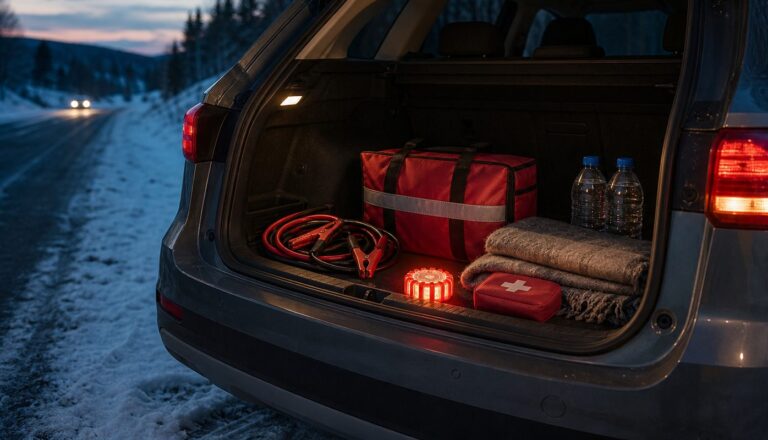
Blanket, light, jumper cables and a shovel in one bag.
Which should you buy?
Match your answer in the finder to one of these.
- Roomy wheel wells, a few trips a season: quick-fit or self-tensioning link chains.
- Roomy wheel wells, emergency use only: cable chains.
- Limited clearance or a low-profile tire: Class S chains for regular use, socks for an emergency.
- Rims of 21 inches or more: a cable or chain the vehicle maker lists, or socks.
- Daily winter driving: heavy-duty diamond or ladder link chains, or winter tires. Socks wear out too fast on bare pavement.
- Light truck or flotation tires: truck chains from a line with your tire size on its chart.
- Manual says no chains: winter tires with the mountain-snowflake mark, and socks only if the manual allows textile devices.
If you plan to drive California R3, Colorado Code 16 or a “chains on all vehicles” order, buy real chains or cables. Socks are accepted in Colorado and Washington but not guaranteed in California.
Frequently asked questions
Do I need chains with AWD?
Sometimes. AWD with snow-tread or mountain-snowflake tires on all four wheels meets California R1 and R2 and Colorado's Traction Law, but you must still carry chains in California and Washington. AWD never exempts you from an all-vehicles order: California R3, Colorado's Chain Law and Washington's chains-on-all-vehicles sign. Check the sign and your tires.
Are snow socks legal?
Snow socks are approved alternative traction devices in Colorado and Washington, and Utah lists them as acceptable. In California the officer decides, because CHP publishes no approved list and sources disagree on socks at R3. Many other states do not mention them. Carry chains if you will cross a California mountain pass.
Are chains or cables better?
Link chains grip better, especially on ice. In one published test a link chain went from 5 to 10 mph in 3.7 seconds against 6.3 for a cable. Cables are lighter, quicker to fit and clear tighter wheel wells. Choose link chains for frequent use and cables for emergencies or limited clearance.
What size tire chains do I need?
Read the width, aspect ratio and rim on your tire sidewall, for example 225/45R17. Then find that size on the maker's fit chart, which gives a size code such as SZ143. Order that code. Amazon titles list part numbers, not tire sizes, and one code covers several tire sizes.
Can I use chains on low-profile tires?
Often yes, but only Class S chains, certain cables or socks. Low-profile tires and large wheels leave little clearance, and manuals commonly say one axle only or no chains. Rims of 21 inches or larger have few options. Check the owner's manual first, then the maker's size chart.
How fast can I drive with chains?
30 mph at most for chains, cables and socks. Some makers set a lower limit, such as 25 mph for most ISSE socks, and California posts 25 to 30 mph at chain controls. Follow the lowest number. Take them off once the road is clear, because bare pavement wears socks quickly and damages both chains and road.
Do chains go on the front or rear tires?
Chains go on the drive wheels: the front for front-wheel drive and the rear for rear-wheel drive. For AWD and 4WD, follow your owner's manual. Many manuals say front, and some say rear. Do not buy a set for all four wheels unless the manual or maker says so.
Does California require chains?
Only when Caltrans posts R1, R2 or R3 on a road, and the controls depend on weather, not the calendar. R1 and R2 allow some exemptions for snow tires and AWD. R3 requires chains or a traction device on every vehicle. The state has no year-round chain requirement for passenger cars.
Do rental cars allow chains?
Check your rental agreement before you buy. Agreements vary by company, and some rental cars come with tires or restrictions that rule out chains. The car's manual also decides whether chains fit. If chains are not allowed, ask the company about socks or a vehicle with snow tires.
When are studded tires legal?
It depends on the state. California allows studs from November 1 to April 30, Washington and Oregon from November 1 to March 31, Nevada from October 1 to April 30 and Utah from October 15 to March 31. Wisconsin and Illinois ban most studs. Studs never replace a chain requirement in Washington.
Sources
- Caltrans: chain controls and CHP: winter driving tips
- CDOT: Traction Law and Passenger Vehicle Chain Law
- Washington: WAC 204-24-050 and WSDOT studded tire notice
- ODOT: winter tires and OAR 734-017
- NDOT: traction and chain requirements
- UDOT: Traction Law
- WYDOT: chain law
- SAE J1232 listing and, for the class figures, Laclede Chain’s SAE classifications
- Maker fit charts: Peerless and Security Chain, Konig and AutoSock
Related guides

Marco Delantero
More from Marco DelanteroHow we reviewed this article
This article was researched against manufacturer records and editorially reviewed before publishing. We accept no payment for coverage.