| Measurement | Current | New | Change |
|---|---|---|---|
| Diameter | 31.61 in | 32.71 in | +1.10 in (+3.5%) |
| Width | 10.43 in | 11.22 in | +0.79 in |
| Sidewall | 7.30 in | 7.85 in | +0.55 in |
| Rim | 17 in | 17 in | same |
| Circumference | 99.3 in | 102.8 in | +3.5 in |
| Revs per mile | 638 | 617 | -22 |
Enter your current tire size and the size you want, and the calculator shows how much taller and wider the new tire is, how far off your speedometer will read and whether the change is small enough to be safe. For example, going from 265/70R17 to 285/70R17 makes the tire 1.1 in (3.5%) taller. At an indicated 60 mph you would really be doing 62.1 mph. Use the Convert tab to turn a metric size like 285/70R17 into inches, or an inch size like 33×12.50R15 into the closest metric sizes.
How to use the tire size calculator
- Enter your current tire size. It is printed on the tire sidewall and on the sticker inside the driver’s door jamb. You can type it any way you like: 265/70R17, P265/70R17, 265 70 17 and LT265/70R17 all work. If you don’t know it, tap “Pick my car”.
- Enter the new tire size. Metric sizes and inch sizes such as 33×12.50R17 both work.
- Read the result. The top line tells you how much taller and wider the new tire is. The colored label tells you if the change is a close match (within 3%), worth checking (3% to 5%) or a big change (more than 5%).
- Check your speedometer. Move the slider to any speed to see your real speed with the new tires.
- Try a close size. Under the results you will find real tire sizes within 3% of your current tire. Tap one to compare it.
Every result has its own link. Copy it to send a comparison to a friend or a tire shop.
How to read a tire size
A size like 265/70R17 is three measurements and a letter:
- 265 is the width of the tire in millimeters, from sidewall to sidewall.
- 70 is the aspect ratio. The sidewall is 70% as tall as the tire is wide, so this sidewall is about 7.30 in tall.
- R means radial construction. Almost every car and truck tire sold today is radial.
- 17 is the wheel (rim) diameter in inches.
A P in front (P265/70R17) means a passenger tire. LT means a light truck tire with a stronger build for heavy loads and towing. The size math is the same for both. The numbers after the size, such as 112T, are the load index and speed rating. They don’t change the size.
Off-road and lifted trucks often use inch (flotation) sizes like 33×12.50R15. Here 33 is the overall height in inches, 12.50 is the width in inches and 15 is the wheel size. To see where each of these marks sits on a real tire, open our car tire 3D model and its sidewall decoder.
Tire size formula
The calculator uses the same formulas as tire makers and tire shops:
- Sidewall height = width × aspect ratio ÷ 100 ÷ 25.4 (to get inches)
- Overall diameter = wheel size + 2 × sidewall height
- Circumference = diameter × 3.1416
- Revolutions per mile = 63,360 ÷ circumference (there are 63,360 inches in a mile)
For 265/70R17: the sidewall is 265 × 0.70 ÷ 25.4 = 7.30 in. The diameter is 17 + 2 × 7.30 = 31.61 in. That tire turns about 638 times per mile. A 285/70R17 is 32.71 in tall and turns 617 times per mile.
These are the sizes on paper. A real tire on a loaded car squats a little, and the same size can differ by a few tenths of an inch between brands. The maker’s spec sheet lists the exact diameter of each tire.
How much bigger can you go?
Tire shops use a simple rule: keep the new tire within 3% of the original diameter. Inside that range your speedometer, ABS and stability control keep working as designed and the tire almost always fits. Past 3% you need to check a few things first.
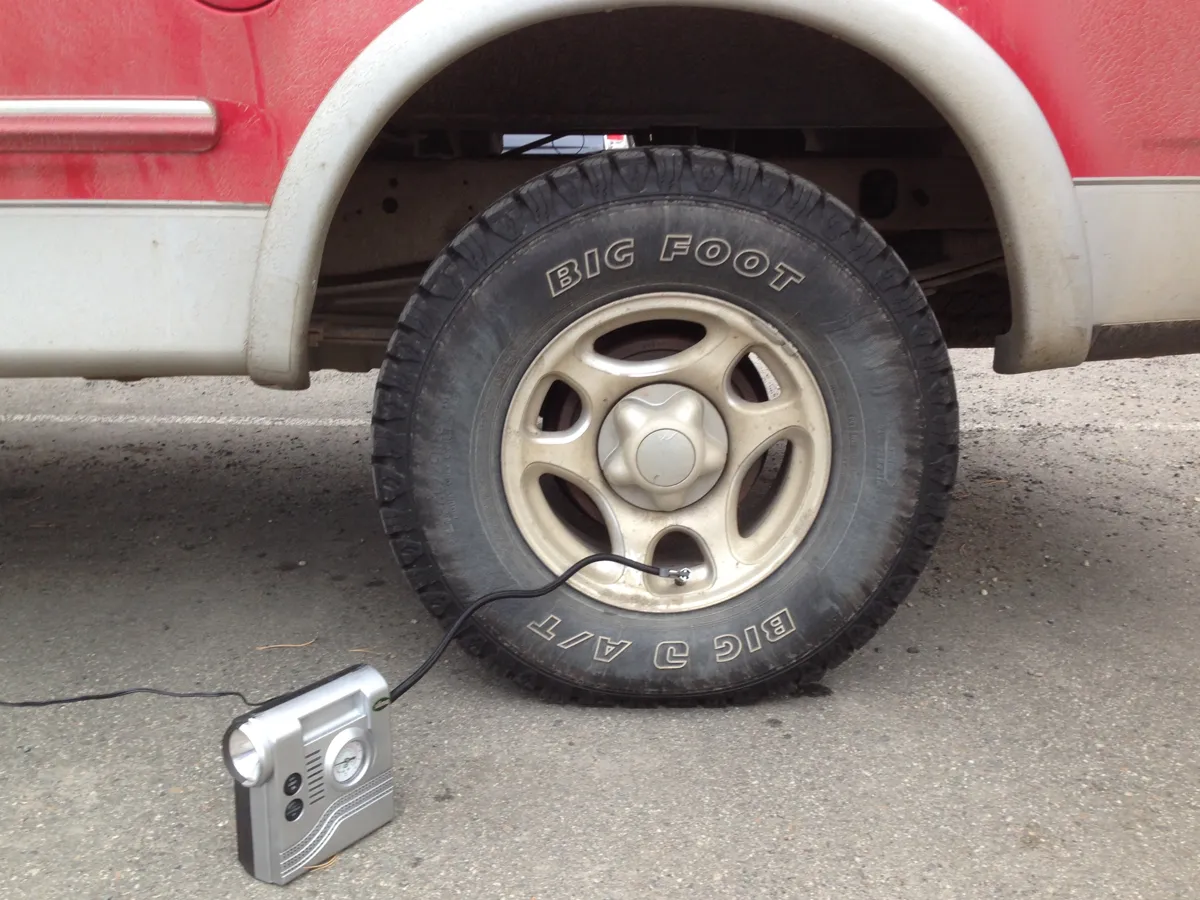
- Room in the wheel well. A taller or wider tire can rub the fender liner, the frame or the suspension when you turn or hit a bump. Check the space at full steering lock. Our wheel offset calculator shows how a new wheel moves the tire in or out.
- Ground clearance. Your axle rises by half the diameter change. Going from 265/70R17 to 285/70R17 lifts it about 0.6 in.
- Gearing. A taller tire acts like a taller gear. The engine turns slower at the same speed, so the truck feels slower off the line and the transmission may shift differently. The gear ratio calculator shows the new cruise rpm and which axle ratio brings it back.
- Load rating. The new tire’s load index must be equal to or higher than the one on your door sticker.
- Wheel width. Every tire size has a range of wheel widths it is approved for. A much wider tire may need wider wheels.
To keep the same height with a bigger wheel, lower the aspect ratio. This is called plus sizing. A 225/45R17 and a 225/40R18 differ by only 0.5%, so the 18-inch wheel keeps the speedometer correct.
Bigger tires and your speedometer
Your car works out its speed by counting how fast the wheels turn. It assumes the tire size it left the factory with. A taller tire covers more ground on each turn, so you go faster than the speedometer shows. A smaller tire makes the speedometer read high.
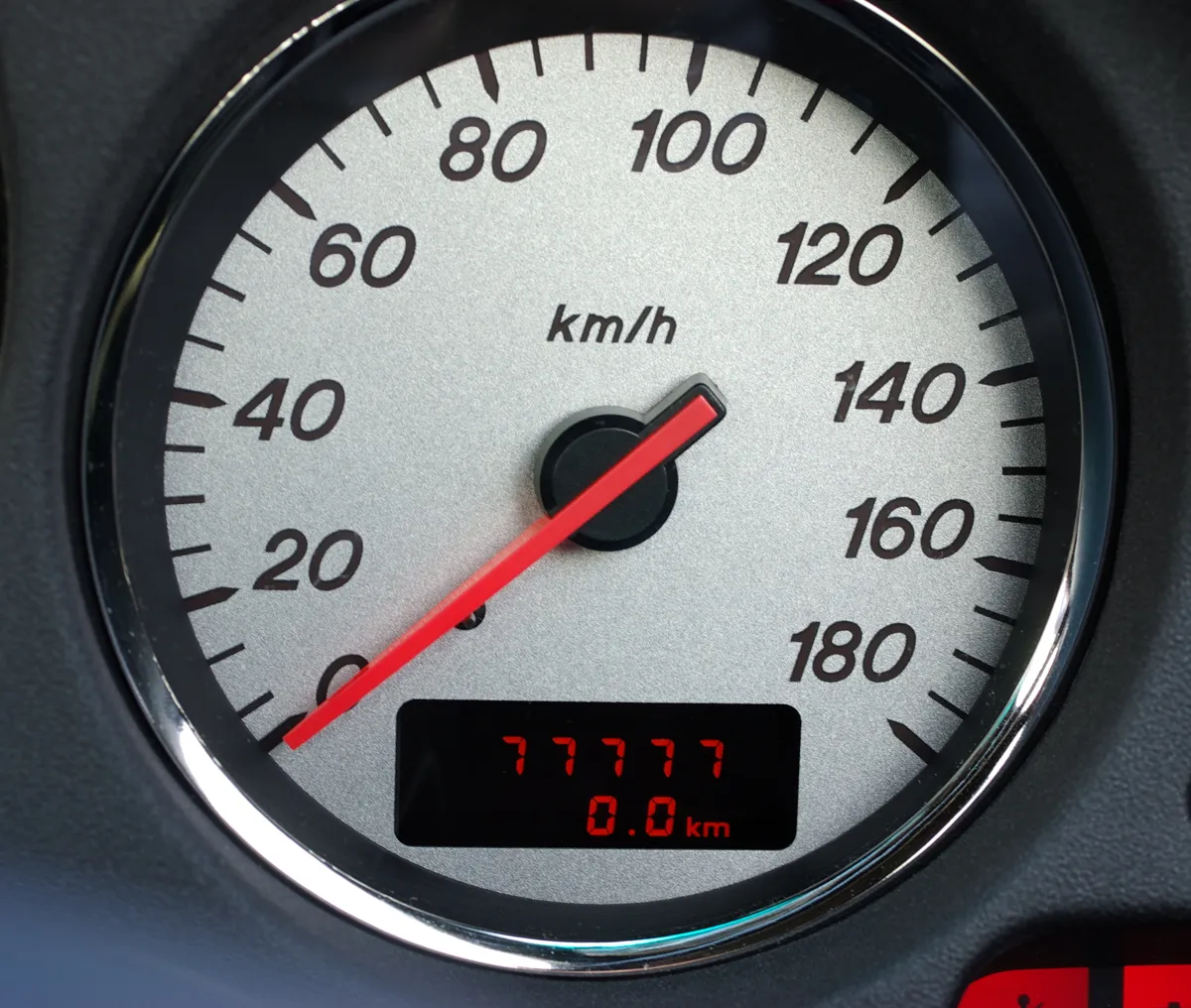
Here is what happens going from 265/70R17 to 285/70R17:
| Speedometer shows | Real speed |
|---|---|
| 25 mph | 25.9 mph |
| 35 mph | 36.2 mph |
| 45 mph | 46.6 mph |
| 55 mph | 56.9 mph |
| 65 mph | 67.3 mph |
| 75 mph | 77.6 mph |
Your odometer is off by the same amount. With these tires it counts about 34 miles too few for every 1,000 miles you drive, which matters for warranty and lease mileage.
Most new cars can have the speedometer reset for the new tire size. A dealer can do it, and for most trucks a handheld programmer does it in a few minutes. Older cars with a cable-driven speedometer need a different drive gear in the transmission.
Metric to inch tire size conversion
To convert a metric size to inches, work out the diameter with the formula above and divide the width by 25.4. Here are some common sizes:
| Metric size | In inches | Closest inch size |
|---|---|---|
| 235/75R15 | 28.9 x 9.3 R15 | 30×9.50R15 (+3.9%) |
| 265/75R16 | 31.6 x 10.4 R16 | 33×11.50R16 (+4.3%) |
| 285/75R16 | 32.8 x 11.2 R16 | 33×11.50R16 (+0.5%) |
| 265/70R17 | 31.6 x 10.4 R17 | 33×11.50R17 (+4.4%) |
| 285/70R17 | 32.7 x 11.2 R17 | 33×11.50R17 (+0.9%) |
| 275/65R18 | 32.1 x 10.8 R18 | 33×11.50R18 (+2.9%) |
| 275/70R18 | 33.2 x 10.8 R18 | 33×11.50R18 (-0.5%) |
| 275/60R20 | 33.0 x 10.8 R20 | 33×11.50R20 (0.0%) |
Inch sizes are rounded. A “33-inch” tire is often 32.5 to 33.2 in tall, so compare the real diameters before you buy. For a full list by wheel size, see our tire size conversion chart, which you can also print.
What the comparison numbers mean
- Diameter is the overall height of the tire. It decides your speedometer reading, gearing and clearance.
- Width is how wide the tire is. Wider tires grip more on dry roads and fill the wheel well, but they can rub and they add a little road noise.
- Sidewall height is the rubber between the wheel and the road. A taller sidewall rides softer and protects the wheel from potholes. A shorter one steers sharper.
- Circumference is the distance the tire rolls in one full turn.
- Revolutions per mile is how many times the tire turns in one mile. Fewer turns means a taller tire.
FAQ
Is a 3% difference in tire size OK?
Yes. Tire shops treat a diameter change of up to 3% as safe for daily driving. Your speedometer will be off by up to 3% and the tire should clear the wheel well. Past 3%, check clearance and plan to reset your speedometer.
How do I compare two tire sizes?
Work out the diameter of each tire: wheel size plus twice the sidewall height, where sidewall height is width × aspect ratio ÷ 2,540. Then divide the difference by the original diameter. The calculator above does all of this and also shows the width, sidewall, revolutions per mile and speedometer change.
What size is a 33-inch tire in metric?
Common metric sizes close to 33 inches are 285/75R16 (32.8 in), 285/70R17 (32.7 in), 275/70R18 (33.2 in) and 275/60R20 (33.0 in). The exact match depends on your wheel size, so enter 33×12.50 with your wheel size in the Convert tab to see the closest sizes.
What size is a 35-inch tire in metric?
Common metric sizes close to 35 inches are 315/75R16 (34.6 in), 315/70R17 (34.4 in), 285/75R18 (34.8 in) and 315/60R20 (34.9 in).
Will bigger tires mess up my speedometer?
Yes, a taller tire makes your speedometer read slower than you are really going. A 3% taller tire shows 60 mph when you are doing about 61.8 mph. Most cars can be recalibrated by a dealer or with a programmer.
Can I put a different size tire on the same rim?
Yes, as long as the new tire has the same wheel diameter (the number after the R) and your wheel width is in the range approved for the new tire. A 265/70R17 and a 285/70R17 both mount on a 17-inch wheel. The tire maker’s spec sheet lists the wheel widths each size is approved for.
Can I use a different tire size than the one on my door sticker?
Yes, if the new size fits, keeps the diameter close to the original and has an equal or higher load index. Your car’s computers expect the original size, so a large change affects the speedometer, shifting and stability control.
Does tire size affect gas mileage?
Yes. Bigger, heavier and wider tires usually cost some fuel economy because they weigh more and have more rolling resistance. Your trip computer will also show better mileage than you really get after a size increase, because it under-counts the miles.
What is the difference between P and LT tires?
P tires are built for passenger cars, SUVs and light pickups. LT tires have a stronger build for heavy loads and towing, and they usually need higher air pressure. A P and an LT tire with the same numbers are the same size.
Do I need to replace all four tires if I change the size?
On an all-wheel-drive or four-wheel-drive vehicle, yes. All four tires should be the same size so the drivetrain isn’t strained. On a two-wheel-drive car, change at least both tires on the same axle.
Photos: VVVN (featured), CC BY 3.0; Alan Levine, CC BY 2.0; speedometer photo public domain (CC0). All via Wikimedia Commons.
Sources & References
- TireSize.com tire size index: https://www.tiresize.com/tiresizes/
- SimpleTire tire sizes by wheel diameter: https://www.simpletire.com/tire-sizes
- BFGoodrich Tires US catalog: https://www.bfgoodrichtires.com/tires
- NHTSA, Tires (sidewall information and load index): https://www.nhtsa.gov/equipment/tires

James Kowalski
More from James KowalskiHow we reviewed this article
This article was researched against manufacturer records and editorially reviewed before publishing. We accept no payment for coverage. Some guides contain affiliate links; see our affiliate disclosure.