What this quarter mile calculator does
This calculator estimates a car’s quarter mile time and trap speed from its horsepower and weight. Search for your car to fill in the numbers, or type them yourself. It also works backward: enter a timeslip and it estimates your horsepower.
A 3,500 lb rear-wheel-drive car with 265 horsepower runs the quarter mile in about 14 seconds. With 465 horsepower it runs about 12 seconds. The table further down shows the horsepower for each time and weight.
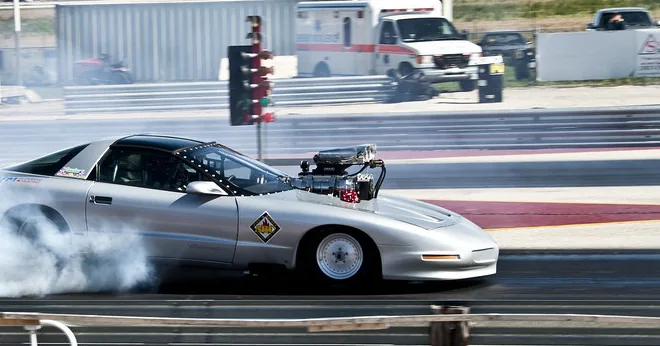
What ET and trap speed mean
The quarter mile is 1,320 feet. ET stands for elapsed time: the seconds a car takes to cover that distance. Trap speed is how fast the car is going at the finish line.
The two numbers measure different things. ET depends on the launch as well as power, so a bad start costs time. Trap speed depends mostly on power and weight, because the launch is long past by the finish line. That is why racers use trap speed to judge horsepower.
How the estimate works
Most quarter mile calculators use one formula with horsepower and weight. This one simulates the run. It starts with a launch limited by tire grip, then a stretch limited by engine power, and it subtracts air drag and rolling resistance the whole way.
That is why it asks for drive wheels and transmission. A rear-drive car gains grip as weight shifts backward under power. A front-drive car loses grip for the same reason. A formula with only horsepower and weight cannot show that difference.
The launch setting changes the grip. Drag strip assumes a good launch on a prepared surface, like a magazine road test. Street assumes a normal road, which has about 15% less grip.
How accurate is it?
We tested the calculator against 227 cars with published road test results, mostly from Car and Driver and MotorTrend. Every car was scored by a version of the model that had not seen that car. The cars run from a 1955 sedan to current electric cars and include family sedans, pickups and hypercars.
Half the estimates landed within 2.3% of the published ET, which is about 0.3 seconds on a 12-second car. Nine in ten landed within 5.8%, or about 0.7 seconds. The range shown with each result contains about 8 in 10 cars.
| Method | Typical ET error | Nine in ten within | Typical trap speed error |
|---|---|---|---|
| This calculator | 2.3% | 5.8% | 2.8% |
| Hale formula | 3.5% | 7.4% | 2.7% |
| Fox formula | 5.6% | 12.6% | 3.3% |
| Huntington formula | 6.0% | 12.9% | 5.5% |
The gain is in ET. For trap speed, this calculator and the Hale formula are about equal.
The classic quarter mile formulas
Most online calculators use one of these three formulas, where weight is in pounds and includes the driver:
- Hale: ET = 5.825 × (weight ÷ horsepower)1/3, trap speed = 234 × (horsepower ÷ weight)1/3
- Fox: ET = 6.269 × (weight ÷ horsepower)1/3, trap speed = 230 × (horsepower ÷ weight)1/3
- Huntington: ET = 6.290 × (weight ÷ horsepower)1/3, trap speed = 224 × (horsepower ÷ weight)1/3
Hale is the closest of the three, but it treats every car the same. Against the same road tests, Hale’s typical miss was 0.7 seconds too slow on electric cars, 0.6 seconds too quick on front-drive cars and 0.4 seconds too quick on rear-drive cars. It was almost exact on all-wheel-drive cars.
How much horsepower for each quarter mile time?
This table shows the estimated engine horsepower for a rear-wheel-drive automatic car on street tires with a good launch. Race weight includes the driver.
| Quarter mile time | 3,000 lb | 3,500 lb | 4,000 lb | 4,500 lb |
|---|---|---|---|---|
| 14.99 s | 180 hp | 205 hp | 235 hp | 265 hp |
| 13.99 s | 230 hp | 265 hp | 300 hp | 335 hp |
| 12.99 s | 295 hp | 345 hp | 390 hp | 435 hp |
| 11.99 s | 405 hp | 465 hp | 530 hp | 590 hp |
| 10.99 s | 620 hp | 710 hp | 805 hp | 895 hp |
Horsepower stops helping once the tires run out of grip. A 3,500 lb rear-drive car on street tires will not break 10 seconds at any power level, according to the model. The same car with all-wheel drive needs about 750 horsepower. Drag radials or slicks change the answer, but this calculator does not model them. The goal time field runs this calculation for your car.
What is a good quarter mile time?
- 15 to 17 seconds: a typical family sedan or crossover.
- 13 to 15 seconds: a sporty car or a turbocharged sedan.
- 12 to 13 seconds: a V8 muscle car.
- 10 to 12 seconds: a sports car or high-performance sedan.
- Under 10 seconds: hypercars and the fastest electric sedans.
These are published test results for real cars:
| Car | ET | Trap speed | Tested by |
|---|---|---|---|
| 2022 Bugatti Chiron Super Sport | 9.1 s | 161 mph | Car and Driver |
| 2026 Tesla Model S Plaid | 9.4 s | 151 mph | Car and Driver |
| 2023 Chevrolet Corvette Z06 | 10.7 s | 129 mph | Car and Driver |
| 2020 Chevrolet Corvette Stingray | 11.2 s | 122 mph | Car and Driver |
| 2021 BMW M3 Competition | 11.6 s | 124 mph | Car and Driver |
| 1965 Shelby Cobra 427 | 12.2 s | 118 mph | Car and Driver |
| 2024 Ford Mustang GT manual | 12.5 s | 114 mph | Car and Driver |
| 2023 Toyota GR Corolla | 13.3 s | 105 mph | Car and Driver |
| 1968 Dodge Charger 426 Hemi automatic | 13.5 s | 105 mph | Car and Driver |
| 2018 Honda Accord 2.0T | 14.1 s | 102 mph | Car and Driver |
| 2022 Honda Civic Touring | 15.75 s | 91 mph | Car and Driver |
| 2018 Toyota Camry SE | 16.2 s | 90 mph | Car and Driver |
How to get horsepower from a timeslip
Open the timeslip tab and enter your ET, trap speed and race weight. Race weight means the car with the driver and fuel aboard. A scale at the track or a truck stop gives the most accurate number.
Use trap speed if you have it. The calculator returns engine horsepower and an estimate of horsepower at the wheels.
With both numbers, it also checks your launch. It works out the ET your trap speed should produce with a good start, then compares that to your real ET. For example, a 3,700 lb rear-drive car that runs 13.2 seconds at 112 mph has about 380 horsepower. That trap speed points to about 12.8 seconds, so the car is losing about 0.4 seconds at the start. Better tires or launch technique will find that time without adding power.
Engine horsepower is what manufacturers advertise. Wheel horsepower is what a chassis dyno measures, after losses in the transmission and drivetrain. Choose the right one in the estimate tab, because they differ by about 15% on most cars.
How to convert 1/8 mile to 1/4 mile
Multiply your 1/8 mile time by 1.55 to estimate your 1/4 mile time. Multiply your 1/8 mile speed by 1.23 to estimate your 1/4 mile speed. Those are the median multipliers across the 227 cars in our test set.
A car that runs 8.00 seconds at 90 mph in the 1/8 mile should run about 12.4 seconds at about 111 mph in the 1/4 mile.
How weather changes your time
Engines make less power in thin air, and hot, humid or high-altitude air is thinner. Racers combine temperature, pressure and humidity into one number called density altitude: the height at which standard air would be as thin as the air at your track.
The rule of thumb is about 0.1 seconds per 1,000 feet of density altitude. Open the track weather section to apply it to your car. It uses the standard atmosphere for air pressure and the SAE J1349 correction for engine power.
A 3,700 lb car with 400 horsepower shows the effect:
| Conditions | Density altitude | ET | Trap speed |
|---|---|---|---|
| Sea level, 60°F | about 160 ft | 12.54 s | 115 mph |
| Sea level, 95°F | about 2,630 ft | 12.70 s | 113 mph |
| Denver, 80°F | about 7,940 ft | 13.31 s | 107 mph |
| Denver, 80°F, turbocharged | about 7,940 ft | 12.92 s | 111 mph |
A turbo or supercharger keeps pushing air into the engine, so we count half the loss for boosted cars. Electric cars lose no power to thin air. With the weather section closed, results assume the SAE standard conditions that horsepower ratings use.
What this calculator leaves out
- Motorcycles: bikes are limited by wheelies as much as tire grip, and the model was not tested on them.
- Drag tires: the model assumes street tires.
- Modified cars: power curves and gearing differ from stock. Enter your dyno number and treat the range as a guide.
Road test drivers are skilled, and a first trip to the strip usually runs slower than the estimate. Choose the street launch for a more realistic number.
Other calculators
- 0-60 calculator: estimate 0-60 time and power to weight.
- Gear ratio calculator: see what tires and gearing do to speed and rpm.
- Car inflation calculator: compare car prices across the decades.
Quarter mile calculator FAQ
How do you calculate a quarter mile time?
Divide the car’s race weight by its horsepower, take the cube root and multiply by 5.825. That is the Hale formula, and a 3,500 lb car with 350 hp gives about 12.6 seconds. This calculator goes further by simulating the run with drive wheels, transmission and grip, which cuts the typical error from 3.5% to 2.3%.
How accurate is a quarter mile calculator?
This one lands within 2.3% of the published time on half of cars and within 5.8% on nine in ten, tested against 227 road tests. On a 12-second car that is about 0.3 seconds and 0.7 seconds. Your own result also depends on your launch, tires and weather.
What is a good quarter mile time?
For a street car, anything under 14 seconds is quick and under 12 seconds is very fast. Family sedans run 15 to 17 seconds, V8 muscle cars run 12 to 13 seconds, and hypercars run under 10 seconds.
How much horsepower do you need for a 10-second quarter mile?
A 3,500 lb all-wheel-drive car needs about 530 hp for a 10.99 and about 750 hp for a 9.99. A rear-drive car of the same weight needs about 710 hp for a 10.99, and on street tires it will not break 10 seconds at any power level.
How much horsepower do you need for a 12-second quarter mile?
A 3,500 lb rear-drive car needs about 465 hp to run an 11.99 and about 345 hp to run a 12.99. Each 500 lb of extra weight adds about 65 hp to that 11.99 figure.
What is trap speed?
Trap speed is how fast a car is going as it crosses the finish line. It depends mostly on power and weight, which makes it a better guide to horsepower than ET.
How do you calculate horsepower from trap speed?
A quick version is horsepower = race weight × (trap speed ÷ 234) cubed. A 3,700 lb car trapping 112 mph gives about 405 hp. The timeslip tab here also accounts for drive wheels and transmission, and it puts the same car at about 380 hp.
How do you convert 1/8 mile to 1/4 mile?
Multiply the 1/8 mile time by 1.55 and the 1/8 mile speed by 1.23. A car that runs 8.00 seconds at 90 mph should run about 12.4 seconds at about 111 mph in the 1/4 mile.
Should I enter engine or wheel horsepower?
Use whichever number you have and set the toggle to match. Advertised horsepower is engine horsepower. A chassis dyno number is wheel horsepower, usually about 15% lower.
Why is my real time slower than the estimate?
The estimate assumes a road test launch on street tires. A slow start, wheelspin, hot weather or high altitude adds time. If your trap speed matches the estimate but your ET does not, the launch is the cause.
How much does weather affect quarter mile times?
About 0.1 seconds for every 1,000 feet of density altitude is the rule of thumb. A car running 12.5 seconds on a cool day at sea level runs about 13.3 seconds on a warm day in Denver.
Does this calculator work for motorcycles?
No. It was tested on cars and trucks. Motorcycles are limited by wheelies as well as grip, so the estimate would not be reliable.
Sources
- Published ET and trap speed: 227 road tests from Car and Driver, MotorTrend and Road & Track, each recorded with its source page.
- Vehicle specifications: manufacturer figures and the road tests above.
- Formula constants: Hale, Fox and Huntington as listed by Omni Calculator.
- Photo: Burnout by Riebart, CC BY 2.0, cropped.
- Engine power correction: SAE J1349, as set out by Richard Shelquist.