Key Takeaways
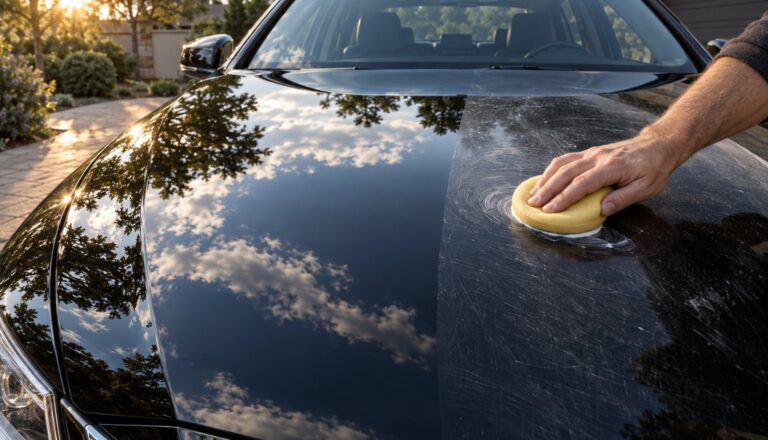
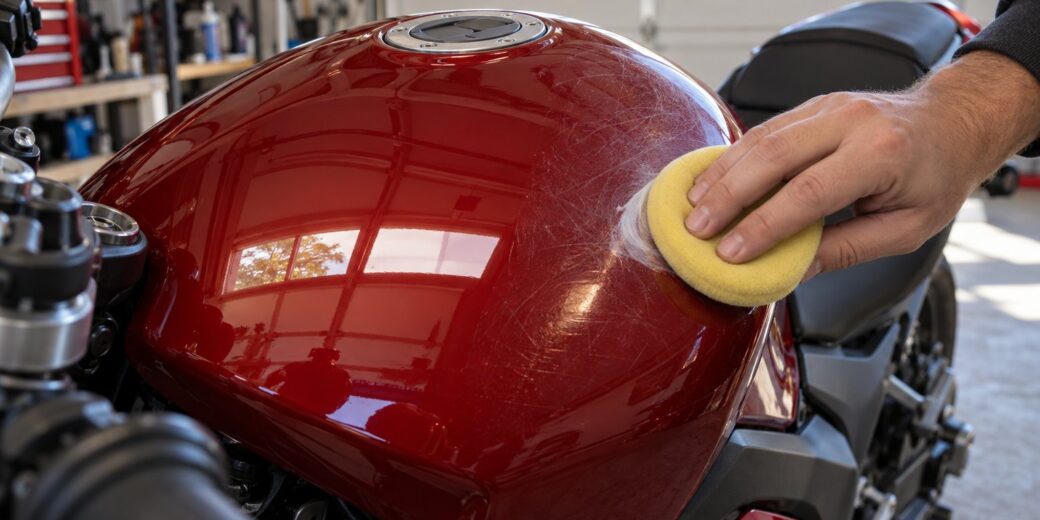
- Meguiar's Ultimate Compound, followed by a polish on dark colors, is the best scratch remover for painted motorcycle tanks, fenders and fairings.
- If your fingernail glides over the scratch, compound will likely remove it. If it catches, you need a sanding kit, touch-up paint or a shop.
- Use a plastic polish such as Novus on uncoated windscreens, and never polish a coated helmet visor.
- Matte paint cannot be polished: any compound or wax leaves a shiny patch.
- Dirt bike plastics are fixed with a blade, sandpaper and careful heat, not compound.
Affiliate links: as an Amazon Associate we earn from qualifying purchases. Picks are based on manufacturer instructions, published reviews and rider reports. Amazon changes prices daily, so this guide does not list them.
The best scratch remover for most motorcycles is Meguiar’s Ultimate Compound, followed by a fine polish. It cuts fast enough for the zipper and boot marks a tank collects, works by hand on small curved panels, and is safe on the clear coat that covers nearly every modern bike’s paint.
A motorcycle is not one surface, though. The same bike can have gloss paint on the tank, matte paint on the side covers, an acrylic windscreen, chrome on the exhaust and bare plastic on the fenders. Each one needs a different product, and the wrong one can do real damage: a compound will leave shiny patches on matte paint and wipe the coating off a helmet visor. Find the surface first, then check the depth, then pick the product.
Quick picks
| Product | Best for | Surface | |
|---|---|---|---|
| Meguiar’s Ultimate Compound | Best overall | Gloss paint | Check on Amazon |
| Meguiar’s ScratchX | One or two light marks | Gloss paint | Check on Amazon |
| 3D One | One-step correction for the whole bike | Gloss paint | Check on Amazon |
| Meguiar’s Ultimate Polish | Finishing dark and candy paint | Gloss paint | Check on Amazon |
| Quixx Paint Scratch Remover Kit | Deeper scratches on a tank or bag lid | Gloss paint | Check on Amazon |
| Novus Plastic Polish Kit | Scratched windscreens | Uncoated clear plastic | Check on Amazon |
| Plexus Plastic Cleaner | Cleaning screens and visors without scratching | Clear plastic | Check on Amazon |
| Mothers Mag and Aluminum Polish | Bare aluminum and stainless | Metal | Check on Amazon |
| SEEKONE Heat Gun | Scuffed dirt bike plastics | Unpainted plastic | Check on Amazon |
| Touch-up paint by paint code | Scratches through the color | Any paint | Check on Amazon |
What is the scratch on?
Start here. Most scratch remover advice online assumes a car door, and a motorcycle has at least five finishes that react differently to abrasives.
| Surface | Where you find it | What works | Avoid |
|---|---|---|---|
| Gloss paint with clear coat | Tank, fenders, painted fairings, side covers | Compound, then polish | Coarse sandpaper |
| Matte or satin paint | Many modern cruisers and nakeds | Matte cleaner only; touch-up or respray for damage | Any compound, polish or wax |
| Clear plastic | Windscreen, headlight lens, gauge cover | Plastic polish such as Novus, on uncoated plastic | Paint compounds, glass cleaner with ammonia |
| Coated helmet visor | Most road helmets | Mild cleaner; replace the visor if the scratch is in your line of sight | Any polish |
| Unpainted plastic | Dirt bike shrouds, fenders, number plates | Sanding, scraping, careful heat | Paint compounds (they do nothing useful) |
| Chrome and bare metal | Exhaust, engine covers, handlebars | Metal polish | Sandpaper on chrome |
Two parts catch people out. Many motorcycle “tanks” are painted plastic covers over the real tank or the airbox, and they take compound exactly like a steel tank. And many factory aluminum wheels and engine covers are clear-coated: metal polish will haze the clear, so treat them as paint. If a polishing cloth picks up gray residue, the metal is bare. If it stays clean, there is a coating on top.
How deep is the scratch?
Gloss motorcycle paint is built the same way as car paint: a clear coat on top, then the color coat, primer, and the steel tank or plastic panel underneath. Scratch removers only work in the clear coat, which is typically 30 to 50 microns thick on factory paint. That is less than half the thickness of a human hair, and a single polishing session removes about 2 to 5 microns of it.
Wash and dry the area, then check it three ways:
- Wet it. If the scratch vanishes under a drop of water and comes back as it dries, it is in the clear coat.
- Run a fingernail across it. This is the standard detailer test. If your nail glides over, compound and polish will likely remove it. If your nail catches, the scratch is deep in the clear or through it.
- Look inside the line. White or gray means primer. Silver on a tank means bare steel, which will rust if you leave it. Black or gray on a fairing means bare plastic.
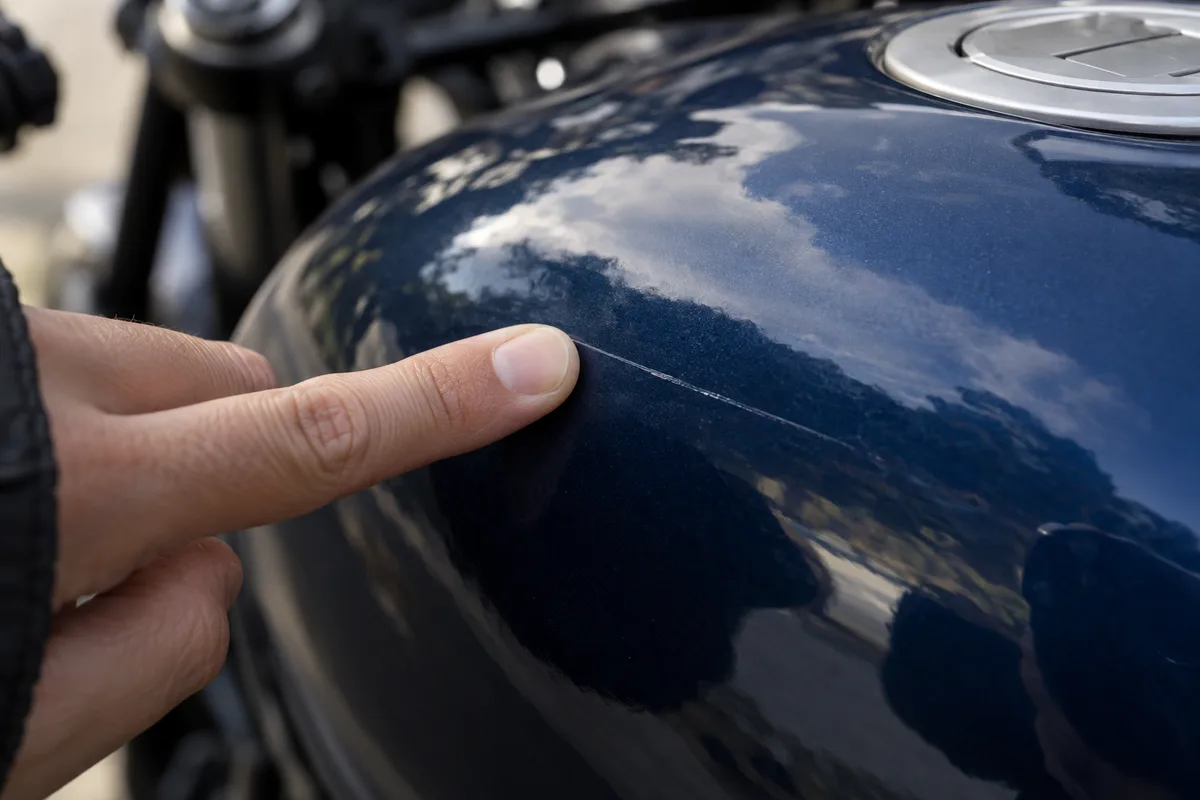
| What you see | Depth | Fix |
|---|---|---|
| Fine swirls in direct sun | Top of the clear coat | Polish |
| Light line, nail glides over | Clear coat | Compound, then polish |
| Line that catches your nail, color still visible inside | Deep clear coat | Sanding kit, or a detailer |
| White or gray line | Primer | Touch-up paint or a paint shop |
| Silver line on a steel tank | Bare metal | Touch-up paint soon to stop rust |
| Gouge in a fairing after a drop | Into the plastic | Filler and paint, or a replacement panel |
Compound, polish or filler?
Three different kinds of product get sold as “scratch remover.”
- Compound. Coarser abrasives that level the clear coat around a scratch. This is the product that actually removes scratches. When riders search for a “compound for motorcycle scratches,” this is what they need.
- Polish. Finer abrasives that remove the light haze a compound leaves behind and bring back full gloss.
- Filler or glaze. Oils and polymers that sit in the scratch and hide it. Nothing is removed, and the marks come back after a few washes.
A motorcycle has far less painted area than a car, so the two-step routine that takes a full day on a sedan takes under an hour on a tank and two side panels. That makes a real compound and polish the sensible choice for most riders. Car products work the same way on bike paint. “Motorcycle” versions of compounds are mostly the same chemistry in a smaller bottle.
The 10 best scratch removers for motorcycles
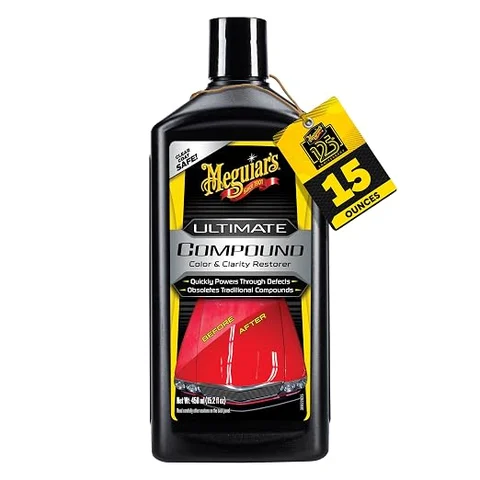
1. Meguiar’s Ultimate Compound
Best scratch remover for motorcycles overall
Ultimate Compound fits a motorcycle well. It works by hand with a foam applicator, which matters on a tank where a machine polisher is awkward around the filler cap, badges and knee recesses. Meguiar’s lists it as safe on clear coats and all gloss paints, and its micro-abrasives break down as you work, so the finish is cleaner than a traditional rubbing compound.
One bottle will cover many bikes. On a tank, a pea-sized drop handles a section about the size of your palm.
- Removes light scratches, zipper marks, swirls and oxidation
- Works by hand or with a dual action polisher
- Follow with a polish on dark colors to clear any haze
2. Meguiar’s ScratchX
Best for one or two light scratches
ScratchX is milder than Ultimate Compound and comes in a small bottle, which suits a rider with a single boot scuff on a side cover or one zipper line on the tank. Meguiar’s sells it for fine scratches, swirls and fingernail marks. It will not shift a scratch that catches your nail; for that, step up to Ultimate Compound.
- Small bottle, easy to keep in the garage for spot repairs
- Gentle enough for thin or older clear coats
- Hand application only needs a foam pad and a microfiber towel
3. 3D One
Best one-step compound and polish
3D One is a hybrid: it cuts like a compound when you work it hard and finishes like a polish as it breaks down. That saves a step when you are correcting a whole bike, especially with a small dual action polisher on the tank and fairings. It also works by hand for spot repairs, and 3D describes the formula as zero-dust, which helps around the engine and wiring.
- One product for light scratches, swirls and gloss
- Hand or dual action polisher
- Good choice for riders who correct the whole bike once a season
4. Meguiar’s Ultimate Polish
Best finishing polish for dark and candy paint
Black, deep red and candy finishes show the faint haze a compound leaves behind. Ultimate Polish is the second step that takes it away and brings back depth. On a light silver or white bike you can often skip it; on a black cruiser tank you should not.
- Removes compound haze and very light swirls
- Pairs with Ultimate Compound
- Seal with a wax or sealant afterward
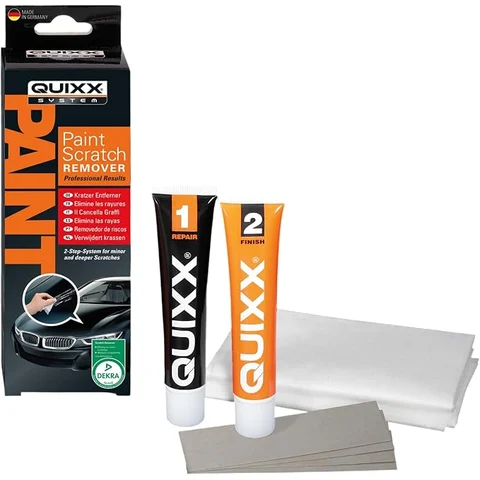
5. Quixx Paint Scratch Remover Kit
Best for deeper scratches on a tank or bag lid
When a scratch catches your nail but the color is still intact, a compound alone may not reach it. The Quixx kit adds a 3000-grit sanding step: you sand the scratch for a few seconds, work in the No. 1 repair paste, then finish with the No. 2 polish. Ultimate Motorcycling tested it on a Yamaha Venture, where it erased a shallow scratch on a saddlebag lid and a mark a magnetic tank bag had worn into the tank. A deeper scratch on a car door came out only halfway.
- Includes 3000-grit paper, two pastes and cloths
- Sand lightly: the reviewer over-sanded the tank and needed extra passes
- The maker says not to use it on ceramic coatings
The 3M Scratch Removal System (see on Amazon) does the same job with a drill-mounted pad.
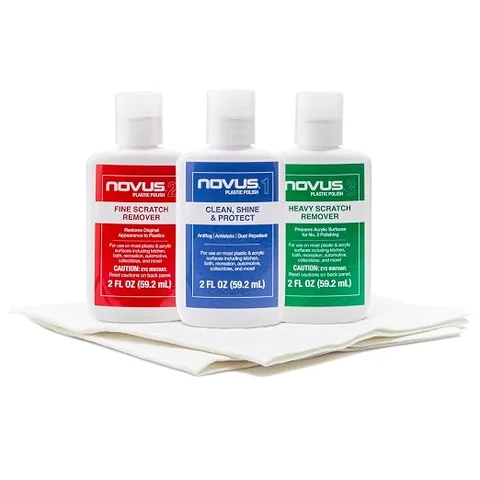
6. Novus Plastic Polish Kit
Best for scratched windscreens
Novus is the standard fix for scratched acrylic windscreens. The kit has three bottles: No. 3 for heavy scratches, No. 2 for fine scratches and haze, and No. 1 for cleaning and shine. You work down from the coarsest product the scratch needs, rubbing at right angles to the scratches. The 2-ounce kit is enough for several screens.
Check what your screen is made of first. Novus states that No. 2 and No. 3 are not recommended for coated plastics, which includes many hard-coated polycarbonate screens and nearly all helmet visors. On those, the polish removes the coating and leaves a worse haze than the scratch.
- Three grades in one kit, from heavy scratches to final shine
- For uncoated acrylic and plastic: screens, deflectors, gauge covers
- The Quixx Acrylic Scratch Remover (see on Amazon) is a single-tube alternative
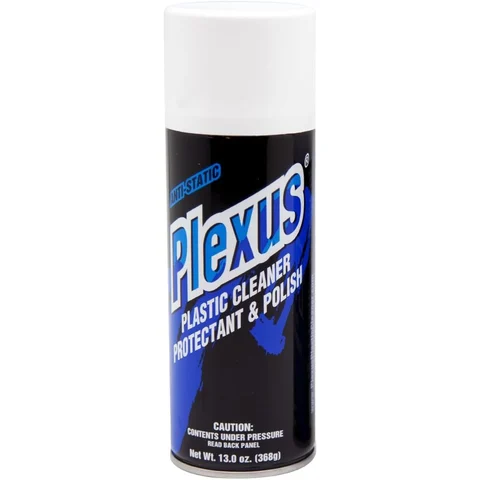
7. Plexus Plastic Cleaner
Best for cleaning screens and visors without new scratches
Plexus does not remove scratches. It belongs on this list because most windscreen and visor scratches come from cleaning: wiping dried bugs off with a dry rag or a paper towel drags grit across soft plastic. Plexus lifts the dirt and leaves a thin wax layer that helps bugs and water release next time, and it hides light spiderweb scratches well enough to cut glare. Anything you can feel with a fingernail will still show.
- Spray on, wipe with a clean microfiber, flip to a dry side and buff
- Use on screens, gauge covers and the outside of the visor
- Soak dried bugs with a wet cloth first; never scrub them off dry
8. Mothers Mag and Aluminum Polish
Best for bare aluminum and stainless
Polished aluminum engine covers, stainless exhaust headers and bare fork lowers scuff easily and take metal polish well. Mothers is a mild abrasive cream that removes oxidation, light scratches and boot scuffs on uncoated metal. Expect black residue on the cloth: that is metal and oxide coming off, and it means the polish is working.
Chrome needs a lighter touch. Chrome plating is thin, so polish only the haze and light marks, and never sand it. For chrome, use a fine metal polish made for plating such as Simichrome (see on Amazon). For brushed aluminum, work along the grain.
- For bare metal only; clear-coated parts are treated as paint
- Let exhaust parts cool fully before you polish them
- Scratches that cut through chrome plating cannot be polished out
9. SEEKONE Heat Gun
Best for scuffed dirt bike plastics
Dirt bike shrouds, fenders and number plates are unpainted polypropylene or polyethylene. Compounds do nothing on them. The fix is mechanical: shave off raised plastic with a razor blade, wet sand the scuffed area smooth, then pass a heat gun over it quickly until the surface just turns glossy. A variable-temperature gun gives you the control to do that without warping the panel.
- Remove the panel from the bike before you heat it
- Keep the gun moving; stop as soon as the surface changes
- Practice on the underside or an old panel first
10. Touch-up paint matched to your paint code
Best for scratches through the color
Once the scratch shows primer, metal or bare plastic, no compound will fix it. Touch-up paint fills the line and seals it, which matters most on a steel tank where exposed metal rusts. Find the color code on the frame label, under the seat or in the owner’s manual, then buy paint made for that code. Dealers sell factory touch-up for most current colors, and several brands mix pens to the codes used by Harley-Davidson, Honda, Yamaha and Kawasaki.
- Search by your exact color code, not just “black” or “red”
- Build thin layers inside the scratch, then level and polish once cured
- Tri-coat and candy colors are hard to match by hand; a paint shop does them better
How to remove scratches from a motorcycle tank
The tank takes most of the damage on a motorcycle: zippers, belt buckles, tank bags, keys and gloves all rub against it. This is the hand method for scratches in the clear coat.
- Wash and dry the tank. Any grit left on the paint turns into new scratches under the applicator.
- Tape off edges and trim. Mask badges, the filler cap, knee pads, panel edges and any decal that sits on top of the clear coat. Edges and stripes have the thinnest paint.
- Work in the shade on a cool tank. A hot tank dries the product before the abrasives can do their job.
- Apply a pea-sized amount of compound to a foam applicator and work a small section with firm pressure, using overlapping back-and-forth strokes across the scratch.
- Wipe and inspect with a clean microfiber under a bright light. Repeat up to two or three times. If the scratch has not changed after three passes, stop: it is deeper than a compound can safely reach.
- Polish the area to remove any haze, especially on dark paint.
- Protect it. Apply wax or sealant, since compounding strips whatever protection was there.
A scratch that catches your nail is where the sanding kit comes in, and where many riders hand the bike to a detailer. Sanding removes clear coat quickly, and there is no way to put it back short of a respray.
On older bikes, check whether the paint is single-stage, meaning color with no clear coat on top. If color comes off on the applicator, it is. Single-stage paint still polishes well, but every pass removes pigment, so use the mildest product that works.
Fairing scratches after a drop
A tip-over in a parking lot or a low-speed slide leaves a different kind of damage: wide scrapes, often through the paint and into the plastic. Light scuffing on a painted fairing comes out with compound like any other paint. Anything that has scraped through to the plastic needs filling and paint, and on most sport bikes a replacement fairing panel is often the cleaner fix. Frame sliders and crash pucks are cheap insurance for the next one.
Windscreens and helmet visors
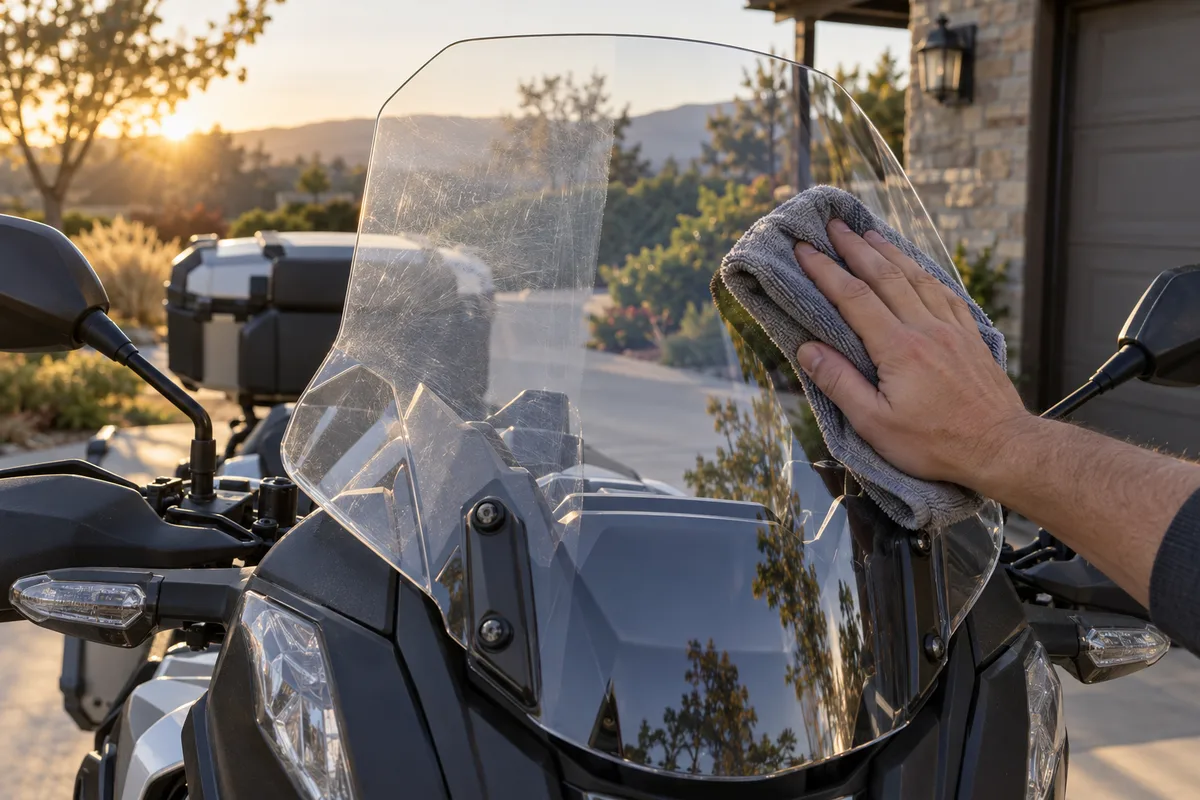
Motorcycle windscreens are usually acrylic or polycarbonate. Acrylic is harder and polishes well with Novus. Polycarbonate is tougher in an impact but softer on the surface, so many polycarbonate screens get a hard coat from the factory. If your screen has a hard coat, plastic polish will remove it in patches. Klock Werks warns that the wrong cleaners cause dulling, hazing and peeling of the hardcoat, and Rider Magazine draws the same line between acrylic and hard-coated polycarbonate. Check your screen maker’s care instructions; if they rule out abrasive cleaners, treat the screen as coated.
Helmet visors are almost always coated: an anti-scratch hard coat, often an anti-fog layer on the inside, and on tinted or iridium visors, a mirror coating on the outside. Polishing a coated visor does not remove the scratch; it removes the coating around it. One r/motorcycles rider wiped a patch of mirror tint off a visor this way. Arai’s care instructions call for only warm water and a microfiber cloth, and Shoei’s manual says to clean or replace a scratched visor. A visor scratch in your line of sight also scatters headlights at night, so the fix is a replacement visor, which costs far less than the helmet.
Matte paint
Matte and satin paint get their finish from a texture that scatters light. Every compound, polish and wax works by smoothing that texture, so any of them will leave a shiny patch that is more visible than the scratch. Honda’s owner’s manuals say plainly: do not use wax or polishing compounds on matte painted surfaces. Meguiar’s marks its scratch eraser kit not for use on matte or satin finishes. Matte finishes should only be cleaned, with a cleaner made for them such as Chemical Guys Meticulous Matte (see on Amazon). Light marks sometimes fade after a proper clean. A real scratch on matte paint needs touch-up or a respray of the panel.
Dirt bike and unpainted plastic
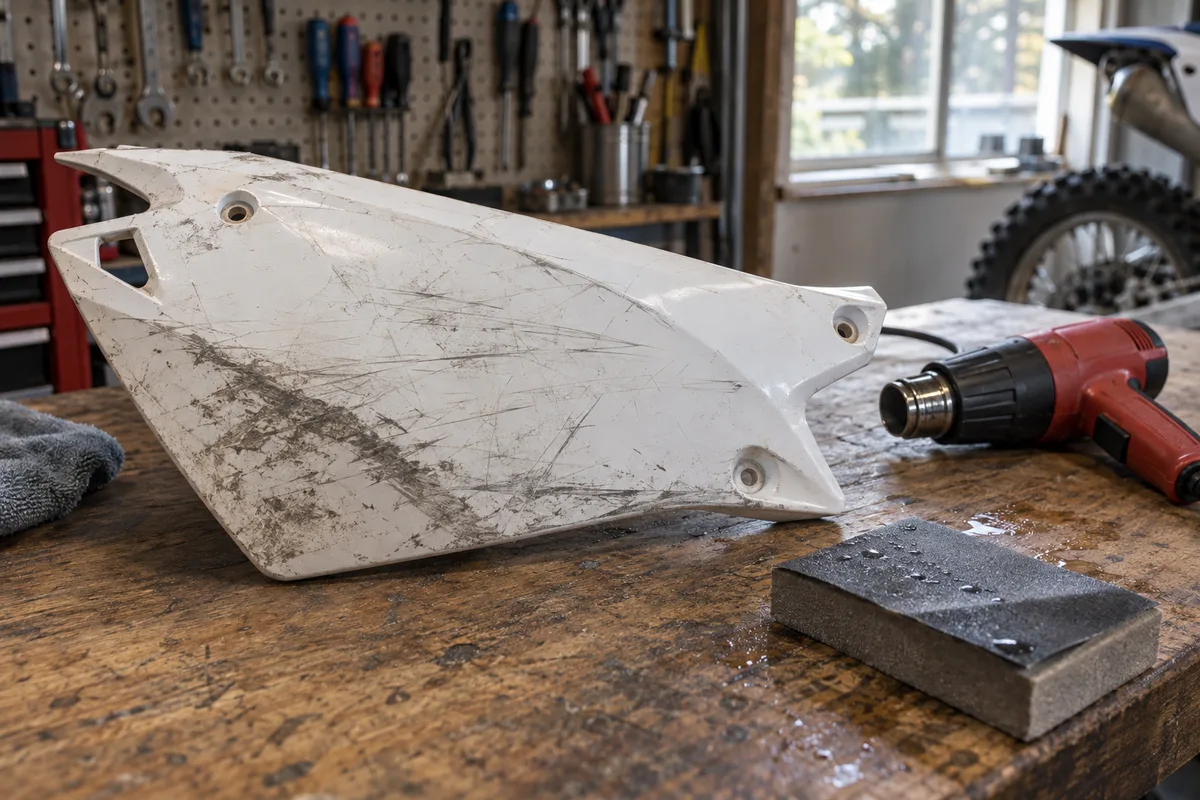
Off-road plastics are colored all the way through, so a scratch never reveals a different color. That makes them forgiving. Slice off raised whiskers with a razor blade held flat, wet sand from around 400 grit up to 1000 or finer, and use a heat gun on a low setting to bring back a uniform surface. White plastic yellows if it gets too hot, and thin panels warp quickly, so work in short passes. Many riders skip all of this and buy new plastics or a graphics kit, which also covers the scuffs.
Scratch remover for motorcycles: what Reddit riders say
We read 1,186 comments in 75 scratch threads on r/motorcycles, r/motorcycle, r/Harley, r/MotoUK, r/Kawasaki, r/Triumph and r/Ducati. Riders rarely name products: no single scratch remover came up more than a handful of times. What they do agree on is the method.
| Advice | Comments | Threads |
|---|---|---|
| Polish, any product | 52 | 26 |
| Touch-up paint matched to the paint code | 41 | 19 |
| Hide it with a black marker (dark paint) | 41 | 15 |
| Leave it as a “badge of honor” | 38 | 20 |
| Body shop or painter | 27 | 14 |
| Wet sanding | 23 | 17 |
- Through the clear means paint. The most upvoted repair replies say a scratch that cuts through the clear coat needs touch-up or a body shop, not a polish.
- Matte paint is the trap. In one r/motorcycle thread, a rider reports that a scratch remover, polish and wax all left a matte panel permanently shiny. Another reply there advises a touch-up pen only on matte tanks.
- Scratch remover is abrasive polish. It removes material, which is why the visor thread above ended with stripped mirror tint.
- Chrome and aluminum get metal polish. A Harley owners’ thread lands on Mothers for aluminum and Simichrome for chrome, with a fine pad worked along the grain on brushed finishes.
- Deep scratches and wet sanding. A painter in r/motorcycle describes starting around 220 to 350 grit, finishing at 1000 wet and widening the area a couple of inches so the repair blends. That is respray prep, and it ends with paint, not polish.
The black marker trick works on black and very dark paint as a stopgap. It fills the bright line so it stops catching light, and it washes away in time. Touch-up paint does the same job permanently.
How to prevent scratches on a motorcycle
- Use a tank pad or protection film. A clear tank protector or paint protection film on the rear of the tank takes the zipper and buckle wear instead of the paint.
- Check your tank bag. Magnetic and strap-on bags trap grit underneath. Clean the base and the tank before you mount one.
- Wash with two buckets and a clean mitt, and dry with a plush towel. Our guides to car wash soap for black paint and the best drying towel apply to bikes too.
- Never dry-wipe a dusty bike. A quick detailer or a rinse first lifts the grit.
- Fit frame sliders on sport bikes. A tip-over then scuffs a replaceable puck, not a fairing.
- Consider a coating. A ceramic coating resists light wash marring, though it will not stop a dropped key.
Car scratch removers vs motorcycle scratch removers
Motorcycle-branded scratch removers exist, but the clear coat on a modern bike is the same type of automotive finish used on cars, so the same compounds work. The difference is in how you use them: smaller sections, more masking, hand application on the curves, and more caution near edges and graphics. If you already own a compound from our guide to scratch removers for black cars, it will work on your bike’s painted parts. For riding gear, see our guide to the best camera for a motorcycle helmet.
FAQ
What is the best compound for motorcycle scratches?
Meguiar’s Ultimate Compound is the best compound for most motorcycle scratches. It removes light scratches and swirls by hand, is safe on clear coat and is easy to control on small curved panels. Follow it with a polish on dark paint.
Can you use a car scratch remover on a motorcycle?
Yes, on painted and clear-coated parts. Motorcycle tanks, fenders and painted fairings use the same kind of paint system as cars. Do not use car scratch removers on matte paint, windscreens, helmet visors or unpainted plastic.
How do you remove scratches from a motorcycle tank?
Wash the tank, tape off badges and edges, then work a small amount of compound into the scratch by hand with a foam applicator. Wipe, inspect and repeat up to three times, then polish and wax. If the scratch catches your fingernail, it may need sanding or touch-up paint.
How do you get scratches out of a motorcycle windscreen?
On an uncoated acrylic screen, use a plastic polish kit such as Novus, starting with the heavy scratch remover and finishing with the cleaner. Hard-coated screens should not be polished; deep scratches on them mean a replacement screen.
Can you remove scratches from a helmet visor?
Not safely. Most visors have anti-scratch, anti-fog or mirror coatings, and polishing strips them. If a scratch sits in your line of sight, replace the visor, since scratches scatter light from oncoming headlights.
Can you polish scratches out of matte motorcycle paint?
No. Polishing makes matte paint shiny in the area you worked. Clean matte paint with a matte-safe cleaner and repair real scratches with touch-up paint or a respray.
Does toothpaste remove scratches from a motorcycle?
Toothpaste is a mild abrasive and can soften a very light mark, but it is not made for paint, cuts unevenly and can leave haze. A proper polish costs little more and gives a predictable result.
Is scratch remover safe on plastic fairings?
Yes, if the fairing is painted and clear-coated. Most sport bike fairings are. On unpainted textured plastic, scratch remover does nothing useful and can leave a white residue in the texture.
Does a Sharpie hide scratches on a motorcycle?
On black or very dark paint, a permanent marker fills a thin scratch so it stops catching light. It is a stopgap that fades with washing. On a scratch through to bare steel, use touch-up paint, because marker ink will not stop rust.
Do scratch removers work on bicycle frames?
On a painted gloss bicycle frame, the same compounds and polishes work, with light pressure since frame paint is thin. Do not use them on matte frames or on raw carbon fiber.
When should I take my motorcycle to a paint shop?
Go to a professional when a scratch shows primer, metal or plastic over a large area, when the paint is a candy or tri-coat color, or when the scratch runs across a graphic or pinstripe you cannot replace.
Sources & References
- Meguiar's, Ultimate Compound product page: https://www.meguiars.com/products/automotive/paint/meguiars-ultimate-compound-g17216-152oz
- Meguiar's, Quik Scratch Eraser Kit (not for matte or satin finishes): https://www.meguiars.com/products/automotive/kits/meguiars-quik-scratch-eraser-kit-g190200-kit
- Novus, 3-step plastic polish system: https://novuspolish.com/pages/3-step-system
- Honda VT1300 owner's manual, cleaning matte painted surfaces: https://www.pieces-honda.be/thumbs/pdf_url/img/owner_manuals/owner_VT1300CXF_CXAF/2500_2500/0104.pdf
- Arai, shield care and cleaning: https://parts.araiamericas.com/product-information/care-cleaning/shield-care-cleaning
- Shoei, GT-Air 2 instructions for use: https://www.shoei.com/user-manual/docs/300-gt-air-2-euro-web-20250418.pdf
- Klock Werks, how to clean your windshield: https://www.cyclegear.com/assets/0008/3730/How_to_clean_your_windshield.pdf
- Rider Magazine, motorcycle windshield maintenance: https://ridermagazine.com/2018/07/09/motorcycle-windshield-maintenance/
- Ultimate Motorcycling, Quixx Paint Scratch Remover Kit review: https://ultimatemotorcycling.com/2022/07/29/quixx-paint-scratch-remover-kit-review-save-your-motorcycles-finish/
- Jimbo's Detailing, how much clear coat is removed when polishing: https://jimbosdetailing.com/blogs/paint-correction/how-much-clear-coat-removed-polishing
- Jackson's Wash, the scratch diagnostic: https://jacksonswash.com/uncategorized/the-scratch-diagnostic-a-professional-detailers-guide-to-paint-damage/

James Kowalski
More from James KowalskiHow we reviewed this article
This article was researched against manufacturer records and editorially reviewed before publishing. We accept no payment for coverage. Some guides contain affiliate links; see our affiliate disclosure.