TLDR
Harley-Davidson sold six families in 1941: the Knucklehead overhead-valve twins (E, EL, F, FL), the 45 ci flathead W series (WL, WLD, WLDR, plus the military WLA and WLC), the 74 and 80 ci flathead U series, the Servi-Car three-wheeler, the LE sidecar, and a commercial package truck. The big news was the FL: 1941 was the first year Harley put a 74 ci engine in the overhead-valve frame. Everything below the Knucklehead was a side-valve flathead.
Contents
- The 1941 lineup at a glance
- Knucklehead models: E, EL, F and FL
- 45 ci flatheads: WL, WLD and WLDR
- 74 and 80 ci flatheads: the U series
- Servi-Car, sidecar and package truck
- How to read the model codes
- The WLA and WLC military bikes
- Collector notes and value ranges
The 1941 lineup at a glance
Most 1941 Harley-Davidson models fall into a simple split. Overhead valves meant the Knucklehead, the fast and expensive one. Side valves meant everything else, the cheaper and tougher machines that carried Harley through the Depression and then into the war.
| Model | Displacement | Valves | Role |
|---|---|---|---|
| E | 61 ci | Overhead | Lower-compression touring twin |
| EL | 61 ci | Overhead | High-compression sport/touring twin |
| F | 74 ci | Overhead | Lower-compression big twin, sidecar use |
| FL | 74 ci | Overhead | High-compression flagship |
| WL | 45 ci | Side valve | Everyday middleweight solo |
| WLD | 45 ci | Side valve | Sport solo, higher compression |
| WLDR | 45 ci | Side valve | Competition |
| WLA / WLC | 45 ci | Side valve | US Army / Canadian military |
| U / UL | 74 ci | Side valve | Heavy-duty twin, sidecar and hauling |
| UH / ULH | 80 ci | Side valve | Largest flathead, same duty as U/UL |
| G family (Servi-Car) | 45 ci | Side valve | Three-wheeled service vehicle |
Knucklehead models: E, EL, F and FL
The Knucklehead got its name from the shape of the rocker boxes, which look like a fist. It launched in 1936 as a 61 ci engine, and by 1941 it had been through five years of fixes: recirculating oil, a dry-sump layout, and a four-speed gearbox with the hand shifter on the tank and a clutch pedal under your left foot.
EL (61 ci). The high-compression 61 was the sporty Knucklehead. Factory output for 1941 is usually cited at 2,280 bikes, which is a small number for a flagship, and it explains why a good one gets attention at auction.
E (61 ci). Same engine family with lower compression, aimed at riders who wanted overhead-valve smoothness without fussing over fuel quality. It sold in smaller numbers than the EL.
FL (74 ci). This is the one that matters most. Before 1941 the 74 cubic inch displacement lived only in flathead engines (for the year before, see 1940 motorcycle models). The FL moved it into the overhead-valve design, with a claimed output around 48 hp and a top speed that could clear 100 mph. Factory production is usually cited at 2,452 bikes. The FL shape and name carried straight into the Panhead and later generations, so collectors treat the 1941 as the start of a long line.
F (74 ci). The lower-compression 74, which suited sidecar work and riders who cared about torque more than top speed.
Production numbers across sources vary by a few percent, depending on whether a given list counts export bikes and special orders. Treat EL and FL figures as factory-order totals rather than a registry of survivors.
45 ci flatheads: WL, WLD and WLDR
The 45 cubic inch side-valve engine was Harley’s volume seller. It used a three-speed gearbox and the same left-foot clutch and hand shift as the big twins, and it was cheaper to buy and far simpler to fix than a Knucklehead.
WL. The standard solo. A rider who wanted dependable transport with a Harley badge bought this.
WLD. The sport version, with a higher compression ratio and a more aggressive state of tune. It was the middleweight for riders who wanted more speed without paying Knucklehead money.
WLDR. A competition variant of the WLD for Class C racing. It’s the rarest of the three on the road today, and the one most often faked: plenty of standard WLs have been dressed up as WLDRs.
74 and 80 ci flatheads: the U series
The U series was the old-school big twin. Where the Knucklehead was about speed, the U was about work. These were heavy, low-revving flatheads built for sidecars, police duty and long hauls with a loaded rig.
- U and UL: 74 ci, with the L being the high-compression version.
- UH and ULH: 80 ci, the largest flathead Harley offered that year.
If you find a U in a barn, don’t expect Knucklehead performance. Expect a bike that pulls like a tractor and doesn’t mind being ignored for twenty years.
Servi-Car, sidecar and package truck
Servi-Car (G family). Harley’s three-wheeler had been around since 1932. It ran the 45 ci flathead, added a reverse gear, and was sold to businesses and police departments. Its most recognizable job was parking enforcement, where an officer chalked tires from the saddle. The Servi-Car stayed in production into the 1970s, which makes it one of the longest-running Harley models ever.
LE sidecar. The LE sidecar was the chair Harley offered for its solo bikes. The 74 and 80 ci U series and the F were the natural partners because of their torque.
M package truck. Harley also listed a commercial package truck, the M, which sat in the same family of utility three-wheelers as the Servi-Car. It’s the least documented model in the 1941 catalog, so check a serial-number source before you trust a seller’s description.
How to read the model codes
Harley’s letter codes look like gibberish until you learn that each letter says one thing. In 1941 the system worked like this:
- E and F are the overhead-valve Knucklehead families: E for 61 ci, F for 74 ci.
- U is the 74 ci flathead big twin. W is the 45 ci flathead.
- L means high compression. An EL is a high-compression E, a WL is the 45 in its standard tune.
- H marks the 80 ci engine in the U family. A UH is an 80 ci U, and a ULH is its high-compression sibling.
- D marks the sport tune on the 45. The WLD is the sporty WL.
- R means racing. The WLDR is the competition WLD.
- A and C on a WL identify military use: A for Army, C for Canadian.
Not every letter means the same thing in every family, which is why a code like WLA doesn’t read the same way as an EL. Within a single model line, though, the pattern holds.
The WLA and WLC military bikes
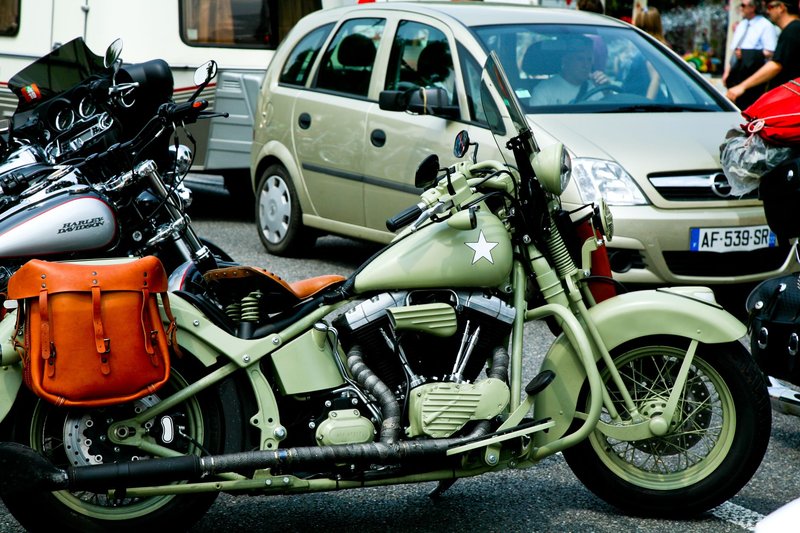
The WLA, the Army’s version of the 45, entered service before the United States joined the war. It added a heavy-duty skid plate, a front-mounted scabbard for a Thompson submachine gun, blackout lighting, and a luggage rack. Harley painted them olive drab. The WLC was the Canadian equivalent, built to a different specification. The motorcycle was the Army’s pick for dispatch riders, messengers and military police, and Harley eventually built tens of thousands for the Allies. You’ll commonly see a total around 88,000 for all wartime military Harleys, though sources disagree on the exact WLA versus WLC split.
That disagreement is part of the confusion online. Two things cause it.
First, the US entered the war after the Japanese attack on Pearl Harbor on December 7, 1941. Civilian production was throttled almost immediately as the factory moved toward war output, and the National WWII Museum documents how quickly American industry converted to military work.
Second, Harley’s model year ran on a rolling schedule that began in the summer before the calendar year. A bike built in the fall of 1941 was generally already counted as a 1942 model. That means many WLAs people casually call “1941 WLAs” are catalogued as 1942 models, and a few sources count them under both years. If you’re checking a specific bike, rely on the engine and frame numbers rather than the label on a listing.
Collector notes and value ranges
A 1941 Harley is a bike worth inspecting slowly. Things to check before you pay:
- Numbers. Engine and frame numbers should match, and they should agree with the model claimed. A WL with a mismatched engine is a different bike from a numbers-matching WL.
- Fakes. WLDR and WLA clones are common. Many original WLs were converted to look like military or racing bikes.
- Knucklehead specifics. Check for cracked cases, oil seepage at the rocker boxes, and worn gearbox internals. Reproduction parts exist for nearly everything, so a bike can look original and still be assembled from catalogs.
- Flatheads. Look at the valve guides and the condition of the cylinder walls. They’re tough engines, but a neglected one can be quietly worn out.
- Servi-Cars. Frames and rear axles take a beating from commercial use. Inspect them for welding repairs.
As a rough guide to sold listings in recent years, restored 1941 FLs and ELs sit at the top of the range, often in the tens of thousands of dollars, and clean, correct examples can climb far higher. A restored 45 ci WL or WLD usually lands in the low five figures. Military WLAs tend to sell at a similar level, depending on how correct the kit is. Unrestored project bikes sell for a fraction of any of those. Condition, originality and paperwork swing the price more than the model name does, so use these as starting points rather than quotes. If you are weighing a 1941 Harley against other prewar marques, the vintage motorcycle brands guide covers the wider field.
The 1941 range tells one clear story. Harley had a fast new flagship in the Knucklehead FL, a workhorse flathead lineup behind it, and a military order that was about to take over the factory. It’s a good year to own and a hard one to catalog, which is why most bikes in the hobby deserve a careful look at their numbers before anyone argues about the model code.

Sarah Thornton
More from Sarah ThorntonHow we reviewed this article
This article was researched against manufacturer records and editorially reviewed before publishing. We accept no payment for coverage. Some guides contain affiliate links; see our affiliate disclosure.