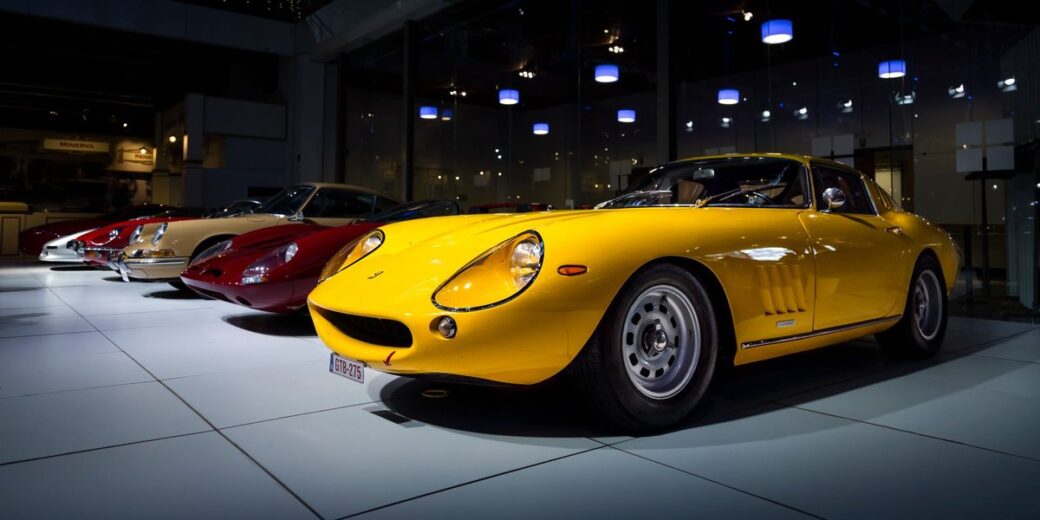
Ferrari in 1952 sold road cars, raced sports cars and won a World Championship, all out of one small factory in Maranello. The result was a lineup of 1952 Ferrari models that ranges from a four-cylinder Formula 2 single-seater to a 280 hp road-race berlinetta built in four examples. This guide lists all of them, tells them apart, and says which ones a buyer could realistically find today.
TLDR
- Ferrari’s 1952 lineup splits three ways: one single-seater (500 F2), road cars (212 Inter, 340 America, 342 America) and sports racers (212 Export, 225 S, 250 S, 250 MM, 340 Mexico).
- The 500 F2 carried Alberto Ascari to his first World Championship. A 250 S won the Mille Miglia.
- Production was tiny. The 225 S, 250 S, 250 MM and 340 Mexico were built in the dozens or fewer, and the road cars in the tens.
- The only models a collector can plausibly buy are the 212 Inter, the 340/342 America, and, with deep pockets, a 212 Export, 225 S or 250 MM.
Contents
- What Ferrari’s 1952 looked like
- 1952 Ferrari models at a glance
- How to read the names
- The single-seater: 500 F2
- The road cars
- The sports racers
- Where the sources disagree
- Which 1952 Ferrari can you buy today?
What Ferrari’s 1952 looked like
Enzo Ferrari had put his own name on a car for the first time in 1947. Five years later, the company was winning at the top level of Grand Prix racing and selling coachbuilt road cars mainly to racing drivers and wealthy privateers.
Two engine families did the work. Gioacchino Colombo’s short-block V12 powered the smaller cars: 2.6, 2.7 and 3.0 liters. Aurelio Lampredi’s larger long-block V12 powered the 4.1-liter cars. Lampredi also designed the 500 F2’s four-cylinder engine, which is why the 1952 lineup contains both a V12 and a four-cylinder Ferrari.
For 1952 and 1953 the World Championship was run to Formula 2 rules, because Alfa Romeo had withdrawn and there weren’t enough Formula 1 cars to fill a grid. That made the 2.0-liter 500 F2 the car of the season.
1952 Ferrari models at a glance
Power and build figures are the commonly quoted ones and are rounded. See where the sources disagree for the shaky numbers.
| Model | Engine | Power | Built | Bodywork | 1952 role |
|---|---|---|---|---|---|
| 500 F2 | 2.0L inline-4 (Lampredi) | ~180 hp | Works cars only, a small batch | Single-seater, built in-house | Formula 2 / World Championship |
| 212 Inter | 2.6L V12 (Colombo) | 150-170 hp | ~80 (1951-53) | Vignale, Touring, Ghia, Pinin Farina | Road |
| 340 America | 4.1L V12 (Lampredi) | ~200 hp | 22 (1951-52) | Vignale, Touring, Ghia | Road, some racing |
| 342 America | 4.1L V12 (Lampredi) | ~200 hp | 6 (1952-53) | Pinin Farina | Road |
| 212 Export | 2.6L V12 (Colombo) | 150-170 hp | ~27 (1951-52) | Vignale, Touring | Sports racing |
| 225 S | 2.7L V12 (Colombo) | ~210 hp | 21 | Vignale | Sports racing |
| 250 S | 3.0L V12 (Colombo) | ~230 hp | 3 | Vignale | Sports racing |
| 250 MM | 3.0L V12 (Colombo) | ~240 hp | 31 (1952-53) | Pinin Farina, Vignale | Sports racing |
| 340 Mexico | 4.1L V12 (Lampredi) | ~280 hp | 4 | Vignale | Road racing (Carrera Panamericana) |
How to read the names
Ferrari’s naming at this point is a measurement, not a marketing choice. On the V12 cars, the number is the displacement of a single cylinder in cubic centimeters, rounded. A 3.0-liter V12 has twelve cylinders of about 246 cc each, so it’s a 250. The 4.1-liter engine works out to about 342 cc per cylinder, hence 340 and 342. The 500 F2 uses the same logic: a 2.0-liter four, about 500 cc per cylinder.
The letters are shorter. “S” is Sport. “MM” is Mille Miglia, the thousand-mile Italian road race Ferrari had won in 1948 and 1949 with its 166 models and wanted on the nameplate. “F2” is the racing formula. “Inter” is short for Internazionale, the road-going coupe line, and “Export” was the sports-racing version sold to customers abroad. “America” and “Mexico” aim at the American market and the Carrera Panamericana respectively.
The single-seater: 500 F2
The Ferrari 500 F2 is the reason 1952 is a famous Ferrari year. Its 2.0-liter four-cylinder made roughly 180 hp, which on a car that light was enough to embarrass the opposition. Ferrari won every championship Grand Prix that wasn’t the Indianapolis 500.
Alberto Ascari won six of the seven championship rounds he started: Belgium, France, Britain, Germany, the Netherlands and Italy. The seventh was the Indy 500, which Ferrari entered with a 4.5-liter 375 and where Ascari retired with a wheel failure. He skipped the Swiss round to prepare for Indianapolis, and Piero Taruffi won it in another 500 F2. Ascari’s championship was the first of two in a row.
You can’t buy a 500 F2 as a normal collector. They were works-only cars, and the survivors sit in museums and the collections of people who race at the Goodwood Revival.
The road cars
Ferrari 212 Inter
The 212 Inter is the 1952 Ferrari you’re most likely to meet in person. The 2.6-liter Colombo V12 made around 150 hp with one carburetor and about 170 with three, in a chassis with a 2,600 mm wheelbase. Roughly 80 were built. The coachbuilders could not agree on a style: Vignale, Touring, Ghia and Pinin Farina all bodied them, so no two look quite alike.
It’s a road car with racing credentials. A 212 Inter won the 1951 Carrera Panamericana, which is the reason the Mexico-themed cars exist at all.
Ferrari 340 America and 342 America
Both use the 4.1-liter Lampredi V12 and put out around 200 hp. The 340 America (1951-52, 22 built) was a barely tamed racing car that Vignale, Touring and Ghia dressed for the road. The 342 America arrived in 1952 and was calmer, with Pinin Farina bodywork and a more road-oriented chassis. Only six were built.
The 342 America is the rare one, and the least raced. It was meant for American buyers who wanted a fast long-distance cruiser, and its Pinin Farina coupes and cabriolets are among the first Ferraris you could call elegant without a qualifier.
The sports racers
Ferrari 225 S
The 225 S is a 2.7-liter Colombo V12 in a small, light Vignale body, producing about 210 hp. Twenty-one were built. It won the sports-car Grand Prix at Monaco in 1952 (Vittorio Marzotto drove) and the sports-car Portuguese Grand Prix the same season.
It sits between the 212 Export and the 250 S in size and power, and was in effect the 1952 stopgap. A big engine in a small car meant it could win on tight circuits.
Ferrari 250 S
The 250 S is where the 3.0-liter Colombo V12 appeared in competition, with about 230 hp. Few were made: three in the count used here.
It earned its place in history in a single race. Giovanni Bracco and Alfredo Rolfo won the 1952 Mille Miglia in a Vignale-bodied 250 S, beating the Mercedes-Benz 300 SL of Karl Kling into second. Ferrari took the lesson and named the follow-up car after the race.
Ferrari 250 MM
The 250 MM is the 250 S made available to customers. The same 3.0-liter V12, about 240 hp, and bodies by Pinin Farina (the elegant berlinetta) and Vignale (spiders). Production ran from 1952 into 1953, with 31 cars built. If you picture one, it’s probably the Pinin Farina berlinetta, the car that effectively set the template for the 250 GT cars that followed.
It’s also the clearest example of the “MM” naming rule: the car was named for the race its predecessor won. For the sports racers and Grand Prix cars Ferrari built in the years after, see the 1955 Ferrari models guide.
Ferrari 212 Export
The 212 Export is the oldest design here: a 2.6-liter Colombo V12 in a short chassis, built from 1951. About 27 were made, bodied as barchettas (open) by Touring or as berlinettas and spiders by Vignale. At 150 to 170 hp it was outgunned by 1952, but it’s a car that customers could actually buy, drive to a race and drive home.
Ferrari 340 Mexico
The 340 Mexico was built for the Carrera Panamericana, the Mexican road race that ran the length of the country. The 4.1-liter Lampredi V12 made about 280 hp, in a Vignale berlinetta body. Four were built. The 1952 edition was won by Mercedes-Benz’s 300 SL, so the Mexico’s reputation rests on being the fastest, largest-engined Ferrari of the year, not on race results.
Where the sources disagree
Build counts for these cars come from registries, auction catalogs and Ferrari’s own records, and the three sources rarely match. For a wider view of the cars sold that year, see The Complete List of 1952 Car Models. A few examples:
- 250 S: commonly three, but some sources count a fourth car or a car re-bodied later. I used three.
- 212 Export: figures in the high 20s are common, and some sources go higher because cars were re-bodied and re-chassised. I used 27.
- 340 Mexico: four is the usual figure, but some lists give a few more. I used four.
Where a number is a single hedged figure in the table, it’s the one I judged the best documented. If you’re buying, the number that matters is the chassis number and the documentation on that particular car, not the production total.
Which 1952 Ferrari can you buy today?
A rough ranking of how realistic each is, with ballpark values for sound, documented cars. Values move with each auction season, so check recent results from major auction houses before relying on any figure.
- 500 F2: effectively off the market.
- 212 Inter: the entry point. Typically seven figures, with coupes at the lower end and Vignale cabriolets at the top.
- 340 America and 342 America: low to mid seven figures. The six 342 Americas rarely appear.
- 212 Export: seven figures, with open Touring barchettas at the top of the range.
- 225 S: seven figures when one is offered, which is not often.
- 250 MM: several million dollars at a minimum for a Pinin Farina berlinetta, more for a well-documented Vignale spider.
- 250 S and 340 Mexico: a few cars each, with a price set by the seller and the event history. Treat them as multi-million-dollar cars.
Taken together, the 1952 Ferrari models show a company at an unusual moment: the same factory building a four-cylinder championship winner, customer sports racers and long-distance road cars. Most of them are out of reach. The 212 Inter and the 340/342 America are the nearest you’ll get to owning a piece of that year.

Daniela Voss
More from Daniela VossHow we reviewed this article
This article was researched against manufacturer records and editorially reviewed before publishing. We accept no payment for coverage. Some guides contain affiliate links; see our affiliate disclosure.