TLDR
The 1946 Ford wasn’t a new car — it was the 1942 Ford with a fresh three-bar chrome grille, because Ford didn’t have time to retool after four years of building tanks and Jeeps instead of sedans. You could get it as a Deluxe or Super Deluxe, in six body styles, with a 90-hp six or a 100-hp flathead V8. Total 1946 production ran a little over 468,000 cars. A driver-quality Tudor or Fordor sedan runs $20,000–$35,000 today; a nicely restored Super Deluxe convertible lands in the $60,000–$90,000 range; and the wood-paneled Sportsman — only 1,209 built — routinely sells for $150,000 or more.
Table of Contents
- A Car Built From What Was Left Over
- Deluxe vs. Super Deluxe: What’s the Difference
- Body Styles: From the Tudor Sedan to the Sportsman Woody
- Engines: The 226 Six vs. the 239 Flathead V8
- How Many Were Built
- The Biff Tannen Car
- What a 1946 Ford Is Worth Today
- Buying One: What to Actually Check
A Car Built From What Was Left Over
Ford didn’t build a single civilian car between February 1942 and mid-1945. The federal government shut down auto production a month after Pearl Harbor and put every plant on war footing — Ford’s lines turned out Jeeps, ambulances, tank engines, and B-24 bombers instead of Tudors and Fordors. When the war ended, Ford wanted to be first back to the showroom floor, and it was: civilian production restarted on July 3, 1945, ahead of every other domestic automaker, and Henry Ford II personally drove the first car off the line to the White House and handed the keys to President Truman. That car was a 1946 Super Deluxe Tudor.
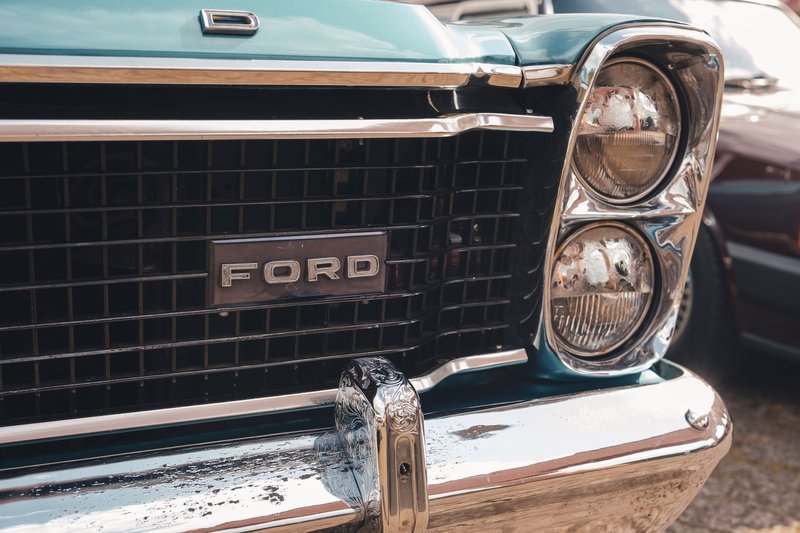
There was no time or tooling budget to design a genuinely new automobile, so the 1946 Ford is, underneath, the 1942 Ford. Same body shell, same basic chassis. What changed was the face: a new three-bar horizontal grille in place of the prewar car’s more vertical, heavier bars, revised parking lights, fresh trim, and a cleaned-up dashboard. It’s a small enough update that a 1942 owner would’ve recognized the car instantly — and that’s exactly the point. Ford needed volume, not novelty, and buyers who’d spent four years without a new car weren’t picky.
Deluxe vs. Super Deluxe: What’s the Difference
Ford ran two trim lines for 1946, and the gap between them is bigger than the badge on the trunk suggests. The Deluxe was the stripped-down, price-leader version — flat dashboard with fewer bright accents, plainer upholstery cloth, and a six-cylinder-only engine lineup in some body styles. The Super Deluxe added chrome window surrounds, richer interior trim, a woodgrain-look dash insert, and the option of the V8 across the range. If you’re shopping listings today, “Super Deluxe” is the trim you’ll see attached to nearly every convertible, wagon, and the Sportsman — Ford reserved its showiest body styles for the upscale line.
Mechanically the two trims are close cousins. The real differences are cosmetic and comfort-oriented, which is worth knowing if you’re chasing a bargain: a clean Deluxe Tudor with the V8 gives you the same drivetrain as a Super Deluxe for meaningfully less money, just with less brightwork.
Body Styles: From the Tudor Sedan to the Sportsman Woody
The 1946 lineup covered a lot of ground. Tudor (two-door) and Fordor (four-door) sedans were the volume sellers, aimed at families who just wanted a car after years of rationing and rideshares. Above them sat the business coupe and club coupe—both popular 1940s coupe designs—plus a two-passenger convertible and the woody-bodied Ford Super Deluxe Station Wagon, which used real structural white ash framing around mahogany or birch panels — a car you had to varnish, not just wash.
Then there’s the Sportsman: a Super Deluxe convertible with wood trim applied over the body rather than structural wood, built in tiny numbers because it was expensive to produce and expensive to maintain — the wood needed regular refinishing to keep it from checking and rotting. Ford built it more as a halo car and dealer draw than a volume product, and it worked; it’s the body style every collector asks about first.
Engines: The 226 Six vs. the 239 Flathead V8
Buyers had two engine choices, both carryovers from before the war:
- 226 cid inline-six — 3.30 x 4.40-inch bore and stroke, rated at 90 horsepower at 3,300 rpm. Standard in the Deluxe line, smoother and cheaper to run than the V8, but noticeably less punchy off the line.
- 239 cid flathead V8 — 3.19 x 3.75-inch bore and stroke, rated at 100 horsepower at 3,800 rpm. The engine most people picture when they think “flathead Ford” — it’s the same basic architecture Ford had been refining since 1932, and by 1946 it was about as sorted as a flathead V8 was ever going to get.
Neither engine is quick by modern standards — 100 horsepower moving roughly 3,000 pounds of postwar steel — but the V8 was the performance choice at the time and remains the more desirable option with collectors and hot-rodders alike, partly because of the aftermarket parts support that’s kept flathead V8s alive for eight decades.
How Many Were Built
Ford moved just over 468,000 cars for the 1946 model year — a strong number for a company still ramping factories back up from military production, and proof that pent-up postwar demand mattered more than novelty. As the list of popular 1946 cars shows, Ford dominated the market that year with multiple bestselling models. Within that total, the numbers get scarcer the further up the lineup you go: Super Deluxe production across all body styles ran into the low hundreds of thousands, the wood-bodied Station Wagon numbered in the low thousands, and the Sportsman — the rarest catalog model Ford sold that year — totaled just 1,209 units. That scarcity is a big part of why Sportsman prices sit in a different universe from every other ’46 Ford.
The Biff Tannen Car
If you’ve seen Back to the Future, you’ve seen a 1946 Ford — it’s the car Biff Tannen crashes into a manure truck, and the one he’s obsessing over restoring in Part II. The production used a Super Deluxe convertible, and the film did more for the model’s name recognition among non-collectors than any car show ever has. It’s a small detail, but it’s the reason plenty of buyers who couldn’t tell a Tudor from a Fordor still know exactly what a “’46 Ford” looks like.
What a 1946 Ford Is Worth Today
Pricing spreads out fast depending on body style, engine, and how much restoration work has already been done. Rough tiers, based on current listings and recent sales:
- Project or driver-quality Tudor/Fordor sedan: roughly $20,000–$35,000. These are the most common survivors, which keeps prices approachable — some listings for rougher, unrestored, or hot-rodded examples start well under $20,000.
- Nicely restored sedan or coupe: $35,000–$55,000, depending on originality and how correct the restoration is to factory spec.
- Super Deluxe convertible, good condition: roughly $60,000–$90,000, with concours-level cars pushing higher.
- Station wagon (structural wood body): highly condition-dependent — wood in poor shape is a major expense to correct, so prices swing from the $40,000s for project cars into six figures for wagons with sound, restored wood.
- Sportsman convertible: the outlier. With only 1,209 built, comps run from roughly $113,000 to over $180,000, and standout examples at major auctions have sold for $170,000–$250,000+.
Values move with the broader collector-car market, so treat these as a snapshot rather than gospel — check recent auction results before you commit to a number.
Buying One: What to Actually Check
Wood is the single biggest cost variable on a Sportsman or Station Wagon — get underneath and look for water staining, soft spots, and mismatched replacement panels before you fall for the patina. On any 1946 Ford, verify the engine matches what the trim level should have (V8 swaps into six-cylinder Deluxe cars are common and hurt value if undocumented), and ask specifically whether the body is genuine 1946 sheet metal or a later ’42-’48 mashup — because the shared bodies across those years mean parts, and sometimes entire cars, get mixed and matched. A car with clear ownership history and known mileage is worth paying a premium for in this class; postwar Fords are old enough that “numbers matching” carries real weight in what a buyer will pay.

Marco Delantero
More from Marco DelanteroHow we reviewed this article
This article was researched against manufacturer records and editorially reviewed before publishing. We accept no payment for coverage.