Short answer: A 3/8-inch Grade 5 bolt takes about 31 ft-lb and a Grade 8 about 44 ft-lb with clean, dry threads. A 1/2-inch bolt takes about 75 ft-lb (Grade 5) or 106 ft-lb (Grade 8). Oiled threads need about 25% less and dry zinc-plated bolts about 15% less. Find your bolt size and grade in the chart below, or download the one-page PDF.
These are the standard values for inch (SAE) bolts, Grade 2, 5 and 8, from 1/4 to 1 inch, in coarse and fine thread. Each one tightens the bolt to 75% of its proof load, the clamping force fastener makers recommend for a joint you want to stay put. The most common mistake is using a dry value on a bolt that has oil or anti-seize on it, which over-stretches it. If a service manual lists a torque for the exact bolt you are tightening, that number wins. Working on metric bolts? Use the metric bolt torque chart.
This article contains Amazon affiliate links. 33gears earns a commission on qualifying purchases. See our affiliate disclosure.
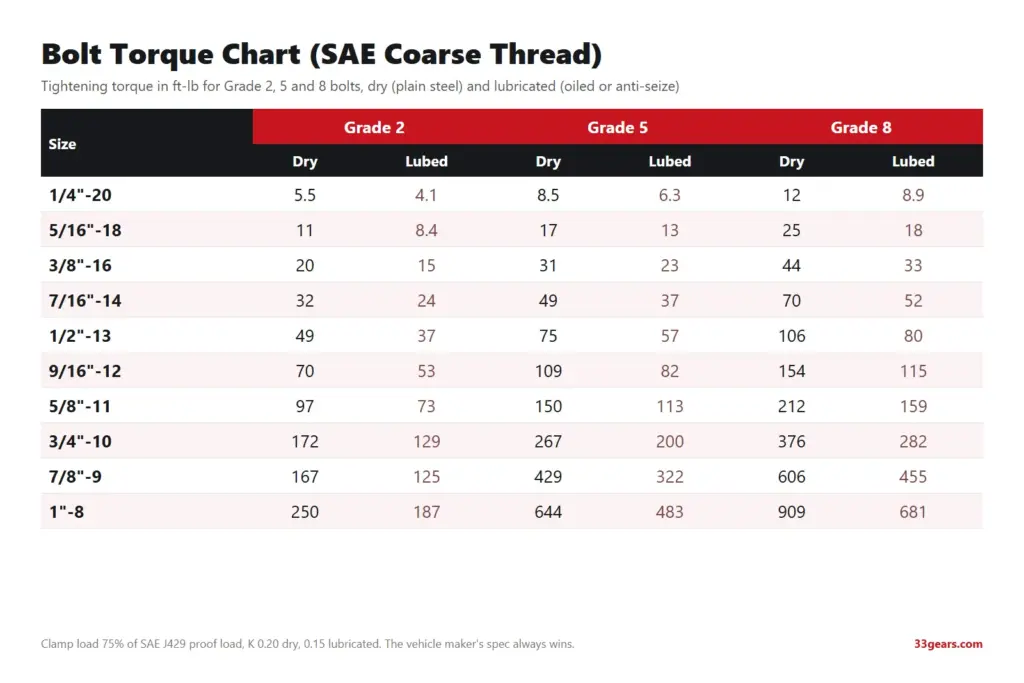
Bolt torque chart: coarse thread (UNC)
Coarse thread (UNC) is the standard inch thread on most bolts you buy at a hardware store and on most American vehicles and equipment. Values are in foot-pounds (ft-lb). “Dry” means clean plain steel or black oxide threads. “Lubed” means threads with oil, grease or anti-seize. Dry zinc-plated bolts fall between the two columns.
| Size | Grade 2 dry | Grade 2 lubed | Grade 5 dry | Grade 5 lubed | Grade 8 dry | Grade 8 lubed |
|---|---|---|---|---|---|---|
| 1/4″-20 | 5.5 | 4.1 | 8.5 | 6.3 | 12 | 8.9 |
| 5/16″-18 | 11 | 8.4 | 17 | 13 | 25 | 18 |
| 3/8″-16 | 20 | 15 | 31 | 23 | 44 | 33 |
| 7/16″-14 | 32 | 24 | 49 | 37 | 70 | 52 |
| 1/2″-13 | 49 | 37 | 75 | 57 | 106 | 80 |
| 9/16″-12 | 70 | 53 | 109 | 82 | 154 | 115 |
| 5/8″-11 | 97 | 73 | 150 | 113 | 212 | 159 |
| 3/4″-10 | 172 | 129 | 267 | 200 | 376 | 282 |
| 7/8″-9 | 167 | 125 | 429 | 322 | 606 | 455 |
| 1″-8 | 250 | 187 | 644 | 483 | 909 | 681 |
Grade 2 bolts above 3/4 inch get a lower value than you might expect (167 ft-lb for 7/8 inch against 172 for 3/4 inch). SAE J429 lowers the Grade 2 proof strength from 55,000 to 33,000 psi for sizes over 3/4 inch, so the larger bolt is rated for less clamping force per square inch.
Fine thread (UNF) bolt torque chart
Fine thread bolts take slightly more torque than coarse bolts of the same size, because the shallower thread leaves more steel in the cross-section. You find them on engines, suspension and brake parts where the joint sees vibration. Values in ft-lb.
| Size | Grade 2 dry | Grade 2 lubed | Grade 5 dry | Grade 5 lubed | Grade 8 dry | Grade 8 lubed |
|---|---|---|---|---|---|---|
| 1/4″-28 | 6.3 | 4.7 | 9.7 | 7.2 | 14 | 10 |
| 5/16″-24 | 12 | 9.4 | 19 | 14 | 27 | 20 |
| 3/8″-24 | 23 | 17 | 35 | 26 | 49 | 37 |
| 7/16″-20 | 36 | 27 | 55 | 41 | 78 | 58 |
| 1/2″-20 | 55 | 41 | 85 | 64 | 120 | 90 |
| 9/16″-18 | 78 | 59 | 121 | 91 | 171 | 128 |
| 5/8″-18 | 110 | 82 | 170 | 127 | 240 | 180 |
| 3/4″-16 | 192 | 144 | 297 | 223 | 420 | 315 |
| 7/8″-14 | 184 | 138 | 474 | 355 | 669 | 502 |
| 1″-12 | 274 | 205 | 704 | 528 | 995 | 746 |
To tell UNC from UNF, count threads per inch with a thread gauge or compare the bolt against a known nut. A 3/8-inch coarse bolt has 16 threads per inch; the fine version has 24.
Bolt torque chart in N·m
Most torque wrenches show both scales. This table is the coarse thread chart converted to newton-meters (1 ft-lb = 1.356 N·m). For bolts sized in millimeters, use the metric bolt torque chart instead: metric classes 8.8, 10.9 and 12.9 have different strengths from SAE grades.
| Size | Grade 2 dry | Grade 2 lubed | Grade 5 dry | Grade 5 lubed | Grade 8 dry | Grade 8 lubed |
|---|---|---|---|---|---|---|
| 1/4″-20 | 7.4 | 5.6 | 11 | 8.6 | 16 | 12 |
| 5/16″-18 | 15 | 11 | 24 | 18 | 33 | 25 |
| 3/8″-16 | 27 | 20 | 42 | 31 | 59 | 44 |
| 7/16″-14 | 43 | 33 | 67 | 50 | 95 | 71 |
| 1/2″-13 | 66 | 50 | 102 | 77 | 144 | 108 |
| 9/16″-12 | 95 | 72 | 147 | 111 | 208 | 156 |
| 5/8″-11 | 132 | 99 | 203 | 153 | 287 | 215 |
| 3/4″-10 | 234 | 175 | 361 | 271 | 510 | 383 |
| 7/8″-9 | 226 | 169 | 582 | 437 | 822 | 616 |
| 1″-8 | 339 | 254 | 873 | 654 | 1,232 | 924 |
Grade 8 bolt torque chart
A Grade 8 bolt takes about 40% more torque than a Grade 5 bolt of the same size, because its proof strength is 120,000 psi against 85,000. Never swap a Grade 8 value onto a Grade 5 or Grade 2 bolt: the weaker bolt will stretch or snap before it reaches it.
| Size | Coarse dry (ft-lb) | Coarse lubed (ft-lb) | Fine dry (ft-lb) | Fine lubed (ft-lb) | Coarse dry (N·m) |
|---|---|---|---|---|---|
| 1/4″ | 12 | 8.9 | 14 | 10 | 16 |
| 5/16″ | 25 | 18 | 27 | 20 | 33 |
| 3/8″ | 44 | 33 | 49 | 37 | 59 |
| 7/16″ | 70 | 52 | 78 | 58 | 95 |
| 1/2″ | 106 | 80 | 120 | 90 | 144 |
| 9/16″ | 154 | 115 | 171 | 128 | 208 |
| 5/8″ | 212 | 159 | 240 | 180 | 287 |
| 3/4″ | 376 | 282 | 420 | 315 | 510 |
| 7/8″ | 606 | 455 | 669 | 502 | 822 |
| 1″ | 909 | 681 | 995 | 746 | 1,232 |
Most Grade 8 bolts come yellow zinc plated. Fastenal rates dry zinc plating at a nut factor of 0.17, so a dry plated 1/2-inch Grade 8 bolt takes about 90 ft-lb, between the two columns. Oil it and use the lubed column.
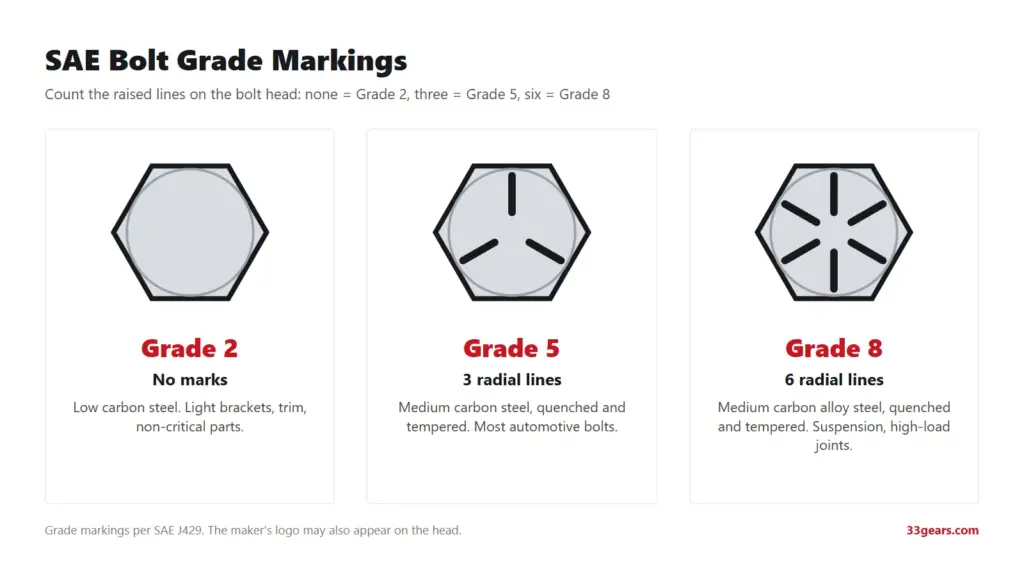
How to tell bolt grade from the head
Count the raised lines on the bolt head. No lines means Grade 2, three lines means Grade 5 and six lines means Grade 8. A bolt with no marks at all should be treated as Grade 2.
Dry vs lubricated bolt torque
Use the lubed column when the threads have oil, grease or anti-seize. Most of the torque you apply goes into overcoming friction under the head and in the threads, and only a small share actually stretches the bolt. Lubricant cuts that friction, so the same wrench setting produces much more clamping force. The chart uses a nut factor (K) of 0.20 for dry steel and 0.15 for lubricated threads, which works out to 25% less torque. Dry zinc plating sits in between at 0.17, about 15% below the dry value.
How to torque a bolt correctly
Clean threads and an even, gradual pull matter as much as the number on the wrench. This is the routine for any bolted joint. You need a click or beam torque wrench (a 3/8-inch drive click wrench covers most bolts up to 1/2 inch; a 1/2-inch drive handles larger ones).
When not to use a bolt torque chart
A generic chart is right for general hardware but wrong for parts that have their own engineered spec. Use the manufacturer’s value, from the service manual or repair database, for these:
Torque-to-yield bolts are tightened to a low torque and then turned a set number of degrees, which stretches them on purpose. They are designed for one use; reusing them risks a failed joint.
How bolt torque values are calculated
Every value in the chart comes from one formula: torque = K x diameter x clamp load. The clamp load is 75% of the bolt’s proof load, which is the proof strength from SAE J429 times the thread’s tensile stress area.
This matches the Fastenal torque-tension chart to the foot-pound. Some popular charts, such as Bolt Depot’s, list lower numbers (23 ft-lb for a 3/8-inch Grade 5 bolt) because they are written for slightly lubricated bolts. Those values line up with the lubed column here.
Frequently asked questions
A 1/2-13 coarse thread bolt takes about 49 ft-lb for Grade 2, 75 ft-lb for Grade 5 and 106 ft-lb for Grade 8 with dry threads. Lubricated threads need about 25% less.
A 3/8-16 bolt takes about 20 ft-lb for Grade 2, 31 ft-lb for Grade 5 and 44 ft-lb for Grade 8, dry. A 3/8-24 fine thread bolt takes slightly more.
Yes. Grade 8 has a proof strength of 120,000 psi against 85,000 psi for Grade 5, so it can be tightened to about 40% more torque and carries more load. It is also less ductile, so it gives less warning before it breaks.
Either works if you use the matching value. Lubricated threads give a more consistent clamp load for a given torque, but they need about 25% less torque than dry threads to reach it.
Liquid thread locker acts partly as a lubricant before it cures, so many makers recommend values close to the lubricated column. Check the thread locker maker’s guidance for the exact product.
One foot-pound equals 12 inch-pounds. Small bolts are often specified in inch-pounds because the numbers are easier to set on a small torque wrench.
For non-critical parts, snug plus a firm quarter turn is common practice, but it is a guess. Anything in the brakes, suspension, steering, wheels or engine should be set with a torque wrench.
Yes. The free PDF on this page fits on one US Letter sheet with coarse and fine thread values in ft-lb, the coarse values in N·m and the grade head markings.
Sources
- Fastenal. Torque-tension chart for A307, Grade 5, Grade 8 and Grade 9 bolts
- Engineering ToolBox. SAE grades for steel bolts
- Engineering ToolBox. US bolts: tensile and proof loads
- Engineering ToolBox. Bolt torque and lubrication effects
- Mutual Screw and Supply. Bolt grade markings and strength chart
- Bolt Depot. US recommended bolt torque
- ARP. Torque values
- AA1Car. Torque-to-yield head bolt tips
- NIST. Guide to the SI, conversion factors

James Kowalski
More from James KowalskiHow we reviewed this article
This article was researched against manufacturer records and editorially reviewed before publishing. We accept no payment for coverage. Some guides contain affiliate links; see our affiliate disclosure.