Short answer: Most cars and small SUVs take 76 to 100 ft-lb of lug nut torque, half-ton pickups and large SUVs take 130 to 150 ft-lb, and heavy-duty trucks up to 165 ft-lb. Find your exact vehicle in the chart below, tighten in a star pattern in two or three passes with the tire on the ground, and re-check after a short drive.
The number varies more than most people expect: a Camry takes 76 ft-lb, an Explorer from 2020 on takes 150, and some Toyota trucks need 97 ft-lb on alloy wheels but 154 on steel wheels. Every value here comes from the owner’s manual for that model and year range, in ft-lb and N·m (newton-meters). The same chart, plus the tightening pattern and a stud-size table, is in the free printable PDF.
This article contains Amazon affiliate links. 33gears earns a commission on qualifying purchases. See our affiliate disclosure.
Lug nut torque chart by make and model
Values are for clean, dry threads, as automakers specify them. Where a row shows two numbers, the first is for alloy (aluminum) wheels and the second for steel wheels. Ranges are printed the way Hyundai, Kia and Mazda print them: any value inside the range is correct, and the middle is a sensible target.
| Vehicle | Years | ft-lb | Nm |
|---|---|---|---|
| Audi A4 Factory service document | 2020-2021 | 89 | 120 |
| Audi Q5 Factory service document | 2021 | 103 | 140 |
| Chevrolet Colorado | 2016-2022, 2024 | 140 | 190 |
| Chevrolet Equinox | 2018-2022 | 100 | 140 |
| Chevrolet Malibu | 2016-2022 | 100 | 140 |
| Chevrolet Silverado 1500 | 2015-2024 | 140 | 190 |
| Chevrolet Silverado 2500/3500HD | 2015-2018, 2022-2024 | 140 | 190 |
| Chevrolet Tahoe / Suburban | 2018-2022 | 140 | 190 |
| Chevrolet Traverse | 2018-2022, 2024 | 140 | 190 |
| Dodge Charger SRT 2018: 111 ft-lb | 2016, 2018-2021 | 130 | 176 |
| Dodge Durango SRT: 110 ft-lb | 2015-2024 | 130 | 176 |
| Ford Bronco (not Raptor) | 2022-2023 | 100 | 135 |
| Ford Bronco Raptor | 2023 | 150 | 204 |
| Ford Escape | 2015-2022 | 100 | 135 |
| Ford Explorer | 2014-2019 | 100 | 135 |
| Ford Explorer | 2020-2023 | 150 | 204 |
| Ford F-150 | 2015-2023 | 150 | 204 |
| Ford F-250 / F-350 | 2015-2019 | 165 | 224 |
| Ford F-250 / F-350 | 2020-2023 | 150 | 204 |
| Ford Maverick | 2022-2023 | 148 | 200 |
| Ford Mustang | 2018-2023 | 150 | 204 |
| Ford Ranger | 2019-2023 | 100 | 135 |
| GMC Canyon | 2017-2022 | 140 | 190 |
| GMC Sierra 1500 | 2015-2018, 2020-2024 | 140 | 190 |
| GMC Sierra 2500/3500HD | 2015-2018, 2020-2024 | 140 | 190 |
| GMC Yukon / Yukon XL | 2021 | 140 | 190 |
| Honda Accord | 2016-2025 | 80 | 108 |
| Honda Civic sedan | 2017-2025 | 80 | 108 |
| Honda Civic hatchback | 2022 | 80 | 108 |
| Honda Civic hatchback, manual | 2025 | 94 | 127 |
| Honda CR-V | 2017-2025 | 80 | 108 |
| Honda Odyssey | 2018-2023 | 94 | 127 |
| Honda Pilot | 2016-2025 | 94 | 127 |
| Hyundai Elantra | 2016 | 65‑79 | 88‑107 |
| Hyundai Elantra | 2017-2023 | 79‑94 | 107‑127 |
| Hyundai Santa Fe | 2020-2025 | 79‑94 | 105‑127 |
| Hyundai Santa Fe Sport | 2017 | 65‑79 | 88‑107 |
| Hyundai Santa Fe Sport | 2018 | 79‑94 | 107‑127 |
| Hyundai Tucson | 2016 | 65‑79 | 88‑107 |
| Hyundai Tucson | 2018-2025 | 79‑94 | 107‑127 |
| Jeep Cherokee | 2017-2023 | 100 | 135 |
| Jeep Gladiator | 2021-2024 | 130 | 176 |
| Jeep Grand Cherokee SRT 2017-2019: 110 ft-lb | 2015-2024 | 130 | 176 |
| Jeep Wrangler JK | 2015-2018 | 100 | 135 |
| Jeep Wrangler JL | 2018-2023 | 130 | 176 |
| Kia Sorento | 2021-2025 | 79‑94 | 107‑127 |
| Kia Sportage | 2023-2024 | 79‑94 | 107‑127 |
| Kia Telluride | 2022-2025 | 79‑94 | 107‑127 |
| Lexus RX | 2018-2022 | 76 | 103 |
| Lexus RX wheel bolts | 2023-2025 | 103 | 140 |
| Mazda CX-5 | 2016-2025 | 80‑108 | 108‑147 |
| Mazda Mazda3 | 2017-2023 | 80‑108 | 108‑147 |
| Mercedes C-Class 2018 manual: 111 ft-lb | 2015-2021 | 96 | 130 |
| Mercedes C-Class | 2023-2024 | 111 | 150 |
| Mercedes GLC | 2016-2017 | 96 | 130 |
| Mercedes GLC | 2018-2024 | 111 | 150 |
| Nissan Altima | 2015-2025 | 83 | 113 |
| Nissan Frontier | 2015-2025 | 98 | 133 |
| Nissan Rogue | 2015-2023 | 83 | 113 |
| Nissan Rogue | 2024-2025 | 80 | 108 |
| Nissan Sentra | 2015-2025 | 83 | 113 |
| Nissan Titan | 2017-2024 | 98 | 133 |
| Nissan Titan XD | 2016-2024 | 131 | 177 |
| Ram 1500 / 1500 Classic | 2015-2024 | 130 | 176 |
| Ram 2500 / 3500 flanged nut: 129 ft-lb | 2015-2024 | 130 | 176 |
| Subaru Crosstrek | 2025 | 89 | 120 |
| Subaru Forester | 2022-2024 | 89 | 120 |
| Subaru Legacy | 2018 | 89 | 120 |
| Subaru Outback | 2018, 2021-2026 | 89 | 120 |
| Tesla Model 3 Factory service manual | 2017-2025 | 129 | 175 |
| Tesla Model Y Factory service manual | 2020-2025 | 129 | 175 |
| Toyota 4Runner alloy / steel | 2016-2024 | 76 / 83 | 103 / 112 |
| Toyota 4Runner alloy / steel | 2026 | 97 / 154 | 131 / 209 |
| Toyota Camry | 2015-2024 | 76 | 103 |
| Toyota Corolla | 2017-2019, 2021-2025 | 76 | 103 |
| Toyota Highlander | 2016-2019, 2021-2024 | 76 | 103 |
| Toyota Prius | 2016-2022 | 76 | 103 |
| Toyota RAV4 | 2013-2018, 2020-2025 | 76 | 103 |
| Toyota Tacoma | 2017-2023 | 83 | 113 |
| Toyota Tacoma alloy / steel | 2024-2026 | 97 / 154 | 131 / 209 |
| Toyota Tundra alloy / steel | 2016-2021, 2023-2025 | 97 / 154 | 131 / 209 |
Vehicle not listed? Start from the stud size
If your vehicle or model year is not in the chart, the manual is still the place to look. A stud-size range is only a sanity check, and generic charts run low: they list 85 to 90 ft-lb for 14 x 1.5 mm studs, while GM, Ram, Ford, Jeep and Dodge specify 110 to 165 ft-lb on that same thread. BMW and Volkswagen are left out of the chart because their US manuals were not available to verify.
| Stud thread | Generic range (ft-lb) | Factory specs in this chart |
|---|---|---|
| 12 x 1.25 mm | 70-80 | 100 (Jeep Cherokee) |
| 12 x 1.5 mm | 70-80 | 100 (Ford Escape, Ranger, Bronco) |
| 14 x 1.5 mm | 85-90 | 110-165 (GM, Ram, Ford, Jeep, Dodge) |
| 7/16 in | 70-80 | – |
| 1/2 in (1/2-20) | 75-85 | 100 (Jeep Wrangler JK) |
| 9/16 in | 135-145 | – |
The stud thread is stamped on some lug nut packaging and listed in parts catalogs by vehicle. Metric studs are written as diameter by pitch, so 12 x 1.5 means a 12 mm stud with 1.5 mm between threads.
How to torque lug nuts
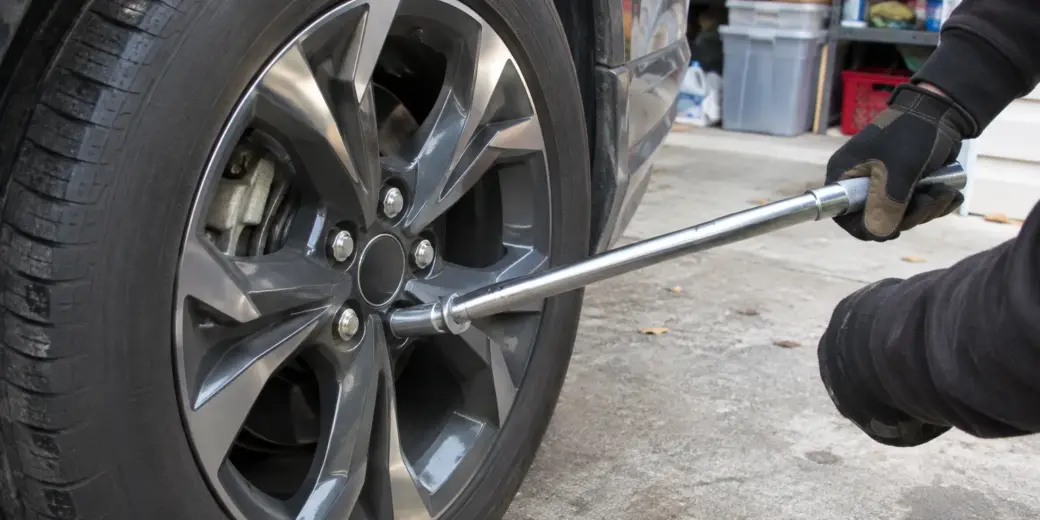
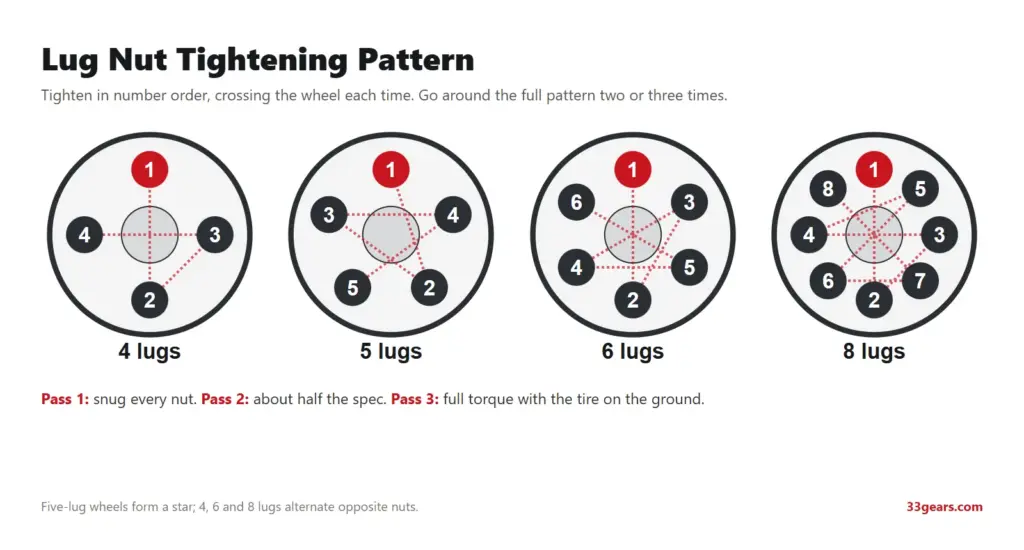
Tighten lug nuts in a star pattern, in two or three passes, and do the final pass with the tire on the ground. You need a 1/2-inch drive click torque wrench that covers at least 150 ft-lb and the right socket for your nuts.
The star pattern pulls the wheel down evenly against the hub. Going around the circle one nut at a time can seat the wheel crooked, which Toyota links to rotor runout and brake vibration.
Do alloy and steel wheels use the same torque?
Usually yes, but not always. Toyota prints separate values for the Tacoma from 2024, the Tundra and the 2026 4Runner: 97 ft-lb with aluminum wheels and 154 ft-lb with steel wheels. The older 4Runner splits 76 and 83. If your truck came with steel wheels or you bought a set of steel winter wheels, read the steel line.
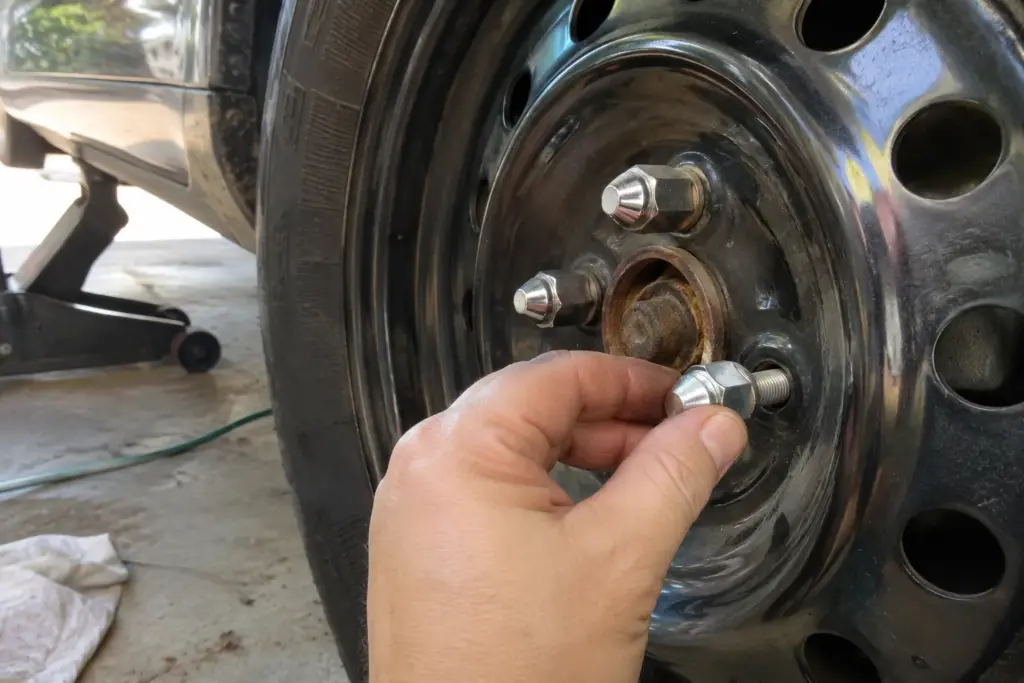
Aftermarket wheels can change more than the torque. A lug nut has to match the stud thread and the wheel’s seat, which comes in three common shapes:
A mismatched seat touches the wheel on a thin ring instead of the full surface. It can loosen, vibrate or crack the wheel even at the right torque. Lug nut makers also require thread engagement at least equal to the stud diameter. For fitment questions beyond the nuts, see the wheel offset calculator.
When to re-check lug nut torque
Re-check after any time the wheels come off, including tire rotations and seasonal swaps. Clamp load can drop a little as new wheels and nuts settle. Automakers do not agree on the distance:
| Source | Re-check after |
|---|---|
| Ram 2500 / 3500 owner’s manual | 25 miles |
| McGard and Gorilla (lug nut makers) | 25 miles |
| Tire Rack, NAPA (new wheels) | 50 to 100 miles |
| Ford F-150 and Super Duty manuals | Within 100 miles |
| Ford dual rear wheel trucks | 100 and 500 miles |
| Toyota Tacoma (2024+) manual | Within 100 miles |
| Nissan and Subaru manuals | About 600 miles |
| Toyota Camry manual | 1,000 miles |
| GM dual rear wheel trucks | 100, 1,000 and 6,000 miles |
If the manual gives a distance, use it. If not, 25 to 100 miles catches a problem early. Let the wheels cool first: a hot wheel gives a false reading.
Impact wrenches and torque sticks
An impact wrench is fine for removing lug nuts and for spinning them on, but not for the final torque. An impact wrench’s output swings from too little to far too much, depending on the tool, the setting and how long you hold the trigger. Toyota tells its technicians not to run nuts all the way down with an impact gun.
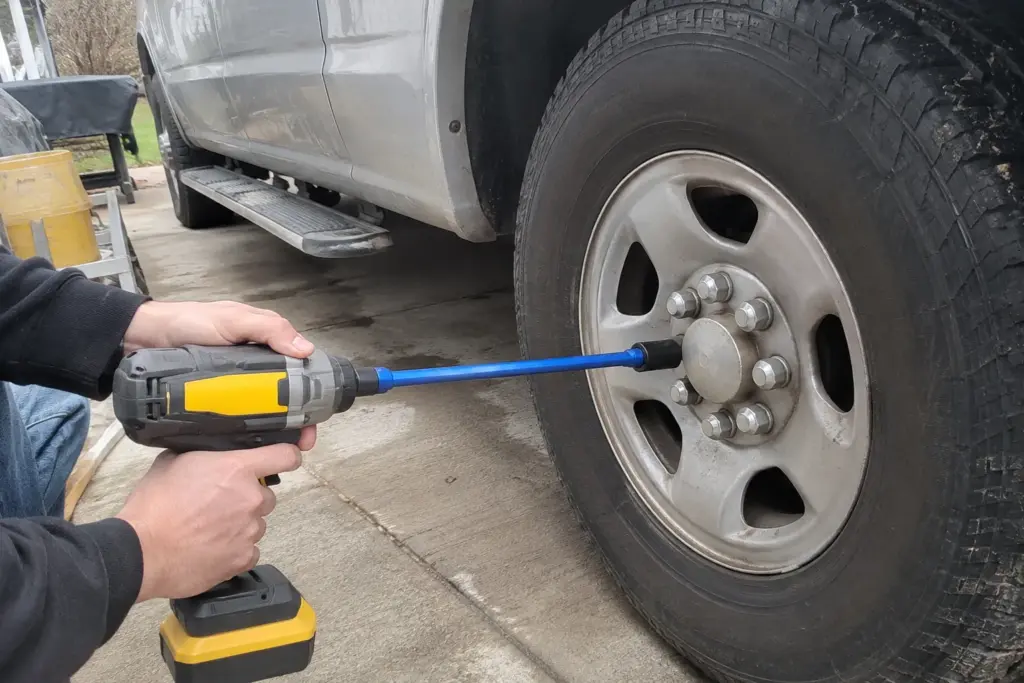
Torque sticks are extensions that flex to cap the torque an impact wrench delivers. Shops use one rated at about two thirds of the spec, then finish with a torque wrench. They wear and lose accuracy over time, so they do not replace the final click.
What happens if lug nuts are too tight or too loose
Both cause real damage. Under-torque is the dangerous one, because the wheel can come off; over-torque causes slower problems you may blame on something else.
Loose lug nuts are serious enough to trigger recalls. In 2019 Mazda recalled 2019 Mazda3 cars because lug nuts on all four wheels could loosen, and in 2023 Toyota recalled Camry cars for loose lug nuts that could let a wheel detach.
Frequently asked questions
Tight to the torque in your owner’s manual, usually 76 to 100 ft-lb for cars and small SUVs and 130 to 165 ft-lb for pickups. Hand-tight or “as tight as you can” is not a substitute for a torque wrench.
Most passenger cars fall between 76 and 100 ft-lb. Toyota and Nissan cars sit at 76 to 83, Honda at 80, and many Ford and Chevrolet cars and crossovers at 100.
It equals 100 pounds of force on a wrench one foot long, or 50 pounds on a two foot bar. That is more than most people apply by feel with a short factory lug wrench.
Yes, for the final pass. Snug the nuts with the wheel in the air, lower the car so the tire carries weight, then torque them to spec in a star pattern.
No. Automakers specify torque for clean, dry threads, and lubricant lets the same torque stretch the stud further and can let nuts loosen later.
Yes. Check them again after a short drive, at the distance in your manual or within 25 to 100 miles if it gives none.
A star or crisscross pattern, moving to the nut across from the one you just tightened. On a five lug wheel that traces a star shape.
Only to run them on, ideally with a torque stick. Do the final tightening with a torque wrench set to the spec in your manual.
Yes. Too much torque stretches studs, can distort the rotor and wheel seats, and makes the nuts very hard to remove with a roadside lug wrench.
Sources
- Toyota. 2026 Tacoma Owner’s Manual, wheel nut torque and retightening
- Toyota Motor Sales. Tech Tip T-TT-0424-16, lug nut torque (via NHTSA)
- Toyota Motor Sales. Service Bulletin L-SB-0151-17, brake vibration and lug nut torque (via NHTSA)
- Mopar. 2022 Ram 2500/3500 Owner’s Manual, torque specifications
- McGard. Lug nut installation instructions
- NAPA Know How. How to tighten lug nuts the right way
- Park Tool. Torque wrench use and care
- Les Schwab. Lug nuts and torque
- NHTSA. Recall 19V425000, 2019 Mazda3 lug nuts
- NHTSA. Recall 23V432000, Toyota Camry lug nuts
- FR Sport. Wheel lug torquing, stud size table

James Kowalski
More from James KowalskiHow we reviewed this article
This article was researched against manufacturer records and editorially reviewed before publishing. We accept no payment for coverage. Some guides contain affiliate links; see our affiliate disclosure.