Short answer: An alert driver in a modern car needs about 110 feet to stop from 30 mph, 230 feet from 50 mph and 305 feet from 60 mph on dry pavement. Wet roads push the 60 mph figure to about 435 feet. Those totals include about 1.5 seconds of reaction time before the brakes do anything.
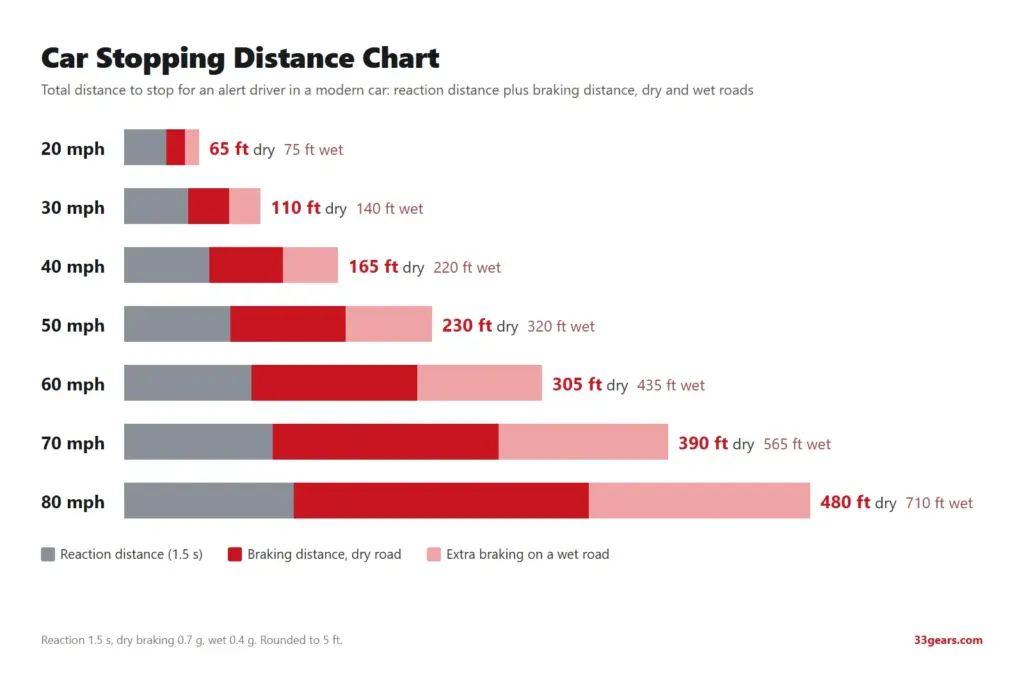
Most drivers underestimate how far a car travels before it stops, because they picture only the braking part. Reaction distance is a big share of the total at every speed, and braking distance grows four times when speed doubles. The chart below gives both parts for 20 to 80 mph on dry and wet roads, and the printable PDF puts the same numbers on one page. For your own car, speed and conditions, use the stopping distance calculator.
This article contains Amazon affiliate links. 33gears earns a commission on qualifying purchases. See our affiliate disclosure.
Car stopping distance chart in feet
Total stopping distance is reaction distance plus braking distance. The figures assume an alert, sober driver, a passenger car with ABS and good tires, and a level road. They line up with the stopping distance table in Virginia law, which courts in that state must accept as fact and which uses the same 1.5 second reaction time. Virginia lists 132 feet of reaction plus 171 feet of braking at 60 mph.
| Speed | Reaction (ft) | Braking, dry (ft) | Total, dry (ft) | Total, wet (ft) | Total, dry (m) |
|---|---|---|---|---|---|
| 20 mph | 45 | 20 | 65 | 75 | 19 |
| 25 mph | 55 | 30 | 85 | 105 | 26 |
| 30 mph | 65 | 45 | 110 | 140 | 33 |
| 35 mph | 75 | 60 | 135 | 180 | 41 |
| 40 mph | 90 | 75 | 165 | 220 | 50 |
| 45 mph | 100 | 95 | 195 | 270 | 60 |
| 50 mph | 110 | 120 | 230 | 320 | 70 |
| 55 mph | 120 | 145 | 265 | 375 | 81 |
| 60 mph | 130 | 170 | 305 | 435 | 93 |
| 65 mph | 145 | 200 | 345 | 495 | 105 |
| 70 mph | 155 | 235 | 390 | 565 | 118 |
| 75 mph | 165 | 270 | 435 | 635 | 132 |
| 80 mph | 175 | 305 | 480 | 710 | 147 |
Distances are rounded to the nearest 5 feet. Real stops vary by a few car lengths either way: a sports car on fresh performance tires stops shorter, and a loaded pickup or an older car without ABS stops longer.
Stopping distance on snow and ice
Snow and ice multiply braking distance because the tires have far less grip. On packed snow a car needs roughly three to four times its dry braking distance, and on ice up to ten times. Reaction distance stays the same, so the gap between dry and icy totals is almost all braking.
| Speed | Dry (ft) | Wet (ft) | Packed snow (ft) | Ice (ft) |
|---|---|---|---|---|
| 20 mph | 65 | 75 | 110 | 200 |
| 30 mph | 110 | 140 | 220 | 450 |
| 40 mph | 165 | 220 | 360 | 750 |
| 50 mph | 230 | 320 | 530 | 1150 |
| 60 mph | 305 | 435 | 730 | 1650 |
| 70 mph | 390 | 565 | 970 | 2200 |
Snow and ice figures use friction values measured with locked wheels, so treat them as a guide. Glare ice near freezing can be even slicker, and winter tires shorten snow and ice stops noticeably.
How stopping distance is calculated
Every number in the chart comes from two short formulas. Reaction distance is speed multiplied by reaction time. Braking distance is speed squared divided by twice the deceleration the tires can deliver.
The step-by-step guide on how to calculate stopping distance covers metric units, worked examples and downhill grades. The stopping distance calculator does the math for any speed, road surface, reaction time and vehicle type.
Why stopping distance grows faster than speed
Braking distance rises with the square of speed: double the speed and the car needs four times the braking distance. From 30 mph a car brakes for about 45 feet. From 60 mph it brakes for about 170 feet. Reaction distance only doubles, so the total almost triples.
This is also why a small speed difference matters in a crash. A car that would stop from 50 mph at the 230 foot mark is still doing about 40 mph at that point if it started from 60 mph.
UK Highway Code stopping distances
The UK Highway Code chart is the one most people find first, and its figures are shorter than the US chart above. It assumes a reaction time of about 0.67 seconds, which only a fully alert driver expecting to brake can match.
| Speed | Thinking (m) | Braking (m) | Total (m) | Total (ft) |
|---|---|---|---|---|
| 20 mph | 6 | 6 | 12 | 40 |
| 30 mph | 9 | 14 | 23 | 75 |
| 40 mph | 12 | 24 | 36 | 118 |
| 50 mph | 15 | 38 | 53 | 175 |
| 60 mph | 18 | 55 | 73 | 240 |
| 70 mph | 21 | 75 | 96 | 315 |
Road safety charity Brake and the Transport Research Laboratory reworked the chart in 2017 with a 1.5 second thinking time. Their totals run from 19 m at 20 mph to 121 m at 70 mph, close to the US numbers above. Use the Highway Code figures for the UK theory test and the longer ones for real driving.
What makes stopping distance longer
Anything that slows your reaction or cuts tire grip adds feet to the chart. These are the factors with the biggest effect:
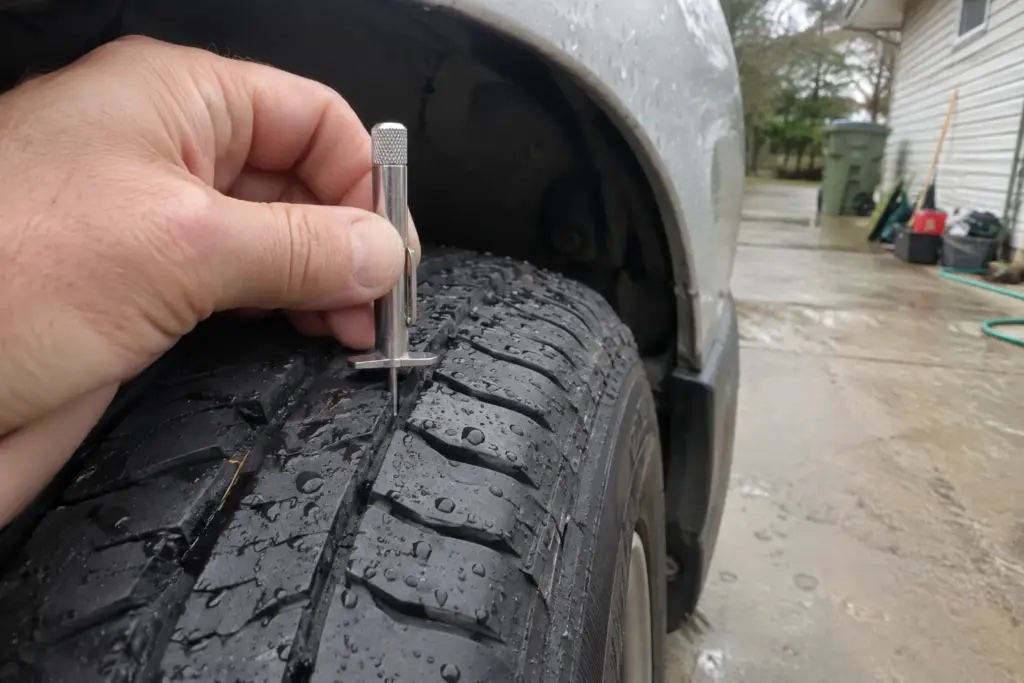
A tread depth gauge costs little and takes the guessing out of tire wear. Replace tires well before the 2/32 inch wear bars show if you drive in rain or snow.
How much following distance to leave
Leave at least 3 seconds between you and the car ahead, and add a second for each hazard such as rain, darkness, heavy traffic or a heavy load. A time gap works at any speed because it stretches as you go faster: 3 seconds at 60 mph is about 265 feet.
A 3 second gap does not cover the full stopping distance at 60 mph. It works because the car ahead also needs room to stop, so you only need enough space to react and match its braking. If the car ahead hits something and stops dead, nothing short of the full stopping distance will do.
Frequently asked questions
About 305 feet on a dry road for an alert driver in a modern car: roughly 130 feet while reacting and 170 feet braking. On a wet road it is about 435 feet.
About 110 feet in total, of which about 65 feet is reaction distance. In the UK Highway Code the figure is 23 metres, or 75 feet.
Counting a car as 15 feet, stopping takes about 7 car lengths at 30 mph, 15 at 50 mph and 20 at 60 mph on a dry road.
No. Braking distance quadruples when speed doubles, and reaction distance doubles, so the total stopping distance nearly triples.
Expect roughly 25 to 45 percent more total distance on wet pavement, and more with worn tires. Some driver manuals round this up to double to build in a margin.
US charts and courts usually use 1.5 seconds, the UK Highway Code uses about 0.67 seconds, and road designers use 2.5 seconds to cover slower drivers.
They assume a very short reaction time and figures that have not changed since the 1960s. Tests with a realistic 1.5 second reaction give totals about a third longer.
Federal standard FMVSS 135 requires a new passenger car to stop from 100 km/h (62 mph) within 70 metres, about 230 feet, in its brake test. That is braking only, with no reaction time.
Sources
- Code of Virginia. Section 46.2-880, Tables of speed and stopping distances
- GOV.UK. The Highway Code, Rule 126
- Brake. Stopping distances
- TxDOT Roadway Design Manual. Stopping sight distance
- Washington State DOT. Report 551.1, pavement friction values
- AAA Newsroom. Worn tires put drivers at risk (2018)
- NHTSA. Kahane, Preliminary evaluation of the effectiveness of antilock brake systems
- NHTSA. Distracted driving
- Williamson and Feyer. Moderate sleep deprivation and alcohol intoxication (2000)
- Georgia DDS. Commercial Driver Manual, stopping distance
- 49 CFR 571.135. Light vehicle brake systems
- Minnesota DPS. Class D Driver’s Manual, following distance

James Kowalski
More from James KowalskiHow we reviewed this article
This article was researched against manufacturer records and editorially reviewed before publishing. We accept no payment for coverage. Some guides contain affiliate links; see our affiliate disclosure.