Short answer: Stopping distance is reaction distance plus braking distance: d = v × t + v² / (2 × μ × g). Multiply your speed (in feet or meters per second) by your reaction time, then add the speed squared divided by twice the deceleration. At 60 mph on dry asphalt with a 1.5 second reaction, that is about 132 + 172 = 304 feet.
Most people who get this wrong forget one of two things: converting mph to feet per second before multiplying, or squaring the speed in the braking part. This guide gives the formula in both US and metric units, works three examples from start to finish and shows how road surface, hills and speed change the answer. To skip the math, use the stopping distance calculator, or read typical values off the car stopping distance chart.
The stopping distance formula
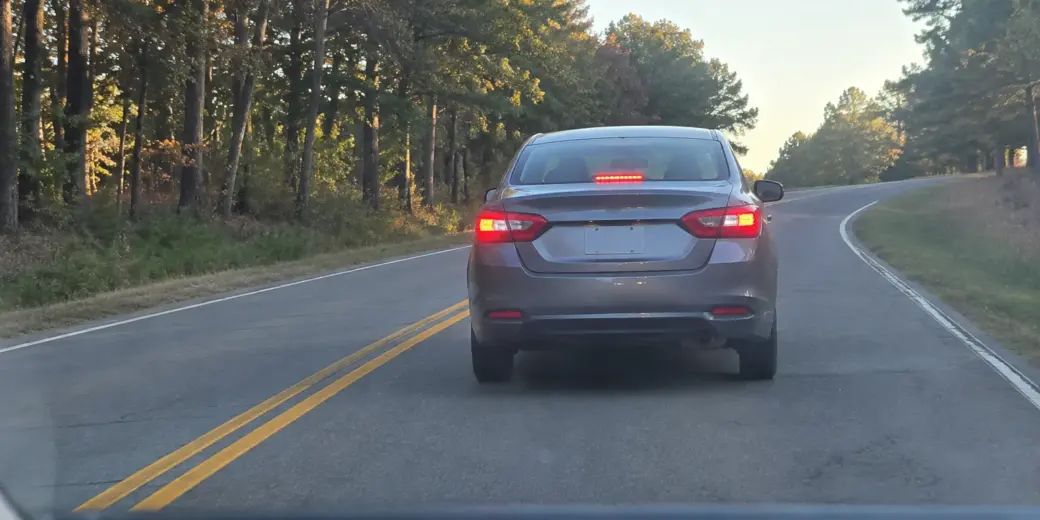
Total stopping distance has two parts. Reaction distance (also called thinking or perception-reaction distance) is how far the car travels at full speed between the moment you see a hazard and the moment your foot presses the brake. Braking distance is how far it travels from that point until it stops.
Written as one line: d = v t + v² / (2 μ g), where v is the starting speed, t the reaction time, μ (mu) the coefficient of friction between tires and road, and g the acceleration of gravity. The braking part comes from the kinematics equation v² = u² + 2as with a final speed of zero. Friction force μmg divided by mass gives the deceleration μg, which is why the car’s weight cancels out.
How to calculate stopping distance step by step
Work through these five steps in order. The example numbers are for 60 mph on a dry road.
Stopping distance worked examples
These three examples cover the cases most homework and driver-ed questions ask about. All use a 1.5 second reaction time.
Example 1: 60 mph, dry road
v = 88 ft/s, μ = 0.7. Reaction: 88 × 1.5 = 132 ft. Braking: 7,744 / 45.1 = 172 ft. Total: 304 feet.
Example 2: 60 mph, wet road
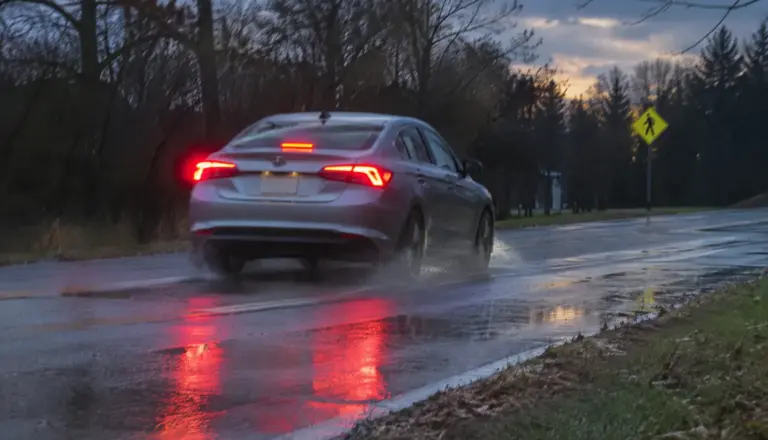
Same speed, μ = 0.4. Reaction distance does not change: 132 ft. Braking: 7,744 / (2 × 0.4 × 32.2) = 301 ft. Total: 433 feet, about 42% longer than dry, with almost all the extra in the braking part.
Example 3: 30 mph, dry road
v = 44 ft/s. Reaction: 44 × 1.5 = 66 ft. Braking: 1,936 / 45.1 = 43 ft. Total: 109 feet. At half the speed, reaction distance is half as long, but braking distance is a quarter as long.
Stopping distance formula in mph and km/h
You can skip the unit conversion with versions of the formula that take speed directly. Road engineers use these, with the deceleration rate a in place of μg.
| Units | Formula | Inputs |
|---|---|---|
| US (feet) | d = 1.47 V t + 1.075 V² / a | V in mph, t in s, a in ft/s² |
| US with friction | d = 1.47 V t + V² / (30 μ) | V in mph, μ unitless |
| Metric (meters) | d = 0.278 V t + V² / (254 μ) | V in km/h, μ unitless |
| Physics (SI) | d = v t + v² / (2 μ g) | v in m/s, g = 9.81 m/s² |
Metric example: 100 km/h = 27.8 m/s. Reaction: 27.8 × 1.5 = 42 m. Braking with μ = 0.7: 27.8² / (2 × 0.7 × 9.81) = 56 m. Total: about 98 meters.
The 1.075 and 30 constants are unit conversions folded into the formula. AASHTO, the body that sets US road design standards, uses 1.47 V t + 1.075 V² / a with a 2.5 second reaction time and a deceleration of 11.2 ft/s², values chosen to cover about 90% of drivers on wet pavement.
Coefficient of friction values for stopping distance
The friction coefficient μ sets the deceleration, so it has the biggest effect on braking distance after speed. Use these values when a problem does not give one:
| Surface | Friction | Deceleration | Braking at 60 mph | Notes |
|---|---|---|---|---|
| Dry asphalt or concrete | 0.7 | 22.5 ft/s² | 172 ft | Standard textbook value; good tires reach 0.8 to 0.9 |
| Wet asphalt | 0.4 | 12.9 ft/s² | 301 ft | Range 0.4 to 0.6 depending on tires and water depth |
| Packed snow | 0.2 | 6.4 ft/s² | 601 ft | Winter tires do better than all-seasons |
| Ice | 0.1 | 3.2 ft/s² | 1202 ft | Can drop lower near freezing with a water film |
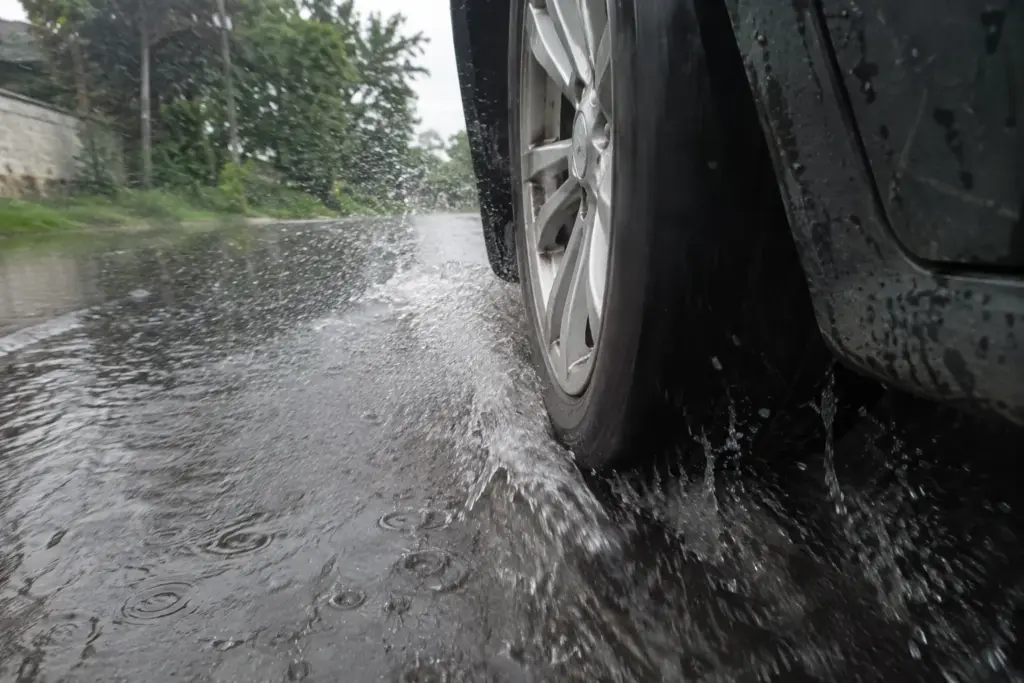
The UK Highway Code gives the same picture in plain terms: stopping distances on wet roads are at least double those on dry roads, and on ice they can be ten times longer. Worn tires, the wrong tires for the season and a heavy load all push the real value below the textbook number.
Why doubling your speed quadruples braking distance
Braking distance depends on speed squared, so it grows much faster than speed itself. Reaction distance grows in a straight line. The table shows both parts for a dry road and a 1.5 second reaction time.
| Speed | Reaction | Braking (dry) | Total (dry) | Total (wet) |
|---|---|---|---|---|
| 20 mph | 44 ft | 19 ft | 63 ft | 77 ft |
| 30 mph | 66 ft | 43 ft | 109 ft | 141 ft |
| 40 mph | 88 ft | 76 ft | 164 ft | 222 ft |
| 50 mph | 110 ft | 119 ft | 229 ft | 319 ft |
| 60 mph | 132 ft | 172 ft | 304 ft | 433 ft |
| 70 mph | 154 ft | 234 ft | 388 ft | 563 ft |
| 80 mph | 176 ft | 305 ft | 481 ft | 710 ft |
Going from 30 to 60 mph doubles reaction distance but multiplies braking distance by four. The kinetic energy the brakes must turn into heat, ½mv², rises the same way. For more speeds, surfaces and the UK Highway Code figures, see the full stopping distance chart.
How to calculate stopping distance on a hill
Add the road grade to the friction term. Going downhill, gravity pulls the car forward and lengthens braking; uphill, it helps the brakes. With G as the grade in decimal form (5% = 0.05):
db = V² / (30 (μ ± G)) in feet with V in mph, using + for uphill and − for downhill. In metric: V² / (254 (μ ± G)) with V in km/h.
Example: 60 mph, dry, 5% downhill. 3,600 / (30 × (0.7 − 0.05)) = 185 ft, versus 171 ft on the flat. On a wet 5% downhill the braking distance reaches 343 ft.
How to calculate speed from skid marks
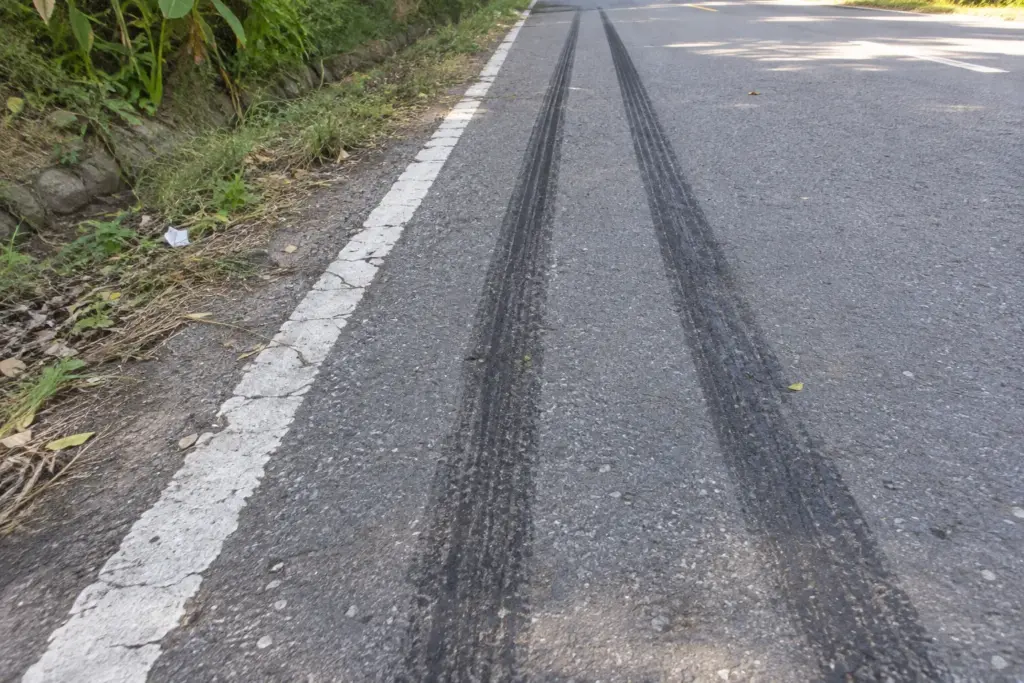
Run the braking formula backwards. If you know the skid length d in feet and the friction coefficient, the speed at the start of the skid is S = √(30 × d × μ) in mph. In metric, S = √(254 × d × μ) in km/h with d in meters.
A 100 foot skid on dry asphalt: √(30 × 100 × 0.7) = 46 mph. This is a minimum: any speed lost before the wheels locked, or energy absorbed in a collision, does not show up in the marks. Cars with ABS rarely leave long dark skids, so crash reconstructionists use data recorders and measured friction instead.
Common mistakes, in one place:
Frequently asked questions
Stopping distance equals reaction distance plus braking distance, written as d = vt + v squared over 2 mu g. Speed must be in feet or meters per second to match g.
Braking distance only counts the distance after the brakes are applied. Stopping distance adds the reaction distance the car travels before the driver presses the pedal.
Physics problems usually give one, often 0.7 to 1.5 seconds. Road design in the US uses 2.5 seconds to cover slower drivers, and the UK Highway Code chart assumes about 0.67 seconds.
In the basic physics formula, no: mass cancels out because heavier cars also press harder on the road. In practice heavy trucks stop in longer distances because their brakes and tires reach their limits sooner.
Divide the speed squared by twice the deceleration, d = v squared over 2a. At 88 feet per second and 22.5 feet per second squared, that gives about 172 feet.
With a 1.5 second reaction time on a dry road, about 388 feet. The UK Highway Code lists 96 meters, or 315 feet, because it assumes a faster reaction.
Braking distance on wet asphalt is roughly 75% longer than dry with a friction coefficient of 0.4. The UK Highway Code advises allowing at least double the stopping distance in the wet.
The brakes have to remove the car’s kinetic energy, which equals one half m v squared. Double the speed and there is four times the energy to turn into heat, so the car needs four times the distance.
Sources
- Georgia State University HyperPhysics. Stopping Distance for Auto
- Georgia State University HyperPhysics. Friction and Automobile Tires
- Texas Department of Transportation. Roadway Design Manual: Sight Distance
- University of Idaho NIATT. Braking Distance
- National Academies Press. NCHRP: Stopping Sight Distance
- GOV.UK. The Highway Code, Rule 126 and typical stopping distances
- GOV.UK. The Highway Code: Driving in adverse weather

James Kowalski
More from James KowalskiHow we reviewed this article
This article was researched against manufacturer records and editorially reviewed before publishing. We accept no payment for coverage. Some guides contain affiliate links; see our affiliate disclosure.