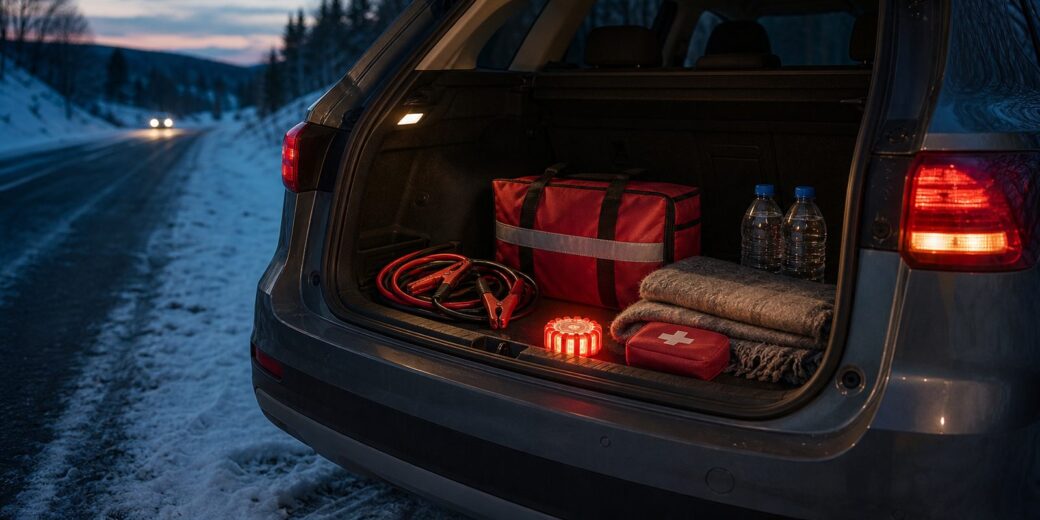
A car emergency kit needs 12 things: a portable jump starter or jumper cables, a 12V tire inflator, a first aid kit, three LED flares or reflective triangles, a flashlight with spare batteries, a phone power bank, a multitool, work gloves, an emergency blanket, drinking water, ration bars and a seatbelt cutter with a window breaker. Water and food scale with the number of people and the days you could be stuck, at one gallon of water per person per day.
Add to that core for your situation. Winter adds a shovel, an ice scraper, traction aids, chains or snow socks and warm layers. A road trip with no cell signal adds a tow strap, a tire plug kit, a paper map and a spare fuel can. Kids, babies and pets each add their own supplies. Set your climate, trip and passengers in the builder below, press Show results and it returns your kit with quantities. The reasoning follows the results.
Some links on this page are affiliate links. If you buy through them we may earn a commission at no extra cost to you. See our affiliate disclosure.
Build your kit
Build your kit
Pick what fits. The checklist changes as you go.
8 litres, a 2-day supply
21 still to buy0 already packed


Some links on this page are affiliate links. If you buy through them we may earn a commission at no extra cost to you. See our affiliate disclosure.
-
 Portable jump starter or jumper cables×1
Battery power drops as the temperature falls while gas and diesel engines need more of it to start (NHTSA), and a charged jump starter restarts the car without waiting for a second vehicle to stop.
Recharge it every season -
 12V tire inflator with gauge×1
AAA found 28 percent of 2017 model-year cars had no spare tire, and NHTSA notes tire pressure drops as the temperature falls, so a 12V inflator is often what gets you to a tire shop.
Check spare + inflator -
 Multitool or pocket knife×1
The Red Cross puts a multi-purpose tool on its minimum supply list, and the CDC's winter car kit includes a pocket knife.
-
 Work gloves×1
Work gloves are on the Red Cross supply list and protect your hands from hot engine parts, sharp edges and cold metal when you change a tire.
-
 Bag of sand or cat litter1 bagAdded: Cold & snow
Ready.gov, NHTSA and the CDC all list sand or cat litter, which you pour under the drive wheels for grip when the car is stuck in snow.
-
 Find your chain sizeTire chains or snow socks1 setAdded: Cold & snow
Ready.gov says to carry any chains or studs your area requires, and the CDC puts tire chains in its winter car kit.
Sized for your tires -
 Tire traction mats×2Added: Cold & snow
NHTSA recommends carrying abrasive material in case the car gets stuck in snow, and traction mats do the same job as sand but can be reused.
-
 LED road flares or reflective warning triangles×3
Federal truck rules rate a burning fusee for 30 minutes and ban flame signals on vehicles carrying flammable cargo, while battery LED flares or reflective triangles warn traffic with no open flame near leaking fuel.
Test batteries -
 Flashlight or headlamp with spare batteries×1
The National Weather Service lists a flashlight with extra batteries for every car kit and warns not to depend on mobile devices with limited battery life.
Spare batteries packed -
 Seatbelt cutter and window breaker×1
In a car going into water you have about 60 seconds to get out through a side window, and experts advise keeping a glass breaker with a belt cutter on the visor, keychain or console, not in the glove box.
Within reach of driver -
 Bright cloth or flag for the antenna×1Added: Cold & snow
NHTSA says to let a stalled car be seen in winter weather by putting bright markers on the antenna or windows and leaving the dome light on.
-
 First aid kit×1
NHTSA lists a first aid kit, including a tourniquet, for every car, and the Red Cross says to check expiration dates and replace used or expired contents.
Replace expired items
-
 Emergency blanket or bivvy×1
The Red Cross includes an emergency blanket in both its basic survival kit and its family first aid kit, and a foil blanket packs smaller than a deck of cards.
One per person -
 Folding snow shovel×1Added: Cold & snow
NHTSA's winter list starts with a snow shovel, and if you are stuck it is how you keep snow off the exhaust pipe, which NHTSA says must stay clear to avoid carbon monoxide poisoning.
-
 Ice scraper and snow brush×1Added: Cold & snow
Ready.gov, NHTSA and the CDC all put an ice scraper on their winter car lists, and NHTSA adds a broom to clear snow off the car.
-
 Wool blanket or sleeping bag×1Added: Cold & snow
NHTSA, Ready.gov and the NWS all list blankets or sleeping bags for a winter car, on top of a foil emergency blanket, because NHTSA's advice when stranded is to stay with the car.
One per person -
 Air-activated hand warmers1 pairAdded: Cold & snow
Each air-activated hand warmer gives up to 10 hours of heat (HotHands) without the engine running, and NHTSA says to run a stuck car only sporadically because of carbon monoxide.
Single use; restock -
 Spare hat, gloves and warm layers1 setAdded: Cold & snow
The CDC lists extra hats, coats and mittens for the winter car kit and the NWS adds spare clothing to keep dry.
One set per person
-
 Drinking water2 gal (8 L)
Water expands about 9 percent when it freezes (USGS), so leave headroom in bottles or carry pouches rated down to -22°F, on top of Ready.gov's one gallon per person per day.
Self-filled: replace every 6 mo -
 Emergency ration bars6 bars
The National Weather Service recommends high-calorie, non-perishable food, and ration bars such as Datrex are rated for 5 years at -22°F to 149°F, which suits a car trunk.
Check expiry date
-
 Phone power bank and car charging cable×1
Ready.gov lists a car phone charger and the CDC adds a portable charger, and a power bank keeps the phone alive even when the car battery is dead.
Charged? Cable packed?
Already packed (0)
Everlit Road Guardian covers 8 of your 21 items.
Add these 13 to finish the list:
- Multitool
- Sand or kitty litter
- Tire chains
- Traction mats
- Bright marker
- Snow shovel
- Ice scraper
- Wool blanket
- Hand warmers
- Warm layers
- Water
- Food bars
- Power bank
Some links on this page are affiliate links. If you buy through them we may earn a commission at no extra cost to you. See our affiliate disclosure.

Car emergency kit checklist
Built for: Cold and snow · Highway and regional · 1 adult · Car
Packed onCheck again on
Check the kit every 6 months.
Page: https://33gears.com/car-emergency-kit-checklist/?ekc=cold&ekt=regional&eka=1&ekv=car
Some links on this page are affiliate links. If you buy through them we may earn a commission at no extra cost to you. See our affiliate disclosure.
| Pick | Product | Amazon |
|---|---|---|
| Best overall kit | AAA Excursion | Find on Amazon |
| Most complete roadside kit | Everlit Road Guardian | Find on Amazon |
| Best kit with a tool box | LIANXIN Roadside Kit | Find on Amazon |
| Best first aid coverage | Swiss Safe 2-in-1 | Find on Amazon |
| Best food-and-water starter | Ready America 72-Hour | Find on Amazon |
| Best jump starter | NOCO GB40 | Find on Amazon |
| Best jumper cables | Energizer 6-gauge cables | Find on Amazon |
| Best tire inflator | AstroAI AIRUN H | Find on Amazon |
| Best compact first aid kit | First Aid Only 10-Person | Find on Amazon |
| Best LED road flares | Tobfit LED flares | Find on Amazon |
| Best escape tool | resqme | Find on Amazon |
| Best crank weather radio | Midland ER310 | Find on Amazon |
| Best traction mats | Escaper Buddy | Find on Amazon |
| Best emergency blanket | SOL Emergency Bivvy | Find on Amazon |
| Best emergency water | Datrex water | Find on Amazon |
| Best ration bars | Datrex 3600 | Find on Amazon |
Car emergency kit checklist: what to keep in your car
What should be in a car emergency kit? These 12 items, each with the reason it earns the space. The builder calls them the core.
- Portable jump starter or jumper cables. Battery power drops as the temperature falls, while gas and diesel engines need more of it to start (NHTSA). A charged jump starter restarts the car without waiting for another vehicle to stop. See the comparison below.
- 12V tire inflator with a gauge. AAA found that 28 percent of 2017 model-year cars shipped without a spare tire. NHTSA notes that tire pressure also drops as the temperature falls. An inflator is often what gets you to a tire shop.
- First aid kit. A car first aid kit covers cuts, burns and scrapes until help arrives. NHTSA lists one, with a tourniquet, in its winter kit. The Red Cross says to replace used and expired contents.
- Three LED flares or reflective triangles. Federal rules rate a burning flare for 30 minutes and ban flame signals on trucks carrying flammable cargo. A battery flare warns traffic with no open flame near leaking fuel. Three is the number federal rules require on a truck. For a car it is our recommendation.
- Flashlight or headlamp with spare batteries. The National Weather Service lists both, and warns against depending on a phone with limited battery life.
- Phone power bank and car charging cable. Ready.gov lists a car phone charger and the CDC adds a portable charger. A power bank keeps the phone working when the car battery is dead.
- Multitool or pocket knife. The Red Cross puts a multi-purpose tool on its minimum supply list, and the CDC includes a pocket knife in its winter car kit.
- Work gloves. They protect your hands from hot engine parts, sharp edges and cold metal while you change a tire or connect cables.
- Emergency blanket, one per person. The Red Cross includes one in both its basic survival kit and its family first aid kit. It packs small enough for a door pocket.
- Drinking water. Ready.gov’s baseline is at least one gallon per person per day. Sealed emergency pouches are easier to leave in a car than bottles you fill yourself.
- Ration bars. The National Weather Service recommends high-calorie, non-perishable food. Plan on three 400-calorie bars per person per day.
- Seatbelt cutter and window breaker. A car going into water gives you about 60 seconds to get out through a side window. Keep the tool on the visor, a keychain or the console, not in the glove box. These tools do not break laminated glass, which includes windshields and some side windows.
To size water and food, multiply people by days by one gallon. A commute counts as 1 day, a regional trip as 2 and a remote trip as 3, which matches the Red Cross three-day supply at the top end. Older kids count as a full person, because Ready.gov says children may need more water. Babies and pets count as half. Two adults and a baby on a remote trip need 2.5 people x 3 days = 7.5 gallons.
For an emergency kit checklist printable, set your inputs in the builder and use Print checklist. It prints one page with tick boxes, your quantities, a short reason for each item and a line for the date of your next check. The list matches your car and your passengers, which a generic PDF cannot.
Jumper cables or a jump starter?
Buy a jump starter if you drive alone, at night or on roads where few cars pass. Keep cables as a backup if you have the room. The two differ in what they need to work.
- Jumper cables need a second running vehicle and someone willing to stop. Nothing needs charging, and a set costs less. A 16-foot, 6-gauge set reaches between cars without nose-to-nose parking. The cables bundled in kits are shorter and thinner: 10 feet and 8 gauge in the AAA Excursion kit, 12 feet and 8 gauge in the Everlit kit.
- A jump starter starts the car alone. NOCO’s GB40 weighs 2.5 pounds, is rated at 1,000 peak amps for gas engines up to 6.0 liters and diesels up to 3.0 liters, and delivers up to 20 starts per charge by NOCO’s figures. It also charges a phone. It does nothing if it is flat, so recharge it at every kit check.
Tesla says the Model 3 cannot be used to jump-start another vehicle, so an EV owner cannot count on cables from a neighbor’s EV either. The EV section below covers what to carry instead.
Winter car emergency kit
A winter car emergency kit adds nine items to the core 12: a folding snow shovel, an ice scraper and snow brush, a bag of sand or cat litter, traction mats, tire chains or snow socks, air-activated hand warmers, a wool blanket for each person, spare hat, gloves and warm layers, and a bright cloth for the antenna. The builder adds them when you choose cold and snow, and defaults to that from October through March.
NHTSA’s advice for a stranded winter driver is to stay with the car. That shapes the kit. The shovel does two jobs: it digs you out, and it keeps snow off the exhaust pipe, which NHTSA says must stay clear to avoid carbon monoxide poisoning. NHTSA also says to run the engine only sporadically, just long enough to stay warm. Hand warmers and wool fill the gaps between runs. HotHands rates each warmer at up to 10 hours of heat. A foil blanket alone is not enough for a long wait, so the winter kit adds wool on top of it.
Sand or litter under the drive wheels is the traditional fix for a car stuck in snow, and Ready.gov, NHTSA and the CDC all list it. Traction mats do the same job and can be reused, but they are bulky: the Maxsa Escaper Buddy pair is two 48-inch mats and weighs about 17 pounds. Mats are our addition, not an agency recommendation. Tie a bright cloth to the antenna or a window and leave the dome light on, as NHTSA advises, so others can see the car.
Chains are the one winter item you buy by part number, not by size. Our tire chain size finder turns your tire size into the right type of device and shows what your state requires. If you drive in snow every week, winter tires do more than chains in the trunk, and our guide to the benefits of winter tires explains the trade.
Keep the fuel tank close to full all winter, as NHTSA advises, and check tire pressure after a cold night. A full tank also lets you run the heater in short bursts if you are stranded.
Hot-weather and summer kit
A hot-weather kit changes the water more than anything else. Ready.gov says water needs can double in very hot temperatures, so the builder doubles the quantity when you pick hot and dry: a regional trip for two adults goes from 4 gallons to 8. It adds a windshield sunshade and a cooling towel for each person. The CDC’s heat advice is to stay cool and drink plenty of fluids, and a wet towel helps when the engine and the air conditioning are off.
A sunshade blocks direct sun through the glass while you wait for a tow. It does not make a parked car safe. NHTSA says that rolling the windows down or parking in the shade does little to change the interior temperature, and that a child’s body temperature rises three to five times faster than an adult’s. The National Weather Service says it is never safe to leave a toddler or a pet locked in a car. If you break down in summer, the children and the dog get out of the car with you and into real shade.
Storms and floods
In storm and flood-prone areas the builder adds a hand-crank NOAA weather radio, a rain poncho for each person and a waterproof bag for your phone and documents. NOAA Weather Radio broadcasts National Weather Service warnings 24 hours a day, and a crank radio gets them with no cell signal. Ready.gov warns that one foot of moving water can sweep a vehicle away, so a flooded road is a place to turn around.
Road trip emergency kit
A road trip emergency kit adds six items to the core 12 for routes with long gaps between towns and no cell signal: a tow strap, a tire plug kit, a paper map with a compass, a spare fuel can, a safety whistle and a toilet kit of bags, tissues and wipes. The builder adds them when you choose road trip and remote.
- Tow strap. The National Weather Service and the CDC both list a tow rope, so another vehicle can pull you out of a ditch or a snowbank.
- Tire plug kit. Many new cars carry a sealant kit instead of a spare. AAA says those kits cannot fix many punctures and expire after 4 to 8 years. A plug kit is a second way to seal a tread puncture far from a shop. It only fixes tread punctures, so pair it with the inflator.
- Paper map and compass. The National Weather Service says not to depend on a mobile device with limited battery life.
- Spare fuel can. Ready.gov and NHTSA both say to keep the tank close to full. A sealed can covers the stretches where stations are far apart. The builder drops it for EVs.
- Whistle. The Red Cross lists one for signaling for help. It needs no battery and no signal.
- Toilet kit. The National Weather Service lists tissues and an improvised toilet for a stranded car.
The water and food total is the biggest change on a remote trip. Two adults need 6 gallons and 18 bars for 3 days, and 12 gallons if the trip is also hot. That volume is the argument for 125 ml pouches: they fit around luggage, where jugs do not.
Kids, babies and pets
A kit for children and pets adds food, comfort and care items, and raises the water total. The builder adds them with the toggles for babies and toddlers, older kids and a dog or cat.
- Babies and toddlers: diapers and wipes, formula, bottles or baby food, and snacks. The Red Cross lists diapers, bottles, formula and baby food among the supplies to add for an infant.
- Older kids: familiar shelf-stable snacks and paper games. Familiar snacks usually go over better than ration bars on a long wait. The Red Cross lists games and activities for children, and paper games need no battery.
- Dogs and cats: a collapsible bowl, a spare leash, collar and ID tag, several days of food in an airtight container, and a pet first aid kit. Ready.gov lists each of these, plus any medicine your pet takes in a waterproof container. Ask your vet what to put in the first aid kit.
- Someone with medical needs: a pouch holding a 7-day supply of medications and a list of them, which the Red Cross recommends. NHTSA’s car kit also includes any necessary medicine.
Ready.gov gives no volume of water for pets, so the builder counts a pet as half a person, as it does a baby. Treat those as planning numbers and add water if you travel with a large dog in summer. Carry one escape tool per adult. Never leave a child or pet in a parked car. NHTSA counts 31 child heatstroke deaths in vehicles in 2025.
EVs: what changes
An EV carries the same core kit with three changes: no fuel can, a charging cord and a different jump-start plan. The builder makes the first two when you choose EV.
- Carry a jump starter, not cables. The 12V battery in an EV can go flat like any other. Tesla’s Model 3 owner’s manual says the car cannot be used to jump-start another vehicle, and its jump-start instructions assume a portable jump starter.
- Carry a portable Level 1 charging cord. Most EVs ship with one. It charges from any standard 120V outlet and adds about 40 miles in 8 hours for a mid-size EV, according to the U.S. Department of Energy. That can be enough to reach a charging station. Add a J1772 or NACS adapter if your car needs one.
- Plan for cold. NHTSA says cold weather reduces the driving range of electric and hybrid vehicles, and advises keeping the battery charged and minimizing drain on it. The hand warmers, wool blanket and warm layers in the winter kit keep you warm without drawing on the battery.
Everything else on the checklist applies. An EV still gets flat tires, so keep the inflator.
Pre-made kit vs build your own
A pre-made roadside emergency kit saves time and gives you a bag, but none of the five kits on this page holds all 12 core items. The most complete covers 8. We counted each kit’s core items from the contents list on its listing or retailer page.
| Kit | Core items covered | Core items missing |
|---|---|---|
| Everlit Road Guardian | 8 of 12 | Power bank, multitool, water, ration bars |
| Lifeline AAA Excursion, 76 piece | 6 of 12 | Power bank, multitool, blanket, water, ration bars, escape tool |
| LIANXIN Roadside Kit | 5 of 12 | Inflator, first aid kit, power bank, gloves, blanket, water, ration bars |
| Ready America 72 Hour, 1 person | 4 of 12, with water and food below this guide’s quantities | Jump starter, inflator, flares, flashlight, power bank, multitool, gloves, escape tool |
| Swiss Safe 2-in-1, 378 piece | 3 of 12 | Inflator, flares, flashlight, power bank, multitool, blanket, water, ration bars, escape tool |
Three patterns show up. First, no kit includes a power bank. Second, only the Ready America pack has water and food, and it has no jump starter or inflator. Third, the cables in the kits are shorter and thinner than a standalone 16-foot, 6-gauge set. Roadside kits cover the breakdown. They do not cover weather, a long wait or the people in the car.
The practical answer is a hybrid. Buy the kit with the best coverage for the bag and the bulky parts, then add what the table says it lacks. Build from scratch if you want better single items, such as a lithium jump starter in place of cables, or if the winter, hot-weather or road trip sections apply to you.
Best car emergency kits for 2026
The cards below cover five pre-made kits and eleven single items, each a named product with a published contents list or specification. Kits with no published contents list are left out. Each link opens an Amazon search for the product name, and the coverage counts match the table above. Where a figure is the maker’s claim and not a tested one, the card says so.
Best overall kit: Lifeline AAA Excursion Road Kit, 76 Piece
Some links on this page are affiliate links. If you buy through them we may earn a commission at no extra cost to you. See our affiliate disclosure.

Best overall kit
Best for: Drivers who want the two breakdown basics, a compressor and booster cables, plus first aid in one case.
- Type
- Pre-made kit
- Pieces
- 76 pieces
- Covers
- 6 checklist items
- Price
- Mid
Lifeline makes the AAA-branded road kits. This one pairs a 12V air compressor with 10-foot, 8-gauge booster cables, an 11.5-inch reflective triangle, a 9-LED flashlight, cotton gloves, basic hand tools and a first aid kit, in a dual-compartment bag.
Pros
- Has both a tire compressor and booster cables
- AAA-specified contents list published by the retailer
- First aid kit and flashlight included
Cons
- Cables are 10 feet and 8 gauge, short and thin next to standalone sets
- No emergency blanket, escape tool, water or food
- One triangle where three are standard for trucks
Contents per the AAA store and Academy listings: AAA bag, warning triangle, air compressor with gauge, 9-LED aluminum flashlight, cotton gloves, Phillips and flat screwdrivers, pliers, 2 shop cloths, bungee cord, 10 cable ties, 10 ft 8-gauge booster cables, first aid kit. Item number 4388AAA.
Most complete roadside kit: Everlit Survival Car Emergency Kit (Road Guardian)
Most complete roadside kit
Best for: One purchase that covers most of the core checklist, including the escape tool and blanket most kits leave out.
- Type
- Pre-made kit
- Pieces
- –
- Covers
- 10 checklist items
- Price
- Mid
Everlit packs a digital 12V tire inflator with auto shut-off, 12-foot 8-gauge jumper cables, a 108-piece first aid kit, a 12-foot tow rope, a reflective triangle, a glass breaker with seatbelt cutter, a space blanket, a rain poncho, gloves and a flashlight. Everlit is a veteran-owned company.
Pros
- Covers 8 of the 12 core items in one bag
- Inflator stops at a preset pressure
- Adds a tow rope, poncho and escape tool
Cons
- Jumper cables are 8 gauge, lighter than a 6-gauge set
- No water or food
- One reflective triangle
Listing contents: digital 12V air compressor with LED light and 3 nozzles; 12 ft 8-gauge copper-clad aluminum jumper cables (UL listed); 108-piece first aid kit; 12 ft tow rope rated 10,000 lb breaking strength; reflective warning triangle; glass breaker; seatbelt cutter; safety gloves; space blanket; rain poncho; flashlight; cable ties, bungee cords, electrical tape. 1-year warranty per the listing. Total piece count not stated.
Best kit with a tool box: LIANXIN Emergency Roadside Kit for Car
Best kit with a tool box
Best for: Drivers who want cables, a tow rope, an escape tool and a small set of hand tools in a hard case.
- Type
- Pre-made kit
- Pieces
- –
- Covers
- 8 checklist items
- Price
- Budget
A hard plastic tool box with 8.2-foot jumper cables, a 9.85-foot tow rope, a safety hammer with a built-in seatbelt cutter, a hand-cranked LED flashlight, a reflective triangle, a rain coat, a reflective vest and a plastic ice and frost scraper. The tool tray holds pliers, a utility knife, three screwdrivers, a tape measure and a test pen.
Pros
- Hand-cranked flashlight needs no batteries
- Includes an escape hammer and a tow rope
- Hand tools are in a fitted hard case
Cons
- Jumper cables are short at 8.2 feet
- No tire inflator and no first aid kit in the box list
- The "snow shovel" is a windshield scraper, not a digging shovel
Box list from the listing: jumper cables (8.2 ft, UL certified), safety hammer and seatbelt cutter, tow rope (9.85 ft, iron hooks), hand-driven LED flashlight, reflective warning triangle, elastic and tie rope, rain coat, "glass snow shovel" (an ABS frost scraper), tool box 14 x 10 in. Bullets also mention "life blankets" and a compass, which are not in the box list, so the blanket is not counted.
Best first aid coverage: Swiss Safe 2-in-1 Car First Aid Kit and Roadside Essentials, 378 Pieces
Best first aid coverage
Best for: Families who want a large first aid kit and a few roadside basics, and will add their own inflator and lights.
- Type
- Pre-made kit
- Pieces
- 378 pieces
- Covers
- 6 checklist items
- Price
- Premium
Swiss Safe pairs a two-sided hard-case first aid kit with 348 medical items and a nylon roadside bag: 12-foot 10-gauge jumper cables, an ice scraper, a tire pressure gauge, work gloves, a socket set, a poncho, a high-visibility vest, a whistle and glow sticks.
Pros
- 348-item first aid kit, the largest here
- Ice scraper and tire gauge for winter checks
- Bag has room to add your own items
Cons
- 10-gauge cables are the lightest in this guide
- No tire inflator, flashlight or road flares
- Glow sticks and a vest are not a substitute for warning lights
Roadside items per the listing: 10-gauge 12 ft jumper cables (120-200 A), ice scraper, tire pressure gauge (5-50 PSI), reversible screwdriver, work gloves, 18-piece socket set, electrical tape, compressed towel, emergency poncho, safety vest, emergency whistle, glow sticks, bungee cord, zip ties; plus 348 first aid items.
Best food-and-water starter: Ready America 72 Hour Emergency Kit, 1 Person

Best food-and-water starter
Best for: Adding the food, water and shelter layer that roadside kits leave out.
- Type
- Pre-made kit
- Pieces
- –
- Covers
- 6 checklist items
- Price
- Budget
A one-person backpack built for the first 72 hours: a 2,400-calorie Mayday food bar, six sealed water pouches, an emergency blanket, a poncho, an 18-piece first aid kit, nitrile gloves, a dust mask, tissues, a 12-hour lightstick and a whistle. Ready America states a 5-year shelf life for the food and water.
Pros
- Food and water rated for 5 years
- Blanket, poncho and whistle included
- Pairs with any roadside kit
Cons
- Six pouches is far less than Ready.gov's gallon per person per day
- No breakdown tools, cables or lights
- One person per pack
Contents per the listing: 1 Mayday 2,400-calorie food ration, 6 Mayday water pouches (5-year shelf life), survival blanket, poncho, 18-piece first aid kit, 2 nitrile gloves, dust mask, 10-count tissue pack, 12-hour green lightstick, whistle with lanyard, backpack. covers_partial: water and food are present but below this guide's per-day quantities.
Best jump starter: NOCO Boost Plus GB40 1000A UltraSafe Lithium Jump Starter
Best jump starter
Best for: Starting a car alone, with no second vehicle, including an EV's 12V battery.
- Type
- Single item
- Fills
- Jump starter
- Price
- Premium
A 2.5-pound lithium pack rated at 1,000 peak amps for gas engines up to 6.0 liters and diesels up to 3.0 liters. NOCO's spark-proof clamps and reverse-polarity protection make a wrong connection harmless. It also charges a phone over USB and has a 100-lumen light.
Pros
- No second car needed
- Spark-proof, reverse-polarity protected clamps
- Doubles as a phone power bank and flashlight
Cons
- Must be kept charged to be useful
- Sized for engines up to 6.0 L gas and 3.0 L diesel
Per listing and no.co: 1000 A peak, 12V, up to 20 starts per charge, IP65 housing, recharges in 3 hours over USB-C, 2.5 lb, 1-year warranty. For EVs, use it on the 12V jump posts as the owner's manual directs; Tesla says its cars cannot jump other vehicles.
Best jumper cables: Energizer 6 Gauge 16 ft Jumper Cables

Best jumper cables
Best for: A low-cost backup that never needs charging, as long as someone stops to help.
- Type
- Single item
- Fills
- Jump starter
- Price
- Budget
Sixteen-foot, 6-gauge copper-clad aluminum cables with vinyl-coated clamps and a carry bag. The length reaches from one car to another without parking nose to nose, and Energizer says the cable stays flexible down to -40°C.
Pros
- Nothing to charge or forget
- 16 ft reach between cars
- 6 gauge, heavier than the 8- and 10-gauge cables in the kits above
Cons
- Needs a second running vehicle
- Copper-clad aluminum, not pure copper
- Not for jumping from an EV
Per listing: 6 gauge, 16 ft, copper-clad aluminum, flexible to -40°C, carry bag included. Other Energizer sets (1 to 8 gauge, 12 to 30 ft) share the search name.
Best tire inflator: AstroAI AIRUN H Tire Inflator Portable Air Compressor, 12V DC
Best tire inflator
Best for: Topping up a low tire, or reinflating after a plug, from the 12V socket.
- Type
- Single item
- Fills
- Tire inflator
- Price
- Mid
You set the target pressure on a backlit display and the compressor stops when it gets there. It plugs into the 12V socket with a 9.8-foot cord, weighs 2.2 pounds and has an LED work light.
Pros
- Auto shut-off at the preset pressure
- Cord reaches all four tires
- Small enough for the glove box or trunk well
Cons
- Needs the car's 12V socket, so no use with a dead battery
- Shuts off after 15 minutes of continuous use to cool
- Not for large inflatables
Per listing: 120 W motor, up to 35 L/min, 30 to 36 PSI on a 195/65R15 in under a minute (maker figure), 15 A fuse, 9.84 ft cord, auto shut-off after 15 minutes with a 10-minute cool-down, 2-year limited warranty.
Best compact first aid kit: First Aid Only 10-Person Compact First Aid Kit, 57 Pieces
Best compact first aid kit
Best for: A compact, organized kit for cuts, scrapes and burns that fits under a seat.
- Type
- Single item
- Fills
- First aid kit
- Price
- Budget
A 57-piece kit in a hard plastic case with compartments: fabric and plastic bandages, antibiotic ointment, antiseptic towelettes, burn cream, gauze, gloves, scissors and tweezers. Add an emergency blanket and any personal medicines to match the Red Cross list.
Pros
- Hard case with labelled compartments
- Covers wounds and burns
- Small enough for under a seat
Cons
- No tourniquet, which NHTSA lists
- Emergency blanket not in the listed contents
- Sized for minor injuries
Per listing: 57 pieces, plastic case, rated by the maker for up to 10 people. Contents include adhesive fabric and plastic bandages, antibiotic ointment, BZK towelettes, burn cream, gauze roll and pads, gloves, scissors, tweezers.
Best LED road flares: Tobfit LED Road Flares, 6 Pack
Best LED road flares
Best for: Warning traffic at night or in snow without an open flame.
- Type
- Single item
- Fills
- LED flares
- Price
- Budget
Six battery LED discs with 9 flashing modes, a magnet to stick them to the car body and a fold-out hook. Tobfit rates the housing IP67 and says a disc can be driven over. Each takes three AAA batteries.
Pros
- No flame, no burnout after 30 minutes
- Magnetic base and hook
- Six discs, enough for the front and rear of the car
Cons
- Batteries not included
- Check and replace batteries each season
- Visibility figures are the maker's
Per listing: 6 discs plus storage bag, 3 x AAA per disc (not included), 9 modes, IP67, magnet base, hook. Tobfit claims visibility up to 1 mile at night and a 30-ton crush rating; neither is independently verified here.
Best escape tool: resqme Car Escape Tool (seatbelt cutter and window breaker)
Best escape tool
Best for: Keeping a belt cutter and glass breaker on the driver's keychain, where you can reach it.
- Type
- Single item
- Fills
- Escape tool
- Price
- Budget
A keychain tool with a blade for a jammed seatbelt and a breaker for tempered side windows. Made in the USA and first sold to firefighters and EMTs, per resqme.
Pros
- Lives on the keychain, within reach
- Cuts belts and breaks tempered glass, per resqme
- Made in the USA
Cons
- Breaks tempered glass only, not laminated windows
- Small, so practice finding it by feel
- One tool per person is best
Per listing: 2-in-1 seatbelt cutter and tempered-glass window breaker, works underwater, made in USA. Many windshields and some side windows are laminated and will not break this way; check your window labels.
Best crank weather radio: Midland ER310 Emergency Crank Weather Alert Radio

Best crank weather radio
Best for: Getting NOAA weather alerts when there is no cell signal and the car battery is off.
- Type
- Single item
- Fills
- Crank radio
- Price
- Mid
An AM/FM radio with NOAA Weather Radio alerts that runs on its rechargeable battery, a solar panel, a hand crank or six AA batteries. It has a USB output to charge a phone and an LED flashlight with an SOS beacon.
Pros
- Four ways to power it
- NOAA weather alerts, not just the weather band
- Charges a phone over USB
Cons
- Bigger than a pocket radio
- Charges over micro USB, not USB-C
Per the Midland user guide: NOAA Weather Radio with alerts, AM/FM, rechargeable Li-ion battery plus solar and hand crank, 6 x AA backup compartment, USB output, LED flashlight with SOS, ultrasonic dog whistle, about 5.5 h full charge over USB.
Best traction mats: Maxsa Escaper Buddy Traction Mats (pair)
Best traction mats
Best for: Drivers in snow country who would rather not carry a bag of sand.
- Type
- Single item
- Fills
- Traction mats
- Price
- Premium
Two 48-inch polypropylene mats with raised tracks that go under the spinning wheels to give them something to climb onto. Maxsa rates them for -15°C to 90°C and they come with handles for carrying.
Pros
- Reusable, unlike sand or litter
- Long at 48 inches per mat
- Works in snow, ice, mud and sand
Cons
- Bulky in a small trunk
- Pair weighs about 17 lb
- Several listings and bundles share the name
Per Maxsa's listing B0C118SGF2: each mat 48 x 14.5 in, pair weighs 17 lb, rated -15°C (5°F) to 90°C (195°F). The roof-mount bundle is not needed for this kit.
Best emergency blanket: S.O.L. Survive Outdoors Longer Emergency Bivvy
Best emergency blanket
Best for: A blanket you can climb into, which holds heat better than one wrapped around you.
- Type
- Single item
- Fills
- Emergency blanket
- Price
- Budget
A one-person sleeping-bag-shaped shelter of aluminum-coated polyethylene that S.O.L. says reflects 90 percent of body heat. Seams are sealed against wind and rain. Turned inside out it works as a blanket. It weighs 3.5 ounces.
Pros
- Bag shape traps more heat than a flat sheet
- Quieter and tougher than thin mylar
- Packs smaller than a soda can
Cons
- One person per bivvy
- Thin; pair it with a wool blanket for a long cold wait
Per listing: 90 percent heat reflectivity (maker figure), 3.5 oz, waterproof with sealed seams, polyethylene, made in USA. 2-person XL and whistle versions exist under similar names.
Best emergency water: Datrex Emergency Drinking Water Pouches, 125 ml
Best emergency water
Best for: Water that can stay in the car through summer and winter and does not need rotating every six months.
- Type
- Single item
- Fills
- Water
- Price
- Budget
Sealed 125 ml pouches of purified water with a 5-year shelf life, U.S. Coast Guard approved and rated for -22°F to 149°F. Thirty pouches is about one gallon, so plan on a case for a family kit.
Pros
- 5-year shelf life
- Rated for -22°F to 149°F storage
- Small pouches fit gaps in the trunk
Cons
- About 30 pouches per gallon, so bulky at kit quantities
- Pack counts vary between listings
Per SOS Products (Datrex distributor): 4.227 fl oz / 125 ml per pouch, 5-year shelf life from manufacture, USCG approved, -22°F to +149°F. The Amazon listing title says 18 pouches and its description says 12; check the count before buying.
Best ration bars: Datrex 3600 Calorie Emergency Food Bar
Best ration bars
Best for: Food that survives a hot trunk and a frozen one, and lasts five years.
- Type
- Single item
- Fills
- Food bars
- Price
- Budget
Each 3,600-calorie pack holds 18 individually wrapped 200-calorie wafers with a mild coconut flavor. Datrex rates them for 5 years and -22°F to 149°F, and they are U.S. Coast Guard approved. One pack is about three days of rations for one person.
Pros
- 5-year shelf life
- Rated for -22°F to 149°F
- Pre-portioned 200-calorie wafers
Cons
- Dry and plain, not a meal
- One flavor (coconut)
Per SOS Products: 18 x 200 kcal wafers per 3,600 kcal pack, 5-year shelf life, USCG approved, -22°F to +149°F. The example ASIN is a pack of two. This guide counts food in 400-calorie servings, so one pack = 9 servings.
Some links on this page are affiliate links. If you buy through them we may earn a commission at no extra cost to you. See our affiliate disclosure.
| Product | Pick | Type | Pieces | Covers | Price | Amazon |
|---|---|---|---|---|---|---|
| AAA Excursion | Best overall kit | Pre-made kit | 76 pieces | 6 checklist items | Mid | Find on Amazon |
| Everlit Road Guardian | Most complete roadside kit | Pre-made kit | – | 10 checklist items | Mid | Find on Amazon |
| LIANXIN Roadside Kit | Best kit with a tool box | Pre-made kit | – | 8 checklist items | Budget | Find on Amazon |
| Swiss Safe 2-in-1 | Best first aid coverage | Pre-made kit | 378 pieces | 6 checklist items | Premium | Find on Amazon |
| Ready America 72-Hour | Best food-and-water starter | Pre-made kit | – | 6 checklist items | Budget | Find on Amazon |
| NOCO GB40 | Best jump starter | Single item | – | Jump starter | Premium | Find on Amazon |
| Energizer 6-gauge cables | Best jumper cables | Single item | – | Jump starter | Budget | Find on Amazon |
| AstroAI AIRUN H | Best tire inflator | Single item | – | Tire inflator | Mid | Find on Amazon |
| First Aid Only 10-Person | Best compact first aid kit | Single item | – | First aid kit | Budget | Find on Amazon |
| Tobfit LED flares | Best LED road flares | Single item | – | LED flares | Budget | Find on Amazon |
| resqme | Best escape tool | Single item | – | Escape tool | Budget | Find on Amazon |
| Midland ER310 | Best crank weather radio | Single item | – | Crank radio | Mid | Find on Amazon |
| Escaper Buddy | Best traction mats | Single item | – | Traction mats | Premium | Find on Amazon |
| SOL Emergency Bivvy | Best emergency blanket | Single item | – | Emergency blanket | Budget | Find on Amazon |
| Datrex water | Best emergency water | Single item | – | Water | Budget | Find on Amazon |
| Datrex 3600 | Best ration bars | Single item | – | Food bars | Budget | Find on Amazon |
How to store it and when to replace things
Check the kit every 6 months. Ready.gov’s interval for water you bottle yourself is 6 months, and the same date works for batteries and the first aid kit. Ready.gov also says to rethink your kit every year as your family changes. Do the check when the seasons change and swap the winter and summer items then. The builder’s printed checklist has a line for the date.
| Item | What to check | Replace when |
|---|---|---|
| Water you fill yourself | Seal and taste | Every 6 months (Ready.gov) |
| Sealed water pouches and ration bars | Date on the package and its temperature rating | At the printed date. Datrex pouches and bars are rated for 5 years at -22°F to 149°F |
| Flashlight and LED flare batteries | Test each light | When dim, and each season for the flares |
| Jump starter and power bank | Charge level | Recharge at each check |
| First aid kit | Expiration dates and used items | Anything expired or used (Red Cross) |
| Factory tire sealant kit | Expiration date | At 4 to 8 years (AAA) |
| Medications | Expiration dates | Rotate with the dates and keep a 7-day supply (Red Cross) |
Heat and cold affect the kit in different ways. Water expands as it freezes, because ice is about 9 percent less dense than liquid water (USGS). A rigid bottle filled to the top can split in a freezing trunk, so leave air in it. Sealed pouches rated to -22°F suit a cold climate, and a bottle that thaws is still drinkable. Check the temperature rating on the package against the hottest and coldest days where you live. Medicines vary by product, so ask a pharmacist whether yours tolerate a hot or cold car, and keep the ones you rely on with you.
Keep what you need in a hurry within reach. The escape tool goes on the driver’s keychain or visor. The first aid kit, flashlight and flares should be where you can grab them without unpacking luggage. The rest can sit in the trunk.
Frequently asked questions
What should be in a car emergency kit?
Twelve core items: a jump starter or jumper cables, a 12V tire inflator, a first aid kit, three LED flares or triangles, a flashlight with spare batteries, a phone power bank, a multitool, work gloves, an emergency blanket, water, ration bars and a seatbelt cutter with window breaker. Water is one gallon per person per day.
What should be in a winter car emergency kit?
Add nine items to the core 12: a snow shovel, ice scraper and brush, sand or cat litter, traction mats, tire chains or snow socks, hand warmers, a wool blanket per person, spare hat, gloves and layers, and a bright cloth for the antenna. NHTSA advises staying with the car and keeping the tank near full.
What should be in a summer car emergency kit?
Double the water: Ready.gov says needs can double in very hot temperatures, so plan on 2 gallons per person per day. Add a windshield sunshade and a cooling towel for each person. A shaded car is still not safe for a child or pet, because NHTSA says shade does little to change the interior temperature.
Is a pre-made car emergency kit worth it?
As a start, yes. None of the five kits we checked holds all 12 core items, and the most complete covers 8. No kit includes a power bank, and only one has water and food. Buy the kit with the best coverage for the bag and bulky parts, then add what it lacks.
How much water should I keep in my car?
Plan on one gallon per person per day, the Ready.gov baseline. Multiply by the days you could be stuck: 1 for a commute, 2 for a regional trip, 3 for a remote one. Count babies and pets as half a person. Two adults on a remote trip need 6 gallons, and 12 in very hot weather.
Can you keep water in a hot or freezing car?
Yes, with the right container. Sealed Datrex pouches are rated for 5 years at -22°F to 149°F. Water you bottle yourself should be replaced every 6 months, per Ready.gov. Ice is about 9 percent less dense than water, so a full rigid bottle can split when it freezes. Leave some air in it.
How often should I check my car emergency kit?
Every 6 months. Ready.gov's interval for water you bottle yourself is 6 months, and the same date suits batteries and the first aid kit. Check expiration dates, test the lights, recharge the jump starter and power bank, and swap seasonal items. Print the checklist from the builder, which has a line for the date.
Are jumper cables or a jump starter better?
A jump starter, for most drivers. It starts the car with no second vehicle, while cables need a running car and someone willing to stop. The catch is that a jump starter must stay charged, so recharge it at every kit check. Keep cables as a cheap backup if you have room.
What should an EV emergency kit include?
The same core kit without the fuel can, plus a portable Level 1 charging cord. Carry a jump starter, not cables: Tesla's Model 3 manual says the car cannot jump-start another vehicle. NHTSA says cold reduces EV range, so keep the battery charged and pack warm layers and blankets.
What should I add to a car kit for kids and pets?
For babies, diapers, wipes, formula or baby food and snacks. For older kids, familiar snacks and paper games. For pets, a collapsible bowl, spare leash and ID tag, sealed food and a pet first aid kit. Count a baby or pet as half a person for water. Never leave a child or pet in a parked car.
Sources
- Ready.gov: cars, build a kit, water, winter weather, pets and floods
- NHTSA: winter driving tips and heatstroke campaign
- National Weather Service: winter safety, children, pets and vehicles and NOAA Weather Radio
- CDC: winter weather safety and heat and health
- Red Cross: survival kit supplies and anatomy of a first aid kit
- AAA: nearly one-third of new vehicles missing a spare tire
- 49 CFR 393.95: emergency equipment
- KidsAndCars.org: what to do if your car sinks
- Tesla Model 3 owner’s manual: jump starting and U.S. DOE: electricity charging
- USGS: water density
- Product specifications: Datrex water pouch and food bar (SOS Products), HotHands, NOCO GB40 and the AAA Excursion kit
Read next
- Tire Chain Size Finder
- Jack and Jack Stand Size Calculator
- Benefits of Winter Tires
- Benefits of All Season Tires
- Roof Rack vs Roof Box
- Benefits of Roof Racks
- Full-Size Van vs Minivan
- Two Row SUV vs Three Row SUV
- Run Flat Tires vs Regular Tires
- Benefits of LED Headlights
- SUV vs Sedan
- Benefits of Garage Parking

Marco Delantero
More from Marco DelanteroHow we reviewed this article
This article was researched against manufacturer records and editorially reviewed before publishing. We accept no payment for coverage.