Key Takeaways
- Plug the scanner into the 16-pin port under the driver's side dash and turn the key to ON.
- Write down every code and its freeze frame before you clear anything.
- A code points to a system, not a failed part: test before you buy parts.
- Clearing codes resets the readiness monitors, so never clear them right before a smog test.
Affiliate links: as an Amazon Associate we earn from qualifying purchases.
To use an OBD2 scanner, plug it into the 16-pin port under the driver’s side of the dashboard, turn the key to ON without starting the engine, and select Read Codes. Write down every code along with its freeze frame data, look up what the code means for your make and engine, fix the cause, then clear the code and drive for a few days to confirm it stays off. The first scan takes about two minutes.
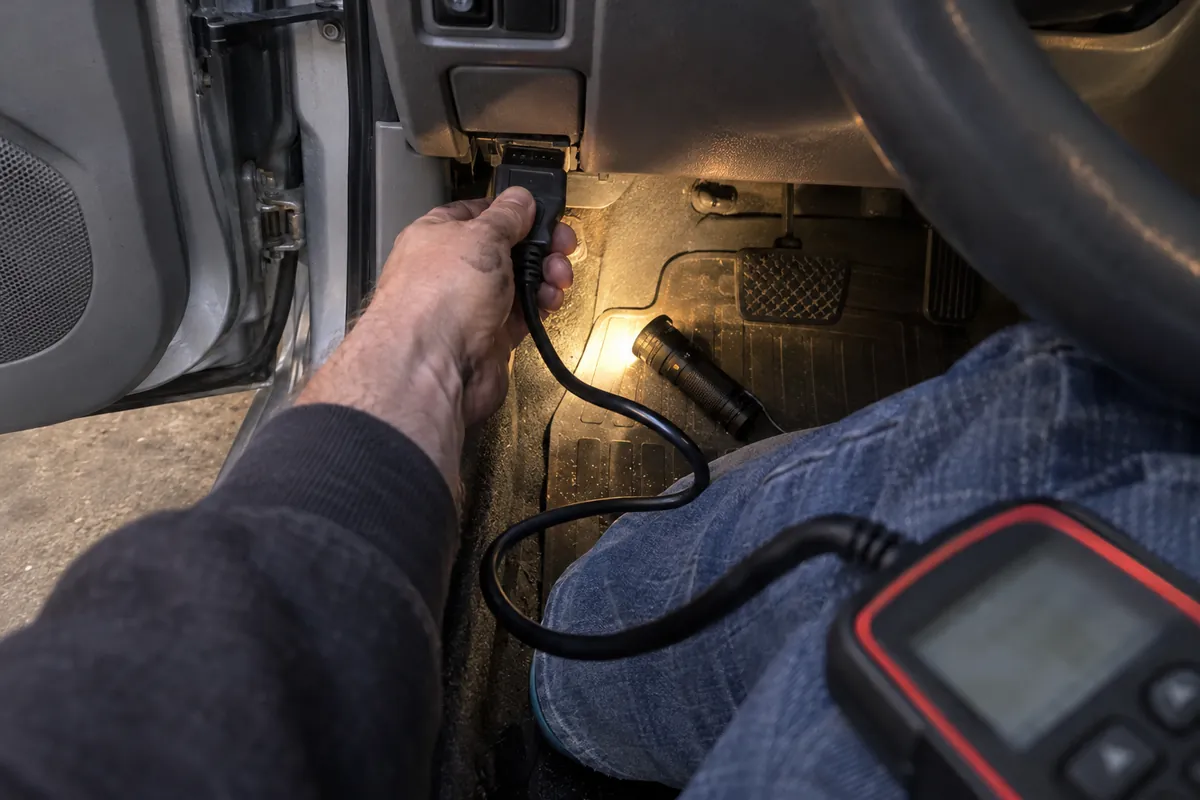
I spent ten years in independent shops and dealer service bays, and I plugged a scanner into thousands of cars. The tool is the easy part. What separates a useful scan from a wasted afternoon is what you do with the information: which codes matter, what the freeze frame tells you and when clearing a code makes things worse. This guide covers the full process the way a technician does it, with the steps written for someone holding a scanner for the first time.
What you need
Any OBD2 scanner works for the steps below. A basic code reader handles engine codes, freeze frame and readiness, which covers most check engine lights. If you do not own one yet, our guide to the best OBD2 scanner for beginners compares 12 handheld and Bluetooth models.
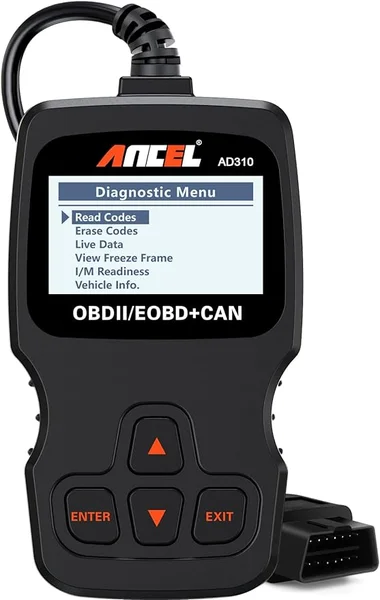 Handheld code reader. The ANCEL AD310 needs no phone or battery and reads codes, freeze frame, live data and readiness. The Autel AL319 adds a color screen and a one-press readiness check.
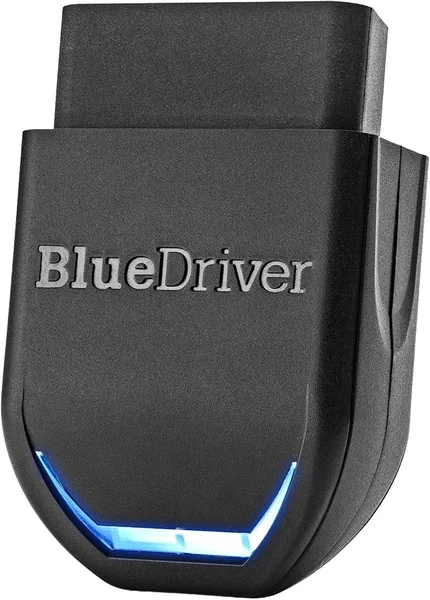 Bluetooth scanner. The BlueDriver pairs with a free app that explains each code with a repair report for your car, with no subscription.
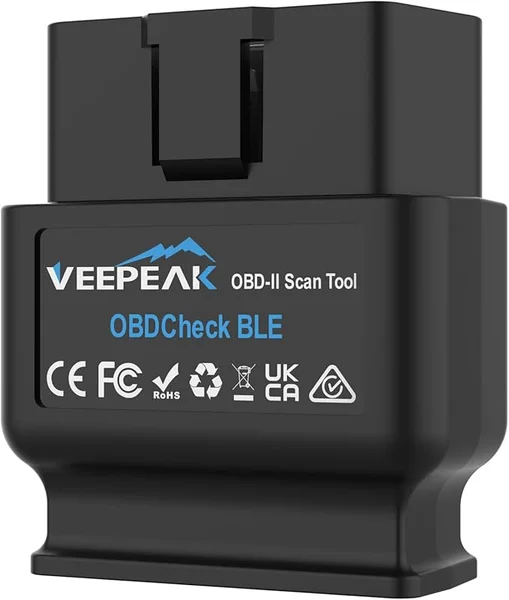 Budget Bluetooth adapter. The Veepeak OBDCheck BLE works with iPhone and Android through a third-party app such as Car Scanner or OBD Fusion.
Also useful: a flashlight for the port, your phone to photograph the screen and a notepad. Knowing your engine size helps when you look up codes, because the same code has different common causes on different engines.
Where is the OBD2 port?
Every gas car and light truck sold in the US since the 1996 model year has a 16-pin diagnostic port, also called the data link connector (DLC). It is shaped like a trapezoid, about two inches wide, with two rows of eight pins. Federal rules require it inside the cabin, reachable from the driver’s seat. On cars built since the mid-2000s it must sit in the driver’s footwell area, between the door and the center console, no higher than the bottom of the steering wheel.
Check these spots in order:
- Under the dashboard, just left of the steering column, above the pedals. This is where it is on most cars.
- Under the dash to the right of the steering column, near the center.
- Behind a small snap-off cover on the lower dash panel or the fuse box cover. Some covers are marked OBD or show a small plug icon.
- In the center console or next to the parking brake on some 1996 to early-2000s cars.
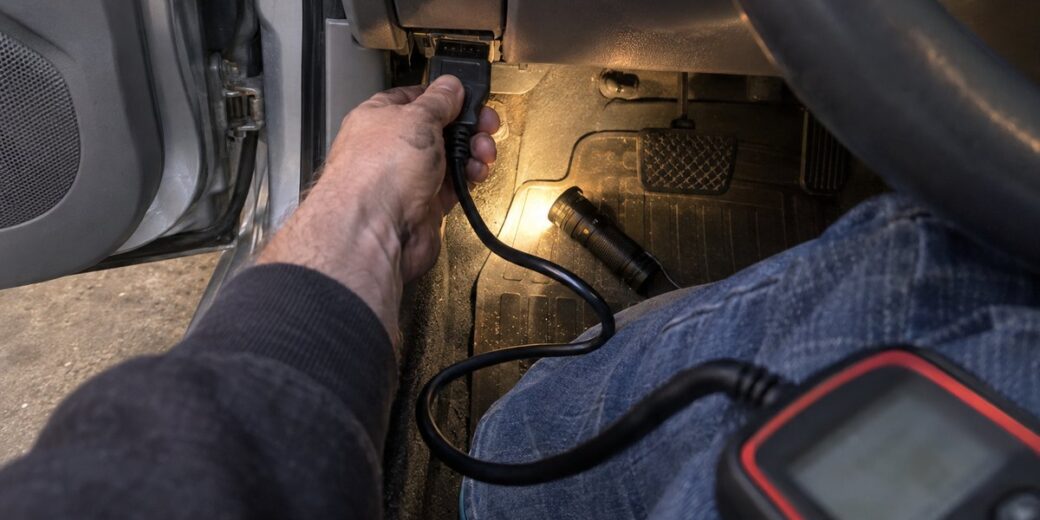
Lie on your back on the driver’s floor and look up with a flashlight. The port usually faces down or toward the pedals, which is why people miss it when they look from the seat. If you still cannot find it, the owner’s manual lists the location in the index under “data link connector” or “diagnostic connector”.
How to use an OBD2 scanner
1. Park safely and turn the car off
Park on level ground, set the parking brake and shift to park (or neutral with the brake on in a manual). Turn the engine off. Plugging in or unplugging a scanner with the engine running rarely causes harm, but the safe habit is to connect with the car off.
2. Plug the scanner into the port
Line up the trapezoid shape and push the connector in until it seats fully. The plug only fits one way. A half-seated connector is the most common cause of a “link error” or “no communication” message, so push firmly.
Route the cable so it cannot catch on the pedals. If you plan to drive with the scanner connected to watch live data, tuck the cable away from the brake and accelerator before you move the car.
3. Turn the ignition to ON without starting the engine
Turn the key to the ON position, where the dashboard lights come on but the engine stays off. On a car with a push-button start, press the button twice without your foot on the brake. The scanner needs the car’s computers awake to talk to them.
You can also read codes with the engine running. Some cars respond faster that way, and you need the engine running for live data. With the key at ON and the engine off for a long scan, watch the battery: 20 minutes is fine, an hour with the headlights on is not.
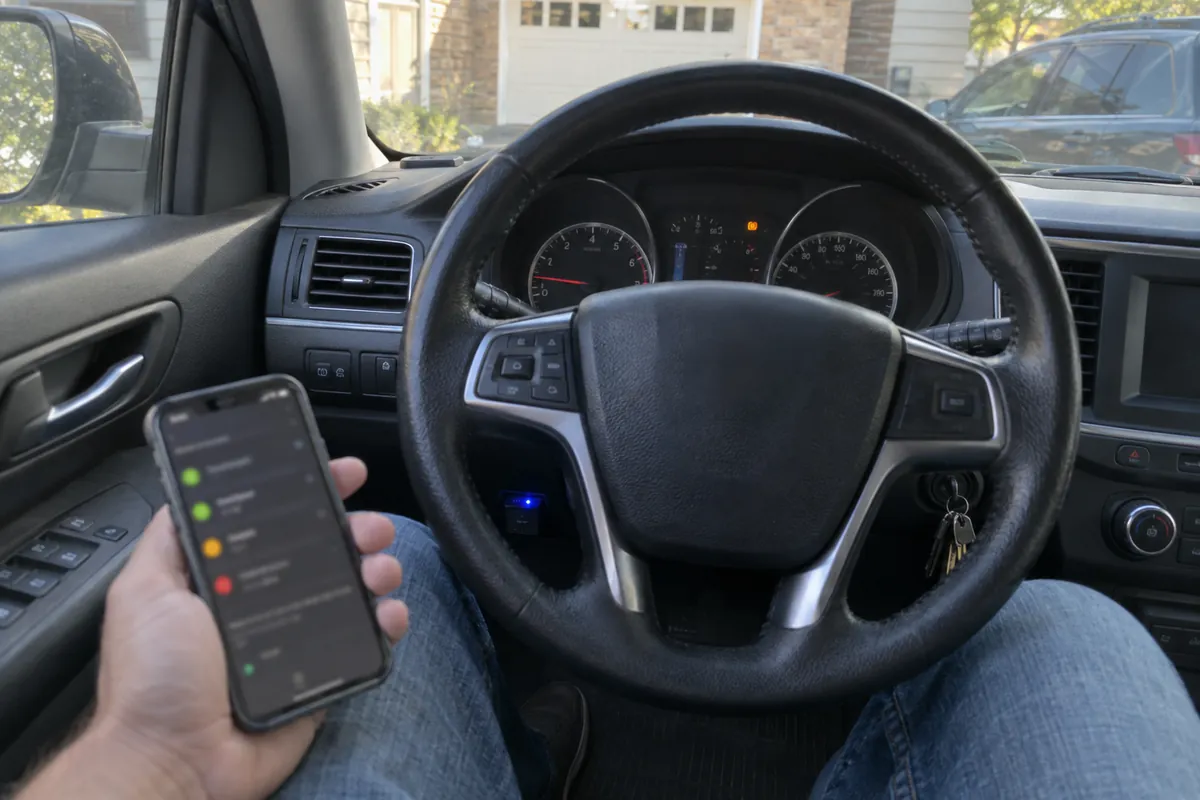
4. Connect the scanner to the car
A handheld scanner powers up from the port and starts on its own. Select OBD2 or Diagnose from the menu. A Bluetooth scanner needs the app: open it and connect from inside the app, not from your phone’s Bluetooth settings menu. Pairing through the phone settings is the most common reason a Bluetooth adapter appears connected but never reads data.
The scanner may ask for the vehicle’s make, model and year, or read the VIN automatically. Enter it accurately, because it changes the code definitions and the enhanced systems the tool can reach.
5. Read the codes
Select Read Codes (sometimes called DTCs or Trouble Codes). The scanner lists every stored diagnostic trouble code with a short definition. A scanner that finds nothing shows “No codes” or “System pass”.
Most scanners separate codes into three groups. They mean different things, and the section below on stored, pending and permanent codes explains each one.
6. Record the codes and the freeze frame data
Write down every code exactly as it appears, or photograph the screen. Then open Freeze Frame and record that too. Freeze frame is a snapshot of the engine’s sensor readings at the moment the code was set: speed, RPM, coolant temperature, engine load, fuel trims and more.
Do this before you clear anything. Clearing codes erases the freeze frame, and it is often the most useful data the scanner gives you.
7. Check I/M readiness
Open I/M Readiness (also called Monitor Status or Smog Check). It lists the self-tests the engine computer runs on its emissions systems and shows each one as complete, incomplete or not supported. This tells you whether the car will pass an emissions test, and whether someone cleared the codes recently.
8. Look at live data with the engine running
Start the engine and open Live Data. You see sensor readings update in real time. You do not need this for every check engine light, but a few readings answer common questions fast, and the live data section lists which ones to watch.
9. Look up the code for your car
Read the scanner’s definition or enter the code in our OBD2 code lookup, then search the code with your year, make, model and engine, for example “P0171 2012 Ford Escape 2.5”. The code tells you which system reported a fault, not which part failed. Searching with your exact engine shows the causes other owners and technicians found most often on that car. A Bluetooth scanner like BlueDriver builds this report for you from the VIN.
10. Fix the cause, clear the code and confirm the repair
After the repair, select Erase Codes or Clear DTCs and confirm. The check engine light goes off. Then drive normally for several days over a mix of city and highway driving, and scan again. If the code has not returned and the readiness monitors show complete, the repair worked.
If the light returns, the fault is still there. Clearing a code never fixes anything; it only resets the computer’s memory and its self-tests.
How to read an OBD2 code
Every trouble code has five characters, and each one carries information. Take P0302 as an example.
| Character | In P0302 | Meaning |
|---|---|---|
| 1st letter | P | System: P powertrain, B body, C chassis, U network |
| 2nd digit | 0 | 0 generic (same on every car), 1 manufacturer-specific |
| 3rd digit | 3 | Subsystem (see table below) |
| 4th and 5th | 02 | The specific fault: here, cylinder 2 |
So P0302 is a generic powertrain code in the ignition and misfire group, pointing at cylinder 2. For P codes, the third digit tells you where to start looking:
| 3rd digit | Subsystem | Example |
|---|---|---|
| 1 and 2 | Fuel and air metering | P0171 system too lean |
| 3 | Ignition system or misfire | P0300 random misfire |
| 4 | Auxiliary emissions controls | P0420 catalyst efficiency, P0455 EVAP leak |
| 5 | Vehicle speed, idle control | P0505 idle control system |
| 6 | Computer and output circuits | P0606 control module processor |
| 7 and 8 | Transmission | P0700 transmission control system |
A basic scanner reads P codes and some generic U codes. B and C codes (airbags, ABS, body electronics) need a scanner that reads those modules for your make.
Stored, pending and permanent codes
Stored (confirmed) codes are faults the computer has seen and confirmed, usually on two drive cycles in a row. A stored emissions-related code turns on the check engine light.
Pending codes are faults seen once but not yet confirmed. They do not turn the light on. A pending code is an early warning: the computer will confirm it if the fault shows up again on the next drive. Pending codes are also the fastest way to check a repair, because they appear after one drive.
Permanent codes exist on cars from the 2010 model year on. A scanner cannot erase them. They clear themselves only after the computer runs its self-test again and the system passes. They were added so that clearing codes in the parking lot of an inspection station would not hide a fault, and many states fail a car with a permanent code.
What freeze frame data tells you
Freeze frame turns a code into a story. Two cars can store the same P0171 lean code for different reasons, and the freeze frame shows which.
- Lean at idle, normal at speed: points to a vacuum leak. Extra air leaking in matters most when the engine pulls little air on its own, at idle.
- Lean at highway speed or high load: points to fuel delivery, such as a weak fuel pump or clogged filter, or a dirty mass airflow sensor.
- Coolant temperature low when a code set: the fault happens on cold starts. Some sensors and leaks only act up cold.
- Misfire with high load and low RPM: often an ignition coil or spark plug breaking down under strain, like pulling uphill in a high gear.
When I worked the counter, the customers who brought a photo of the freeze frame along with the code saved themselves an hour of diagnostic time. A shop has to recreate the conditions that set the fault; freeze frame tells them what those conditions were.
Live data: the readings worth watching
Live data lists dozens of values. A beginner needs four of them.
| Reading | What normal looks like | What a problem looks like |
|---|---|---|
| Coolant temperature (ECT) | Climbs to about 195 to 220°F after a 10 to 15 minute drive and stays there | Stays below 160°F on the highway: thermostat stuck open (P0128) |
| Short and long term fuel trim (STFT, LTFT) | Within about plus or minus 10% when warm | Long term above +10%: engine running lean. Below -10%: running rich |
| Upstream oxygen sensor (B1S1) | Switches quickly between about 0.1 and 0.9 volts at a warm idle | Stuck high, stuck low or switching slowly |
| Downstream oxygen sensor (B1S2) | Fairly steady, around 0.5 to 0.8 volts | Switching as fast as the upstream sensor: the catalytic converter is not storing oxygen (P0420) |
Fuel trims are the most useful number here. They show how much fuel the computer adds or removes to keep the mixture right. A quick check for a vacuum leak: note the long term trim at idle, then hold the engine at 2,500 RPM. If the trim drops toward zero at higher RPM, a vacuum leak is the likely cause, because the same leak matters less when the engine pulls more air.
Reading I/M readiness monitors
The engine computer runs self-tests on its emissions systems while you drive. Each test is a readiness monitor. Three run all the time (misfire, fuel system and comprehensive components). The others run only when driving conditions are right: catalyst, evaporative system (EVAP), oxygen sensor, oxygen sensor heater, EGR and, on some cars, secondary air and heated catalyst.
Clearing codes or disconnecting the battery resets every monitor to incomplete. They finish again over several days of normal driving. The EVAP monitor is usually the slowest, because it waits for specific conditions such as a fuel level between about a quarter and three quarters of a tank and a cold start after the car sits overnight.
For emissions testing, federal rules allow one incomplete monitor on 2001 and newer cars and two on 1996 to 2000 cars. More than that and the car is rejected until it is driven more. Check readiness before every smog appointment.
Readiness is also the most useful check on a used car. If several monitors show incomplete on a car that supposedly runs fine, someone may have cleared the codes recently to hide a problem. Ask the seller, or come back after they have driven it for a week.
Example: diagnosing a misfire code
Here is how a scan turns into a repair on one of the most common codes I saw, a single-cylinder misfire. A four-cylinder sedan comes in with a check engine light that flashed once on the highway and now stays solid.
The scan: stored code P0302 (cylinder 2 misfire), with a pending P0302 as well. Freeze frame shows 62 mph, 2,100 RPM, high engine load and normal coolant temperature. A misfire under load at highway speed points at ignition before fuel.
The test: on a coil-on-plug engine, each cylinder has its own ignition coil. Swap the coil from cylinder 2 with the coil from cylinder 3. It takes a 10 mm socket and about ten minutes. Clear the codes, then drive the car under the same conditions as the freeze frame.
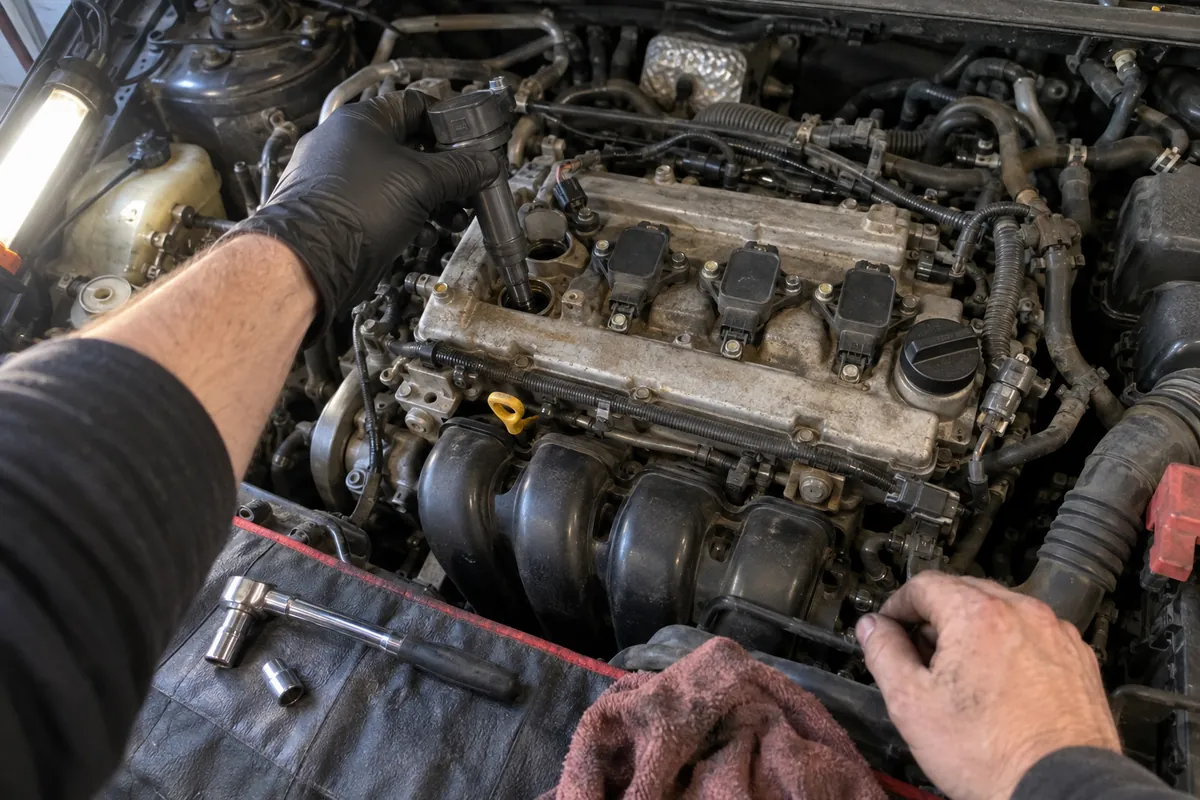
The result: scan again. If the code is now P0303, the misfire followed the coil, and the coil is bad. If it stays P0302, the coil is fine; swap the spark plugs the same way next, then look at the fuel injector or compression on that cylinder.
That sequence (scan, read freeze frame, run a cheap test, confirm with a second scan) is how technicians use a scanner on almost every code. The scanner does not name the failed part. It tells you where to look and confirms when you have found it.
Common codes and what to check first
| Code | Meaning | Check first |
|---|---|---|
| P0455, P0456, P0442, P0457 | EVAP system leak | Gas cap: tighten until it clicks, replace it if the seal is cracked |
| P0300 to P0308 | Misfire (P0300 random, last digit is the cylinder) | Coils and spark plugs; swap the coil to see if the code follows |
| P0171, P0174 | System too lean | Vacuum leaks, cracked intake boot, dirty mass airflow sensor |
| P0420, P0430 | Catalyst below efficiency | Exhaust leaks and oxygen sensors before the converter itself |
| P0128 | Coolant below thermostat temperature | Thermostat stuck open |
| P0135, P0141 | Oxygen sensor heater circuit | Sensor connector and fuse, then the sensor |
| P0700 | Transmission control system fault | Needs a scanner that reads the transmission module for the real code |
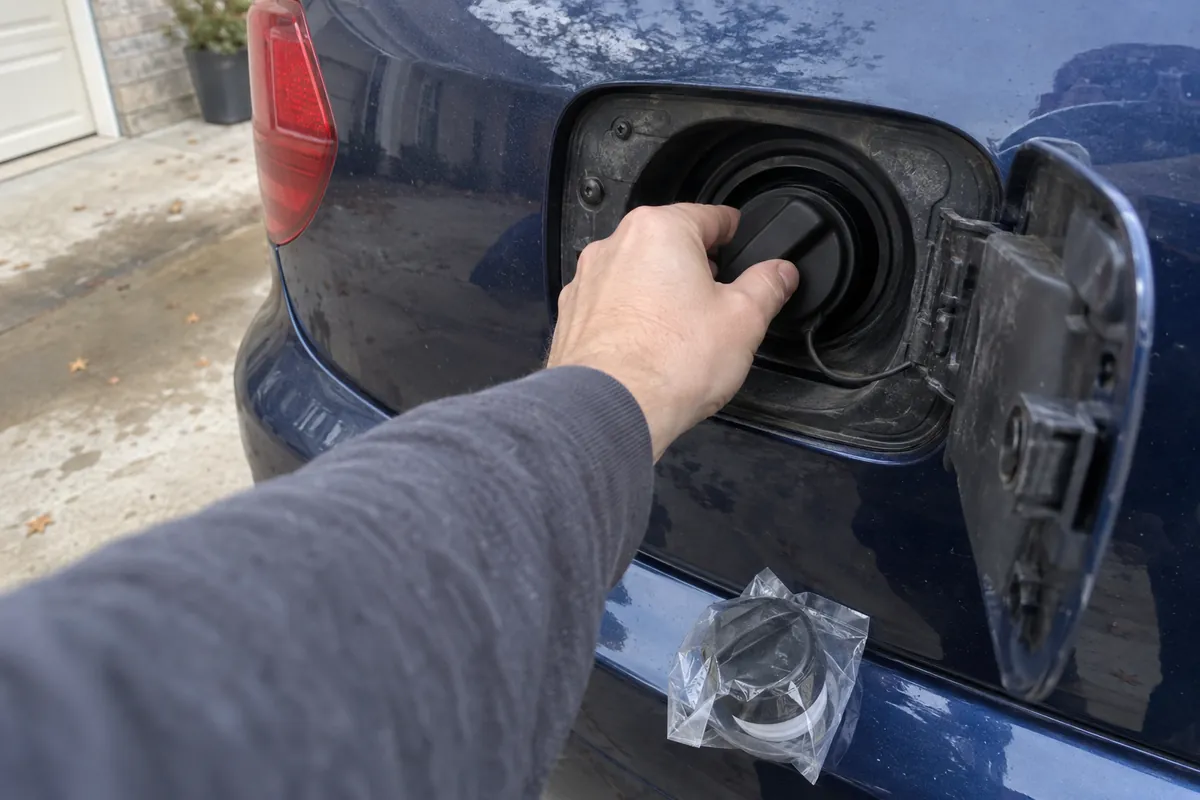
EVAP codes are where a scanner pays for itself first. A loose or worn gas cap lets fuel vapor escape, the system fails its leak test, and the light comes on. Tighten the cap until it clicks, clear the code and check for a pending code after a few days. If the cap seal is cracked or flattened, a new cap is the cheapest repair on any check engine light.
When to stop and see a mechanic
- The check engine light is flashing. A flashing light means an active misfire bad enough to overheat and damage the catalytic converter. Slow down, avoid hard acceleration and get the car looked at the same day.
- The car runs badly along with the code: overheating, loss of power, stalling, smoke or a fuel smell.
- Airbag (SRS) codes. Do not unplug or probe airbag parts yourself. Read the code, then let a shop do the work.
- Several unrelated codes at once, especially U codes. Many codes from different systems often share one cause, such as a weak battery, a bad ground or a network fault. Test the battery first, then have a shop look.
- The code keeps coming back after you fixed the obvious causes.
Going to a shop with the codes and freeze frame in hand still saves money. You can tell a fair diagnosis from a guess, and you avoid paying for a second scan.
Mistakes beginners make
- Clearing codes before writing them down. The code and the freeze frame are gone, and if the fault is intermittent you may wait weeks for it to return.
- Clearing codes right before an emissions test. The readiness monitors reset and the car is rejected. On 2010 and newer cars, permanent codes stay anyway.
- Buying the part named in the definition. P0420 reads like “replace the catalytic converter”, but oxygen sensors and exhaust leaks set the same code for much less money.
- Treating a pending code as a false alarm. A pending code is a real fault seen once. Watch it.
- Leaving a cheap adapter plugged in. Some no-name Bluetooth adapters draw power constantly and can flatten a battery over a long weekend. Unplug them, or buy one with a sleep mode.
- Ignoring the battery. A weak battery causes strange codes across several modules. If you see a pile of unrelated codes after a hard start, test the battery before anything else.
A scanner is one of the cheapest tools for cutting repair bills, because it stops small faults from turning into big ones. To see how much repairs add to what your car costs each year, try our cost of owning a car calculator.
FAQ
Do you plug in an OBD2 scanner with the car on or off?
Plug it in with the car off, then turn the key to ON without starting the engine to read codes. You can also read codes with the engine running, and you need the engine running to view live data.
Where is the OBD2 port located?
The OBD2 port is under the dashboard on the driver’s side, usually just left of the steering column above the pedals. On some cars it sits behind a small cover, near the center of the dash or in the center console. The owner’s manual lists the exact location under data link connector.
Why won’t my OBD2 scanner connect?
The usual causes are a connector that is not fully seated, the ignition not switched to ON, a blown fuse for the port’s power (often the cigarette lighter or accessory fuse) or, for Bluetooth adapters, pairing through the phone’s settings instead of the app. Check each in that order.
Can you use an OBD2 scanner while driving?
Yes. A Bluetooth adapter can stay plugged in while you drive, and many apps log live data during a drive. Do not look at the screen while driving; let a passenger watch it or record the data and review it after you park.
Will clearing codes with a scanner fix the problem?
No. Clearing codes turns off the check engine light and resets the readiness monitors, but the fault is still there. If the cause is not repaired, the computer finds the fault again and the light returns.
How long after clearing codes can I pass an emissions test?
Usually after 50 to 100 miles of mixed driving over several days, including at least one cold start after the car sits overnight. Check readiness with your scanner first: 2001 and newer cars can have at most one incomplete monitor, and 1996 to 2000 cars two.
What is the difference between a pending and a stored code?
A pending code is a fault the computer saw once and has not confirmed, and it does not turn on the check engine light. A stored code is a confirmed fault, usually seen on two drives in a row, and it turns the light on.
Can an OBD2 scanner drain the car battery?
A scanner left plugged in can drain the battery if the car sits for several days. Handheld scanners should be unplugged after use. Bluetooth adapters with a sleep mode, such as the OBDLink MX+ or BlueDriver, draw very little and can stay in.
Does an OBD2 scanner work on every car?
Every gas car and light truck sold in the US from the 1996 model year on has an OBD2 port, so any OBD2 scanner reads its engine codes. Reading ABS, airbag and transmission codes depends on the scanner and on your make, model and year.
Can a scanner tell me which part to replace?
No. A code tells you which system reported a fault, not which part caused it. Use the freeze frame, live data and a simple test, like swapping a coil between cylinders, to find the failed part before you buy anything.
Related guides
- Best OBD2 scanner for beginners: 12 handheld and Bluetooth scanners compared
- OBD2 code lookup: meaning, urgency and likely causes for any generic code
- Best books to learn about cars: including the Haynes OBD-II Techbook
- Jack and jack stand size calculator: the right lifting gear before you work under the car
- How to reduce car ownership costs
Sources & References
- EPA, vehicle emissions inspection and maintenance: https://www.epa.gov/state-and-local-transportation/vehicle-emissions-inspection-and-maintenance-im
- California Air Resources Board, on-board diagnostic program: https://ww2.arb.ca.gov/our-work/programs/obd-board-diagnostic-program
- 40 CFR 85.2222, on-board diagnostic test procedures: https://www.ecfr.gov/current/title-40/chapter-I/subchapter-C/part-85/subpart-W/section-85.2222

James Kowalski
More from James KowalskiHow we reviewed this article
This article was researched against manufacturer records and editorially reviewed before publishing. We accept no payment for coverage. Some guides contain affiliate links; see our affiliate disclosure.