- Wheel hp22318% lost in the drivetrain (RWD automatic)
- kW203engine power in kilowatts
- PS276engine power in metric horsepower
- 2003 Mitsubishi Lancer Evolution VIII271 hp
- 2018 Tesla Model 3 Long Range RWD271 hp
- 1972 Chevrolet Chevelle SS 454 LS5270 hp
This horsepower calculator estimates how much power your car or engine makes from numbers you can measure or look up. It works from four kinds of input: a quarter-mile or eighth-mile time, a 0-60 time, the engine size (in cc, cubic inches or liters) or a torque figure with the rpm it was measured at. Each result shows horsepower at the engine and at the wheels, kilowatts, metric horsepower (PS), a likely range and real cars with about the same power. Pick the method that matches the numbers you have. If you have more than one, use Check it another way to see if the answers agree.
How to calculate horsepower
There are four ways to calculate horsepower, and the right one depends on what you know about the car.
| What you know | How horsepower is found | Typical error |
|---|---|---|
| Torque and rpm (from a spec sheet or dyno) | hp = torque (lb-ft) × rpm ÷ 5,252 | Exact |
| Quarter-mile time and trap speed, plus weight | Physics model of the run, solved for power | 7.6% median |
| Quarter-mile time only, plus weight | Same model, solved from the time | 8.7% median |
| 0-60 time, plus weight | Physics model of the launch, solved for power | 8.2% median |
| Engine size and type | Liters × typical horsepower per liter for that kind of engine | 9.6% median, wide range |
The error figures come from running every method against real cars with published horsepower: 227 cars with a tested quarter-mile time and trap speed, 285 cars with a tested 0-60 time and 279 engines with a known displacement. Torque and rpm is a definition, not an estimate, so it needs no test.
Example: a 2018 Ford Mustang GT
In a road test, a 2018 Mustang GT with a manual gearbox ran the quarter mile in 12.7 seconds at 114 mph. With a driver on board it weighs about 3,885 lb. Enter those three numbers and the calculator returns about 437 hp, with a likely range of 375 to 505 hp. Ford rates the car at 460 hp. The same car’s 420 lb-ft of torque at 4,600 rpm works out to 368 hp, which is less than its peak because peak torque and peak power happen at different rpm.
How to use the horsepower calculator
- Pick a method. Tap Race time, 0-60 time, Engine size or Torque and rpm at the top of the calculator.
- Pick your car (optional). For race time and 0-60, type the make and model in the search box. It fills in the weight, drive and transmission, and shows the car’s published horsepower next to the estimate. If your car is not in the list, type the numbers yourself.
- Enter your numbers. Use the weight with the driver in the car. If you only know the curb weight, add 180 lb. For race time, enter the time, the trap speed or both. Trap speed gives the closer answer.
- Set drive and transmission. These decide how much power is lost between the engine and the wheels, which sets the wheel horsepower figure.
- Read the result. The big number is engine horsepower. The bar shows the range the real figure most likely falls in. Copy link saves your numbers in a link you can share or come back to.
Horsepower from a quarter-mile time
A drag strip timeslip is the best evidence of how much power a car makes short of a dyno. It records two numbers that matter: the elapsed time (ET) and the trap speed, which is how fast the car was going as it crossed the finish line.
Trap speed is the better witness. By the end of a quarter mile the car is pulling hard in its top gears, and the speed it reaches depends almost entirely on power and weight. ET also depends on the launch: wheelspin, a slow reaction or a bog off the line can add half a second without changing the engine’s power at all. When you enter both, the calculator works out horsepower from the trap speed, then checks what ET that power should run with a good launch. If your real ET is 0.2 seconds or more slower, it tells you the launch is costing you time.
The calculator uses the same physics model as our quarter mile calculator, run in reverse. It accounts for drivetrain, gearing, tire grip and the shift times of manual, automatic and dual-clutch gearboxes. An eighth-mile time is converted to a quarter mile first, using the ratio between the two measured on real cars.
The classic quarter-mile horsepower formulas
Most quarter-mile horsepower calculators use one of two formulas from the 1960s and 1970s. The calculator shows both under the result for comparison.
- Hale formula (trap speed): hp = weight × (trap speed ÷ 234)³
- Huntington formula (ET): hp = weight × (6.290 ÷ ET)³
Weight is in pounds with the driver, and trap speed is in mph. For the 2018 Mustang GT above, Hale gives 449 hp and Huntington gives 472 hp against a rated 460.
Hale holds up well on gas cars. Across the 197 gas cars in our test set its median miss is 6.9%, about the same as the physics model’s 7.4%. It misses badly more often, though: one car in ten is off by more than 20%, against 17% for the model. On electric cars Hale’s median miss is 25%, about double the model’s. Huntington, which works from ET alone, misses by 19% on a typical car because it cannot separate a slow launch from a weak engine. The calculator uses the model for its answer and shows both formulas underneath. When a time is quicker than street tires allow, as with a built drag car on slicks, it falls back to the classic formula.
Horsepower from a 0-60 time
A 0-60 time works the same way, but it carries less information than a quarter mile. The first second or two of any launch is decided by grip, not power, so two cars with very different engines can post similar times. The calculator models the launch, the shifts and the point where the car stops spinning its tires, then finds the horsepower that produces your time.
Very quick cars hit a limit. A front-engine, rear-wheel-drive car on street tires rarely gets to 60 mph much quicker than about 3.5 seconds no matter how much power it has, because the tires cannot put it down. When you enter a time close to or below that limit, the calculator switches to a simpler estimate based on how real cars with that power-to-weight ratio perform, and it tells you so. A 2015 Dodge Challenger SRT Hellcat at 3.6 seconds and 4,630 lb returns about 708 hp this way. Dodge rates it at 707.
To go the other direction and predict a 0-60 time from horsepower, use our 0-60 calculator.
Horsepower from engine size (cc to hp)
Engine size alone gives a rough answer. How much power an engine makes per liter depends on what kind of engine it is far more than on its size. A turbocharged four-cylinder makes far more power per liter than an old pushrod V8, and a sport bike engine makes more per liter than almost anything with four wheels. The calculator multiplies the displacement by the typical horsepower per liter for the engine type you pick, and shows the range most engines of that type fall in.
| Engine type | Typical hp per liter | Most engines | Example |
|---|---|---|---|
| Mass-market naturally aspirated gas cars, SUVs and pickups | 78 | 67 to 85 | 2,500 cc: about 195 hp |
| Turbocharged and supercharged gas engines | 126 | 106 to 148 | 2,000 cc: about 253 hp |
| High-performance naturally aspirated gas engines | 90 | 69 to 111 | 5,000 cc: about 474 hp |
| Turbo diesel cars and pickups | 71 | 55 to 88 | 3,000 cc: about 251 hp |
| Sport bike | 145 | 120 to 197 | 1,000 cc: about 145 hp |
| Other motorcycle or scooter | 96 | 56 to 124 | 650 cc: about 63 hp |
| Small engines (mowers, generators, go-karts) | 30 | 27 to 38 | 200 cc: about 6 hp |
To convert cubic inches to cc, multiply by 16.387. A 350 cubic inch V8 is 5,735 cc, or 5.7 liters. To go from cc to liters, divide by 1,000.
Two more examples: a 150 cc scooter engine makes about 14 hp, and a 196 cc engine from a log splitter or go-kart about 5.9 hp.
These figures describe engines built since about 2005. Older engines made much less from the same size. A modern 5.7 liter non-turbo V8 works out to about 447 hp, but the 5.7 liter (350 cubic inch) V8 in a 1975 Chevrolet Corvette was rated at 165 hp, and the same size in a 1980 Corvette at 190 hp. For an older engine, use a race time or a dyno figure instead.
Horsepower from torque and rpm
Horsepower is torque multiplied by engine speed. In US units the formula is:
hp = torque (lb-ft) × rpm ÷ 5,252
The 5,252 comes from the definition of one horsepower, 33,000 foot-pounds of work per minute, divided by 2π to turn revolutions into radians. In metric units the formula is kW = torque (N·m) × rpm ÷ 9,549. Because of the 5,252, every engine’s horsepower and torque curves cross at 5,252 rpm when torque is in lb-ft. Below that speed the torque number is higher, and above it the horsepower number is higher.
An engine that makes 330 lb-ft at 5,000 rpm makes 330 × 5,000 ÷ 5,252 = 314.2 hp at that speed. The formula gives the power at the rpm you enter. To get peak horsepower, use the torque at the rpm where power peaks, not the peak torque figure, which almost always comes lower in the rev range.
If the torque number came from a chassis dyno, it was measured at the wheels. Set My torque number is to At the wheels and the calculator treats the result as wheel horsepower and works out the engine figure from the typical drivetrain loss. To convert a power figure between hp, kW, PS and watts, use our horsepower converter.
Engine horsepower vs wheel horsepower
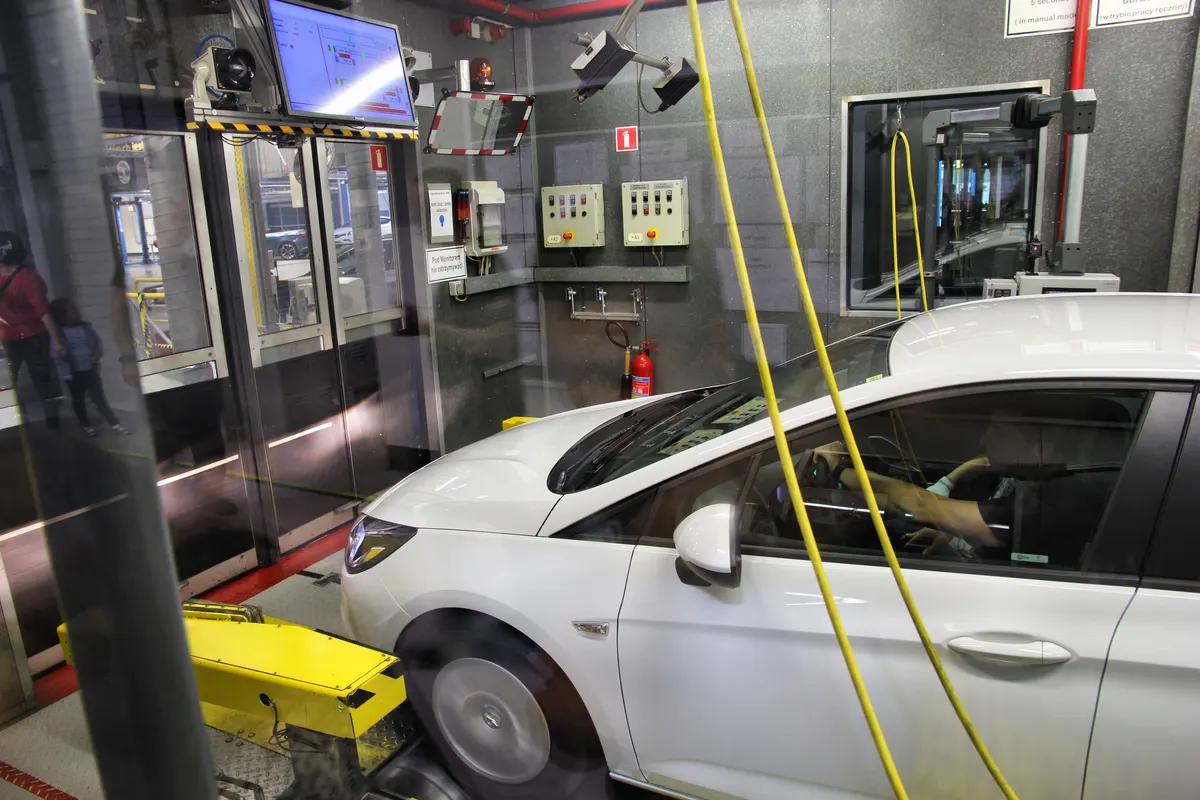
The horsepower a manufacturer advertises is measured at the engine’s crankshaft. By the time that power reaches the tires, some of it has been lost to friction in the transmission, driveshaft, differential and axles. Wheel horsepower (whp) is what a chassis dyno measures, and it is always lower.
| Drive | Manual | Automatic or DCT |
|---|---|---|
| Front-wheel drive (FWD) | 12% | 15% |
| Rear-wheel drive (RWD) | 15% | 18% |
| All-wheel drive (AWD) | 20% | 23% |
| Electric (EV) | 8% | |
These are the typical drivetrain losses the calculator uses. Real losses vary with the dyno, the tires and the gear the car is run in, so a dyno figure from one shop rarely matches another shop exactly. Our horsepower converter has a wheel to engine tab with a custom loss. To turn wheel horsepower into engine horsepower, divide by one minus the loss: 300 whp from a rear-wheel-drive manual is 300 ÷ 0.85 = 353 hp at the engine.
Old cars add one more wrinkle. Before 1972, American manufacturers rated engines in SAE gross horsepower, measured on a test stand without the air filter, alternator, water pump or full exhaust. The SAE net ratings used since then are measured as installed in the car. A gross rating is roughly 30% higher than the same engine’s net figure. A 1968 Dodge Charger with the 425 hp Hemi ran 13.5 seconds at 105 mph in a period road test, and the calculator puts that run at about 380 hp. The calculator’s back-test converts gross ratings to net before comparing.
Power-to-weight ratio
Horsepower on its own says little about how fast a car feels. A 300 hp pickup and a 300 hp sports car are not close. The number that predicts acceleration is power-to-weight, usually written in the US as pounds per horsepower: the car’s weight divided by its horsepower. Lower is quicker.
| Pounds per hp (with driver) | What it means | Example |
|---|---|---|
| Under 5 | Extremely strong for its weight | Supercars, Hellcat-class muscle cars |
| 5 to 8 | Very strong for its weight | Corvette Stingray, Porsche 911 GT3 |
| 8 to 12 | Strong for its weight | Mustang GT, WRX STI, Civic Type R |
| 12 to 17 | Typical for a family car | V6 Camry, turbo crossovers |
| 17 to 25 | Modest for its weight | Four-cylinder sedans and SUVs |
| Over 25 | Low for its weight | Economy cars, heavy work trucks |
The calculator shows power-to-weight for the race time and 0-60 methods, the two that use the car’s weight. In metric countries the same idea is usually given as horsepower or kilowatts per tonne.
Real cars: estimate vs published horsepower
These are the calculator’s answers for real road tests, using only the published time, trap speed and weight. The published figure is the manufacturer’s rating.
| Car | Test result | Estimate | Published |
|---|---|---|---|
| 2020 Chevrolet Corvette C8 Stingray | 11.2 s @ 122 mph | 496 hp | 495 hp |
| 2015 Subaru WRX STI | 13.3 s @ 105 mph | 312 hp | 305 hp |
| 2018 Ford Mustang GT (manual) | 12.7 s @ 114 mph | 437 hp | 460 hp |
| 2017 Toyota Camry XSE V6 | 14.6 s @ 98 mph | 252 hp | 268 hp |
| 2017 Ford F-150 Raptor | 13.8 s @ 100 mph | 475 hp | 450 hp |
| 2016 Mazda MX-5 Miata | 14.6 s @ 95 mph | 170 hp | 155 hp |
| 2023 Honda Civic Type R | 13.7 s @ 105.1 mph | 287 hp | 315 hp |
| 2015 Volkswagen GTI Performance | 0-60 in 5.9 s | 229 hp | 220 hp |
| 2015 Dodge Challenger SRT Hellcat | 0-60 in 3.6 s | 708 hp | 707 hp |
| 2024 Tesla Model 3 Performance | 11.0 s @ 125 mph | 576 hp | 510 hp |
Across all 227 cars with a tested time and trap speed, the median miss is 7.6%, and the published figure falls inside the calculator’s range for 89% of them. The biggest misses are electric cars, covered below.
Why electric cars break horsepower formulas
The Tesla in the table is the odd one out, and that is typical. Electric motors make full torque from a standstill and the car has no gearshifts, so an EV accelerates harder for its rated power than a gas car does. EV horsepower ratings are also slippery: many makers quote a peak figure that the battery can only deliver for a few seconds, or a figure that only applies with a launch or boost mode. The classic Hale and Huntington formulas, built on 1970s V8s, overestimate most EVs. The calculator models an EV as an all-wheel-drive car with a single-speed drive, which gave the closest answers on the 30 EVs in the test set (12.8% median miss). Treat any EV estimate as a measure of how quick the car is rather than a check on the window sticker.
What is horsepower?
Horsepower is a unit of power: how fast work gets done. James Watt defined it in the 1780s to sell steam engines to mine owners who used horses to pump water. He worked out that a horse could do 33,000 foot-pounds of work per minute, the effort needed to lift 33,000 lb by one foot in one minute. One horsepower equals 745.7 watts, so 100 hp is 74.6 kW.
Two other units share the name. Metric horsepower, written PS in Germany and CV or ch in France and Italy, is slightly smaller at 735.5 watts, so a car rated at 300 PS makes 296 hp. For kilowatts, see kW to hp and hp to kW. Brake horsepower (bhp), the term used in the UK, is the same as mechanical horsepower; the “brake” refers to the dynamometer brake used to measure it.
For more on how an engine turns fuel into power, explore our car engine 3D model. To see how gearing multiplies an engine’s torque at the wheels, try the gear ratio calculator.
FAQ
How do I calculate horsepower?
Multiply torque in lb-ft by engine rpm and divide by 5,252. If you do not know the torque, estimate horsepower from a quarter-mile time and trap speed, a 0-60 time or the engine size, using the car’s weight with the driver. The calculator on this page does all four.
What is the horsepower formula?
The horsepower formula is hp = torque × rpm ÷ 5,252, with torque in lb-ft. In metric units, kW = torque in N·m × rpm ÷ 9,549. For drag racing, the Hale formula estimates horsepower from trap speed: hp = weight × (trap mph ÷ 234)³.
How much horsepower does my car have?
The manufacturer’s rating is printed in the owner’s manual and on most spec sheets, and you can find it by year, make, model and engine. To check what your car actually makes, take it to a dyno or run it at a drag strip and enter the time, trap speed and weight in the calculator above.
How do I convert cc to hp?
There is no fixed conversion from cc to hp, because displacement measures engine size, not power. Multiply the size in liters by the typical horsepower per liter for that type of engine: about 78 hp per liter for a regular non-turbo car engine, 126 for a turbocharged one and 30 for a lawn mower or generator engine. A 2.0 liter car engine usually makes about 156 hp.
How much horsepower is 1,000 cc?
A 1,000 cc engine makes about 78 hp in an ordinary car, about 126 hp with a turbo and about 145 hp in a modern sport bike, which revs much higher. Engine type matters more than size.
What is the difference between hp and whp?
Hp is engine horsepower, measured at the crankshaft and used in advertised ratings. Whp is wheel horsepower, measured at the tires on a chassis dyno after drivetrain losses. Whp is usually 12 to 23% lower than hp, depending on the drivetrain.
How do you calculate horsepower from a quarter-mile time?
Enter the trap speed and the car’s weight with driver into the calculator. The classic shortcut is the Hale formula, hp = weight × (trap mph ÷ 234)³. If you only have the elapsed time, the Huntington formula is hp = weight × (6.290 ÷ ET)³, but it is less reliable because a poor launch slows the time without changing the power.
How much horsepower do I need for a 10-second quarter mile?
A 10-second pass usually ends at about 130 mph. By the Hale formula, a 3,500 lb car with driver needs about 600 hp at the engine to trap 130 mph. Getting the launch to match takes drag radials or slicks, because street tires cannot put that much power down off the line.
What is a good power-to-weight ratio?
Under 12 lb per hp with the driver feels quick, and under 8 lb per hp is sports car territory. Most family cars sit between 12 and 17 lb per hp. To find yours, divide the car’s weight with driver by its horsepower.
Why are horsepower and torque equal at 5,252 rpm?
Because horsepower is defined as torque × rpm ÷ 5,252. At 5,252 rpm the rpm and the constant cancel out, so the two numbers are the same. Any engine that revs past 5,252 rpm will show its horsepower curve crossing its torque curve there when torque is in lb-ft.
Is bhp the same as hp?
Yes. Brake horsepower and mechanical horsepower are the same unit, 745.7 watts. Metric horsepower (PS, CV or ch) is about 1.4% smaller, so 100 PS equals 98.6 hp.
How accurate is a horsepower calculator?
From a quarter-mile time and trap speed, this calculator’s median error is 7.6% across 227 tested cars. From a 0-60 time it is 8.2%. Engine size gives the widest range because engines of the same size vary so much. Only a dyno measures power directly, and even dynos differ by a few percent from shop to shop.
Sources & References
- NIST Special Publication 811, Guide for the Use of the International System of Units (horsepower and metric horsepower in watts): https://www.nist.gov/pml/special-publication-811
- SAE J1349, Engine Power Test Code, Spark Ignition and Compression Ignition, As Installed Net Power Rating: https://www.sae.org/standards/content/j1349_201109/
- Car and Driver road tests (quarter-mile times, trap speeds, 0-60 times and test weights used in the back-test): https://www.caranddriver.com/
- Manufacturer and Wikipedia engine specifications for the 279-engine displacement dataset (full list in the tool source)
- 33gears Quarter Mile Calculator and 0-60 Calculator models (shared physics model and calibration): https://33gears.com/quarter-mile-calculator/

James Kowalski
More from James KowalskiHow we reviewed this article
This article was researched against manufacturer records and editorially reviewed before publishing. We accept no payment for coverage. Some guides contain affiliate links; see our affiliate disclosure.