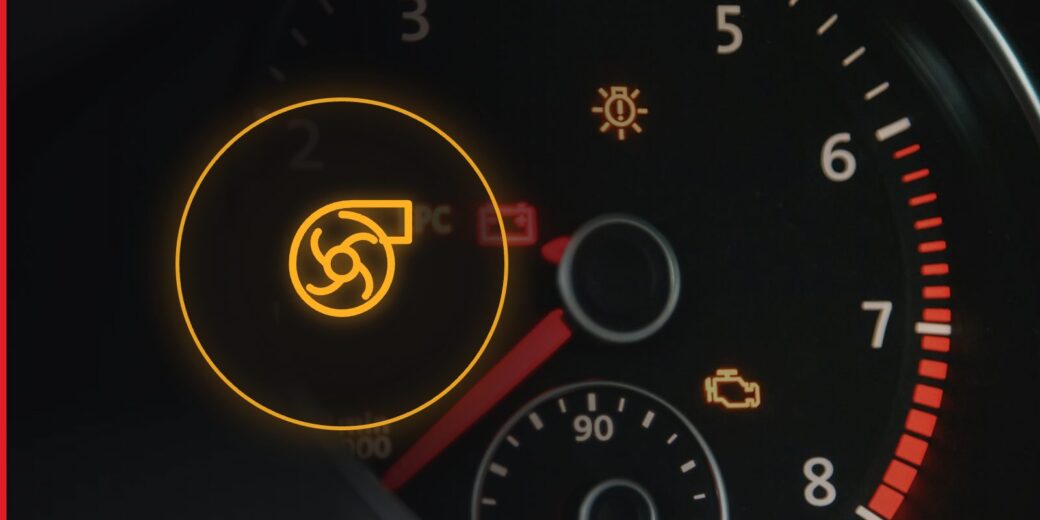
P0299 means the turbocharger is building less boost pressure than the engine computer requested. The usual causes are a boost leak at an intercooler hose and a wastegate stuck open. The car loses power and may drop into limp mode. Short trips are possible, but fix it soon.
| Code | P0299 |
|---|---|
| Meaning | Turbocharger/Supercharger A Underboost Condition |
| Severity | Fix promptly |
| Can I keep driving? | Short trips are usually possible, but power will be reduced. Fix it soon, since a failing turbo or a leak can get worse. |
| Most common cause | Leaking intercooler hose or loose clamp |
| Difficulty | Moderate DIY |
What does P0299 mean?
A turbo engine has a target boost pressure for each load and rpm. The computer compares that target with the reading from the boost or MAP sensor. If actual pressure stays below the target by more than a set margin for long enough, it sets P0299. The code is called underboost. The “A” refers to the first or only turbocharger on the engine.
The code covers both gasoline and diesel turbo engines, and the causes differ in emphasis. Gasoline engines often fail through wastegate or diverter valve faults. Diesels often fail through leaks or sticking variable vanes. The opposite problem, too much boost, is P0234.
P0299 symptoms
- Loss of power, most noticeable when you accelerate hard or climb a hill
- Whistling or hissing under boost
- Worse fuel economy
- Limp mode, where the computer limits power to protect the engine
- Black smoke on diesels
- A check engine light
What causes P0299?
- Boost leak: a split intercooler hose, a loose clamp or a cracked coupler lets pressurized air escape. This is the most common cause and the cheapest to fix. Oil around a joint is the telltale sign.
- Wastegate stuck open or faulty actuator: the wastegate lets exhaust bypass the turbine. If it sits open, pressure never builds. Look for a loose or seized actuator rod, a failed vacuum actuator or a failed electric actuator.
- Faulty boost control solenoid or vacuum line: the computer controls the wastegate through the solenoid. A cracked or disconnected line leaves the actuator without signal.
- Failing turbocharger: worn bearings, damaged blades or a sticking variable vane mechanism reduce boost. Whining, smoke and oil in the intake tubing point here.
- Clogged air filter or restricted exhaust: either one limits the turbo from spinning up. A blocked catalytic converter or diesel particulate filter is the usual exhaust cause.
- Faulty boost sensor: rare. The turbo builds pressure, but the sensor reports too little.
How to fix P0299
- Check the air filter and the boost path: replace a blocked filter, then follow the pipes from the turbo to the intercooler and on to the throttle body. Look for splits, oil-wet joints and loose clamps. Check clamp tightness with the engine off.
- Pressure test the intake: a boost leak tester or a smoke machine finds leaks that do not show by eye. Keep the pressure low and within the maker’s limit.
- Compare requested and actual boost: a scanner that shows live data gives both values. The scanner guide covers the steps and the beginner scanner list names models that show it. Boost that never rises points to a wastegate stuck open or a large leak. Boost that rises, then sags at higher rpm suggests a leak or an actuator that cannot hold.
- Check the wastegate and solenoid: with the engine off, move the actuator rod by hand. It should move freely and not seize. Check the vacuum lines and the boost control solenoid.
- Check for turbo damage: remove the intake pipe and look for oil, and check for shaft play. A failed turbo needs replacement. Find out why it failed, or the next one will fail too.
A split in the pipe between the MAF sensor and the turbo inlet draws in unmetered air under load, so it can also set P0101 or P0171.
Can you drive with a P0299 code?
Short trips are usually possible, but power will be reduced. Avoid towing, hills and hard acceleration, and fix it soon. A failing turbo can get worse and send metal or oil into the engine. Stop driving if you hear loud grinding or whining, see heavy smoke or the oil level drops quickly.
Related codes
- P0234: Turbocharger/Supercharger A Overboost Condition
- P0101: Mass or Volume Air Flow Sensor A Circuit Range/Performance
- P0171: System Too Lean (Bank 1)
FAQ
Can a dirty air filter cause P0299?
It can, but only a badly clogged filter does. It restricts airflow to the turbo, so boost builds late or stays low.
Can I fix P0299 without replacing the turbo?
Usually yes. Boost leaks, a stuck wastegate actuator, a boost solenoid and a clogged filter cause more cases than a dead turbo. Replace the turbo only after the leak test and the actuator check pass and the turbo shows damage.
Will P0299 clear itself?
Sometimes. If a loose clamp caused it and you tightened it, the light can go out after several drive cycles. If the cause is still there, the code returns the next time you ask for full boost, and the car may go back into limp mode.
What is the difference between P0299 and P0234?
P0299 is underboost and P0234 is overboost. In the first, the turbo makes less pressure than requested. In the second, it makes more. They have separate causes, though a sticking wastegate can set either one depending on whether it sticks open or closed.
Got more than one code? Enter them all in the OBD2 code lookup to see each meaning, severity and first check side by side. If you still need a reader, start with the best OBD2 scanners for beginners, then follow how to use an OBD2 scanner to pull freeze frame data before you clear anything.
Sources & References
- SAE J2012, diagnostic trouble code definitions: https://www.sae.org/standards/content/j2012_201612/
- California Air Resources Board, on-board diagnostics: https://ww2.arb.ca.gov/our-work/programs/obd-board-diagnostic-program
- EPA, vehicle emissions inspection and maintenance: https://www.epa.gov/state-and-local-transportation/vehicle-emissions-inspection-and-maintenance-im

James Kowalski
More from James KowalskiHow we reviewed this article
This article was researched against manufacturer records and editorially reviewed before publishing. We accept no payment for coverage. Some guides contain affiliate links; see our affiliate disclosure.