My E85 isn’t 85%Usually 70 to 83%
Mix chart for your tankE20 to E85
| Target | From empty | From 25% full | ||
|---|---|---|---|---|
| E85 | Gas | E85 | Gas | |
| E20 | 2.0 | 13.0 | 2.0 | 9.3 |
| E30 | 4.0 | 11.0 | 4.0 | 7.3 |
| E40 | 6.0 | 9.0 | 6.0 | 5.3 |
| E50 | 8.0 | 7.0 | 8.0 | 3.3 |
| E60 | 10.0 | 5.0 | 10.0 | 1.3 |
| E70 | 12.0 | 3.0 | – | – |
| E85 | 15.0 | 0.0 | – | – |
Is E85 cheaper for you?Cost per mile
Check what’s really in your E85Testers
- Helix Racing Products Fuel/Ethanol Tester 350-3915 A graduated test tube that shows how much ethanol is in the E85 you just pumped.
- Reusable E85 ethanol testing kit, wide mouth, 2-pack Cheap reusable test bottles you can keep in the glovebox and fill from the nozzle.
- Innovate Motorsports MTX-D ethanol content and fuel temp gauge kit A dash gauge with an in-line sensor that reads the ethanol percentage of the fuel as you drive.
- Zeitronix ECA-2 ethanol content analyzer A digital analyzer that reads a flex fuel sensor and sends ethanol percent to a gauge or tuning software.
- AEM 30-2200 ethanol content flex fuel sensor kit The sensor an aftermarket tune uses to adjust fueling when the ethanol percentage changes.
To make E30 in an empty 15-gallon tank, pump 4.0 gallons of E85 and then fill the rest with 11.0 gallons of regular E10 gas. That assumes the E85 really is 85% ethanol. Most pump E85 has less, so use the calculator above with your tank size, the fuel already in the tank and the real ethanol content of your E85. It tells you how many gallons of each to add, what the fill-up costs and what it does to your miles per gallon.
How to use the E85 calculator
- Tank size. Enter how many gallons (or liters) your tank holds. The owner’s manual lists it, usually under “Capacities”.
- Fuel in the tank now. Slide to match your fuel gauge. A quarter tank on a 15-gallon tank is about 3.75 gallons.
- What’s in the tank now. If you last filled with regular gas, pick E10. If you are topping up a blend you mixed before, pick that blend.
- Target blend. Pick the blend you want, such as E30 or E50. Your tune or your flex fuel car decides what you can run.
- Pump gas. Most US regular gas is E10. Pick E0 if your station sells ethanol-free gas and you use it for mixing.
- Real ethanol in your E85. Leave it at 85 if you don’t know, or enter the number from a fuel test.
The answer updates as you type. Pump the E85 first, then fill with gas until the pump clicks off. Doing it in that order means you only have to watch the meter once.
E85 mix chart
These amounts start from an empty tank, with E85 at 85% ethanol and E10 pump gas. If your tank is not empty, or your E85 tests lower, the calculator gives the right numbers.
| Target | 12 gal tank | 15 gal tank | 20 gal tank |
|---|---|---|---|
| E20 | 1.6 + 10.4 | 2.0 + 13.0 | 2.7 + 17.3 |
| E30 | 3.2 + 8.8 | 4.0 + 11.0 | 5.3 + 14.7 |
| E40 | 4.8 + 7.2 | 6.0 + 9.0 | 8.0 + 12.0 |
| E50 | 6.4 + 5.6 | 8.0 + 7.0 | 10.7 + 9.3 |
| E60 | 8.0 + 4.0 | 10.0 + 5.0 | 13.3 + 6.7 |
Each cell shows gallons of E85 first and gallons of E10 gas second. Mixing E30 every fill-up? The E30 mix calculator opens straight on E30.
The E85 mixing formula
Every blend calculator uses the same idea: the ethanol already in the tank plus the ethanol you add has to equal the ethanol you want in a full tank.
E85 to add = (tank size × target % − fuel in tank × its % − gas you add × pump gas %) ÷ (E85 % − pump gas %)
When you fill to the top, the gas you add is whatever space is left after the E85, so the formula simplifies to:
E85 gallons = (T × target − V × current − (T − V) × pump) ÷ (E85 − pump)
T is tank size, V is the fuel already in the tank, and every percentage is written as a decimal (30% = 0.30).
Worked example. A 15-gallon tank is a quarter full (3.75 gallons) of E10. You want E30, your E85 is 85% and the pump gas is E10.
- Ethanol you want: 15 × 0.30 = 4.5 gallons
- Ethanol already there: 3.75 × 0.10 = 0.375 gallons
- Ethanol the gas brings if the rest were all gas: 11.25 × 0.10 = 1.125 gallons
- E85 to add: (4.5 − 0.375 − 1.125) ÷ (0.85 − 0.10) = 3.0 ÷ 0.75 = 4.0 gallons
- Gas to add: 11.25 − 4.0 = 7.25, so about 7.3 gallons
At the July 2026 national average prices ($2.95 for E85 and $3.84 for regular), 4.0 gallons of E85 and 7.3 gallons of gas cost about $39.83.
Ethanol and gasoline do not shrink when mixed. The blend comes out 0.08% to 0.3% larger than the two amounts added separately, which is too small to matter at the pump.
Your E85 is probably not 85% ethanol
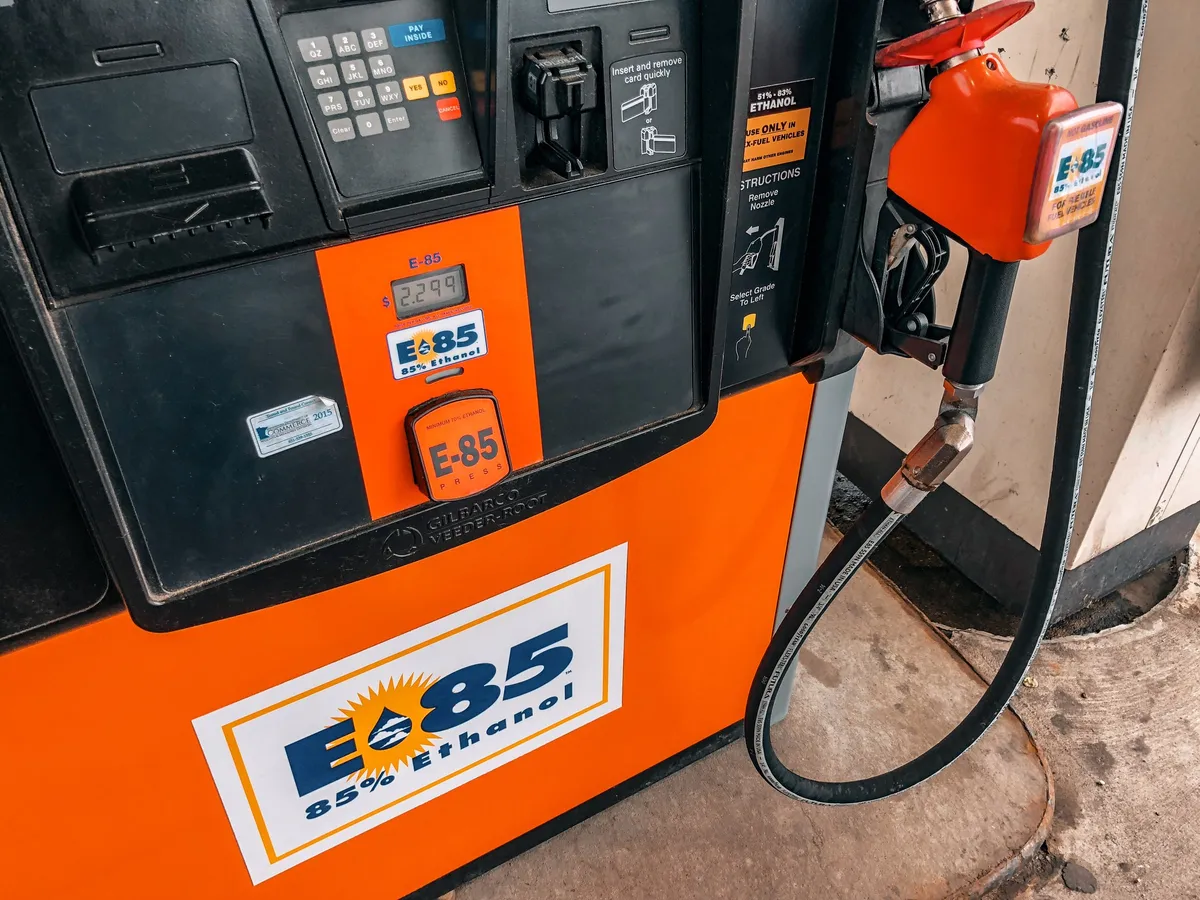
“E85” is a name, not a measurement. The fuel standard for it (ASTM D5798) allows anywhere from 51% to 83% ethanol, so legal E85 can never actually be 85%. Stations sell more ethanol in summer and less in winter, because a cold engine needs some gasoline to start.
The last national pump survey (NREL, 2010 to 2011) found summer E85 averaged 80% ethanol and winter E85 averaged 74%, with single samples from 66% to 87%. The Department of Energy assumes about 70% when it compares fuel prices.
That gap changes your mix. Here is the E85 needed for E30 in an empty 15-gallon tank with E10 pump gas:
| Real ethanol in your E85 | E85 to add | Gas to add |
|---|---|---|
| 85% | 4.0 gal | 11.0 gal |
| 80% | 4.3 gal | 10.7 gal |
| 75% | 4.6 gal | 10.4 gal |
| 70% | 5.0 gal | 10.0 gal |
If you set the calculator to 85 but your fuel is really 70%, a planned E30 comes out closer to E26. For a flex fuel car that doesn’t matter, because its sensor reads the blend. For a tuned car without a flex fuel sensor, it can mean running leaner than the tune expects. Test the fuel.
How to test E85 at home
The cheap way is a water test. A graduated tube such as the Helix Racing fuel ethanol tester has a line for water and a line for fuel. Fill water to the first line, fuel to the second, shake and let it sit. Ethanol mixes into the water, so the water layer grows. The tube’s scale turns that growth into the ethanol percentage. It takes about five minutes.
Tuned cars with a flex fuel sensor can show the number live on a gauge, such as the Innovate MTX-D ethanol content gauge. Many tuning apps also read it over OBD2.
E10 or E0 pump gas
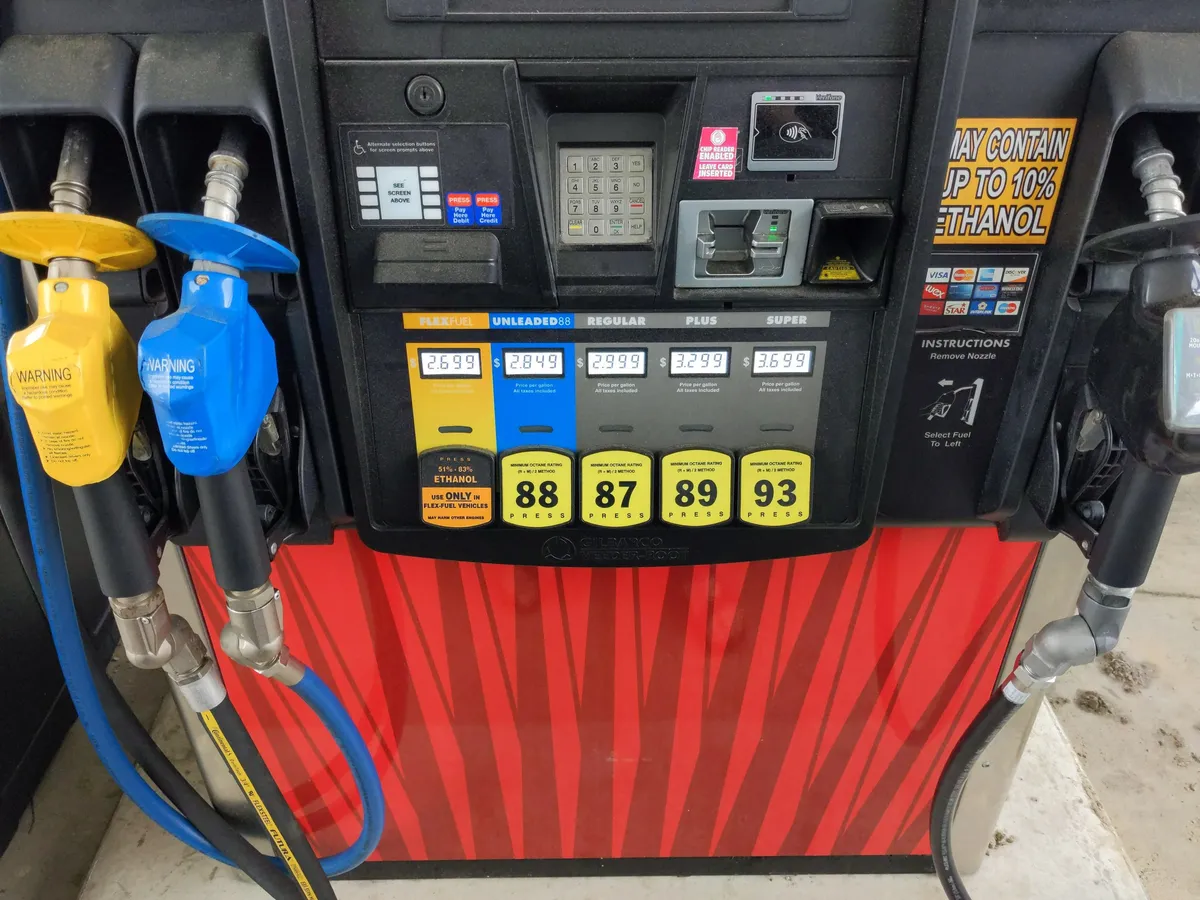
Nearly all regular gas in the US already has 10% ethanol, and calculators that assume ethanol-free gas give you too much ethanol. With ethanol-free (E0) pump gas you need more E85 to reach the same blend: E30 in an empty 15-gallon tank takes 5.3 gallons of E85 and 9.7 gallons of E0, instead of 4.0 and 11.0 with E10. E15 is sold as “Unleaded 88” at some stations. Pick whichever you will actually pump.
When the calculator says you can’t reach your target
Sometimes the fuel already in the tank makes a blend impossible on this fill-up.
- Too much ethanol already. A 15-gallon tank half full of E85 can’t become E30, even if you fill the rest with gas. You land at E48. To get E30, run the tank down to 4.0 gallons first, then fill with gas.
- Not enough room. A 15-gallon tank with 10 gallons of E10 can’t reach E50, even if you fill the rest with E85. The calculator shows the highest blend you can reach and how far to run the tank down.
In both cases the calculator tells you the closest blend you can get today and the fuel level to wait for.
Is E85 cheaper than gas?
Only when the price gap is bigger than the mileage loss. A gallon of ethanol holds about 75,700 Btu of energy and a gallon of gasoline about 115,400 Btu, so a car goes fewer miles on each gallon of E85. The government’s fuel economy site puts the loss at 15% to 27% compared with gas.
From energy content alone, true 85% E85 gives about 27% fewer miles per gallon than E10. To cost the same per mile, it has to sell for about $2.81 when regular is $3.84. In July 2026 the national average for E85 was $2.95, which makes it slightly more expensive per mile than regular gas. E85 that is really 70% ethanol does better, because it holds more gasoline: its break-even price is about $3.02.
Blends land in between. E30 loses about 7% in miles per gallon, so the main reason to run it is power and knock resistance, not saving money. Enter your local prices and your car’s mpg in the “Is E85 cheaper?” panel of the calculator to see your own numbers.
Can my car run E85?
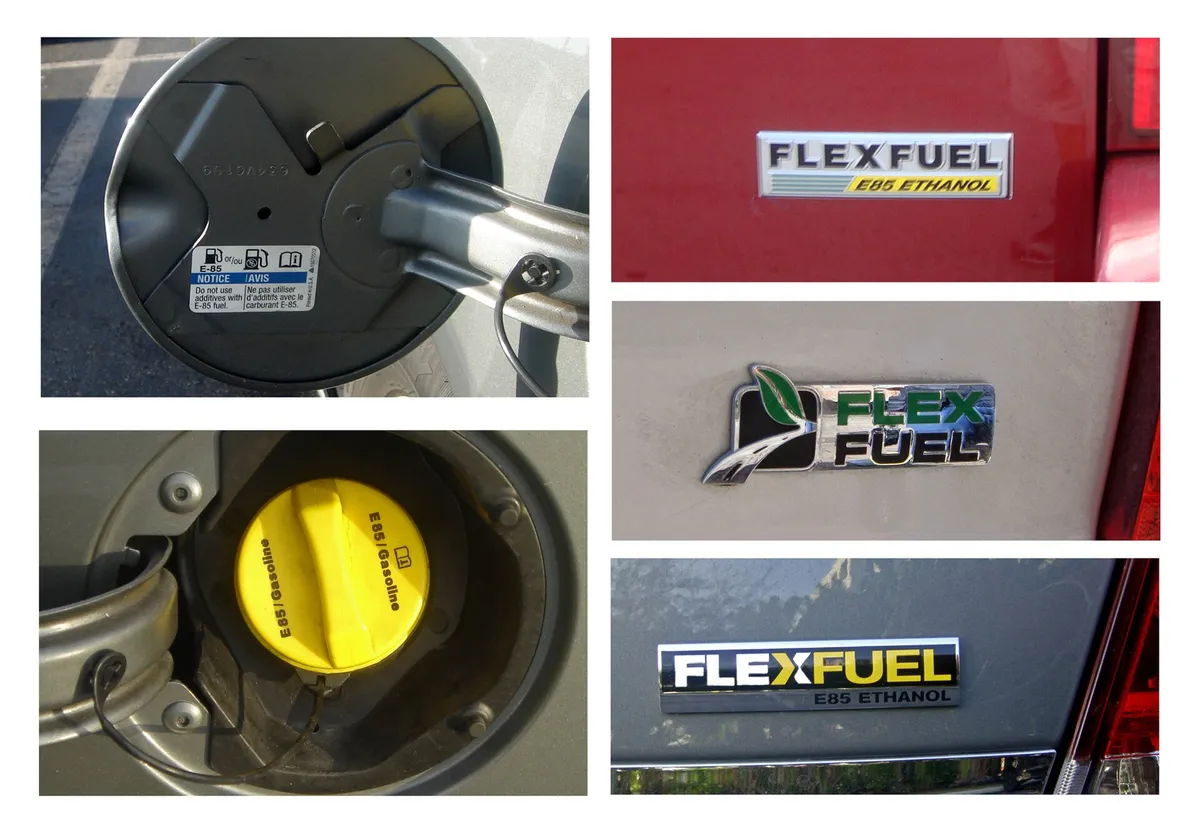
Only flex fuel vehicles (FFVs) are built to run any mix from gasoline to E85. Ways to check:
- A “Flex Fuel”, “FFV” or “E85” badge on the trunk or tailgate
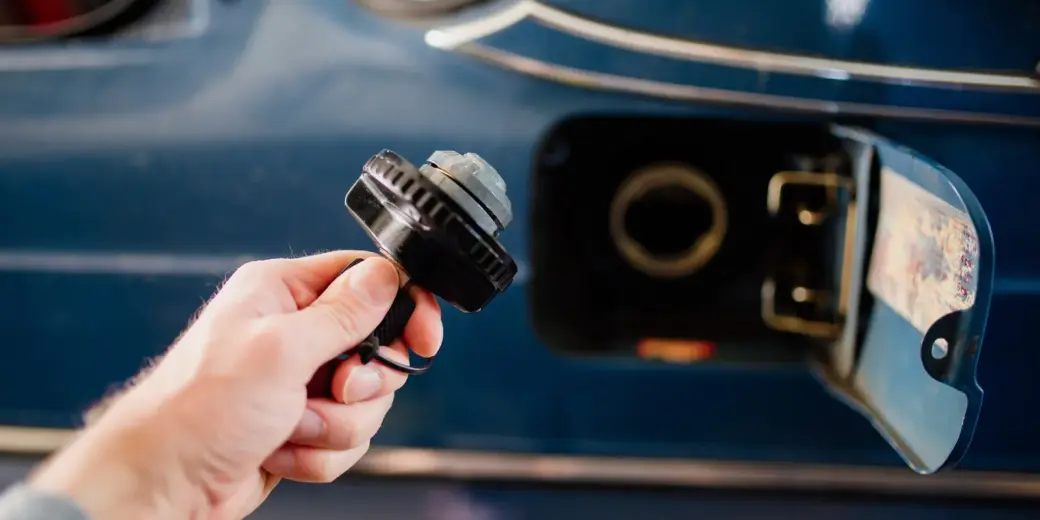
- A yellow gas cap or a yellow ring inside the fuel door
- The owner’s manual or the label inside the fuel door
- The government’s flex fuel vehicle search at fueleconomy.gov
A car that is not flex fuel can safely use E10, and E15 if it is a 2001 or newer model. Higher blends need a tune. Ethanol needs about 30% more fuel by volume than gasoline to burn completely, so an untuned car runs lean and usually sets a P0171 “system too lean” code. Long-term, ethanol can also damage fuel parts that were not made for it.
Notes for tuned cars
- Air-fuel ratio. Gasoline burns completely at 14.7 parts air to 1 part fuel and pure ethanol at 9.0. E85 sits near 9.8 and E30 near 12.9. The calculator shows the stoich ratio for your blend.
- Fuel system. High blends need roughly a third more fuel flow, which is why E50 and E85 builds often need larger injectors and a bigger fuel pump.
- Consistency. A tune made for E30 without a flex sensor expects E30 every time. Use the calculator at every fill-up and test the E85 when the seasons change.
FAQ
How much E85 do I need to make E30?
For an empty 15-gallon tank with E10 pump gas and E85 at 85% ethanol, add 4.0 gallons of E85 and 11.0 gallons of gas. That works out to about 27% of the tank as E85. If your E85 tests at 70%, you need 5.0 gallons instead.
What blend do 5 gallons of E85 and 10 gallons of gas make?
With E85 at 85% and E10 gas, 5 gallons of E85 plus 10 gallons of gas makes 15 gallons of E35. The math is (5 × 0.85 + 10 × 0.10) ÷ 15 = 0.35.
Is E85 really 85% ethanol?
No. The US standard allows 51% to 83% ethanol in fuel sold as E85. Summer fuel averages around 80% and winter fuel around 74%, and some stations sell less. Test the fuel if your tune depends on the exact blend.
Can you mix E85 and regular gas in the same tank?
Yes. Ethanol and gasoline mix completely and stay mixed, so you can pump them in either order. Pumping E85 first and topping off with gas is easier because you only watch the meter once.
Can I mix E85 with 93 octane premium?
Yes. Premium is usually E10 like regular, so the calculator’s E10 setting works. Premium raises the octane of the final blend a little more than regular does.
What if my tank already has too much ethanol?
Fill with pump gas only and you get the lowest blend possible on this fill-up. The calculator shows that blend and the fuel level to run the tank down to before your target becomes reachable.
Is E85 bad for my engine?
Not in a flex fuel car or a car tuned for it with suitable fuel parts. In a car built only for gasoline, E85 makes the engine run lean, can set check engine codes and can wear rubber and plastic fuel parts over time.
Do I lose gas mileage with E85?
Yes. Flex fuel cars typically get 15% to 27% fewer miles per gallon on E85 than on gasoline. E30 gives about 7% fewer miles per gallon than E10.
Can I use the E85 calculator in liters?
Yes. Switch the units to liters and every amount, including the tank size and the answer, is shown in liters.
Does a flex fuel car need a calculator?
Not for safety. Its sensor reads whatever blend is in the tank. The calculator is still useful if you want to run a set blend such as E30, or to work out what a fill-up costs.
Photos: Shixart1985 (featured) and Tony Webster, CC BY 2.0; Jleedev, CC BY-SA 4.0; Mario Roberto Duran Ortiz, CC BY-SA 3.0. All via Wikimedia Commons.
Sources & References
- DOE Alternative Fuels Data Center, E85 (ASTM D5798) specifications: https://afdc.energy.gov/fuels/ethanol_e85_specs.html
- DOE Alternative Fuels Data Center, ethanol fuel basics: https://afdc.energy.gov/fuels/ethanol-fuel-basics
- NREL / CRC, national survey of E85 quality (2010-2011): https://www.nlr.gov/docs/fy12osti/52905.pdf
- DOE Clean Cities and Communities Alternative Fuel Price Report, July 2026: https://afdc.energy.gov/files/u/publication/alternative-fuel-price-report-july-2026
- fueleconomy.gov, flexible fuel vehicles: https://www.fueleconomy.gov/feg/flextech.shtml
- API density correction information for ethanol and gasoline blends (NCWM, 2025): https://cdn.ncwm.com/userfiles/files/Meetings/Interim/Pub%2015%20Archive/2026/L%26R%20Supporting%20Documents/LMD-26_1-2%20page%20Density%20Correction%20Information%20from%20API-2025-12-9.pdf

James Kowalski
More from James KowalskiHow we reviewed this article
This article was researched against manufacturer records and editorially reviewed before publishing. We accept no payment for coverage. Some guides contain affiliate links; see our affiliate disclosure.