Table of Contents
- 1950 Was the Year Detroit Broke Its Own Record
- The American Lineup
- 1950 Car Prices at a Glance
- The Hardtop Convertible Goes Mainstream
- What Was Happening Outside Detroit
- Why 1950 Is the Real Starting Line for the Fifties
- The Short Version
Type “cars from the 1950s” into a search bar and you’ll get a decade blurred into one long chrome-and-tailfin montage. That’s not what 1950 looked like. Tailfins were barely a rumor, chrome was still restrained, and the cars rolling off assembly lines that year were closing out one design language while quietly starting another. This is the year itself — the actual model-year lineup, what it cost, and the one body style that changed what a “family car” could look like.
1950 Was the Year Detroit Broke Its Own Record

The U.S. auto industry built roughly 8 million cars and trucks in 1950, a production record the industry had been chasing since the war shut the lines down for tanks and jeeps. Materials weren’t rationed anymore, buyers had cash saved from the war years, and Detroit finally had enough steel to build what people actually wanted instead of what the government allowed.
It was also the year Ford passed Chrysler for the industry’s number-two sales spot, a shift that reshaped the competitive order for the next two decades. Chrysler had spent the 1940s playing it safe with conservative, boxy styling under K.T. Keller’s “you can wear a hat in it” philosophy. Ford didn’t play it safe. Neither did GM. That gap in nerve is a big part of why the cars below look the way they do.
The American Lineup
Here’s what a shopper actually cross-shopped in a 1950 Chevrolet dealership’s parking lot, or flipping through a Saturday Evening Post full of car ads.
Chevrolet Bel Air. The Bel Air nameplate started life in 1950 as a single body style: a two-door hardtop with no center pillar, built on the Styleline De Luxe. Chevrolet borrowed the format from GM’s senior divisions and priced it at $1,741, cheap enough that a Bel Air cost about $150 more than a regular Chevy coupe. Under the hood sat the 235.5-cubic-inch “Blue Flame” six, making 92 horsepower with the standard three-speed manual or a slightly reworked 105-horsepower version paired to the new Powerglide automatic. It wasn’t fast. It didn’t need to be — the point was the roofline.
Oldsmobile 88. Olds dropped its 303-cubic-inch overhead-valve Rocket V8, introduced the year before in the bigger 98, into the shorter, lighter B-body for 1950. The combination made the 88 the quickest thing you could buy from a mainstream American dealer that wasn’t wearing a Cadillac badge. It’s the car that would inspire the 1951 single “Rocket 88,” often cited as the first rock and roll record — not bad for a family sedan that started around $1,800.
Buick Roadmaster. Buick’s flagship carried the 320-cubic-inch straight-eight making 152 horsepower, paired exclusively with the Dynaflow automatic transmission. The Roadmaster’s calling card was its face: the toothy chrome grille bars and the fender portholes (VentiPorts) that Buick had introduced the year before and that buyers now specifically asked for by name. A sedan ran about $2,750; the convertible pushed past $3,200.
Cadillac Series 62. Cadillac’s entry-level model wasn’t entry-level in any way that mattered to the neighbors. The 331-cubic-inch overhead-valve V8, new for 1949, made 160 horsepower and would go on to power Cadillacs for the next fifteen years with only minor changes. A coupe started around $3,050; a convertible topped $3,800, real money when a schoolteacher’s annual salary was under $3,000.
Ford Custom Deluxe / Crestliner. Ford didn’t have a true pillarless hardtop in 1950 — that came in 1951 with the Victoria — so it improvised with the Crestliner, a two-tone Custom Deluxe with a vinyl-covered roof section that visually chased the same hardtop look for about $1,711. Power came from the familiar 239-cubic-inch flathead V8 making around 100 horsepower, the same basic engine hot rodders had already been building a subculture around for a decade.
Mercury Eight. Mercury’s flathead V8 sedan became the default canvas for the emerging custom car scene almost as soon as it left the lot — chopped tops, shaved trim, and lowered stances turned Mercs into the definitive “lead sled.” Stock, it ran about $1,875 and offered more room and a smoother ride than a Ford for a few hundred dollars more.
Plymouth Special Deluxe. The most conservative car on this list by a wide margin, still riding on Chrysler’s cautious postwar styling and a flathead six good for modest performance. It sold anyway, at around $1,540, because Plymouth buyers in 1950 wanted a car that would run forever, not turn heads.
Studebaker Champion. Nobody mistook a 1950 Studebaker for anything else on the road. The “bullet-nose” front end — a spinner-style hood ornament flanked by a wraparound grille — was polarizing then and still is now. Prices ranged from about $1,486 for a business coupe to nearly $1,981 for the convertible, with a 170-cubic-inch six making roughly 85 horsepower.
Nash Rambler. Nash beat the rest of the industry to the compact segment by more than a decade. The 1950 Rambler launched as a single body style, a Landau convertible with a fixed center roof section, priced at $1,808. It’s arguably the first modern American compact car, built for buyers who wanted a second car for a growing suburb, not a status symbol.
Hudson Commodore. Hudson’s “step-down” design, introduced in 1948, put the floor pan below the frame rails instead of on top of them, which lowered the car’s center of gravity and gave it handling that embarrassed heavier competitors. The Commodore Eight used a 262-cubic-inch flathead straight-eight making 128 horsepower and started around $2,300. The step-down chassis would carry Hudson to serious success on early NASCAR ovals within two years.
1950 Car Prices at a Glance
| Make & Model | Starting Price | Engine | Notable Feature |
|---|---|---|---|
| Chevrolet Bel Air | $1,741 | 235.5 ci six, 92–105 hp | First-year pillarless hardtop for a mainstream brand |
| Oldsmobile 88 | ~$1,800 | 303 ci Rocket V8, 135 hp | Light body + big V8, proto-muscle car |
| Buick Roadmaster | ~$2,750 | 320 ci straight-eight, 152 hp | Dynaflow automatic, signature VentiPorts |
| Cadillac Series 62 | ~$3,050 | 331 ci V8, 160 hp | New OHV V8 that lasted 15 years |
| Ford Custom Deluxe Crestliner | $1,711 | 239 ci flathead V8, ~100 hp | Two-tone vinyl roof, hardtop look without the hardtop |
| Mercury Eight | ~$1,875 | 239 ci flathead V8 | Favorite platform of early custom car builders |
| Plymouth Special Deluxe | ~$1,540 | Flathead six | Conservative styling, built to last |
| Studebaker Champion | $1,486–$1,981 | 170 ci six, ~85 hp | “Bullet-nose” spinner front end |
| Nash Rambler | $1,808 | Six-cylinder | First modern American compact |
| Hudson Commodore Eight | ~$2,300 | 262 ci flathead straight-eight, 128 hp | Step-down unibody, low center of gravity |
The Hardtop Convertible Goes Mainstream
GM’s senior brands — Cadillac, Buick, and Oldsmobile — introduced the pillarless hardtop in 1949, a body style that kept a convertible’s open, airy greenhouse but with a fixed steel roof and no center post to interrupt the side glass. It was an engineering flex as much as a styling one, and for a year it stayed a luxury feature.
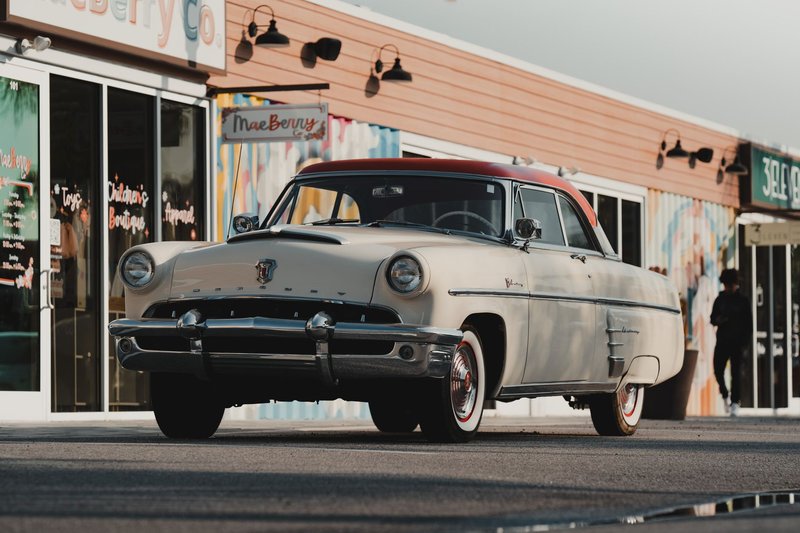
1950 is when the format stopped being a rich person’s toy. Chevrolet brought the pillarless hardtop down to the Bel Air’s price point, and buyers who could never have afforded a Buick Roadmaster Riviera suddenly had the same silhouette parked in a modest driveway. The Smithsonian’s collection of postwar American automobiles traces this exact shift — hardtops moving from a status symbol to a mass-market body style within a single model year, which is part of why so many collectors treat 1950 as a hinge point rather than just another year in a decade-long stretch.
Once Chevrolet proved a hardtop could sell at a mainstream price, every competitor had to answer. Ford followed with the Victoria in 1951; Plymouth followed a year after that. The domino effect started here, and the 1956 lineup represented the complete triumph of the hardtop as a mass-market body style, offered across all the major American manufacturers.
What Was Happening Outside Detroit
American coverage of 1950 tends to stop at the coastline, but it was a real year for cars built somewhere other than Michigan.
Jaguar XK120. Jaguar moved the XK120 from show-car curiosity into actual production in 1950, powered by a 3.4-liter dual overhead-cam inline six making 160 horsepower — genuinely advanced engineering for the price. A stock example had already been clocked at 132 mph on a closed stretch of Belgian highway, and the roadster undercut most American sports cars while outrunning nearly all of them. UK list price was around £1,263 including purchase tax, though most early production went straight to export markets, the U.S. chief among them.
MG TD. The TD replaced the TC in 1950 and became many Americans’ first experience of a proper small sports car — a 1.25-liter four-cylinder making about 54 horsepower, wire wheels, and a driving position that put you closer to the road than any domestic product. U.S. price landed around $1,850, competitive with a Mercury, and it built the appetite that later fed the entire MGB and Austin-Healey era.
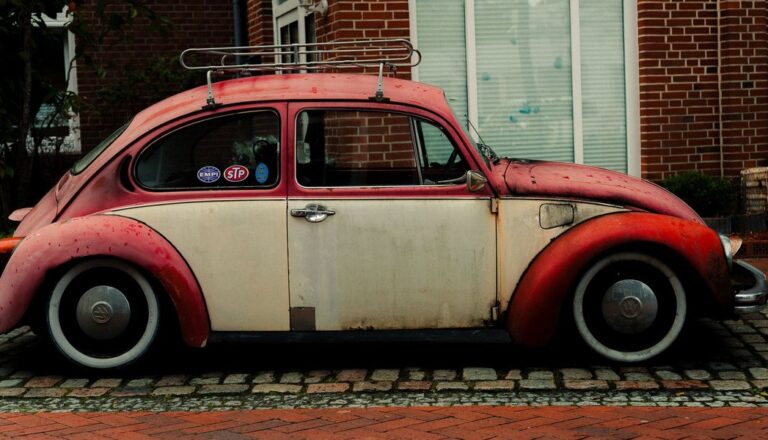
Volkswagen Beetle. The Beetle’s American beachhead started forming in 1950, with the air-cooled 1.1-liter flat-four making a modest 25 horsepower moving cars for around $1,280. It was slower than almost anything else on this list and looked nothing like it. That was the point — a decade later, that contrast is exactly what made it a cultural phenomenon in the U.S. market.
None of these cars sold in volumes that worried Detroit in 1950. Their importance shows up later, once American buyers started wanting something GM, Ford, and Chrysler weren’t building.
Why 1950 Is the Real Starting Line for the Fifties
Most “1950s cars” content treats the whole decade as one long tailfin-and-chrome joke, which erases what actually happened in 1950 itself. The tailfins hadn’t ballooned yet — Cadillac’s fins were still modest, borrowed from a WWII fighter plane tail and nothing like the 1959 excess. Chrome was accent, not armor. What 1950 actually delivered was structural: the V8 arms race kicking off with the Rocket 88 and Cadillac’s OHV engine, the hardtop becoming something a normal family could afford, and the first real crack in Detroit’s decades-long assumption that a “second car” or “small car” had no market, courtesy of Nash.
The Economic History Association’s overview of the American auto industry points to exactly this stretch as the moment postwar pent-up demand collided with genuine product innovation rather than just badge-engineering leftover prewar designs. Everything people associate with “the fifties car” — the fins, the two-tone paint, the chrome dashboards — is 1950’s ideas taken to their logical, occasionally absurd extreme over the following nine years.
The Library of Congress’s public automobile photo collection is a good place to actually see the difference: line up a 1950 photo next to a 1958 one, and the gap looks more like two different decades than two ends of the same one.
The Short Version
1950 gets flattened into “the fifties” by almost every list that covers it, and that’s the gap worth exploiting if you’re actually curious about the year. It was Detroit’s biggest production year on record, the year the hardtop stopped being a luxury flex, the year the Rocket 88 previewed the muscle car a decade early, and the year Nash bet correctly that America wanted a small car before anyone else believed it. The 1959 Cadillac gets all the pop-culture attention. The 1950 Bel Air is the car that actually started the run.

Marco Delantero
More from Marco DelanteroHow we reviewed this article
This article was researched against manufacturer records and editorially reviewed before publishing. We accept no payment for coverage. Some guides contain affiliate links; see our affiliate disclosure.