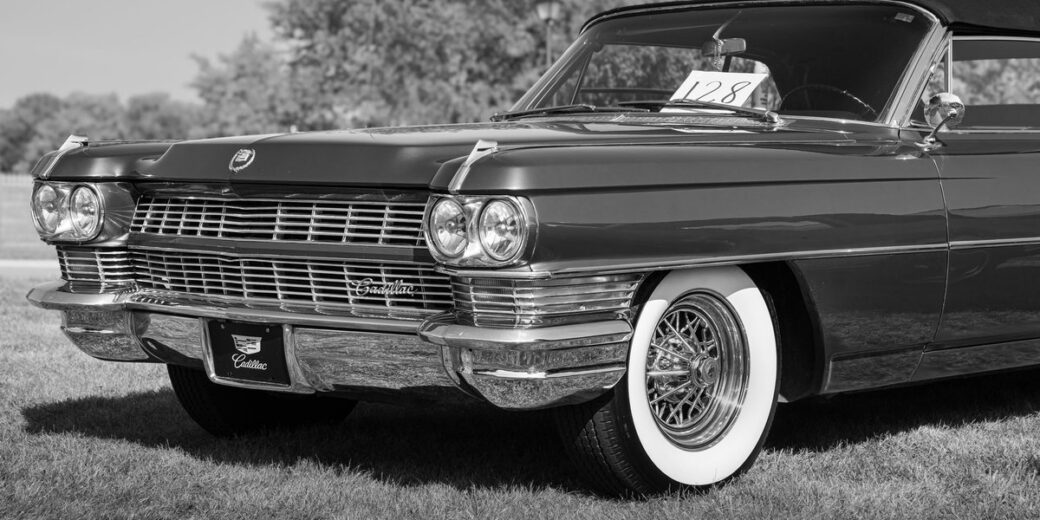
Cadillac started the 1970s selling the biggest cars in America and ended them selling some of the smallest it had made in decades. In between came the 1973 oil embargo, emissions rules that strangled V-8 output, the death of the American convertible, and a compact Cadillac built to take on Mercedes-Benz. Every model from the decade fits into five lines, and once you know them, the whole story makes sense.
Contents
- The 1970s Cadillac lineup at a glance
- Why the decade split in two
- DeVille and Calais
- Fleetwood Sixty Special Brougham and Seventy-Five
- Eldorado: coupe and convertible
- Seville: the small Cadillac
- Decade timeline
- Which 1970s Cadillacs to buy, and which to skip
- Summary
The 1970s Cadillac lineup at a glance
| Model line | Years in the decade | Body styles | Main engines | Defining fact |
|---|---|---|---|---|
| Calais | 1970-76 | Coupe, sedan | 472 V-8 | Entry-level model, dropped after 1976 |
| DeVille | 1970-79 | Coupe de Ville, Sedan de Ville | 472 V-8, then 425 V-8 from 1977 | The volume seller; shrank in 1977 |
| Fleetwood Sixty Special Brougham | 1970-79 | Four-door sedan | 472 V-8, then 425 V-8 from 1977 | Long wheelbase, rear-seat luxury |
| Fleetwood Seventy-Five | 1970-79 | Limousine, formal sedan | 472 V-8, then 425 V-8 from 1977 | Factory limousine with a divider |
| Eldorado | 1970-79 | Coupe, convertible (1971-76) | 500 V-8; 425 V-8 from 1977 | Front-wheel drive; shrank in 1979 |
| Seville | 1975-79 | Four-door sedan | Fuel-injected 350 V-8; diesel option from 1978 | First compact Cadillac |
Engine displacement is in cubic inches. The 472 is 7.7 liters, the 500 is 8.2 liters, and the Seville’s 350 is 5.7 liters.
Why the decade split in two
Before 1973, the job was to make cars bigger and smoother. The 1971 redesign gave the full-size line a new body, and Cadillac kept the 472 and 500 cubic-inch V-8s as the engines that did the work. The 500, built for the front-drive Eldorado, was the largest-displacement production car engine in America when it appeared in 1970, and it made 550 lb-ft of torque.
Then the rules changed. The Clean Air Act of 1970, described in the EPA’s history of the act, pushed automakers toward lower compression and later toward catalytic converters. Power ratings switched from gross to net in 1972, which made the numbers look worse on paper and in some cases was worse on the road. The 1973 oil embargo turned a 15-mpg-if-you’re-lucky car from a status symbol into an awkward purchase. Federal fuel-economy standards followed in 1975 and gave GM a deadline. Chevrolet felt the same pressure, and the 1970s Chevrolet lineup traces that shift from big-block muscle to economy cars.
Cadillac’s answer came in two waves: the Seville in 1975 and a downsized DeVille and Fleetwood in 1977. Most buyers still wanted the big car, so the downsizing worked. Cadillac sales hit records late in the decade.
DeVille and Calais
The DeVille was the heart of the lineup, sold as the two-door Coupe de Ville and the four-door Sedan de Ville. Calais sat below it as the cheaper entry point, sharing the body and the 472 V-8 but with less trim and fewer standard features. It was dropped after 1976.
The 1971 to 1976 cars share the same basic body and the same feel: long hood, a ride like a waterbed and a steering wheel you steer with two fingers. Federal bumper rules show up as you move through the years. From 1973 the front bumper grew into a 5-mph impact unit, and 1974 added the same at the rear, which is why a 1974 looks heavier at both ends than a 1972.
The 1977 model year is the cut line. The new DeVille rode on a 121.5-inch wheelbase, was about ten inches shorter and roughly 950 pounds lighter than its predecessor, and swapped the 472 for a 425 V-8. It still looked like a Cadillac, with the upright grille and the formal roofline intact, but it parked in spaces the 1976 model couldn’t use. Calais was gone and the DeVille took over as the base car.
Fleetwood Sixty Special Brougham and Seventy-Five
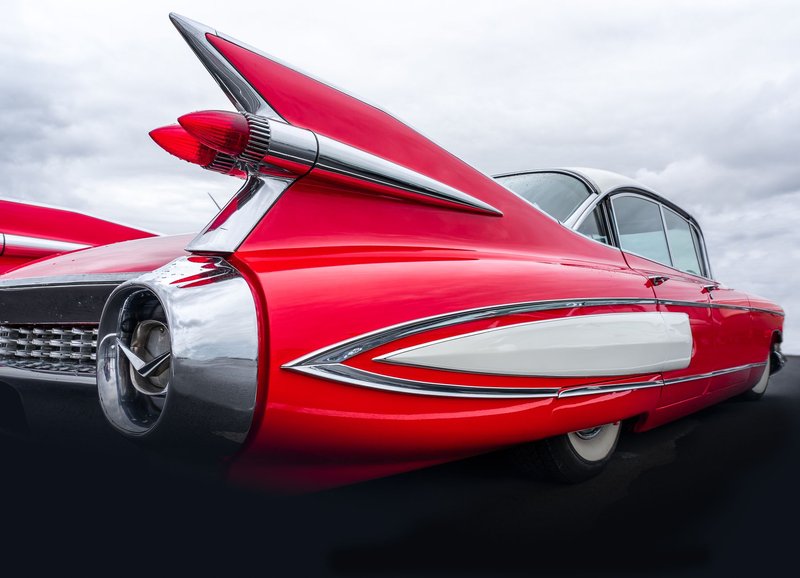
Fleetwood was the step up. The Sixty Special Brougham was a long-wheelbase four-door aimed at buyers who rode in the back or wanted to be seen doing it. It took the DeVille’s mechanical package and added rear legroom, plusher upholstery and, in 1975, the Fleetwood Talisman, a trim package with a tufted interior and a rear-seat setup closer to a limousine than a sedan.
Above it sat the Fleetwood Seventy-Five, the factory limousine and formal sedan, with a divider window and jump seats. Funeral homes and executive car services bought most of them. Through 1976 the Seventy-Five carried the 472, and in 1977 it moved to the 425 along with the rest of the downsized line, although it stayed on a longer wheelbase.
Eldorado: coupe and convertible
The Eldorado was the personal luxury car: two doors, front-wheel drive, and the 500 V-8 sending power through the front wheels. It had been on its own platform since 1967, and the 1971 redesign made it bigger and heavier, with a longer, flatter body than the 1967 to 1970 cars.
Cadillac added a convertible to the Eldorado in 1971, after the DeVille convertible ended in 1970. That convertible became the story of the decade. In 1976 Cadillac announced the Eldorado convertible as the last American-built convertible, and the last one came off the line on April 21, 1976. It was a Bicentennial-themed car, Cadillac built about 14,000 of them that year, and buyers bought them as investments, many keeping them wrapped in plastic. That promise did not hold: Chrysler, Ford and others brought convertibles back within a few years, and Cadillac itself returned in 1984 with a convertible Eldorado Biarritz. Still, the 1976 car is the one that collectors name first.
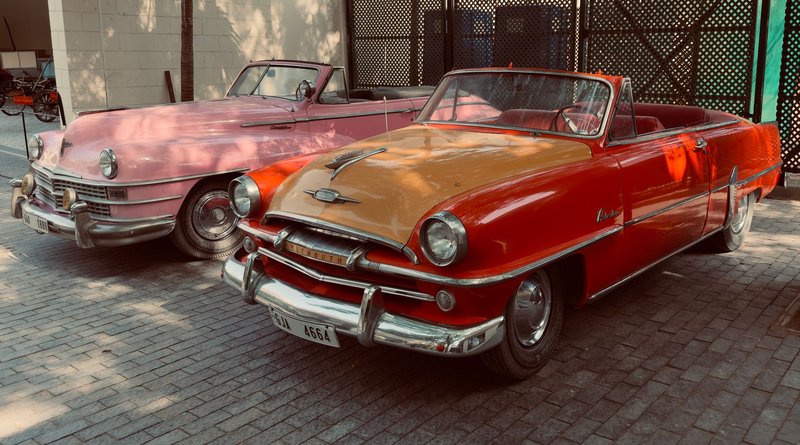
Engineering changes mattered here too. The Eldorado offered electronic fuel injection on the 500 from 1975, years before most American cars used it. The 1977 and 1978 coupes kept the huge body while the DeVille shrank, which looks backward in hindsight. Cadillac fixed that for 1979, downsizing the Eldorado onto a smaller platform shared with the Buick Riviera and Oldsmobile Toronado. The 1979 car dropped the 500 for a 6.0-liter 368 V-8 and offered the Oldsmobile 350 diesel as an option.
Seville: the small Cadillac
Cadillac introduced the Seville in spring 1975 as a 1976 model, and it was a different kind of car. At just over 200 inches long and on a 114.3-inch wheelbase, it was roughly a foot shorter than the DeVille, and the target was clear: the Mercedes-Benz S-Class and other European imports that were pulling affluent buyers away. It was priced at just over $12,000, a lot for an American sedan then and roughly the price of a Mercedes 280.
The engine was a 5.7-liter 350 V-8 with Bendix electronic fuel injection, rated at 180 horsepower. The body was clean and square-shouldered, with a notched trunk and hood lines that made it unmistakable. Standard equipment included air conditioning, power windows and leather options that previously cost extra on bigger Cadillacs.
In 1978 the Seville became the first Cadillac offered with the Oldsmobile-built 350 diesel, a decision Cadillac and GM spent years regretting. Wider, softer-looking Sevilles followed with the 1980 redesign, which is a story for another decade.
Decade timeline
- 1970: Last DeVille convertible. The 500 V-8 debuts in the Eldorado.
- 1971: All-new full-size body. Eldorado convertible joins the lineup. Compression drops so engines can run on lower-lead fuel.
- 1972: Power ratings switch to the net system.
- 1973: The oil embargo begins in October. Front impact bumpers arrive.
- 1974: Rear impact bumpers arrive.
- 1975: Catalytic converters and the Seville announced in spring. Fuel injection offered on the Eldorado.
- 1976: Seville goes on sale. Last Eldorado convertible built on April 21.
- 1977: DeVille and Fleetwood downsized. 425 V-8 replaces the 472. Calais discontinued.
- 1978: Diesel 350 offered in the Seville.
- 1979: Eldorado downsized. Cadillac sales stay at record levels.
Which 1970s Cadillacs to buy, and which to skip
Strongest values:
- 1976 Eldorado convertible. The best known and the most expensive of the decade. Check that the car is the real thing and not a hardtop converted by an aftermarket shop.
- 1971-74 Eldorado convertibles and coupes. The largest engines, the most power and the least emissions hardware. These are the cars that feel most like what people picture.
- 1970s Fleetwood Sixty Special Brougham. Rare, comfortable and still cheaper than an Eldorado.
Fine if you want a driver:
- 1977-79 DeVille and Fleetwood. Easier to park, easier on fuel, and parts are plentiful. They won’t appreciate dramatically.
- 1976-79 Seville. A real piece of design history, though the fuel injection is difficult to service. Buy one with records.
Skip or inspect hard:
- 1978-79 diesel Sevilles and Eldorados. The Oldsmobile-derived diesel had a reputation for head gasket and injection pump trouble. Many were swapped to gasoline engines long ago.
- Any 1975-76 car with a worn catalytic and vacuum system. The emissions plumbing is a maze, and cars that have lost it often run badly.
- The 1981 V8-6-4. It falls outside the decade, but its cylinder-deactivation system gave Cadillac a bad reputation and is still the reason buyers distrust early-80s Cadillacs.
On every car from this era, check the body mounts, the frame and the rear window seals for rust. The Eldorado’s front-drive transaxle is robust, but it’s a specialist part and a pricey repair.
Summary
The 1970s Cadillac models fit into five lines: DeVille and Calais for volume, Fleetwood for the long-wheelbase buyers, Eldorado for the personal coupe and the last convertible, and Seville for the compact. The 472 and 500 V-8s defined the early years. Emissions rules, the oil embargo and fuel-economy law dismantled that approach, and the 1977 downsizing and the 1975 Seville show how fast the company adapted. If you’re buying, the early-decade Eldorados and the 1976 convertible carry the value, while the diesel cars carry the risk.

Daniela Voss
More from Daniela VossHow we reviewed this article
This article was researched against manufacturer records and editorially reviewed before publishing. We accept no payment for coverage. Some guides contain affiliate links; see our affiliate disclosure.