TLDR
Lamborghini sold exactly two models in 1990: the Countach 25th Anniversary, the final and most refined version of the wedge that defined the brand for sixteen years, and the LM002, the 450-horsepower off-roader nicknamed the “Rambo Lambo.” One is a V12 supercar built for straight lines and stoplights. The other is a V12 truck built for dunes and jungle roads. Both share the same engine family, both are worth more today than they were new, and neither shows up together on the same page anywhere else — which is the whole reason for this guide.
Table of Contents
- Two Cars, One Strange Year at Sant’Agata
- The Countach 25th Anniversary
- The LM002
- What They’re Worth Today
- Which One a Collector Should Actually Buy
- The Model That Never Showed Up: The P140
Two Cars, One Strange Year at Sant’Agata
By 1990, Lamborghini had been owned by Chrysler for three years, and the lineup was thin. The Jalpa, the smaller V8 model, had already been discontinued. That left two cars on the production line at Sant’Agata Bolognese: a sixteen-year-old supercar shape nearing the end of its life, and a military-vehicle experiment that had somehow turned into a road-legal luxury 4×4. Nothing else. No sedans, no entry-level model, nothing between them.
That’s an unusual amount of range for a two-car lineup, and it’s exactly what makes 1990 an interesting model year to study instead of just catalog.
The Countach 25th Anniversary
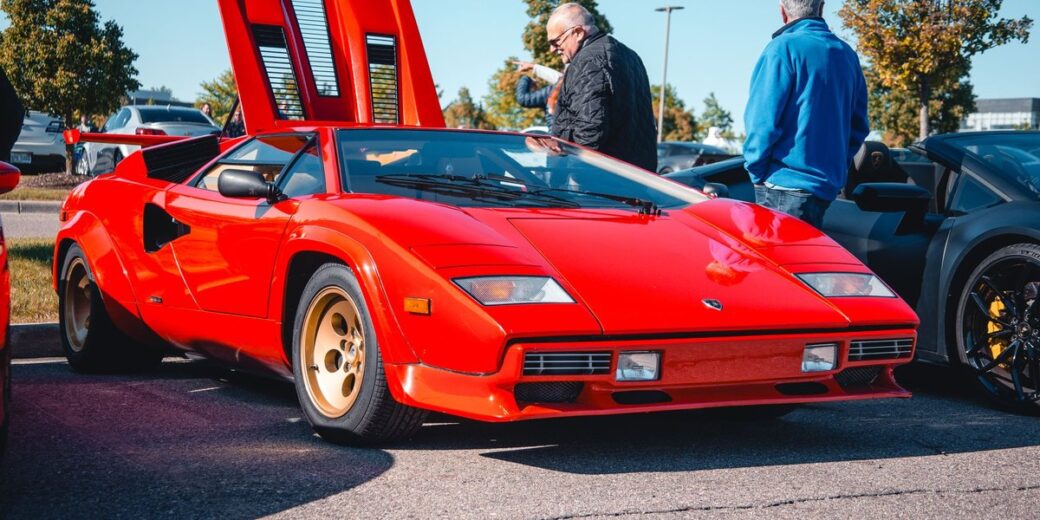
The 25th Anniversary was the last Countach, produced from 1988 through 1990 before the Diablo took over. Lamborghini built roughly 657 of them across that run, making it the most common Countach variant by a wide margin — a fact that surprises people who assume every Countach is a five- or six-figure-mile unicorn.
The reason it looks different from earlier Countaches comes down to one hire. Horacio Pagani — yes, the same Pagani who’d later found his own hypercar company — was working as a composites engineer at Lamborghini in the late ’80s, and he reworked the body panels in fiberglass and Kevlar for the Anniversary update. The smoothed-in bumpers, the redesigned sills, and the slatted engine cover louvers that most people picture when they think “Countach” are his doing, not Marcello Gandini’s original 1974 design. Sandro Munari, the four-time Monte Carlo Rally winner Lamborghini kept on as a development driver through the ’80s, had input on sorting the suspension for the update — a detail that gets lost because Munari’s rally fame overshadows the quieter development work he did for the factory.
Under the louvered engine cover sits a 5.2-liter V12 making 449 horsepower in European trim, good for a 183 mph top speed and 0-60 in around 4.7 seconds — numbers that still hold up against plenty of modern performance cars, let alone anything else on the road in 1990. U.S.-spec cars ran lower output thanks to emissions equipment, which is worth checking on any example you’re evaluating, since it directly affects both the driving experience and the price a buyer should expect to pay. New, the Anniversary carried a sticker north of $100,000, which made it one of the most expensive cars sold in America that year.
The LM002
The LM002’s backstory explains everything about how strange it is. Lamborghini originally built it in response to a U.S. military request for a high-mobility off-road vehicle, lost that contract to what became the Humvee, and then — rather than scrap the engineering — turned the prototype into a civilian luxury 4×4 anyway. It shipped with the same 5.2-liter V12 as the Countach, tuned to around 450 horsepower, moving a two-and-a-half-ton truck to 60 mph in roughly 7.7 seconds with a top speed near 118 mph. Pirelli developed a dedicated tire for it, the Scorpion, because nothing off the shelf could handle a V12-powered SUV at speed. The fuel tank held 76 gallons, which tells you everything about how the V12 sipped fuel under load.
Lamborghini built around 300 LM002s across its full 1986–1993 run, with a batch of 48 finished to U.S. “LM/American” spec and sold new for about $158,000 — nearly double the Countach’s price for a vehicle that couldn’t come close to matching it in a straight line, but could do things no Countach owner would ever attempt.
What They’re Worth Today
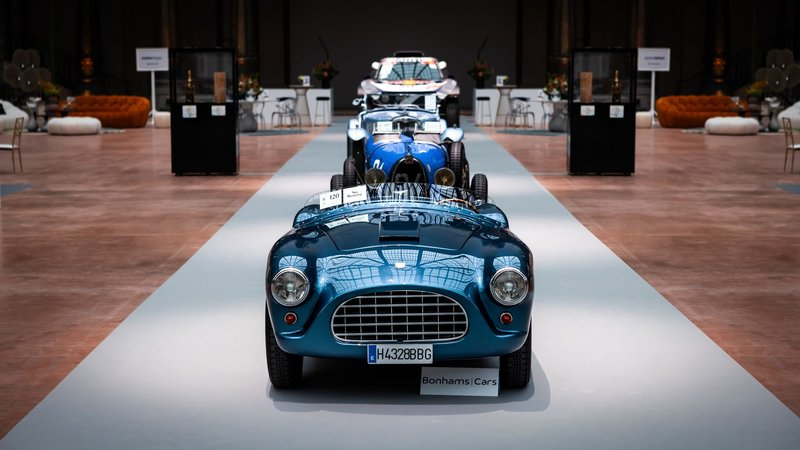
Both cars have climbed hard, but the Countach 25th Anniversary has climbed harder. Condition and provenance swing the number enormously: recent sales have landed anywhere from around $555,000 for a driver-quality example up to $1,655,000 for a low-mileage, single-family-ownership car sold in New York in late 2024 — and a 1989 example sold in Milan in 2025 broke that again, crossing €1.1 million. The spread tells you this isn’t a market where “a Countach is a Countach.” Mileage, originality, and paperwork move the price by a factor of three or more.
The LM002 market moves in smaller numbers but the same direction. A well-kept example with moderate miles typically brings $300,000 to $400,000 now, with the best-documented, lowest-mileage trucks pushing past $500,000 — one 1989 example with just over 23,000 miles sold for $703,500 in 2024. Given the LM/American’s original $158,000 sticker, that’s a return most 1990 luxury purchases never came close to delivering.
Which One a Collector Should Actually Buy
These aren’t really competing purchases — they’re answers to different questions.
The Countach is the halo car: buy it for what it represents, accept that you’ll drive it rarely, and budget for a specialist mechanic who already knows the model’s quirks (the visibility, the heat soak, the maintenance intervals that don’t forgive neglect). It’s the car you buy to own a piece of the wedge era outright.
The LM002 is the usable oddity. It’s louder, thirstier, and less refined, but it’s also the car you can actually take somewhere — a dirt road, a car meet, a driveway full of neighbors who’ve never seen one in person. Parts support lags behind the Countach’s because Lamborghini built far fewer LM002s and the truck platform shares less with anything else in the catalog, so budget more time for sourcing before you buy, not after.
If the goal is appreciation with the least ownership hassle, the data currently favors the Countach. If the goal is a car you’ll actually start on a Saturday, the LM002 wins every time.
The Model That Never Showed Up: The P140
There should have been a third 1990 Lamborghini, and it’s the one no directory page mentions.
The P140 was conceived as the follow-up to the Jalpa, the smaller V8 model that Lamborghini had discontinued in 1988 and never directly replaced. It was a mid-engine car, developed as an entry point below the Diablo, and it represented Lamborghini’s first real attempt at a V10 — a layout the company wouldn’t put into production until the Gallardo arrived in 2003, more than a decade later. Prototypes were running by the early ’90s.
Then Chrysler’s ownership hit its financial limits right as the early-’90s recession landed, and the P140 got shelved along with a lot of other ambitions the company couldn’t afford to chase. It never reached a dealership, never got a production name, and today it survives mostly as a footnote — the smaller, more attainable Lamborghini that 1990 almost gave the world, a full generation before Audi’s money finally made that idea real.

Daniela Voss
More from Daniela VossHow we reviewed this article
This article was researched against manufacturer records and editorially reviewed before publishing. We accept no payment for coverage.