How do I measure these?
Advanced: flange lip
This wheel offset calculator compares your current wheels with the ones you want to buy. Pick your car or type in your wheel size, then change the width, offset, tire size or spacer. The diagram shows how far the new wheel moves out toward the fender and in toward the suspension, in millimeters and inches. Add the gaps you measured on your car and it tells you whether the new setup fits, is tight or will rub.
What is wheel offset?
Wheel offset is the distance from the center line of the wheel to the flat face that bolts against the car’s hub. It is measured in millimeters and stamped on the back of most wheels as “ET” followed by a number, such as ET45. A wheel marked 18×8.5 ET35 is 18 inches across, 8.5 inches wide and has a +35 mm offset.
Offset decides where the wheel sits under the fender. Change the offset and the whole wheel moves in or out, even if the width stays the same.
Positive vs negative offset
| Offset | Where the mounting face sits | What it looks like | Common on |
|---|---|---|---|
| Positive (+) | Toward the outer face of the wheel | Wheel tucked under the fender | Most cars and crossovers, usually +35 to +50 |
| Zero (0) | Exactly on the center line | Neutral | Older trucks and some off-road wheels |
| Negative (−) | Toward the back of the wheel | Wheel sticks out, deep “dish” face | Lifted trucks and Jeeps |
A lower offset pushes the wheel out. A higher offset pulls it in. Going from +45 to +35 moves the wheel 10 mm closer to the fender and 10 mm farther from the strut.
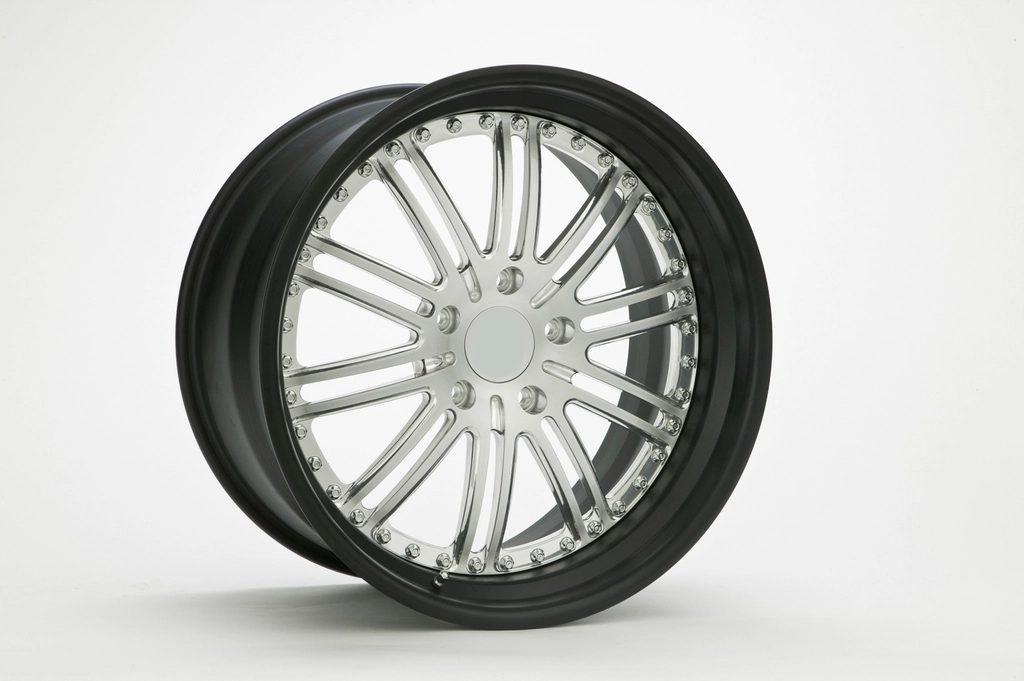
Wheel offset vs backspacing
Backspacing is the distance from the mounting face to the inner edge of the wheel, measured in inches. Offset is measured from the center line. Both describe the same thing, so you can convert one into the other if you know the width.
The formula is: backspacing = (wheel width + 1) ÷ 2 + offset ÷ 25.4. The extra inch is the rim flanges. A wheel sold as 8.5 inches wide measures about 9.5 inches from edge to edge. For an 8.5-inch wheel at +35 mm, backspacing is 4.75 + 1.38 = 6.13 inches.
To go the other way: offset = (backspacing − (width + 1) ÷ 2) × 25.4. Truck and off-road wheels are often sold by backspacing. The converter tab in the calculator does both directions.
Wheel offset chart
Backspacing in inches for common widths and offsets, using a 1-inch flange allowance.
| Offset | 7″ | 8″ | 8.5″ | 9″ | 10″ | 12″ |
|---|---|---|---|---|---|---|
| +50 | 5.97 | 6.47 | 6.72 | 6.97 | 7.47 | 8.47 |
| +45 | 5.77 | 6.27 | 6.52 | 6.77 | 7.27 | 8.27 |
| +40 | 5.57 | 6.07 | 6.32 | 6.57 | 7.07 | 8.07 |
| +35 | 5.38 | 5.88 | 6.13 | 6.38 | 6.88 | 7.88 |
| +25 | 4.98 | 5.48 | 5.73 | 5.98 | 6.48 | 7.48 |
| +15 | 4.59 | 5.09 | 5.34 | 5.59 | 6.09 | 7.09 |
| 0 | 4.00 | 4.50 | 4.75 | 5.00 | 5.50 | 6.50 |
| −12 | 3.53 | 4.03 | 4.28 | 4.53 | 5.03 | 6.03 |
| −25 | 3.02 | 3.52 | 3.77 | 4.02 | 4.52 | 5.52 |
| −44 | 2.27 | 2.77 | 3.02 | 3.27 | 3.77 | 4.77 |
How to measure your wheel offset and backspacing
If the stamp on the back of the wheel is gone, you can measure it with two straight rulers.
- Take the wheel off the car and lay it face down.
- Lay a straightedge across the back rim edge.
- Measure from the mounting pad up to the straightedge. That is the backspacing.
- Measure the full width from the outer edge of one rim lip to the other.
- Offset in mm = (backspacing − full width ÷ 2) × 25.4.
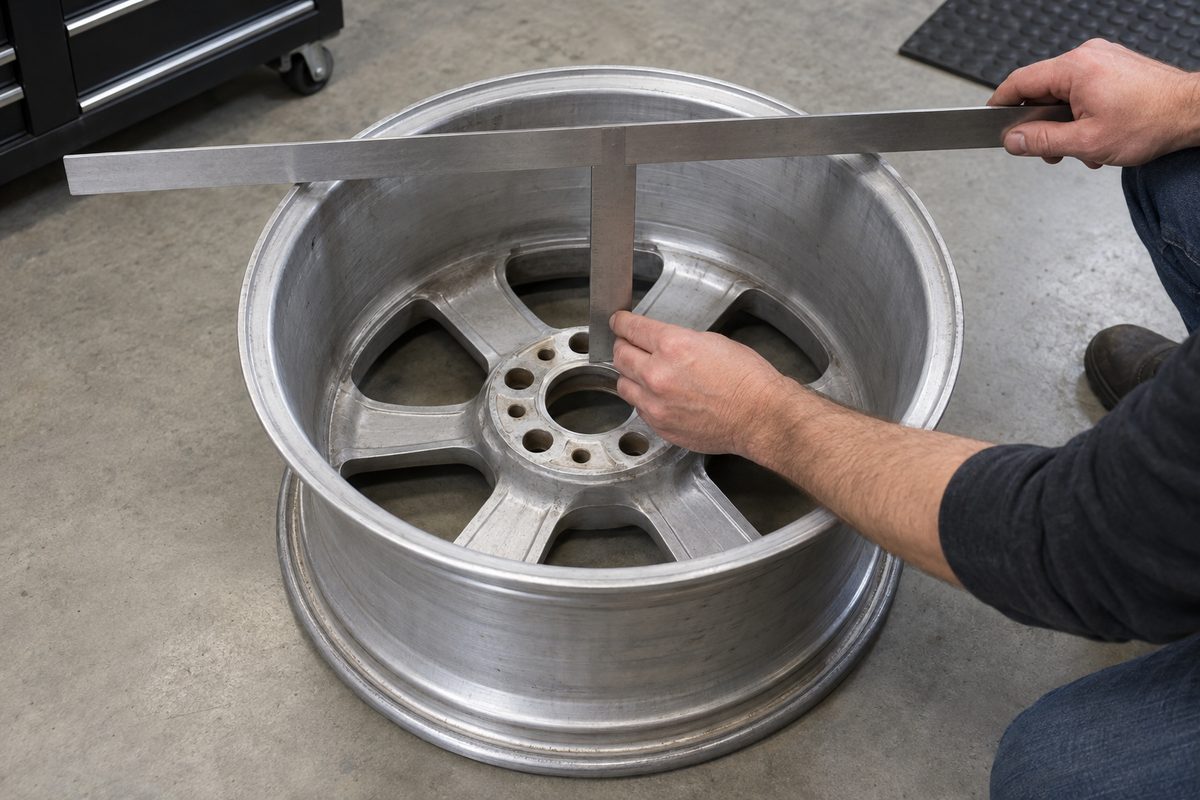
Measure with the tire off if you can. A mounted tire bulges past the rim edge and makes the straightedge sit too high.
How width and offset change poke and inner clearance
“Poke” is how far the wheel or tire sticks out past the fender. Two changes move the outer face of the wheel:
- Lower offset moves the whole wheel out by the same amount. Inside and outside both move 1 mm per 1 mm of offset.
- More width adds half the extra width to each side. One more inch of width at the same offset adds 12.7 mm outside and 12.7 mm inside.
That is why a wider wheel often needs a higher offset to clear the strut, and a lower offset to fill the fender. The calculator adds both effects together and includes the tire, since the tire sidewall usually sticks out a little past the rim.
Wheel spacers and effective offset
A spacer sits between the hub and the wheel and pushes the wheel out by its thickness. Your effective offset is the wheel offset minus the spacer. A +45 wheel on a 15 mm spacer sits like a +30 wheel.
Two things matter with spacers:
- Thread engagement. Thin slip-on spacers shorten how much of the stud the lug nut grips. The nut should thread on at least as far as the stud is wide, so 12 mm on an M12 stud. Spacers over about 10 mm usually need longer studs or the bolt-on type.
- Hub-centric fit. Use spacers with a center lip that matches your hub so the wheel stays centered. A wheel held only by its lug nuts is more likely to vibrate.
Will my new wheels fit? What a calculator can’t measure
The calculator works from your measured gaps. It cannot see these, so check them on the car:
- Brake calipers. Large calipers can hit the spokes even when the barrel clears. Spoke shape matters more than offset here.
- Turning and suspension travel. The tire moves up into the fender over bumps and swings forward when you steer. Measure at the closest point, then leave room.
- Camber. Lowered cars often lean the top of the wheel in, which gives more room at the fender lip and less at the strut.
- Bolt pattern and center bore. These must match your car or be corrected with hub rings. The vehicle lookup shows both.
As a starting point, keep at least 5 mm of space on each side, and more on cars with a lot of suspension travel.
FAQ
How do I calculate wheel offset?
Measure the backspacing and the full width of the wheel in inches. Offset in mm = (backspacing − full width ÷ 2) × 25.4. If the backspacing is more than half the width, the offset is positive.
What does offset mean on a car wheel?
It is how far the mounting face of the wheel sits from the wheel’s center line, in millimeters. It sets how far in or out the wheel sits under the fender.
What is the difference between positive and negative offset?
Positive offset puts the mounting face toward the outside of the wheel, so the wheel sits further in. Negative offset puts it toward the back, so the wheel sticks out. Most cars use positive offset.
Is a higher or lower offset better?
Neither. Use the offset that fits your car. Going lower than stock gives a wider stance but adds steering effort and load on the wheel bearings. Going higher can bring the wheel into the strut.
What is the difference between wheel offset and backspacing?
Offset is measured from the center of the wheel in millimeters. Backspacing is measured from the back edge of the wheel in inches. You need the wheel width to convert between them.
How do I calculate wheel poke?
Poke changes by the drop in offset plus half the extra width. Going from 18×8 +45 to 18×9 +35 adds 10 mm from the offset and 12.7 mm from the width, so the outer face moves 22.7 mm further out.
How do I know if I need a wheel spacer?
You need one when the new wheel touches the strut or brake caliper, or when you want the wheel to sit further out. The thickness you need is the amount the calculator says the wheel must move out.
How much does 10 mm of offset change?
It moves the wheel 10 mm, about 0.39 inches, in or out. On both sides of the car that changes track width by 20 mm.
Does wheel offset affect the speedometer?
No. Offset only moves the wheel sideways. The speedometer changes when the overall tire diameter changes, which the calculator shows when you enter tire sizes.
Will these wheels fit my car?
Pick your car or enter your current wheels, enter the new size, then add the gaps you measured to the strut and the fender. The calculator tells you how much room is left on each side.
Sources & References
- Tire Rack, what is wheel offset: https://www.tirerack.com/upgrade-garage/what-is-wheel-offset
- Edmunds, what is wheel offset: https://www.edmunds.com/car-maintenance/what-is-wheel-offset.html
- Wikipedia, rim offset: https://en.wikipedia.org/wiki/Rim_(wheel)

James Kowalski
More from James KowalskiHow we reviewed this article
This article was researched against manufacturer records and editorially reviewed before publishing. We accept no payment for coverage. Some guides contain affiliate links; see our affiliate disclosure.