Tire DOT code decoder
Enter the code from your sidewall
Have only the last four digits? Enter those. They give you the date.
Plant and recall data: NHTSA. As an Amazon Associate 33Gears earns from qualifying purchases.
I started reading DOT codes after I bought a used sedan with deep tread on all four tires. They looked close to new. Two months later a shop pointed at the sidewall and showed me a date code that was nine years old. The seller had told me the truth about the tread. Nobody had mentioned the age.
That is why I built this tire DOT code decoder. Type in the code and it gives you the manufacture date, the tire’s age, the plant that built it and any recall campaign worth comparing. The plant list comes straight from NHTSA’s manufacturer database: 1,246 tire plants, old and new codes.
What the tire DOT code means
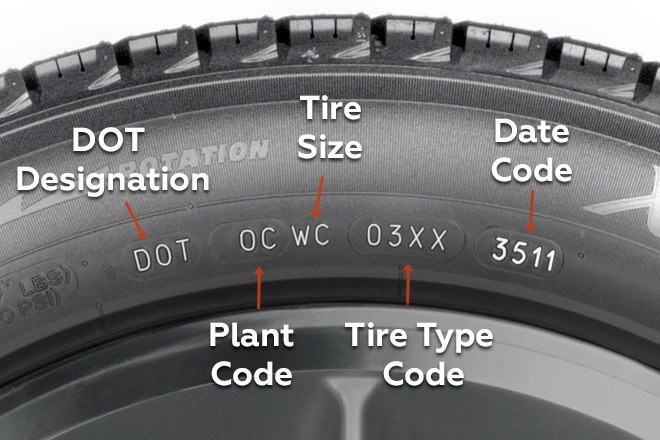
The DOT code is the tire’s identification number, or TIN. It runs from the letters DOT to the date at the end. I read it in three groups.
| Group | Example | What it tells you |
|---|---|---|
| Plant code | 1B7 | The factory. NHTSA assigns it. New tires use three symbols and older tires use two. |
| Manufacturer’s code | TP0X | Six symbols the maker uses for tire type or brand owner. Older tires split this into a size code and an optional code. |
| Date code | 4023 | Week 40 of 2023. Always the last four digits. |
Makers do not publish what the middle group means, so no decoder can turn it into a brand or model. For the size markings elsewhere on the sidewall, I put together a 3D tire model with a sidewall reader.
How to read the tire date code
Take the last four digits. The first two are the week and the last two are the year, so 1819 means week 18 of 2019. Federal rules define week 01 as the first full Sunday-to-Saturday week of the year, which is how the decoder gets an exact date range.
Three things tripped me up the first few times:
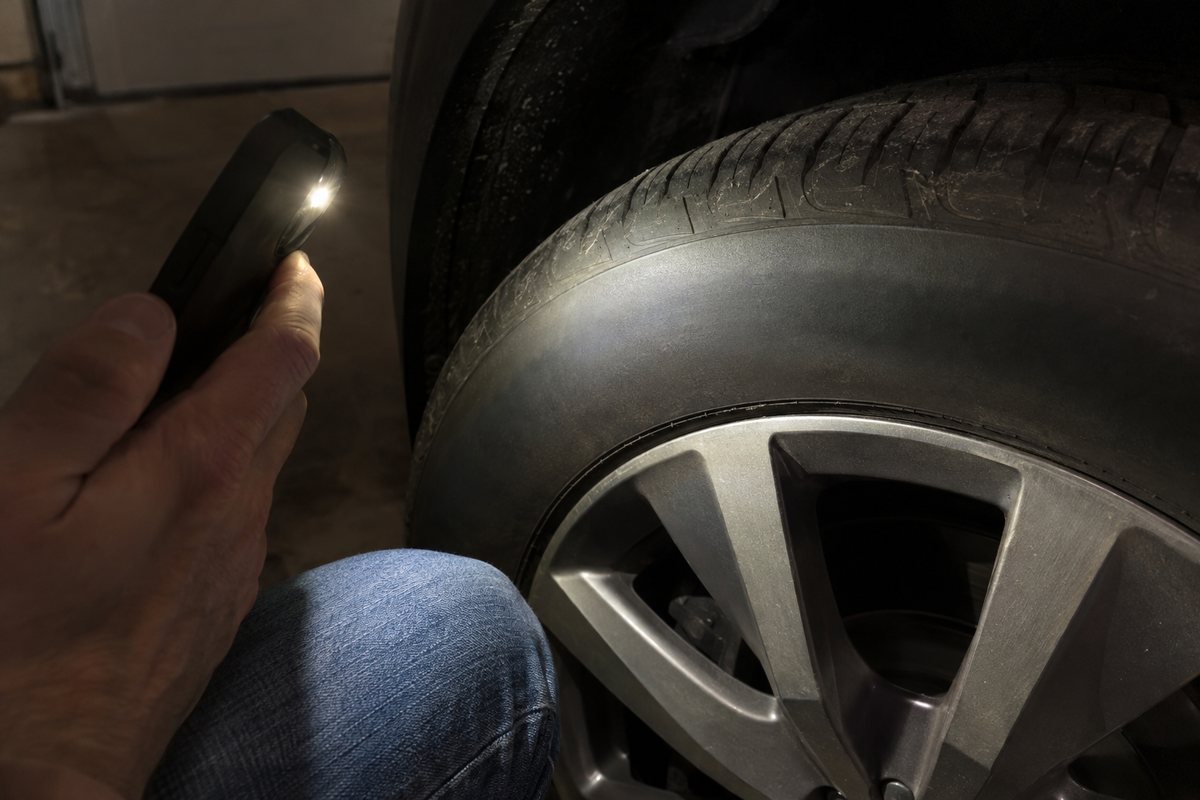
- The code is on one side. The full code with the date may sit on the inner sidewall. If you find a short code with no date, you are on the wrong side. Turn the wheel to full lock for front tires, or lie down with a flashlight for rears.
- Some digits are hard to see. I hold my phone light almost flat against the rubber, so the raised characters throw a shadow. A wipe with a damp rag helps more than you would expect.
- Some letters do not exist in these codes. A TIN never uses G, I, O, Q, S or Z. If you think you see an O, it is a zero. The decoder corrects these for you and tells you what it changed.
A three-digit date means the tire was built before 2000. Bridgestone’s example is 189, which is week 18 of 1999. That tire needs to come off the car whatever it looks like.
How old is too old for a tire?
No federal rule sets an age limit, and tire makers say they have no data that fixes one exact age. They do publish limits, so those are what I go by.
| Tire age | Whose guidance | What I do |
|---|---|---|
| Under 5 years | No age limit applies | Watch tread, pressure and damage |
| 5 years | Michelin: professional inspection every year | Book the inspection at a rotation |
| 6 years | Ford, Nissan and Mercedes-Benz: replace | Follow the owner’s manual and start shopping |
| 10 years | Michelin, Continental and Bridgestone: remove from service | Replace it, spare included |
Heat is what moves me toward the early end. NHTSA research found that tires age faster in warm climates, so a six-year-old tire in Phoenix gets less patience from me than one in Minnesota.
How long do tires last?
On my daily drivers, tread runs out first, usually after four or five years. The age limits catch the tires that do not wear out: weekend cars, RVs, trailers and spares. My old sedan had the classic problem. Low yearly mileage kept the tread deep while the rubber aged. Tread at 2/32 inch is the common legal minimum in the US, but a tire can pass that test and still be too old.
How the recall check works
NHTSA publishes its tire recalls by maker, model and build dates rather than by full TIN, so I matched those files to your plant and build week. The tool covers 241 campaigns with known build dates since 1996.
Read the result in two levels. Recall match means the campaign names your plant code and build period. Campaigns to compare means the same company recalled some tires built that week, and yours are only affected if the model and size match your sidewall. The result links to the USTMA’s tire recall lookup, which searches by TIN for tires from its member companies since 2000. A clear result from us is not a guarantee, so run that search too.
Buying used? Select Sold used in the tool, decode all four tires and add each to your set. It shows the oldest tire and the age gap. Once your tires check out, it is worth a look at the spare and the rest of your car emergency kit.
FAQ
What is a tire DOT code?
It is the tire identification number molded into the sidewall after the letters DOT. It shows the plant that built the tire, a manufacturer’s code and the week and year of production. The DOT mark also certifies that the tire meets US safety standards.
How do I find out how old my tires are?
Read the last four digits of the DOT code. The first two are the week and the last two are the year, so 4023 is week 40 of 2023. Enter the code in the decoder above for the exact age.
Where is the DOT code on a tire?
It is on the lower sidewall near the rim, starting with the letters DOT. The full code with the date can be on one side only, so check the inner sidewall if the outer side has a short code or none.
Can a DOT code tell me the tire brand?
Not directly. The plant code shows the factory and its owner, but one plant can build several brands. The brand and model are printed on the sidewall itself.
Does a DOT code mean a tire was made in the USA?
No. DOT means the tire is certified for sale in the US. It can be built anywhere. The plant code shows the country, and most plants on NHTSA’s list are outside the United States.
Do unused tires expire?
Tires have no printed expiration date, but rubber ages even in storage. Michelin’s 10-year limit counts from the manufacture date, not the day the tire was mounted, and it applies to spares.
How old can a tire be when sold as new?
No federal rule limits this, and a tire can sit in storage for a while before sale. I accept up to two years and ask for a newer batch beyond that. Read the code before the tire is mounted.
Why doesn’t my date code work in the decoder?
The week must be 01 to 53 and the date cannot be in the future. Most failures come from a misread 3, 8 or 0. Clean the sidewall and check again with a light held low against the rubber.
Sources & References
- NHTSA Manufacturer Information Database, tire plants: https://vpic.nhtsa.dot.gov/mid/
- NHTSA recall flat files: https://static.nhtsa.gov/odi/ffdd/rcl/RCL.txt
- 49 CFR 574.5, tire identification requirements: https://www.law.cornell.edu/cfr/text/49/574.5
- Michelin, when to replace tires: https://www.michelin.ca/en/auto/learn/tire-buying-guide/when-to-replace-tires
- Continental, tire service life: https://www.tirerack.com/images/pdf/CO_TireServiceLife.pdf
- Bridgestone Firestone, tire service life: https://www.tirerack.com/images/pdf/BFNA_TireServiceLife.pdf
- Edmunds, how old and dangerous are your tires: https://www.edmunds.com/car-care/how-old-and-dangerous-are-your-tires.html
- USTMA tire recall lookup: https://recallinfo.ustires.org/

James Kowalski
More from James KowalskiHow we reviewed this article
This article was researched against manufacturer records and editorially reviewed before publishing. We accept no payment for coverage. Some guides contain affiliate links; see our affiliate disclosure.