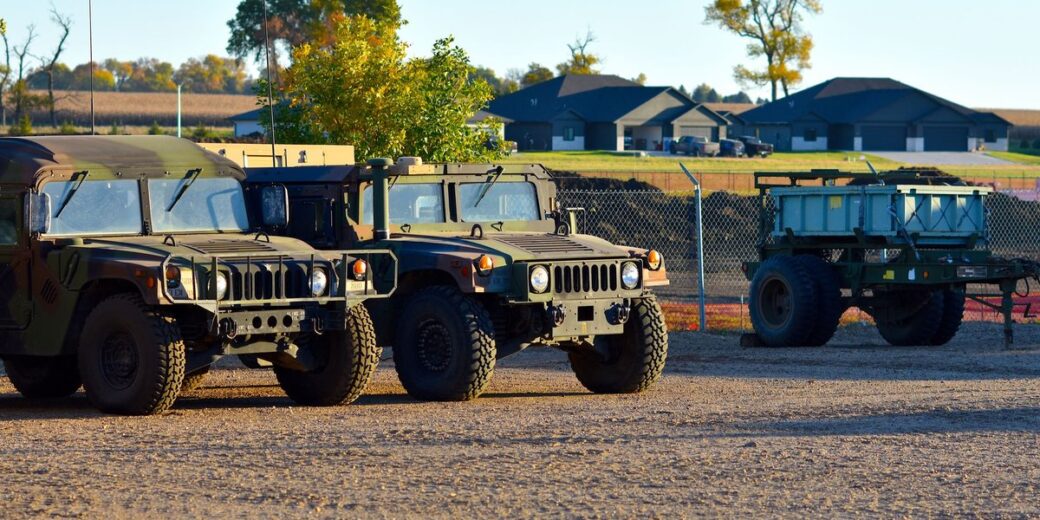
There was no 1944 Beetle you could buy. No Volkswagen dealer sold a car to a civilian that year, and the Wolfsburg plant spent 1944 building military vehicles for the Wehrmacht while Allied bombers worked their way through the factory. If you’ve seen a listing for a “1944 Volkswagen Beetle,” it’s either a mislabeled military vehicle, a wartime KdF-Wagen from a tiny elite run, or a mistake.
What did exist: a handful of Type numbers, all built on the same air-cooled, rear-engined layout that later made the Beetle famous. This is the full list of 1944 Volkswagen car models, what separated them, and why the production numbers you’ll find online don’t agree.
Table of Contents
- TLDR
- The 1944 Volkswagen lineup at a glance
- Kübelwagen (Type 82)
- Schwimmwagen (Type 166)
- Type 82E and Type 87 staff cars
- What about the civilian KdF-Wagen (Type 60)?
- A timeline of 1944 at the Volkswagen plant
- Why the production numbers disagree
- How the wartime cars led to the postwar Beetle
- Finding a surviving 1944 Volkswagen
TLDR
- No civilian Volkswagens were sold in 1944. The plant built military vehicles only.
- The main models were the Kübelwagen (Type 82), the Schwimmwagen (Type 166), and two Beetle-bodied staff cars, the Type 82E and the Type 87.
- A very small number of civilian-style KdF-Wagens (Type 60) went to Nazi officials during the war, not to the public.
- Production figures conflict between sources. Treat any single number as approximate.
- Allied air raids in 1944 wrecked large parts of the plant, and the Schwimmwagen line shut down that year.
The 1944 Volkswagen lineup at a glance
Figures are approximate and, as covered below, contested.
| Model | Type | Role | Drivetrain | Approx. production | 1944 status |
|---|---|---|---|---|---|
| Kübelwagen | 82 | General-purpose light vehicle | Rear engine, rear-wheel drive | About 50,000 (1940-1945) | In production until April 1945 |
| Schwimmwagen | 166 | Amphibious scout car | Rear engine, four-wheel drive | About 14,300 built at Wolfsburg | Production ended in 1944 |
| Kübelwagen staff car | 82E | Officer’s car with Beetle-style body | Rear engine, rear-wheel drive | Roughly 550-690 | Built in small numbers |
| Kommandeurswagen | 87 | Officer’s car with Beetle-style body | Rear engine, four-wheel drive | Roughly 560-670 | Built in small numbers |
| KdF-Wagen | 60 | Civilian-style sedan | Rear engine, rear-wheel drive | Several hundred across the whole war | Effectively limited to officials |
Kübelwagen (Type 82)
The Kübelwagen is the car people usually mean when they search for a 1944 Volkswagen. Its name comes from Kübelsitzwagen, “bucket-seat car,” a nickname for open-topped German military cars with bucket-style seats. Volkswagen built roughly 50,000 of them between 1940 and 1945, and it was the plant’s volume product throughout the war.
Under the flat, slab-sided body is a Beetle in work clothes: a rear-mounted air-cooled flat-four, a backbone chassis, and rear-wheel drive only. What lifted it off the road were reduction gears in the rear hubs, which raised the ground clearance, and a self-locking differential, which helped it crawl through mud where two-wheel drive should have stalled.
The 1944 version differs from the 1940 original in one way that matters. The early cars used a 985 cc engine making about 23.5 hp. In early 1943 that moved to a 1,131 cc unit rated at about 25 hp, which is what a 1944 build carries. If someone sells a “1944 Kübelwagen” with the smaller engine, check the paperwork.
The body is deliberately plain: flat pressed panels, a canvas top, and nothing that couldn’t be stamped quickly and repaired in the field.
Schwimmwagen (Type 166)
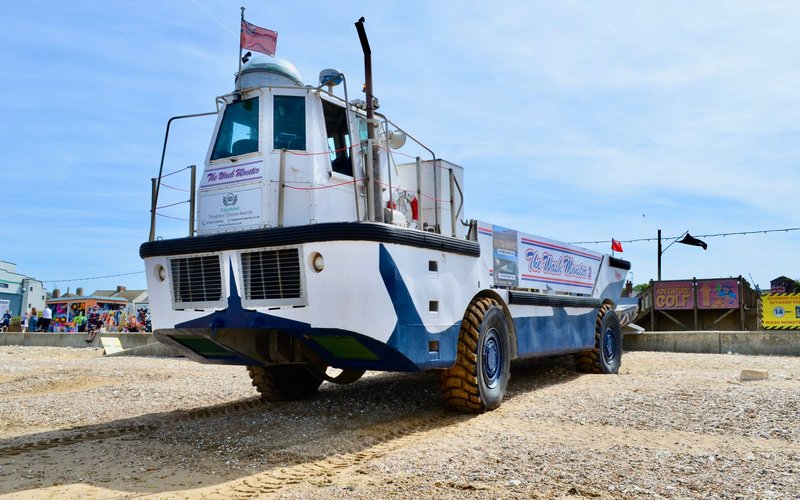
The Schwimmwagen is the odd one: a four-wheel-drive, boat-hulled scout car with a propeller on a hinged arm at the back. Swing the arm down, engage the drive, and the same 1,131 cc engine that turns the wheels pushes the car across a river.
Here is how the numbers shake out. Wolfsburg-area production (the Fallersleben plant) is usually given as about 14,276 vehicles, built from autumn 1942 until August 1944. Some counts reach roughly 15,600 once you add the earlier, Porsche-built vehicles. Either way it’s the most-produced amphibious car in history.
Production stopped in 1944, and the reason cited most often is cost: a Schwimmwagen took a lot of man-hours and a lot of material compared with a Kübelwagen. So a Schwimmwagen with a 1944 build date is one of the last. That’s why they’re prized.
Type 82E and Type 87 staff cars
Two models looked less like jeeps and more like Beetles.
The Type 82E is a Beetle-style saloon body fitted to Kübelwagen running gear. It kept the Kübelwagen’s rear-wheel drive and its reduction-geared hubs, so it sat higher than a normal Beetle.
The Type 87 Kommandeurswagen took the same idea further. It had a Beetle-like body on a four-wheel-drive chassis, with the Schwimmwagen’s drivetrain, and wider fenders to cover the wider track. Of all the 1944 Volkswagen car models, it’s the one that most resembles a four-wheel-drive Beetle, and the one the postwar world never saw again in anything like that form.
Both were officers’ cars, built in the hundreds rather than the tens of thousands, which makes each one roughly a hundred times rarer than a Kübelwagen.
What about the civilian KdF-Wagen (Type 60)?
The KdF-Wagen was the car sold to German savers before the war under the “Strength Through Joy” scheme. More than 330,000 people paid into it. Almost none received a car.
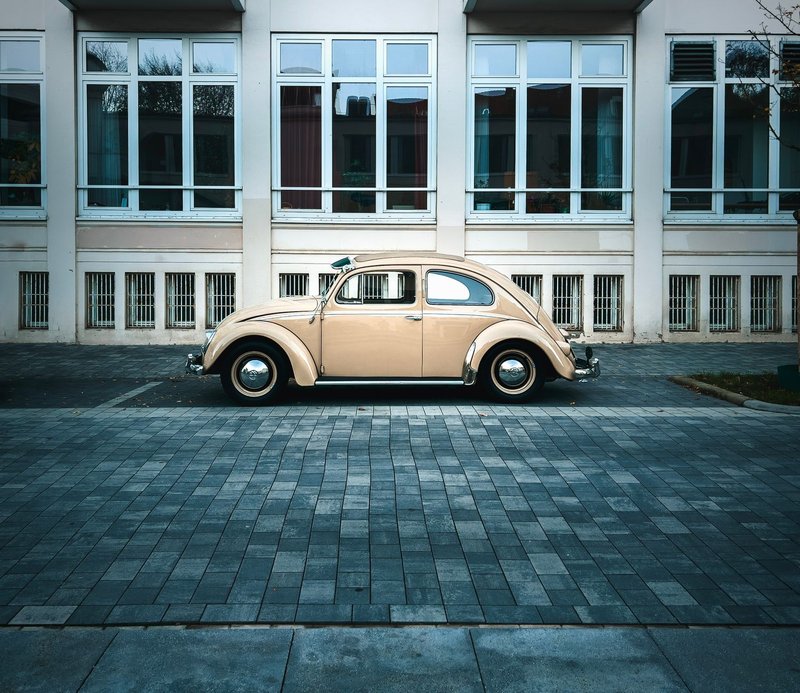
The factory was converted to war production, and the few KdF-Wagens that were completed went to Nazi officials and the military. Most counts put civilian-style Type 60 output across the whole war at several hundred cars. By 1944 the number being built was close to nothing. A true “1944 Beetle” would be a leftover of that tiny elite run, and a documented one would be a major find.
A timeline of 1944 at the Volkswagen plant
- Early 1944: Wolfsburg builds Kübelwagens, Schwimmwagens, and small runs of the 82E and 87, along with other war material.
- Through the year: The plant is hit by five Allied air raids, and large parts of the factory are destroyed. Production departments are moved into temporary premises elsewhere.
- August 1944: The Schwimmwagen line ends.
- April 10, 1945: The last 50 Kübelwagens for the German army are finished.
- April 11, 1945: US troops arrive. Volkswagen’s own account says more than 7,700 forced laborers were freed at the plant.
That last point deserves more than a line. The plant ran largely on forced labor. Roughly 20,000 people, including prisoners of war and concentration camp inmates, were made to work there between 1942 and 1945, and a satellite camp, Arbeitsdorf at Fallersleben, operated on the plant site in 1942. Any 1944 Volkswagen was built in that system. Museums that show these cars now say so, and you should expect the same from any serious seller.
Why the production numbers disagree
You’ll see Kübelwagen totals of 50,435 in one place and 50,788 in another. The Type 87 gets quoted at 564 or 667. The Type 82E at 546 or 688. The Schwimmwagen sits at 14,276 or 15,584.
The usual causes:
- Different cutoffs. Some counts end in 1944, others run until the plant stopped in April 1945.
- Different definitions. Does a total include prototypes, the earlier Porsche-built amphibians, or vehicles assembled from parts after the war ended?
- Lost records. Bomb damage and the end of the war destroyed paperwork, so later researchers reconstructed the figures from surviving chassis numbers and shipping documents.
The practical rule: use ranges, and be wary of any source that gives an exact number for the staff cars.
How the wartime cars led to the postwar Beetle
The Beetle’s survival is partly an accident of what the factory made in 1944. The wartime Kübelwagen proved the air-cooled rear-engine layout could take mud, cold, and neglect. The British Army, which controlled the Wolfsburg area after the war, ordered 20,000 cars in late 1945 under Major Ivan Hirst, and the plant restarted using the same tooling and the same engine family. In the first weeks after the Americans arrived, it was building Kübelwagens for the US Army.
So the line from the 1944 Kübelwagen to the postwar Beetle is short. The engine grew a little, the body changed, the chassis stayed.
Finding a surviving 1944 Volkswagen
How to tell what you’re looking at
- Check the chassis number and the body stampings against the model’s known ranges. Lookalikes are everywhere.
- Don’t confuse a Kübelwagen with the 1968-1983 Volkswagen Type 181 (“Thing”), which borrows the idea but not the history. Replicas are common, too.
- A Schwimmwagen should have the hull, the propeller arm and the four-wheel-drive layout. Many are rebuilt from parts, and a real one should come with provenance.
Where to see them
Wartime Volkswagens sit in military museums and automotive collections. Surviving Schwimmwagens are on display at places like the Imperial War Museum at Duxford and the Army Museum in Dresden, and Kübelwagens turn up in museums across Europe and North America. Volkswagen also keeps examples in its own museum collection in Wolfsburg.
What they sell for
Original, documented Kübelwagens and Schwimmwagens sell for six figures at auction, with Schwimmwagens at the high end. The Type 82E and Type 87 are rare enough that sales are infrequent and prices are hard to benchmark. Expect heavy scrutiny of provenance on any of them.
Marco Delantero
More from Marco DelanteroHow we reviewed this article
This article was researched against manufacturer records and editorially reviewed before publishing. We accept no payment for coverage. Some guides contain affiliate links; see our affiliate disclosure.