Table of Contents
- Why 1959 Was Unlike Any Other Year in Automotive History
- 1959 Cadillac Series 62
- 1959 Chevrolet Impala
- 1959 Ford Galaxie
- 1959 Chrysler 300E
- 1959 Lincoln Continental Mark IV
- 1959 Buick Electra 225
- 1959 Dodge Custom Royal
- 1959 Oldsmobile 98
- 1959 Edsel Corsair
- 1959 Studebaker Lark
- 1959 Austin-Healey 3000
- 1959 BMW 507
- BMC Mini (1959 Debut)
- 1959 Datsun Bluebird 310
- Collectibility and Current Values
Why 1959 Was Unlike Any Other Year in Automotive History {#why-1959}
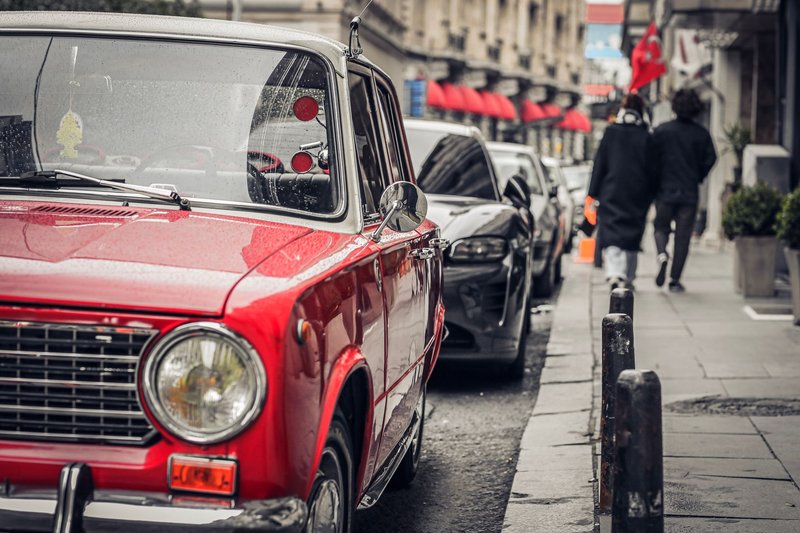
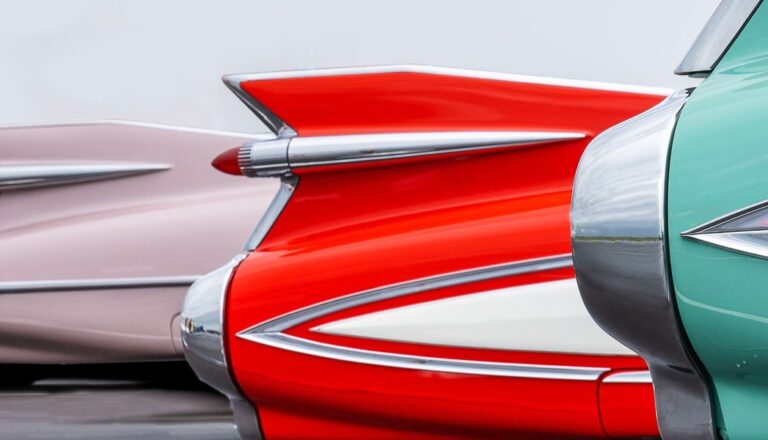
Nineteen fifty-nine was peak absurdity and peak ambition at the same time. American manufacturers had spent the better part of the decade adding fins, chrome, and two-tone paint to everything with four wheels — and in ’59 they hit the wall. The Cadillac’s tailfins that year were so tall they’ve never been equaled. The Chevrolet Impala’s rear wings were so wide they looked like the car was perpetually trying to take off.
But the same year America was perfecting excess, Europe was doing the opposite. The BMC Mini debuted in August 1959 and set the template for the modern economy car — front-wheel drive, transverse engine, barely 10 feet long, and somehow roomier inside than cars twice its size. Japan was quietly making its move too, with the Datsun Bluebird beginning to appear in export markets.
It’s the hinge year. Big fins reached their apex and began their decline. The import wave that would reshape American buying habits in the 1960s was already building. If you only study one model year in automotive history, 1959 is the most instructive.
1959 Cadillac Series 62 {#cadillac-series-62}
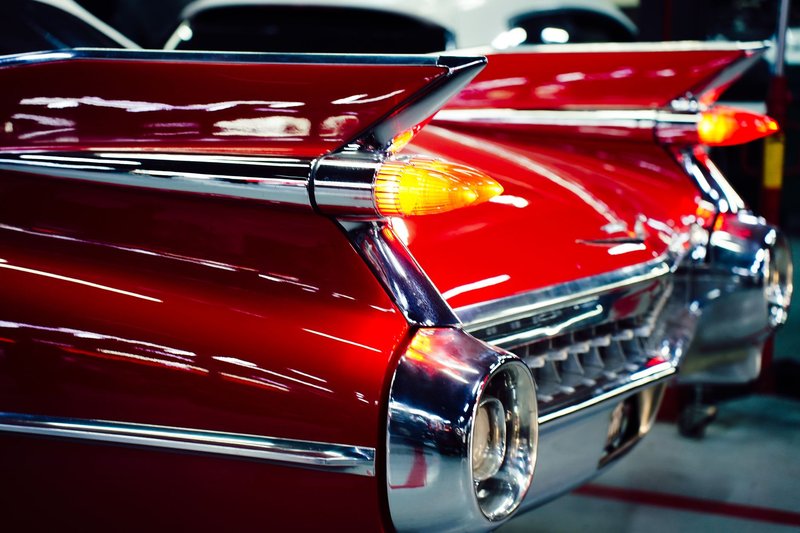
No model defines the year more literally. The Series 62’s tailfins — topped with twin bullet taillights — stood 42 inches tall at their highest point. They weren’t just big, they were architectural. Cadillac’s design chief Bill Mitchell had spent years escalating the fin wars, and this was the summit.
Under the hood: a 390 cubic inch V8 making 325 horsepower through a Hydra-Matic automatic. The car weighed over 4,600 pounds and didn’t pretend otherwise.
What people miss is how refined the interior was. The dash was organized and legible by the standards of the era. Power windows, power seat, and air conditioning were available — the kind of equipment that came standard in American luxury long before European rivals even offered them as options.
Collectibility: Clean examples have sold above $60,000 at auction. The convertible commands a meaningful premium. Rust is the primary enemy — look at the lower quarters, rocker panels, and trunk floor before anything else.
1959 Chevrolet Impala {#chevrolet-impala}
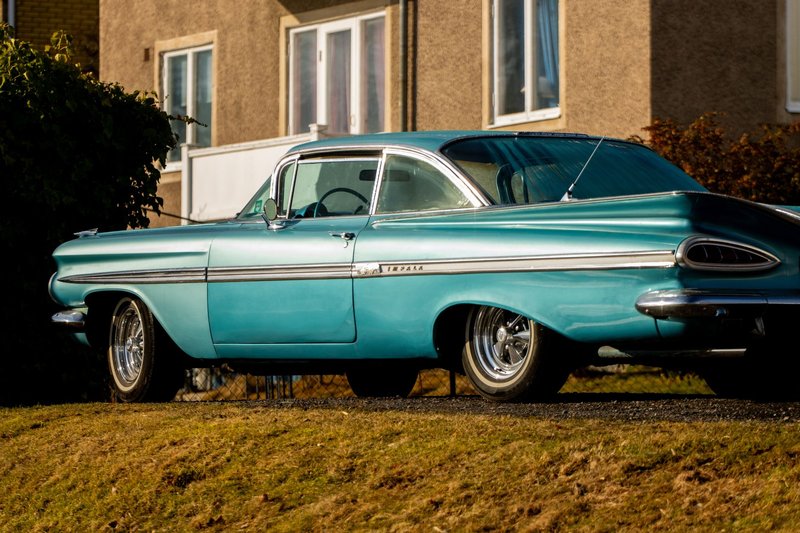
The Impala was never supposed to be the volume seller — that was the Biscayne. But buyers kept gravitating toward the top trim, and by 1959 the Impala was Chevrolet’s image car.
The ’59 body is immediately recognizable by its “bat wing” rear treatment: a nearly horizontal fin capped with an elongated cat-eye taillight. The whole rear deck is flat and wide, giving the car a look that’s more spacecraft than automobile.
Engine choices ran from a 235 cubic inch six (for fleets and people who didn’t care) up to the 348 cubic inch “Super Turbo-Thrust” V8 in 315 horsepower trim. The Sport Coupe hardtop — no B-pillar, big glass area — is the body style most collectors want today. If you’re drawn to the broader world of classic American sedans, the Impala’s lineage runs through some of the most recognizable names in domestic automotive history.
Collectibility: Among the most actively traded of all 1959 American cars. A solid V8 Sport Coupe is typically $25,000–$45,000 in driver condition. The rare convertibles go considerably higher.
1959 Ford Galaxie {#ford-galaxie}
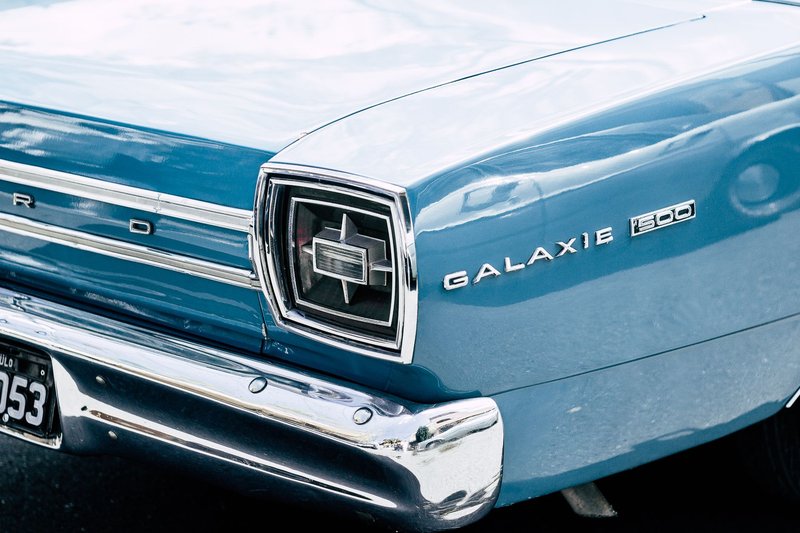
Ford introduced the Galaxie name mid-year in 1959, replacing the Fairlane 500 at the top of the lineup. The timing was deliberate — Ford was chasing Chevrolet and needed something with a little more cachet.
The ’59 Ford carries cleaner lines than its Chevy rival. Where the Impala went bat-wing wild, Ford went low and squared off the roofline. The Thunderbird-inspired roofline on the retractable hardtop version is one of the more elegant shapes from the period. You could also get a genuine Ford Skyliner — a retractable hardtop that folded into the trunk — which remains one of the most mechanically complex production cars of the 1950s.
The 352 cubic inch “Interceptor” V8 at 300 horsepower was the performance choice. Police departments bought them in quantity.
Collectibility: Ford Galaxies are undervalued relative to equivalent Chevys — same era, similar quality, noticeably cheaper. A mid-range hardtop in good shape runs $20,000–$35,000. The Skyliner retractable is its own category.
1959 Chrysler 300E {#chrysler-300e}
The 300 letter series was Chrysler’s halo car — built for performance first, luxury second. The 300E carried a 413 cubic inch Hemi V8 rated at 380 horsepower in standard form, with a ram induction option pushing it to 390. In 1959, that was one of the highest factory outputs of any American production car.
The styling was Virgil Exner’s “Forward Look” taken nearly as far as it would go. Fins, yes, but also a grille with a restraint unusual for the period. The 300E sits lower and meaner than its contemporaries. Chrysler built just 692 hardtops and 140 convertibles that year.
Collectibility: Rare, fast, and well-documented. These trade in the $60,000–$100,000+ range depending on condition and build sheet. The letter series has a devoted following, and documentation matters.
1959 Lincoln Continental Mark IV {#lincoln-continental-mark-iv}
Lincoln was trying to out-Cadillac Cadillac in 1959, and by some measures it worked. The Mark IV was massive — 227 inches long, over 5,000 pounds in some configurations — and almost painfully overdressed.
The 430 cubic inch MEL V8 (Mercury-Edsel-Lincoln) put out 350 horsepower. The interior was legitimately impressive: deep pile carpeting, padded dash, power everything. Lincoln sold these to people who found Cadillac too flashy, which tells you something about the era’s scale of excess.
Collectibility: Less aggressively collected than Cadillac but solid. Expect $25,000–$45,000 for a good driver-quality example.
1959 Buick Electra 225 {#buick-electra-225}
The “deuce and a quarter” gets its name from its length: 225.4 inches. Buick introduced the Electra name in 1959 to slot above the LeSabre and Invicta — a cleaner, longer, more formal car aimed at buyers who found Cadillac’s fins too aggressive.
Power came from a 401 cubic inch “Nailhead” V8, so called because the intake valves were small and upright, resembling nails. It produced 325 horsepower and moved the car with authority despite the weight.
The Electra’s chrome was more tasteful than most ’59 American cars — the fins were present but not dominant, and the overall silhouette was sleeker than comparable GM products.
Collectibility: Underappreciated. Good examples trade below equivalent Cadillacs for no good reason other than the badge. $18,000–$35,000 for presentable cars.
1959 Dodge Custom Royal {#dodge-custom-royal}
Chrysler’s Dodge division went completely wild with fins in 1959. The Custom Royal’s rear fins swept upward at an angle that made the Cadillac’s look conservative — or at least less menacing. Virgil Exner called this the “Forward Look,” and at Dodge it was more forward-flung than anywhere else in the lineup.
The top engine option was a 383 cubic inch V8 in 345 horsepower “Super Red Ram” form. Dodge’s D-500 performance package made these genuinely quick cars, not just styled ones.
Collectibility: The Custom Royal convertible is the money car. Clean examples with the big V8 regularly exceed $40,000. Hardtops are $20,000–$30,000 in good condition.
1959 Oldsmobile 98 {#oldsmobile-98}
Oldsmobile’s flagship was quieter about its ambitions than the Cadillac but not by much. The 98 (ninety-eight) ran a 394 cubic inch “Rocket” V8 making 315 horsepower — the same displacement, refined from the engine that had been introducing “Rocket” power since 1949.
The interior was the selling point. Oldsmobile positioned itself between Buick and Cadillac, and the 98 delivered quieter road manners than most of its competitors. The suspension was tuned for isolation over handling, which is exactly what the buyer wanted.
Collectibility: Solid if not flashy. $18,000–$32,000 for a presentable hardtop. Convertibles climb higher.
1959 Edsel Corsair {#edsel-corsair}
No discussion of 1959 cars is complete without the car that defined how not to launch a new brand.
Ford had been developing the Edsel since 1952. By the time it reached dealers in 1957, consumer tastes had shifted — the economy had slowed and buyers weren’t interested in yet another mid-range Ford product with a different grille. The vertical “horse collar” grille was disliked, and early quality control problems made it worse.
The 1959 Corsair was actually an improved car. Ford addressed the worst quality issues, trimmed the lineup, and produced something more coherent than the ’58. Didn’t matter. The public had decided. Ford killed the Edsel in November 1959 after producing just 2,846 units for the model year.
Collectibility: The failure made it a curiosity. Edsel values have climbed steadily among collectors of automotive oddities. A ’59 Corsair convertible — one of perhaps 1,343 built — can exceed $30,000. The story alone is worth something.
1959 Austin-Healey 3000 {#austin-healey-3000}
The British answer to American excess: a 2,660cc six-cylinder roadster that weighed half what a Cadillac did and handled corners rather than just going straight fast.
The 3000 was an evolution of the “Big Healey” that had been racing since 1953. The new 2.9-liter engine (hence the name) made 124 horsepower — unimpressive by American V8 standards, but the car weighed 2,400 pounds, so the power-to-weight ratio was competitive on a twisty road. The Austin marque had deep roots in British motoring, and collectors drawn to that heritage will find useful context in this guide to old Austin models worth buying.
The 3000 went on to a distinguished rally career, winning the Alpine Rally multiple times and earning a class win at Le Mans.
Collectibility: Strong and growing. Well-documented BJ7 and BJ8 variants from the early 1960s command a premium, but a genuine 1959 BJ1 in good condition is a $35,000–$60,000 car.
1959 BMW 507 {#bmw-507}
Technically the 507 ran from 1956 to 1959, making the final production year a notable one. BMW built just 252 of them. The aluminum body over a 3168cc V8 was designed by Albrecht Goertz, who also styled the 503 sedan, and it remains one of the most beautiful German cars ever produced. It belongs in the same conversation as the iconic old BMW models that defined the brand’s character long before the modern M series existed.
Elvis Presley owned one while stationed in Germany. He reportedly had it painted red after fans kept leaving lipstick marks on the original white finish.
BMW lost money on every 507 they built — the production cost exceeded the sale price. The car nearly bankrupted the company. Which is why there were only 252.
Collectibility: Museum-grade. Authenticated 507s have sold for more than $2 million at auction. According to Sotheby’s records, the 507 consistently ranks among the highest-valued postwar European sports cars.
BMC Mini — The Car That Changed Everything {#bmc-mini}
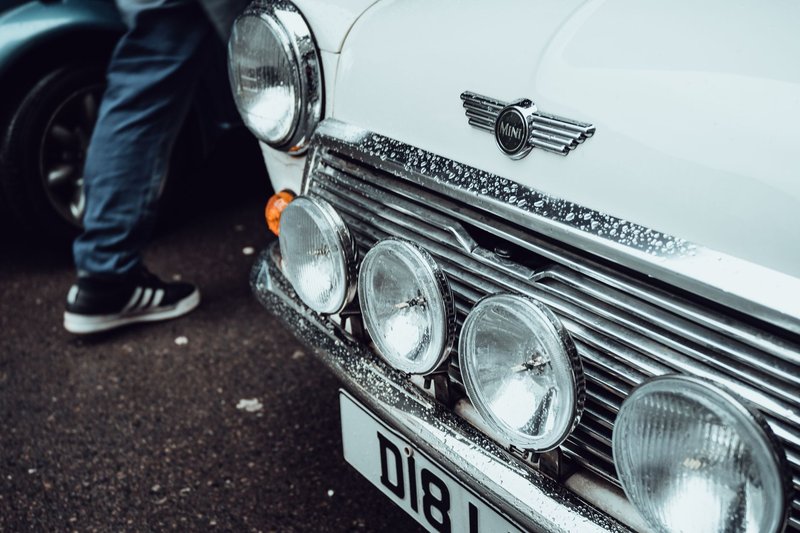
The Austin Seven and Morris Mini-Minor launched on August 26, 1959 — designed by Alec Issigonis in response to the Suez Crisis fuel shortages. The solution was radical: put the engine sideways, drive the front wheels, and package four adults in 10 feet of car.
The Mini used a 848cc A-series engine making 34 horsepower. On paper, nothing. In practice, the car’s low weight (under 1,300 pounds) and neutral handling made it a genuine driver’s car.
John Cooper recognized this immediately, and the Cooper works-prepared variants that followed turned the Mini into a motorsport phenomenon, culminating in three Monte Carlo Rally victories between 1964 and 1967.
The Mini’s layout — transverse engine, front-wheel drive, subframe construction — became the template for nearly every economy car built since. Fifty years of hatchbacks trace their DNA directly to Issigonis’s 1959 brief.
Collectibility: Original 1959–1967 Minis are actively traded in the UK market. A good 1959 Austin Seven runs £10,000–£18,000 in the UK. Cooper S variants are significantly higher.
1959 Datsun Bluebird 310 {#datsun-bluebird-310}
Japan’s automotive export push began in earnest in 1959 with the Bluebird 310, a compact sedan developed with help from Austin (Nissan had been building Austins under license since 1952).
The 310 carried a 988cc four-cylinder engine — modest by any standard — but was reliable, affordable, and aimed squarely at buyers priced out of American domestic cars. Datsun began exporting to the U.S. in 1958, and the Bluebird was the car that established the brand.
It’s not glamorous. But the 310 is historically significant as the leading edge of a Japanese automotive invasion that would reshape the global industry by the 1970s.
Collectibility: Rare survivors. These were used up and scrapped; finding an original 310 in any condition requires genuine effort. More a curio than an investment, but valued by Nissan historians.
Collectibility and Current Values {#collectibility}
The 1959 model year sits at the sweet spot for classic car collectors: old enough to be definitively vintage, young enough that parts and specialists still exist, and design-distinctive enough that even non-enthusiasts recognize these cars on sight.
A few general principles for anyone buying into this era:
Documentation matters disproportionately. A Cadillac with its original build sheet and service history is worth dramatically more than an identical car without records. The high-end buyers insist on it, and it filters through the whole market.
Convertibles command 30–60% premiums over equivalent hardtops in almost every nameplate. Supply is lower and demand is reliably higher.
Engine matching is worth investigating. Many of these cars have had engine swaps over 65 years of use. Matching numbers — where the original engine is still in the car — adds value and changes the asking price significantly on desirable models.
The import cars are undervalued relative to their historical importance. A 1959 Mini or Austin-Healey 3000 is harder to find in original condition than a Chevrolet Impala, and the price doesn’t always reflect that scarcity.
For current auction records and market trends, Hagerty’s valuation tools are the most comprehensive resource available for classic American iron. European models are better tracked through specialist auction houses.
Nineteen fifty-nine gave us the most extreme cars Detroit ever built — and the car that would eventually replace them all. That’s not a coincidence. It’s what peak looks like just before the turn.

Marco Delantero
More from Marco DelanteroHow we reviewed this article
This article was researched against manufacturer records and editorially reviewed before publishing. We accept no payment for coverage. Some guides contain affiliate links; see our affiliate disclosure.