Table of Contents
- Honda in 1954: A Company on the Edge
- Honda Dream 4E
- Honda Juno K-Type
- Honda Benly JA
- 1954 Honda Model Comparison
- German Influence on Early Honda Design
- Collectibility Today
Honda in 1954: A Company on the Edge {#honda-in-1954}
By 1954, Soichiro Honda had already built a company that Japan’s motorcycle market knew well. What most people don’t know is that 1954 nearly ended it. Honda Motor Co. was cash-strapped and overextended — a combination of rapid production scaling and early export ambitions that outpaced revenues. The bikes Honda introduced that year weren’t triumphant product launches. They were survival machines.
That context matters when you look at the 1954 lineup. These weren’t vanity projects or luxury indulgences. They were calculated bets on market segments Honda needed to own: commuter scooters for urban Japan, lightweight four-strokes for buyers wanting a step up from mopeds, and a flagship four-stroke that could compete with European machines on engineering credibility. Honda placed three of those bets in 1954.
All three are historically significant beyond just their specs. They document the moment Honda committed to four-stroke engines across its lineup — a strategic choice that separated the company from the two-stroke-heavy competition and set the engineering DNA that would carry Honda through the 1960s American market invasion.
Honda Dream 4E {#honda-dream-4e}
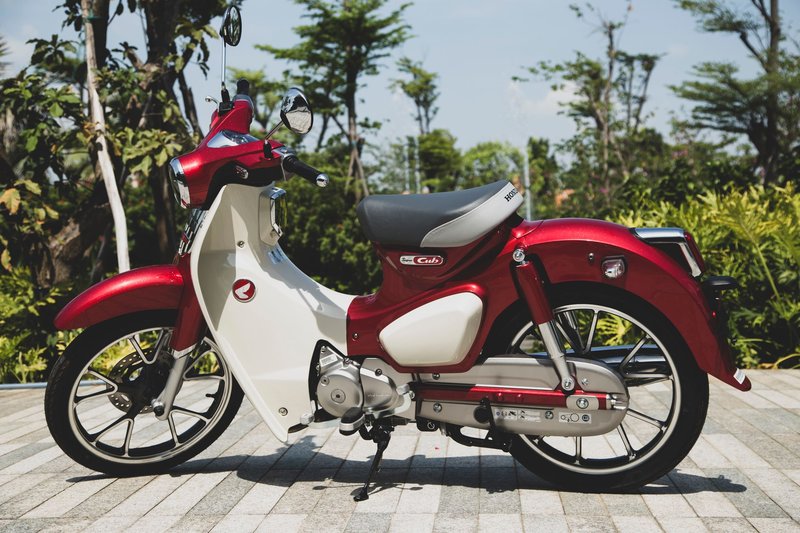
The Dream 4E is the most museum-worthy machine Honda built in 1954, and the National Motorcycle Museum holds one of the finest surviving examples, with 33 photographs documenting its condition. It’s a 146cc overhead-cam four-stroke single — a specification that sounds modest until you consider what was common in Japan at the time.
The 4E produced around 7.5 horsepower at 8,000 rpm. That’s not a lot by any modern standard, but for a 150cc commuter motorcycle in 1954 Japan, it was punchy. The overhead cam layout was the tell: Honda was already optimizing for high-revving performance over low-end torque, a signature that would become a Honda trademark.
The styling showed clear European influence — pressed steel bodywork, a fully-enclosed drivetrain, and lines that echoed the German DKW and early NSU designs Honda engineers had studied closely in the postwar period. The frame was a pressed-steel backbone unit, not a tube chassis. Practical, inexpensive to manufacture, and effective enough for Japan’s roads.
Top speed was approximately 75 km/h (47 mph). Not fast. But reliable, economical, and built to a quality standard that outstripped most domestic competition of the era.
Specifications:
- Engine: 146cc OHC single-cylinder four-stroke
- Power: ~7.5 hp @ 8,000 rpm
- Transmission: 3-speed
- Top Speed: ~75 km/h (47 mph)
- Frame: Pressed steel backbone
Honda Juno K-Type {#honda-juno-k-type}
Honda’s 1954 scooter entry was the Juno K-type — a 200cc four-stroke designed to go head-to-head with the Vespa and Lambretta imports that were gaining traction among urban Japanese buyers. The Juno was Honda’s most ambitious styling exercise of the era: fully enclosed bodywork, a step-through frame, and a profile that looked more automotive than motorcycle.
The K-type ran a 199cc overhead-valve single that produced around 8 horsepower. That made it one of the more powerful scooters available in Japan at the time, capable of carrying two riders without becoming a liability. Honda positioned it as a proper alternative to a small car, not just as a motorcycle substitute.
The Juno K never became the hit Honda hoped for. Production was expensive, the market for large scooters in Japan was smaller than projected, and the design was revised shortly after. But it established Honda’s engineering credibility in the scooter segment — and the Juno nameplate continued into subsequent generations.
Specifications:
- Engine: 199cc OHV single-cylinder four-stroke
- Power: ~8 hp
- Body: Full enclosure, step-through frame
- Target Use: Urban commuting, two-up riding
Honda Benly JA {#honda-benly-ja}
The Benly JA was Honda’s entry into the lightweight four-stroke commuter segment — a deliberate move to capture buyers who wanted something more refined than a two-stroke but couldn’t justify the price of a Dream. The JA ran a 89cc four-stroke single producing around 3 horsepower, and its 140cc sibling appeared later in the Benly lineage.
The JA’s significance is partly what it wasn’t: it wasn’t a two-stroke. Honda made a deliberate choice to build even its entry-level machines with four-stroke engines, betting on longer engine life and lower emissions over the simpler manufacturing of two-stroke alternatives. That bet paid off as the Japanese motorcycle market matured.
The Benly name became one of Honda’s longest-running model lines, surviving into the 1980s in various forms. The 1954 JA was the founding entry — modest in power, straightforward in design, but proof that Honda’s four-stroke commitment extended to every price point in its range.
Specifications:
- Engine: 89cc four-stroke single
- Power: ~3 hp
- Configuration: Lightweight commuter
- Transmission: 3-speed
1954 Honda Model Comparison {#comparison-table}
| Model | Displacement | Engine Type | Est. Power | Top Speed | Primary Market |
|---|---|---|---|---|---|
| Dream 4E | 146cc | OHC single, 4-stroke | ~7.5 hp | ~75 km/h | Mid-range commuter |
| Juno K-type | 199cc | OHV single, 4-stroke | ~8 hp | ~80 km/h | Urban scooter buyer |
| Benly JA | 89cc | Single, 4-stroke | ~3 hp | ~60 km/h | Entry-level commuter |
All three are four-stroke machines. That wasn’t an accident.
German Influence on Early Honda Design {#german-influence}
Honda’s engineers spent significant time studying German and European motorcycle engineering after World War II, and the fingerprints are visible throughout the 1954 lineup. NSU’s pressed-steel frame construction directly influenced the Dream 4E’s chassis design. The Juno K-type’s enclosed bodywork tracked developments at German and Italian scooter manufacturers.
This wasn’t imitation for its own sake. Honda was operating with limited resources and needed to build machines that could compete immediately. Studying what BMW, NSU, and DKW had proven in the European market — particularly the shift toward overhead-valve and overhead-cam engines — gave Honda’s engineers a reliable engineering baseline. They then iterated on those designs with Japanese manufacturing constraints and domestic market preferences in mind.
The four-stroke commitment came partly from this German influence. The German manufacturers Honda engineers admired — BMW in particular — had built reputations on four-stroke reliability. Honda adopted that philosophy for its entire range, not just its flagship models. That philosophy would eventually help Honda become one of the most recognizable names among the classic motorcycle brands still celebrated by collectors worldwide.
Collectibility Today {#collectibility-today}
Surviving 1954 Honda machines are genuinely scarce. Production numbers were modest to begin with, and the intervening seven decades have been unkind to anything that wasn’t deliberately preserved. Museum-quality Dream 4E examples appear occasionally at specialized auctions — Classic.com tracks the handful that change hands — and prices have climbed steadily as early Honda history gets better documented.
The Juno K-type is rarer still. Limited production, a short lifespan before the model was revised, and the difficulties of preserving fully-enclosed bodywork means intact examples are genuinely museum pieces rather than rider machines. If you find one in decent condition, it belongs in a collection, not on the road.
The Benly JA sits in an interesting middle position: common enough that parts networks existed through the 1960s and 1970s, uncommon enough that clean examples attract serious collector attention today. Its significance as the founding model of the long-running Benly line gives it narrative value beyond just its mechanical specification.
For collectors new to early Honda, the Dream lineage is the most accessible entry point. Documentation is better — the National Motorcycle Museum’s detailed 1954 Dream 4E entry is the gold standard reference — and the bikes appear at auction often enough that pricing is relatively transparent. A concours-quality 4E from 1954 will cost you, but the historical significance is real: you’re looking at a machine Honda built while the company itself was uncertain it would survive the year.
That’s what makes these bikes worth caring about. Not the horsepower numbers, which are modest. Not the styling, which is period-appropriate without being exceptional. It’s the context: Honda in 1954 was betting the company, and these three motorcycles were the chips on the table.

Sarah Thornton
More from Sarah ThorntonHow we reviewed this article
This article was researched against manufacturer records and editorially reviewed before publishing. We accept no payment for coverage.