TLDR
Yes, Kawasaki made motorcycles in the 1950s, but not under its own name for most of the decade. Kawasaki Aircraft started developing motorcycle engines in 1949. A 148cc air-cooled overhead-valve four-stroke single, rated at roughly 4 hp, went into mass production in 1953. The first complete motorcycle followed in 1954 under the Meihatsu brand, with an improved version in 1956. The green-tank Kawasaki most people picture arrived in the 1960s.
Table of Contents
- The short timeline
- 1949: an aircraft company builds a motorcycle engine
- The 148cc engine of 1953
- Meihatsu: the first complete bike in 1954
- Why Japan in the 1950s was the right market
- 1960 to 1962: Meguro, Kawasaki Auto Sales and the B8
- What is still undocumented
- Can you still find one?
The short timeline
| Year | Event |
|---|---|
| 1949 | Kawasaki begins developing motorcycle engines |
| 1953 | 148cc OHV four-stroke single goes into mass production |
| 1954 | First complete motorcycle, sold under the Meihatsu name |
| 1956 | Improved Meihatsu model |
| 1960 | Kawasaki takes a stake in Meguro; Meguro’s BSA A7-based twin is in the picture |
| 1961 | Kawasaki Auto Sales is established |
| 1962 | The B8, a small Kawasaki-badged motorcycle |
Most of what ranks for this topic jumps from “Kawasaki is a heavy-industry company” straight to the Mach 3 of 1969. The decade in between is where the motorcycle business actually began.
1949: an aircraft company builds a motorcycle engine
Kawasaki’s motorcycle story does not start in a motorcycle factory. It starts in the aircraft business. After the war, Japan’s aircraft industry was shut down, and companies with engineering staff, machine tools and nothing to build went looking for work. Engines for cheap personal transport were an obvious target.
In 1949, Kawasaki began development of motorcycle engines. That is the earliest date the company itself ties to its two-wheeled history, and it is a development program, not a product launch. Kawasaki’s official corporate history covers the 1950 to 1989 period in detail but is a heavy-industry record, so the motorcycle thread has to be pieced together from other sources.
The company was an engine maker first. It would be several years before anyone could buy a complete Kawasaki-engined motorcycle.
The 148cc engine of 1953
The first engine that mattered is a 148cc, air-cooled, overhead-valve four-stroke single. It made about 4 hp and went into mass production in 1953.
| Spec | Detail |
|---|---|
| Displacement | 148cc |
| Layout | Single cylinder |
| Cycle | Four-stroke |
| Valvetrain | Overhead valve (OHV) |
| Cooling | Air |
| Output | About 4 hp |
| Mass production | 1953 |
Four horsepower is not a typo. This was a utility engine for a postwar economy, built to move one rider and a load of goods along bad roads without costing much to run. Overhead valves on a four-stroke single were a sensible, conservative choice. The real news was volume: “mass production” in 1953 means Kawasaki was already supplying engines in numbers, not hand-building prototypes.
You will see the designation KB-5 attached to this engine family in collector searches. Treat the code with some care. The displacement, layout and 1953 production date are well supported; how every Kawasaki engine code of the 1950s maps to a specific engine and year is thinner on paper than most hobby pages admit.
Meihatsu: the first complete bike in 1954
In 1954 the first complete motorcycle appeared, branded Meihatsu. An improved model followed in 1956.
The arrangement is the part people get wrong. Kawasaki Aircraft supplied the engine know-how, and Meihatsu was the name on the finished motorcycle. So the answer to “what was the first Kawasaki motorcycle?” has two honest versions. If you mean the first complete motorcycle built around Kawasaki’s engine, it is the 1954 Meihatsu. If you mean the first motorcycle sold with the Kawasaki badge, you have to wait until the early 1960s.
That is why searches for “Kawasaki Meihatsu” and “first Kawasaki motorcycle” land in the same place. They are the same story told from two ends.
Why Japan in the 1950s was the right market
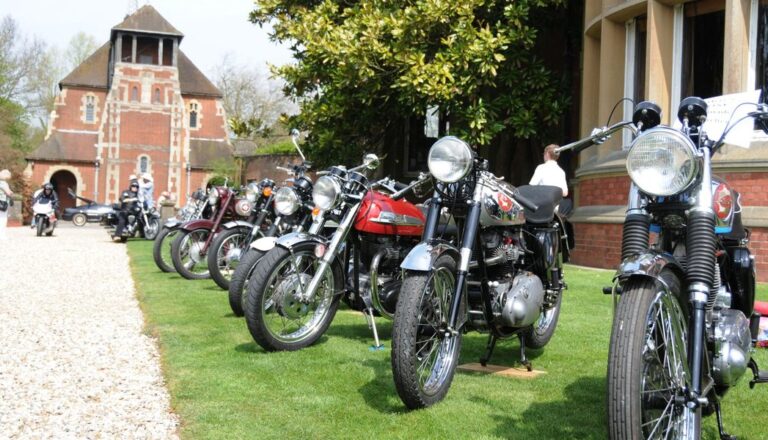
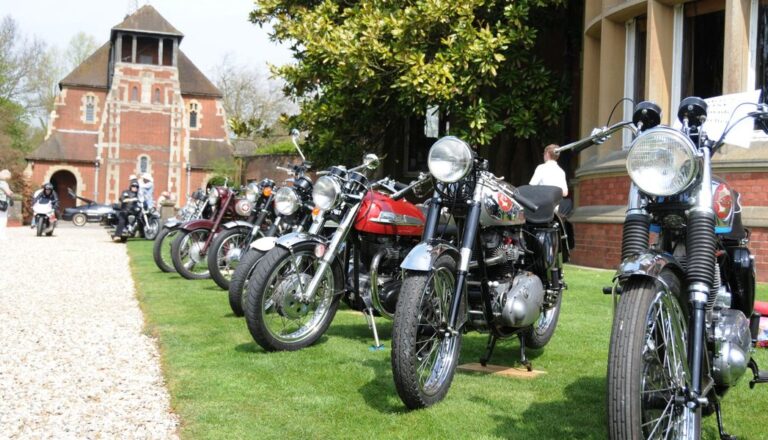
Japan in the early 1950s had a large number of small manufacturers building scooters and lightweight motorcycles—you can see a broader list of classic motorcycle brands from this era—many of them using bought-in engines. Roads were poor, cars were out of reach for most households, and a 100 to 150cc machine was the realistic way to get a family or a business moving. Honda had launched its first complete motorcycle in 1949, and the market was crowded and fast.
A company with an engine design in mass production was well placed in that world. It could sell engines to other makers, or put its own engine into a finished machine, which is what the Meihatsu arrangement did. Kawasaki entered as a supplier of the part that was hardest to build, which is a different path from the founder-in-a-shed origin stories that dominate Japanese motorcycle lore.
1960 to 1962: Meguro, Kawasaki Auto Sales and the B8
The decade’s loose ends tie up right as it closes.
In 1960, Kawasaki took a stake in Meguro, one of Japan’s older motorcycle makers. Meguro’s flagship was a 500cc vertical twin that was a licensed copy of the British BSA A7. That deal gave Kawasaki a dealer network, a factory with real motorcycle production experience and a heavyweight model, all things it did not yet have.
In 1961, Kawasaki Auto Sales was set up to handle selling the machines. In 1962 came the B8, a small Kawasaki motorcycle that carried the company’s own identity rather than a partner’s name. This was just the beginning—the 1960s would be the decade that built the Kawasaki brand.
By the time the 1960s were a couple of years old, Kawasaki had gone from supplying engines to owning a sales company, a stake in an established maker and a bike with its own badge. The 1950s were the groundwork.
What is still undocumented
Here is what I can’t give you with confidence, and what other pages quietly skip:
- Exact production figures for the 1954 and 1956 Meihatsu models. No reliable number is published in the sources I trust.
- The precise corporate relationship between Kawasaki Aircraft and Meihatsu: who owned what, and when. The supplier-and-brand description above is the safe summary.
- A clean model-by-model list. Most “complete lists” of Japanese motorcycles are strongest from 1960 onward and vague before it.
- Period photographs with clear licensing. Few 1950s Meihatsu images are freely reusable, so be skeptical of any page that illustrates the era with confident captions.
If a page gives you a neat spec sheet for a specific 1955 Kawasaki, check where the numbers came from.
Can you still find one?
Realistically, almost never outside Japan. Meihatsu-branded machines from the mid-1950s were small, cheap and used until they wore out, and the brand did not carry the later Kawasaki cachet that makes people save things. Parts support is essentially nonexistent.
If you want a physical piece of this history, your best targets are the early-1960s machines. The Meguro K-series bikes, with their BSA A7 lineage, are the most collectible link between the 1950s groundwork and the Kawasaki that followed. For genuine Meihatsu hardware, Japanese auction and museum sources are where to start, and the realistic expectation is a project, not a runner.
Sarah Thornton
More from Sarah ThorntonHow we reviewed this article
This article was researched against manufacturer records and editorially reviewed before publishing. We accept no payment for coverage. Some guides contain affiliate links; see our affiliate disclosure.