McLaren sold no road car in 1972. The company was a racing constructor, and every model it ran that year was built for a circuit: Formula 1, the Indianapolis 500, Can-Am and Formula 2. If you came here looking for a 1972 McLaren you could register for the street, it doesn’t exist. What does exist is a lineup of four distinct racing families, and one of them won the Indy 500.
Contents
- TLDR
- 1972 McLaren models at a glance
- Formula 1: M19A and M19C
- How to tell the M19A from the M19C
- Indianapolis: M16B
- Can-Am: M20 and the customer M8F
- Formula 2: M21
- Why there was no 1972 McLaren road car
- Where the 1972 cars led
TLDR
- 1972 McLaren models: M19A and M19C (Formula 1), M16B (Indianapolis), M20 (Can-Am), M21 (Formula 2). Customers also still ran older M8F Can-Am cars.
- No road cars were sold that year.
- Best results: Denny Hulme won the South African Grand Prix in an M19A and finished third in the drivers’ championship. Mark Donohue won the Indy 500 in a Penske-entered M16B.
- The M20 lost the Can-Am title to Penske’s turbocharged Porsche 917/10, ending McLaren’s five-year run.
1972 McLaren models at a glance
| Model | Category | Engine | Main drivers in 1972 |
|---|---|---|---|
| M19A | Formula 1 | Ford-Cosworth DFV 3.0 L V8 | Denny Hulme, Peter Revson, Brian Redman |
| M19C | Formula 1 | Ford-Cosworth DFV 3.0 L V8 | Hulme, Revson, Jody Scheckter |
| M16B | Indianapolis / USAC | Turbocharged Offenhauser four-cylinder | Mark Donohue (Penske) and other customers |
| M20 | Can-Am | Chevrolet big-block V8, about 8 L | Hulme, Revson |
| M8F / M8FP | Can-Am (customer) | Chevrolet big-block V8 | Privateers |
| M21 | Formula 2 | 2.0 L Formula 2 engines | Customer teams |
Formula 1: M19A and M19C
The M19 was the car McLaren took to Formula 1 in 1972, built around the Ford-Cosworth DFV, the 3.0-litre V8 that nearly everyone not named Ferrari was using by then. The M19A was the opening-season version. The M19C replaced it mid-season as an updated development of the same basic car.
The season started well. Hulme won the South African Grand Prix at Kyalami in an M19A, the team’s first Grand Prix win in a long stretch. He went on to finish third in the Formula 1 drivers’ championship, behind Emerson Fittipaldi and Jackie Stewart. McLaren also finished third among constructors, behind Lotus and Tyrrell.
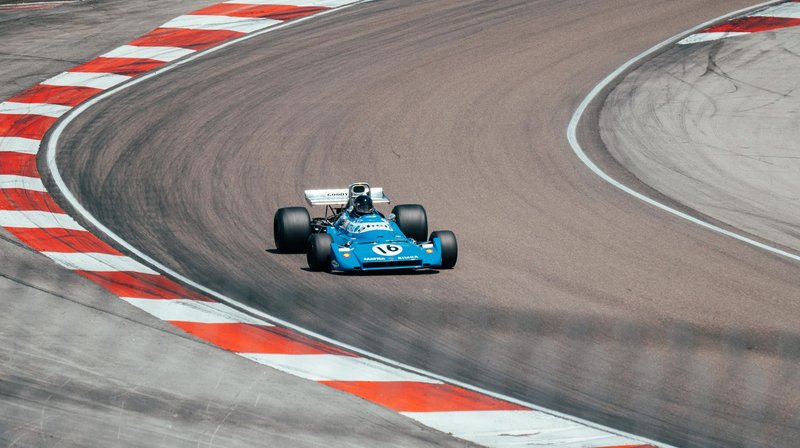
Revson, an American who’d come up through McLaren’s Can-Am team, shared the F1 drive with Hulme. Brian Redman took a one-off M19A drive early in the year, and a young South African named Jody Scheckter made his Grand Prix debut at the US Grand Prix at Watkins Glen in a third McLaren M19C. He finished ninth.
How to tell the M19A from the M19C
Photos of the two get mixed up constantly, including on museum and auction pages. The mechanical layout is shared, so the difference is in the bodywork. The M19C carried revised bodywork and a reshaped front end compared with the M19A. If a caption doesn’t say which one it is, look at the nose first, then the date: an M19 in a photo from the first races of 1972 is almost certainly an M19A, and one from late in the season is likely a C.
Scale-model buyers have the same problem. Spark has made 1:43 models of the M19 in several liveries, so check the listing for the A or C designation before you assume you’re getting the car you want.
Indianapolis: M16B
The M16B was McLaren’s Indy car, a wedge-shaped design that put McLaren customers in the 500 for several years running. In 1972 it gave Roger Penske his first Indianapolis 500 win as a team owner. Mark Donohue drove a Penske-entered M16B to victory, powered by a turbocharged Offenhauser four-cylinder, in what was already an old engine design by 1972. His average speed of 162.962 mph set a new race record, according to Britannica’s Indianapolis 500 history.
The M16B wasn’t a works McLaren in the way the F1 cars were. Customer teams ordered it from McLaren, which is why the same chassis family shows up under different team colors, including Donohue’s blue-and-yellow Sunoco livery.
Can-Am: M20 and the customer M8F
Can-Am was the series McLaren had owned. Between 1967 and 1971 it won every championship, a dominant run built on the Chevrolet-powered cars Bruce McLaren developed through the late 1960s, before his death in 1970.
The M20 was the 1972 attempt to keep that streak alive. Hulme and Revson drove it, with an aluminum Chevrolet V8 of about 8 liters and roughly 750 hp. It won races, but it didn’t win the championship. Penske’s Porsche 917/10 Turbo, driven by George Follmer, took the 1972 title, and the era of McLaren Can-Am dominance ended there.
Older M8F cars, which had won the 1971 title, were still being raced by customers, along with Penske-modified M8FP variants. If a source lists an M8F next to a 1972 date, that’s usually why.
Formula 2: M21
The M21 was McLaren’s Formula 2 car for the 1972 season. It’s the least documented of the 1972 lineup, with only a small number of chassis built and a chassis-by-chassis history that survives mostly in specialist archives like Old Racing Cars. Formula 2 in 1972 was a two-liter formula, a proving ground for drivers heading to Formula 1, and the M21 sat in that mid-field space between customer racing and works ambition.
Why there was no 1972 McLaren road car
McLaren had tried a road car once. The M6GT, a road-going version of the Can-Am M6A sports racer, was built in 1969 and 1970 in tiny numbers. It was abandoned after Bruce McLaren died in a testing accident in June 1970. In 1972 the company was funding itself from racing, and a road-car division wasn’t on the table. The next McLaren road car didn’t arrive until the McLaren F1, revealed in 1992.
Where the 1972 cars led
The 1972 lineup was the end of one McLaren era and the start of another. The Can-Am dominance was over. The M19C was the last of the cars designed before the M23, which debuted in 1973 and went on to win the Formula 1 drivers’ championship in 1974 with Fittipaldi and again in 1976 with James Hunt. The M16 line kept going through Indy racing in the 1970s.
So the answer to “what 1972 McLaren car models existed” is five racing models and no road car: M19A, M19C, M16B, M20 and M21, plus the older M8F cars still racing under customer entries. Each one covers a different racing series, which is why no single page ever gathered them in one place.

Marco Delantero
More from Marco DelanteroHow we reviewed this article
This article was researched against manufacturer records and editorially reviewed before publishing. We accept no payment for coverage. Some guides contain affiliate links; see our affiliate disclosure.