Table of Contents
- McLaren in 1968: The Setup
- The McLaren M7A — Formula 1 Contender
- The McLaren M8A — Can-Am Dominator
- The McLaren M6B — The Customer Car
- 1968 McLaren Models: Side by Side
- The Legacy of 1968
Most McLaren histories start in 1966 with the founding, jump to the 1984 F1 dominance, or start with the F1 road car in 1992. But 1968 is the year that actually mattered. Bruce McLaren’s team ran three distinct cars across two major championships — and won both of them.
This isn’t a trivia point. It’s the year the template was set.
McLaren in 1968: The Setup
McLaren Racing had only been a constructor for three years by 1968. The team was competing in Formula 1 for the first time as a full factory effort — meaning they built their own chassis rather than running a customer car — and they were defending the 1967 Can-Am championship they’d won with Bruce McLaren and Denny Hulme at the wheel.
The funding model was clever: Can-Am prize money subsidized F1 development. The two programs fed each other technically, and 1968 was where that crossover produced results.
Three cars defined the season: the M7A in Formula 1, the M8A in Can-Am, and the M6B as a customer version of the previous year’s winner sold to private entrants. Each one tells a different part of the story.
The McLaren M7A — Formula 1 Contender
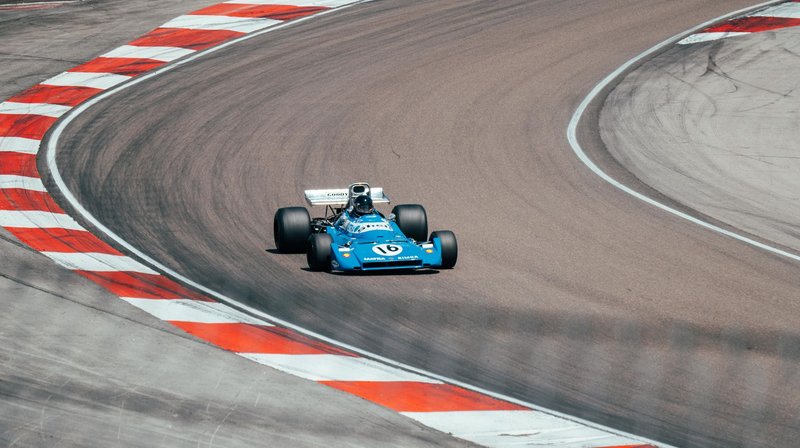
The M7A was McLaren’s first purpose-built Formula 1 chassis, replacing the customer BRM and then customer BT20 Brabham chassis the team had been using in earlier seasons. Designed by Gordon Coppuck and Jo Marquart, it was a conventional monocoque with a Cosworth DFV V8 mounted as a stressed member — the same configuration every serious F1 team was scrambling to adopt after Lotus debuted it the year before.
Engine: Ford Cosworth DFV V8, 2,993 cc, approximately 405 bhp at 9,000 rpm Transmission: Hewland DG300 5-speed Chassis: Aluminium monocoque Drivers: Bruce McLaren, Denny Hulme
The M7A made its debut at the 1968 South African Grand Prix and ran the full season. Hulme won at Monza and at Watkins Glen. Bruce McLaren won the Race of Champions at Brands Hatch — a non-championship race, but significant as it was the M7A’s first outright victory. In the Drivers’ Championship, Hulme finished third and McLaren fifth.
What made the M7A consequential wasn’t the win total — Lotus and Ferrari were still faster on their best days. It was the reliability. The DFV was already known to blow up; McLaren’s engineering discipline kept theirs running. They finished races that rivals didn’t, and by the end of the season they sat third in the Constructors’ Championship.
The car’s other distinction: it was one of the first Formula 1 cars to run with rear aerofoil wings after the mid-season scramble to adopt downforce following their sudden appearance at the Monaco and Belgian Grands Prix in 1968.
The McLaren M8A — Can-Am Dominator
If the M7A was the respectful debut, the M8A was the statement. McLaren built this car specifically to defend the Can-Am title, and it was faster than anything else on the grid by a margin that made most races academic.
Engine: Chevrolet V8 (big-block), 7,000 cc (427 cu in), approximately 620 bhp Transmission: Hewland LG600 4-speed Chassis: Aluminium monocoque Drivers: Bruce McLaren (car #4), Denny Hulme (car #5) Results: 5 wins from 6 rounds, Constructors’ title, 1-2 in Drivers’ standings
The M8A ran a 7-litre Chevrolet big-block because the Can-Am series had no displacement limit. That was the point. While European racing was constraining itself with formula rules, Can-Am let engineers ask the more interesting question: how much power can we actually use? The M8A’s answer was about 620 horsepower, channelled through wide rear tyres and a body designed in collaboration with the Royal Aircraft Establishment’s wind tunnel at Farnborough.
The distinctive orange livery — sprayed in McLaren’s papaya orange — became the series’ visual signature. When both M8As were running at the front, which was most of the time, the Can-Am field was essentially competing for third place.
Bruce McLaren won at Elkhart Lake, Bridgehampton, and Laguna Seca. Hulme won at Watkins Glen and Edmonton. The only round they didn’t win — Riverside — went to John Surtees. McLaren finished 1-2 in the Drivers’ Championship and claimed the Constructors’ title comfortably.
The M8A’s engineering was ahead of its time in one specific way: the team used aerodynamic testing systematically, not as a one-off, and the resulting underbody and wing configuration gave them a downforce advantage that rivals couldn’t replicate mid-season. That process — wind tunnel testing as routine, not exception — was ahead of most teams’ thinking in 1968.
The McLaren M6B — The Customer Car
The M6B is often overlooked in 1968 McLaren histories because it was a 1967 design sold to customers rather than a new development. That’s the wrong way to think about it.
The M6A had won the 1967 Can-Am championship. McLaren’s decision to sell the M6A design as the M6B to customer teams was both a revenue move and an early example of the customer racing model that would later define GT3 programs. Private entrants could buy essentially last year’s championship-winning car — fully proven, with known setup parameters — for around $17,500.
Engine: Chevrolet V8 (various displacements depending on buyer configuration) Notable customer entrants: Lothar Motschenbacher, Chuck Parsons, Jerry Titus
Customer M6Bs were competitive at the back of the Can-Am field even against the factory M8As, which tells you how strong the 1967 design was. Motschenbacher ran one particularly effectively throughout the season, taking points finishes when the works cars hit trouble.
The M6B also exists in a third, more significant form: Bruce McLaren had been quietly developing a road car version of the M6 design called the M6GT. It was the earliest ancestor of the McLaren road car program — a proper two-seat GT with a mid-mounted engine and a fibreglass body. McLaren built a handful of M6GT prototypes, intending to produce 250 to qualify for GT homologation. Bruce McLaren’s death at Goodwood in June 1970 ended that plan, but the M6GT prototype survives and is the legitimate starting point of McLaren’s road car lineage, not the F1 of 1992.
1968 McLaren Models: Side by Side
| Model | Series | Engine | Power (approx.) | Wins | Drivers |
|---|---|---|---|---|---|
| M7A | Formula 1 | Ford Cosworth DFV 3.0L V8 | ~405 bhp | 2 (championship rounds) | McLaren, Hulme |
| M8A | Can-Am | Chevrolet 7.0L V8 | ~620 bhp | 5 of 6 rounds | McLaren, Hulme |
| M6B | Can-Am (customer) | Chevrolet V8 (varied) | ~500–560 bhp | 0 | Multiple private entrants |
The displacement difference between the M7A and M8A illustrates the gap between formula racing and Can-Am better than any explanation could. Formula 1 capped engines at 3 litres. Can-Am had no cap, so McLaren ran more than twice that displacement. The M8A produced roughly 50% more power than the M7A.
The Legacy of 1968
McLaren won the Can-Am title in 1968, 1969 (with the M8B), 1970 (M8D, posthumously, after Bruce’s death), 1971 (M8F), and 1972 (M20). Five consecutive titles. The formula for that run was established in 1968: a big-block Chevrolet, aerodynamic development done properly, and a driver pairing of Bruce McLaren and Denny Hulme who trusted each other enough not to fight over strategy.
In Formula 1, the M7A’s successor — the M14A, then eventually the M19, M23 — would carry the program through to Emerson Fittipaldi’s 1974 world championship. The patient, reliable approach the team showed with the M7A paid off across an entire decade.
The 1968 season is the moment McLaren stopped being a plucky startup and started being a major constructor. Three cars, two championships targeted, one title won outright and an F1 season that punched above its weight. For a team in its third year building its own chassis, that’s not a minor result — that’s the blueprint.
Bruce McLaren was 30 years old when the 1968 season ended. He had two more seasons to live.

Marco Delantero
More from Marco DelanteroHow we reviewed this article
This article was researched against manufacturer records and editorially reviewed before publishing. We accept no payment for coverage.