The year 1986 sat right at the inflection point of automotive history. The boxy, squared-off shapes of the 1970s were genuinely on their way out, and the industry was landing on something more fluid — wind-tunnel shapes, flush glass, aero noses. At the same time, the performance drought of the late 1970s and early 1980s (thank you, smog regulations) was finally lifting. Horsepower numbers were creeping back up. Turbochargers were appearing on cars that had no business being fast.
The result was a model year packed with genuinely interesting machinery across every segment.
Below are 20 cars that defined 1986 — not just the exotic ones that everybody lists, but the everyday cars, the family sedans, the economy hatches that millions of people actually drove.
Table of Contents
- Buick Grand National
- Ford Taurus
- Chevrolet Corvette C4
- Pontiac Firebird Trans Am
- Dodge Omni GLH-S
- Ferrari Testarossa
- Lamborghini Countach 5000 QV
- Toyota Supra Mk III
- Honda Accord Third Generation
- Mazda RX-7 FC
- Nissan 300ZX Z31
- Mitsubishi Starion ESi-R
- BMW 3 Series E30 M3 (Homologation)
- Mercedes-Benz 300E W124
- Porsche 944 Turbo
- Alfa Romeo Spider Series 3
- Volkswagen Golf GTI Mk2
- Peugeot 205 GTI 1.9
- Honda CRX Si
- Renault 5 GT Turbo
Quick Reference: 20 Cars Made in 1986
| Model | Origin | Engine / HP | Original MSRP (approx.) | Collector Status |
|---|---|---|---|---|
| Buick Grand National | USA | 3.8L Turbo V6 / 245 hp | $16,000 | High demand |
| Ford Taurus | USA | 3.0L V6 / 140 hp | $9,500 | Low |
| Chevrolet Corvette C4 | USA | 5.7L V8 / 230 hp | $27,000 | Moderate |
| Pontiac Firebird Trans Am | USA | 5.0L V8 / 190 hp | $14,000 | Moderate |
| Dodge Omni GLH-S | USA | 2.2L Turbo I4 / 175 hp | $11,000 | Cult classic |
| Ferrari Testarossa | Italy | 4.9L Flat-12 / 390 hp | $87,000 | Very high |
| Lamborghini Countach 5000 QV | Italy | 5.2L V12 / 455 hp | $110,000 | Very high |
| Toyota Supra Mk III | Japan | 3.0L I6 / 200 hp | $18,000 | Growing fast |
| Honda Accord 3rd Gen | Japan | 2.0L I4 / 98 hp | $10,500 | Low |
| Mazda RX-7 FC | Japan | 1.3L Rotary / 146 hp | $12,000 | Moderate–High |
| Nissan 300ZX Z31 | Japan | 3.0L Turbo V6 / 200 hp | $18,500 | Moderate |
| Mitsubishi Starion ESi-R | Japan | 2.6L Turbo I4 / 176 hp | $14,000 | Cult classic |
| BMW E30 M3 | Germany | 2.3L I4 / 200 hp | $35,000 | Very high |
| Mercedes-Benz 300E W124 | Germany | 3.0L I6 / 177 hp | $36,000 | Moderate |
| Porsche 944 Turbo | Germany | 2.5L Turbo I4 / 220 hp | $29,000 | High |
| Alfa Romeo Spider Series 3 | Italy | 2.0L I4 / 115 hp | $17,000 | Moderate |
| VW Golf GTI Mk2 | Germany | 1.8L I4 / 107 hp | $9,000 | Moderate–High |
| Peugeot 205 GTI 1.9 | France | 1.9L I4 / 130 hp | $9,500 | Very high (EU) |
| Honda CRX Si | Japan | 1.5L I4 / 91 hp | $8,500 | Cult classic |
| Renault 5 GT Turbo | France | 1.4L Turbo I4 / 115 hp | $9,000 | Cult classic (EU) |
American Cars Made in 1986
Buick Grand National
The GNX didn’t arrive until 1987, but the 1986 Grand National is the one that changed the conversation. Here was a turbocharged V6 in a Buick — a brand associated with your grandfather’s driveway — running the quarter mile faster than a Corvette. The 3.8-liter intercooled engine made a rated 245 hp, though dyno tests suggest that number was understated. Black on black, no chrome, no nonsense. Magazine editors couldn’t believe what they were driving.
Today, clean Grand Nationals command $30,000–$60,000 depending on mileage and condition. T-tops are common but introduce rust concerns; inspect the roof seals carefully.
Ford Taurus
The Taurus didn’t look like any other American car in 1986 — and that was the entire point. Ford’s oval-everything design language was a deliberate break from the rectilinear shapes Detroit had been selling since the 1960s. It became the best-selling car in America almost immediately and held that title for years. The aerodynamic body and front-wheel-drive layout felt genuinely modern.
Collector value? Essentially zero. But for automotive historians, it’s significant: the Taurus is the car that told American consumers jellybean shapes were acceptable.
Chevrolet Corvette C4
The C4 Corvette received an important update in 1986 — the convertible returned for the first time since 1975, and the coupe got an aluminum cylinder head that bumped output to 230 hp. It also became the Indy 500 pace car that year, which the marketing department was very pleased about.
By the late 1980s, horsepower would climb further, making the base-spec 1986 a relative entry point into C4 ownership. Values sit in the $10,000–$20,000 range depending on options, making it one of the more accessible pieces of American performance history.
Pontiac Firebird Trans Am
The third-generation Trans Am was past its cultural peak by 1986 — that peak being “Smokey and the Bandit” in 1977 — but the car itself remained genuinely capable. The 5.0-liter V8 made 190 hp in the base spec; the higher-output Tuned Port Injection version pushed 210. The handling package, inherited from F-body development shared with the Camaro, meant these cars could actually corner.
Prices have been rising on clean examples. A survivor-condition 1986 T/A in formula colors now consistently brings $20,000–$30,000.
Dodge Omni GLH-S
Carroll Shelby put his name on a lot of things in the 1980s, and the Omni GLH-S was one of the better decisions. GLH stood for “Goes Like Hell” — and at 175 hp from a 2.2-liter turbocharged four-cylinder in a car weighing under 2,300 pounds, the name held up. Shelby sharpened the suspension, deleted the weight, and produced something genuinely quick by any era’s measure.
About 500 were built. Finding one today requires patience and a willingness to pay cult-classic premiums — expect $15,000–$25,000 for a good example.
European Cars Made in 1986
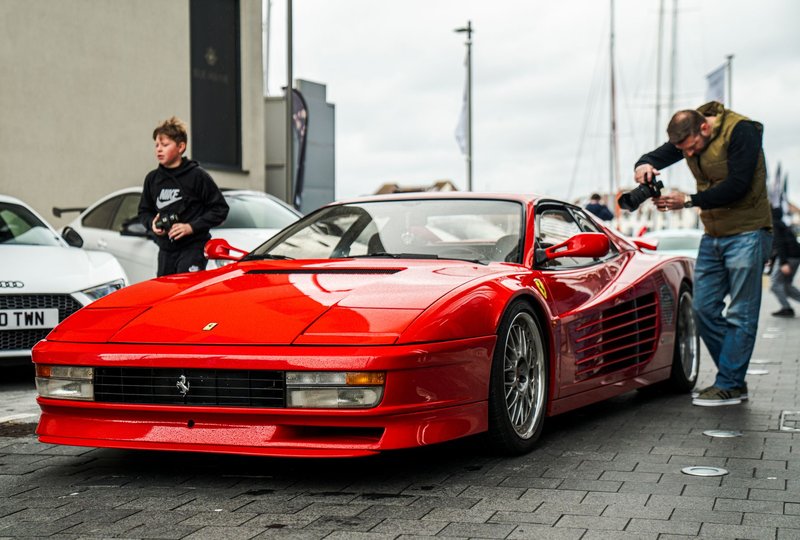
Ferrari Testarossa
The Testarossa had debuted at Paris in 1984, but by 1986 it was in full production and becoming the poster car of the decade. The flat-12 engine behind the driver made 390 hp and 361 lb-ft of torque, with a top speed just over 180 mph. The side strakes — five horizontal fins running the length of each door — were functional (they fed cooling air to the radiators relocated to the rear) and became one of the most copied styling cues of the era.
Values have held firmly above $150,000 for well-documented examples. The temptation to buy a deferred-maintenance example at $80,000 is real; the repair bills that follow tend to be educational.
Lamborghini Countach 5000 QV
“QV” stood for Quattro Valvole — four valves per cylinder, a configuration that pushed the V12 to 455 hp and finally gave the Countach the straight-line performance that matched its appearance. The 5000 QV is the version most people picture when they think “Countach”: massive rear wing optional, wide-body wheel arches standard, scissor doors absolutely mandatory.
It’s worth noting that the actual top speed was lower than Lamborghini claimed — road tests of the era measured around 170 mph rather than the advertised 183. That didn’t matter to anyone who owned one.
Porsche 944 Turbo
The 944 Turbo — badged the 944 Turbo, never the “944T” — was Porsche’s real sports car in 1986, regardless of what the 911 purists said. The 2.5-liter turbocharged four-cylinder made 220 hp and pushed the car to 60 mph in 5.7 seconds. Balanced 50/50 front-to-rear, with a transaxle layout that kept the weight distribution neutral in corners. If you want to understand the full context of what Porsche was offering that year, the complete 1986 Porsche lineup makes for illuminating reading — the 944 Turbo sat alongside the 911 and 928 in a catalog that covered more ground than most people realize.
Clean 944 Turbos are appreciating steadily. The timing belt service history matters enormously — a snapped belt destroys the engine.
BMW 3 Series E30 M3
Homologation for Group A touring car racing required BMW to build 5,000 road cars. They built roughly 17,000, which tells you something about how people reacted to the M3. The E30 M3’s 2.3-liter four-cylinder was borrowed from the M1 supercar program and made 195–200 hp depending on market, but the number undersells the character. It revved freely to 7,250 rpm and felt unlike any other four-cylinder road car of the period. It’s part of a broader story of BMW building driver’s cars across multiple decades — one that covers the brand’s most iconic models and what they’re worth now.
E30 M3 prices have reached uncomfortable levels — $60,000 to over $100,000 for pristine examples. Low-mileage U.S. market cars are particularly sought after.
Mercedes-Benz 300E W124
The W124 is the car that proved a Mercedes-Benz sedan didn’t need to be a wallowing luxury barge. The 3.0-liter inline-six was smooth enough to idle at idle speeds you could barely hear and powerful enough to cruise at 130 mph indefinitely (German autobahn speeds were the design reference). Build quality was, by the standards of the era, almost absurd — door seals, panel gaps, interior materials all engineered to last decades. The W124 sits among the strongest entries in the complete guide to 1980s Mercedes-Benz models, a decade that also produced the W126 S-Class and the legendary 190E 2.3-16.
They do last decades. A well-maintained W124 with under 150,000 miles is still a competent daily driver in 2026. Values remain modest given their durability — typically $8,000–$18,000 for clean examples.
Alfa Romeo Spider Series 3
The Alfa Spider had been in production since 1966 by this point, and the Series 3 revision — pininfarina-designed, now with standard fuel injection — updated the nose and brought U.S. emissions compliance without gutting the personality. The 2.0-liter twin-cam four-cylinder made modest power (around 115 hp in American spec), but the car weighed just over 2,400 pounds and the gearbox was a pleasure to operate.
Series 3 Spiders are moderately collectible, though rust is the enemy. Original paint, documented service history, and clean undercarriage separate the good ones from the money pits.
Volkswagen Golf GTI Mk2
The Mk2 GTI arrived in the U.S. for 1985, grew its wheelbase and gained a more practical rear seat, and was in full stride by 1986. The 1.8-liter engine made 107 hp — enough in a car that weighed under 2,200 pounds. More importantly, the chassis was composed in ways that contemporary reviewers found difficult to explain. It simply went where you pointed it.
Good Mk2 GTIs are getting hard to find rust-free. The survivor tax is real — clean examples in the U.S. market have crossed $15,000.
Peugeot 205 GTI 1.9
The 205 GTI 1.9 is possibly the most significant hot hatch in history, full stop. The 1.9-liter XU engine made 130 hp, which sounds unremarkable until you account for the 1,900-pound curb weight and the near-perfect chassis tune. British automotive media of the era ran out of superlatives. The car has a genuine snap-oversteer reputation that punished drivers who lifted off mid-corner — a trait that made it thrilling and occasionally terrifying.
Never officially sold in the U.S. European market examples are now serious collector items; a clean 1.9 in France or the UK regularly exceeds €25,000.
Renault 5 GT Turbo
Renault’s answer to the 205 GTI was smaller, wilder, and genuinely faster despite a smaller engine. The 1.4-liter turbo four made 115 hp, but the turbocharger spooled with a lag that taught you to plan ahead — and then hit like a door slamming. It weighed 1,850 pounds. The interior was basic even by 1986 standards.
Like the 205 GTI, never sold in the U.S. Market: European collectors only, with values rising sharply in the last decade.
Japanese Cars Made in 1986
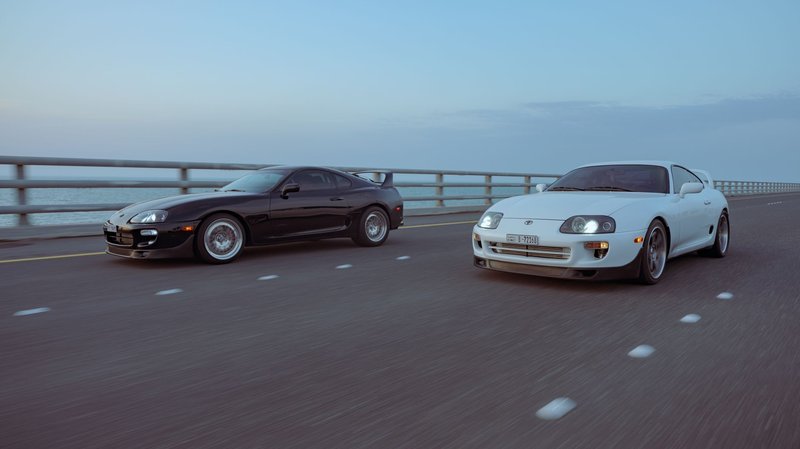
Toyota Supra Mk III
The A60 to A70 transition brought the Supra into its own identity, separate from the Celica. The 7M-GE inline-six displaced 3.0 liters and made 200 hp in naturally aspirated form; the 7M-GTE turbo version pushed 230 hp. The styling was cleaner than its predecessor, the interior more refined, and the suspension — MacPherson front, semi-trailing arm rear — allowed genuine cornering ability.
Supra values have tracked the A80 (MKIV) market upward. Clean MkIII turbos now regularly sell for $25,000–$40,000, a number that would have seemed absurd five years ago.
Honda Accord Third Generation
The third-generation Accord arrived in 1986 with a new platform, more interior room, and the kind of build quality that made Toyota nervous. It wasn’t exciting — 98 hp from a 2.0-liter four-cylinder — but the driving position was right, the switches clicked properly, and the car simply worked without drama for years. In Japan, it was available as a sedan, coupe, and hatchback; the U.S. got the first two.
No meaningful collector value, but its importance to the segment is historical. It’s the car that made Japanese reliability a mainstream expectation rather than an enthusiast’s niche preference.
Mazda RX-7 FC
The second-generation RX-7 (FC series) ditched the pop-up headlight look of the original and arrived with proper European sports car proportions. The 1.3-liter twin-rotor Wankel engine made 146 hp in naturally aspirated trim; the turbocharged version pushed 182 hp. Rear-wheel drive, well-balanced, with steering that communicated what the front wheels were doing.
FC values have been climbing as the FB (first-gen) prices became prohibitive. Turbo versions with clean engine seals are the desirable ones — apex seal wear is the rotary owner’s permanent concern.
Nissan 300ZX Z31
The Z31 300ZX often gets overlooked because its successor, the Z32, arrived in 1989 and immediately became the more famous car. That’s unfair. The turbocharged Z31 made 200 hp and provided a level of refinement unusual for a Japanese sports car of the period — leather interior, digital dash, T-tops. It was the first Z-car to feel genuinely luxurious rather than just capable.
Z31s are undervalued and increasingly recognized as such. Low-mileage turbos represent good value at $10,000–$18,000.
Mitsubishi Starion ESi-R
The wide-body Starion ESi-R is one of the decade’s stranger propositions: a Japanese grand tourer with a 176 hp turbocharged four-cylinder, rear-wheel drive, and an interior that tried to compete with European rivals on luxury. The flared rear fenders were dealer-installed in early years but factory-standard by 1986. It’s genuinely fast, genuinely rare, and almost completely unknown outside enthusiast circles.
Finding a clean one requires real effort. Values remain modest — $10,000–$20,000 — which makes it one of the more interesting collector opportunities from 1986.
Honda CRX Si
The CRX Si was Honda’s statement that you didn’t need a lot of car to have a lot of fun. The 1.5-liter engine made 91 hp — nothing remarkable — but the car weighed under 1,900 pounds and the driving position was so low-slung it felt like wearing the vehicle rather than sitting in it. Fuel economy was remarkable: 30+ mpg combined without trying.
Clean CRX Si examples have crossed from “used car” to “collector car” territory. Rust-free California and southwestern U.S. examples fetch $12,000–$20,000.
Final Thoughts
Nineteen eighty-six produced cars across every price point and market segment that, viewed together, tell a coherent story: the industry was finding confidence again. Performance was returning. Design was becoming bolder. Japan was demonstrating that quality and reliability weren’t in conflict with driving satisfaction.
The collector market has recognized most of this already — Grand Nationals, E30 M3s, and Testarossas have all been bid up accordingly. The opportunity, if you’re looking for one, sits in the overlooked cars: the Nissan Z31 Turbo, the Mitsubishi Starion, the Honda CRX Si. These are cars that will only get harder to find clean.
For reference, the Wikipedia 1986 in motoring article provides a comprehensive chronological record of introductions and motorsport events from that year if you want the full scope of what was happening globally.

Marco Delantero
More from Marco DelanteroHow we reviewed this article
This article was researched against manufacturer records and editorially reviewed before publishing. We accept no payment for coverage. Some guides contain affiliate links; see our affiliate disclosure.