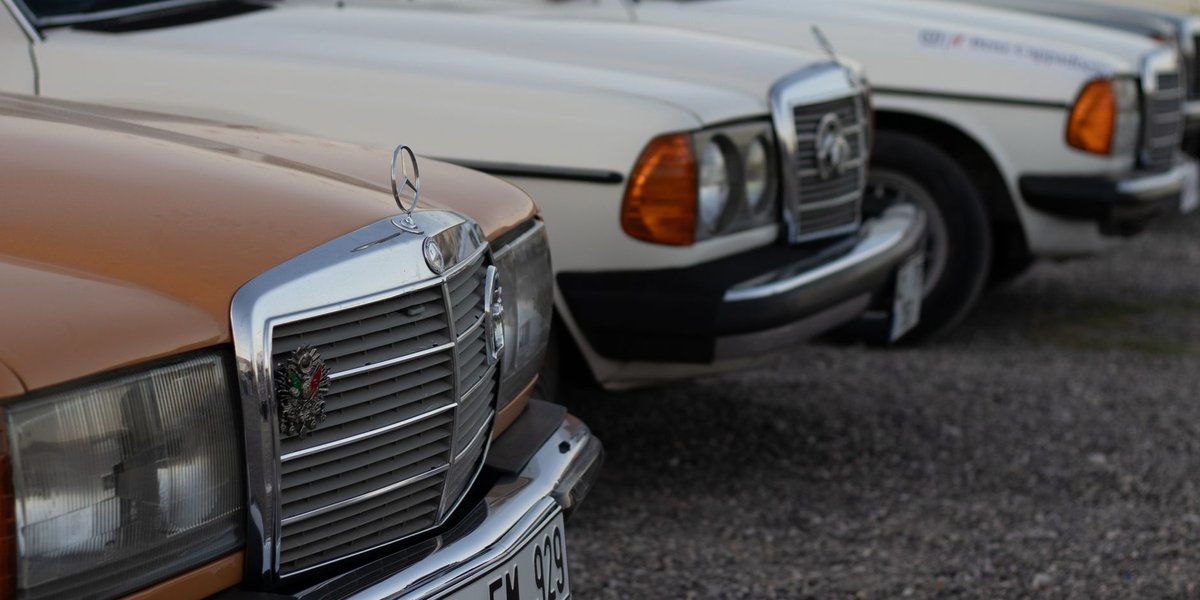
Most “classic Mercedes” articles zoom in on the W126 S-Class and call it a day. That’s fair — it’s one of the great cars of the 20th century. But Mercedes spent the 1980s building an entire ecosystem of models, from a compact entry-level sedan that redefined the segment to an SL roadster that went on to become one of the longest-running production sports cars in history. The decade was arguably the brand’s peak.
This guide covers every major 1980s Mercedes-Benz model line: what it is, why it matters, what ownership looks like today, and which variants are worth tracking down.
Table of Contents
- TLDR: Which 1980s Mercedes Should You Buy?
- The Model Lineup at a Glance
- W126 S-Class (1979–1991): The Flagship
- W201 190E (1982–1993): The Entry Car That Wasn’t
- W124 E-Class (1984–1995): The One That Earned the Legend
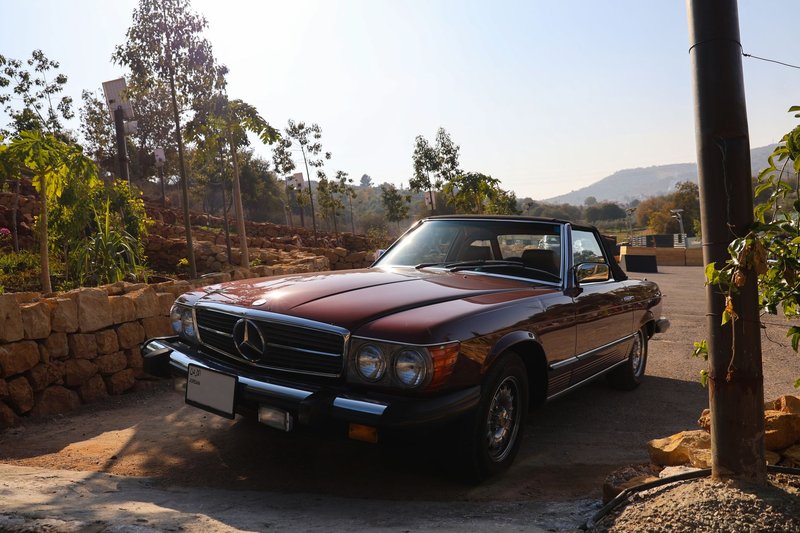
- W107 SL (1971–1989): The Outgoing Sports Icon
- R129 SL (1989–2001): The New Benchmark
- W126 SEC Coupé: The S-Class with a Sunroof Delete
- W460/W461 G-Wagen (1979–present): Before It Was a Status Symbol
- AMG in the 1980s: The Factory Wasn’t the Only Option
- Ownership Summary: Reliability, Parts, and Market Value
TLDR: Which 1980s Mercedes Should You Buy? {#tldr}
Best all-rounder: W124 300E. Overbuilt to a degree that’s almost irrational, parts are everywhere, and it drives like the engineers didn’t have a cost department. Around $8,000–$18,000 for a solid example.
Best flagship: W126 560 SEL. The full long-wheelbase S-Class with the 5.6-liter V8. Presence, comfort, and reliability that outlasts its owners. Budget $10,000–$25,000 for a clean one.
Best driver’s car: 190E 2.3-16 (Cosworth). Sixteen-valve head developed with Cosworth, homologated for touring car racing, and genuinely fun to hustle. They’re climbing — expect $20,000–$40,000 now.
Best weekend car: R129 300 SL or 500 SL. The 1989-onward SL is more modern than it looks, with a proper pop-up roll bar and available hardtop. Prices are still reasonable for the six-cylinder cars.
Avoid: Any of the above with deferred maintenance and a vague service history. These cars need their fluids loved.
The Model Lineup at a Glance {#model-lineup}
| Model | Chassis | Years | Segment | Key Engine(s) |
|---|---|---|---|---|
| S-Class Sedan | W126 | 1979–1991 | Flagship | 280 SE, 300 SE, 420 SE, 500 SEL, 560 SEL |
| SEC Coupé | W126 | 1981–1991 | Flagship Coupé | 380 SEC, 420 SEC, 500 SEC, 560 SEC |
| 190E / 190D | W201 | 1982–1993 | Entry | 190E 1.8/2.0/2.3/2.6, 190D 2.0/2.5 |
| E-Class Sedan/Wagon | W124 | 1984–1995 | Mid-size | 230E, 260E, 300E, 300D, 300CE, 300TE |
| SL Roadster (outgoing) | W107 | 1971–1989 | Sports | 380 SL, 560 SL |
| SL Roadster (new) | R129 | 1989–2001 | Sports | 300 SL, 500 SL, 600 SL |
| G-Wagen | W460/W461 | 1979–present | Off-road | 230G, 280GE, 300GD |
W126 S-Class (1979–1991): The Flagship {#w126-s-class}
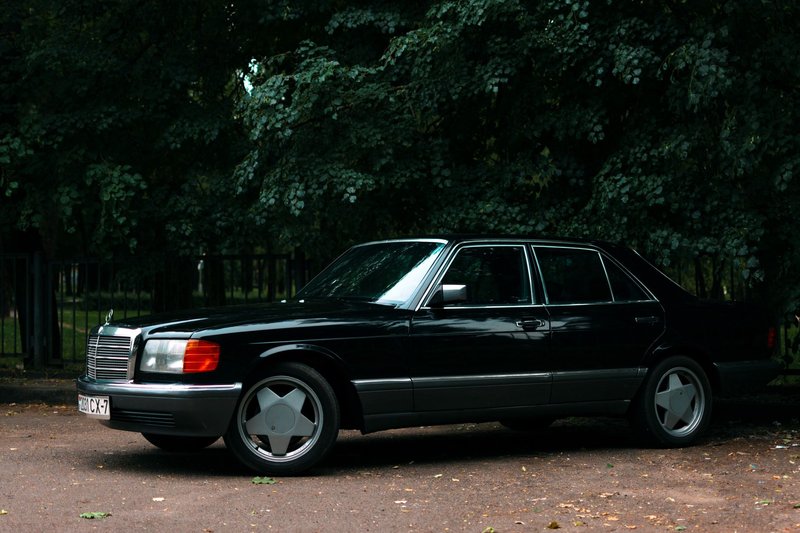
The W126 is the car that codified what a luxury flagship should be. Chief engineer Hans Scherenberg signed off on a development process that reportedly involved over 2,000 engineers across seven years. Every panel fits. Every door closes with that specific thunk. Forty years later, there are W126s with 300,000 miles still in daily use.
Production ran from late 1979 through 1991, with the most desirable variants concentrated in the second half of the decade. The 1986 facelift brought revised bumpers and interior updates — it was one of the more significant mid-cycle refreshes of a strong year for European luxury cars; the big engine news came at the same time with the introduction of the 560 variants — a 5.6-liter M117 V8 producing 238 hp in US trim, with European cars making closer to 300 hp.
The variants that matter:
The 300 SE is the gentleman’s choice — a 3.0-liter straight-six that’s quieter and more economical than the V8s, and nearly as effortless. The 500 SEL long-wheelbase sedan is the one that ambassadors rode in. The 560 SEL is the performance choice, with the largest wheelbase and the strongest engine offered in the US market.
Ownership today: The W126 is genuinely one of the more reliable classics you can own. Rust is the main enemy — check the rear wheelarches, the battery tray, and the floor pans. The M117 V8 is a known quantity; the timing chain tensioner gets attention at high mileage. An independent pre-purchase inspection is non-negotiable. Budget around $2,000–$4,000 per year for maintenance on a well-kept car.
Market: Clean 500 SEL and 560 SEL examples have appreciated steadily. A tatty driver can be had for under $5,000; a concours-ready 560 SEL runs $25,000–$35,000 and climbing.
W201 190E (1982–1993): The Entry Car That Wasn’t {#w201-190e}
Mercedes’ first compact rear-wheel-drive sedan was controversial internally — it was smaller and cheaper than anything the brand had sold before. What it turned out to be was one of the most carefully engineered small cars of the decade. When it debuted in 1982, it stood out even against a field of genuinely strong competition — the best cars of 1982 included some serious machinery, and the 190E still earned its place at the top of the segment.
The W201 introduced multi-link rear suspension to the mainstream Mercedes lineup, a geometry later adapted for the W124 and W202. The chassis is tighter than it looks, and the driving feel — especially in the 190E 2.3 and 2.6 — is a proper sports sedan. Not quick, but balanced and precise in a way that rewards a driver who knows what they’re doing.
The range: The base 190E 1.8 is the tax-disc special — fine, but the 2.0 is more usable. The 2.3 hits the sweet spot: torquey enough for motorway use, not heavy on fuel. The 2.6 straight-six is the sleeper pick — it drops into the car with barely any additional mass and transforms the character entirely. The 190D variants are diesel legends, especially in Europe, where they accumulated absurd mileages without drama.
The one to find: The 190E 2.3-16 is a different animal. Mercedes partnered with Cosworth to design a 16-valve cylinder head that pushed output to 185 hp. The car was built specifically to qualify for the Deutsche Tourenwagen Meisterschaft (DTM) series, and Ayrton Senna drove one at the inaugural Nürburgring race in 1984. The 2.5-16 Evolution variants that followed in 1988–89 — with widened bodywork and adjustable rear wing — were full homologation specials. Those are now collector cars, not daily drivers.
Ownership: The standard 190E is cheap to maintain and parts are plentiful. The 2.3-16 needs a specialist for the Cosworth head work; parts exist but aren’t common. Rust affects the same spots as other W-bodies — sills and arches. Budget example: $4,000–$8,000 for a clean 2.3. The 2.3-16 starts around $20,000 for a driver-quality car.
W124 E-Class (1984–1995): The One That Earned the Legend {#w124-e-class}
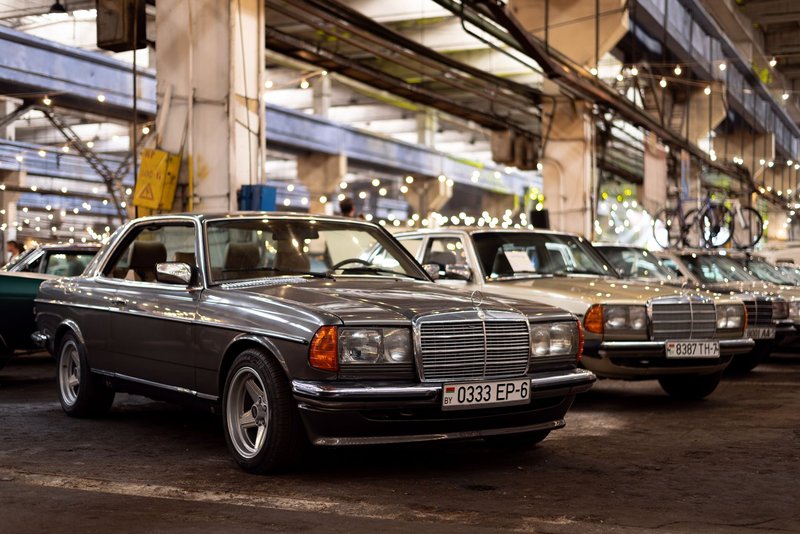
The W124 has a reputation that its competitors in 1984 couldn’t match and its successors haven’t fully recaptured. Engineers tested each car at Germany’s notoriously demanding Autobahn speeds for extended periods before sign-off. The body panels are thick. The chassis was designed for a 20-year service life as a fleet and taxi vehicle, which meant the suspension components that taxis run to 500,000 km are the same ones on your weekend driver.
The body styles: Sedan (the most common), Estate/Wagon (300 TE — the one with three rows and genuine boot space), Coupé (300 CE, later called the E-Class Coupé), and Cabriolet (a full four-seat convertible introduced in 1991). The estate and cabriolet are the most coveted today.
Engine highlights: The 300E is the benchmark — Mercedes’ 3.0-liter M103 straight-six is smooth, reliable, and produces 177 hp that feels more linear than the numbers suggest. The 300D turbo diesel is the mileage monster; there are examples with well over 400,000 miles on the original engine. The 500E deserves its own section but arrived in 1991, so it falls just outside the strict 1980s window — still worth mentioning because it’s arguably the best W124: a hand-assembled sedan with a 5.0-liter V8 from the W126, built in collaboration with Porsche.
Ownership: The W124 is forgiving to own if the previous owner kept up with maintenance. The main failure points are the front subframe mounts (they crack on high-mileage cars), the climate control vacuum system (old German HVAC is never simple), and the automatic transmission if it was never serviced. Finding a manual-gearbox W124 is worth the effort — they’re rarer in North America but transform the drive. Market: $5,000–$15,000 for a solid 300E; $18,000–$35,000 for a good 300 CE Cabriolet.
W107 SL (1971–1989): The Outgoing Sports Icon {#w107-sl}
The W107 is technically a 1970s car — it launched in 1971 — but it was still in production until 1989, and the 560 SL variant that dominated the US market through the decade is very much an 1980s car in practice.
By the mid-1980s, the W107 was long in the tooth mechanically but the market didn’t care. The 380 SL and 560 SL sold in massive numbers to buyers who wanted a leisure roadster that could be parked at a country club without explanation. The American market absorbed the majority of production. Both soft and hard tops were included as standard — a detail that still makes the W107 SL one of the most complete open cars ever offered, practically speaking.
Ownership today: The W107 is plentiful and parts are not a problem. The main ownership challenge is deferred maintenance on cars that sat in garages for years being “preserved.” A W107 that hasn’t moved in five years will have perished fuel lines, seized calipers, and a cooling system that needs a full refresh. Buy one that someone actually drives. Market: $15,000–$35,000 for a clean 560 SL.
R129 SL (1989–2001): The New Benchmark {#r129-sl}
The R129 launched at the 1989 Geneva Motor Show and immediately made the W107 look like what it was: an 18-year-old design. Where the W107 was all chrome and flat glass, the R129 was a modern safety-focused roadster with an integrated roll bar that deployed automatically if sensors detected a rollover — a first for a production car.
The earliest cars — the 300 SL and 500 SL — are the ones that fall cleanly within the 1980s, having debuted at Geneva in March 1989. The 300 SL uses the M104 3.0-liter straight-six (upgraded to 3.2 liters in 1993). The 500 SL runs a 326 hp 5.0-liter V8 and reaches 100 km/h in under 6 seconds — quick by any 1989 standard.
Ownership today: The R129 is mechanically more complex than the W107 it replaced. The automated roll bar mechanism needs periodic inspection; the hydraulic soft-top is a known failure point on neglected cars. The ABC (Active Body Control) suspension on later V12 cars is a money pit — stick to the straight-six or V8 cars for a simpler ownership experience. Market: $12,000–$22,000 for a clean 300 SL or 500 SL.
W126 SEC Coupé: The S-Class with a Sunroof Delete {#w126-sec}
The W126 SEC is the two-door version of the S-Class, and it’s arguably the better-looking car. Removing the B-pillar and shortening the roofline turned the already-handsome sedan into something genuinely elegant. Bruno Sacco’s design studio produced some of their best work here.
The 560 SEC is the flagship variant, and the one that AMG got their hands on most famously. Standard production cars were already fast; the 560 SEC AMG wide-body — with flared arches, 17-inch wheels, and engine work pushing output past 380 hp — was a different proposition entirely.
Ownership today: The SEC shares all mechanicals with the SEL sedan, so the ownership advice applies equally. The price premium over the sedan is real and has been growing — a clean 560 SEC in driver condition runs $15,000–$30,000. The car’s proportions are such that it photographs well, which hasn’t hurt values.
W460/W461 G-Wagen (1979–present): Before It Was a Status Symbol {#g-wagen}
The G-Wagen entered production in 1979 as a military vehicle, developed in cooperation with Steyr-Puch of Austria. The civilian 1980s G-Wagens are pure utility machines: box-section ladder frame, solid axles front and rear, three locking differentials, and a near-vertical windscreen that makes no aerodynamic pretense.
The 1980s models came with a range of engines — the 230 G (petrol four-cylinder), 280 GE (straight-six), and 300 GD (diesel). They were sold in short-wheelbase and long-wheelbase configurations. They are not fast, not comfortable on road, and not fuel-efficient.
Why they matter now: Early G-Wagens with legitimate off-road provenance have become collector items. The 280 GE long-wheelbase in particular is sought after in Europe. Values have climbed sharply for unmolested examples. A G-Wagen from this era that hasn’t been lifted, re-engined, or subjected to a Safari-build is worth finding.
AMG in the 1980s: The Factory Wasn’t the Only Option {#amg-1980s}
AMG in the 1980s was not yet a Mercedes-Benz subsidiary — it was an independent tuner in Affalterbach that Mercedes privately approved of (and eventually bought into in 1999). The relationship was close enough that AMG cars were sold through dealerships, but they were hand-built in a way that factory cars weren’t.
The 190E 2.3-16 was AMG-adjacent but factory-developed; the real AMG cars were things like the 560 SEC 6.0 AMG — a 560 SEC with a bored-out 6.0-liter version of the M117, producing around 385 hp. These cars were built in very small numbers and were sold to a specific kind of customer who wanted S-Class refinement and performance that embarrassed much younger machinery.
The AMG “Hammer” — typically a W124 300E or 300 CE with a 5.6 or 6.0-liter V8 transplanted — arrived in the mid-1980s. Road & Track tested the 300 CE AMG 6.0 in 1987 and recorded a 0–60 mph time of 4.8 seconds, which was faster than a Ferrari 328. These are legitimate performance artifacts.
Collecting AMG from this era: Documentation is everything. Without original AMG build records or a verified VIN, you’re buying a conversion that may or may not be authentic. Values for verified cars are strong and rising.
Ownership Summary: Reliability, Parts, and Market Value {#ownership-summary}
| Model | Reliability (1–5) | Parts Availability | Entry Price | Best Buy Variant |
|---|---|---|---|---|
| W126 S-Class | ★★★★★ | Excellent | $5,000 | 560 SEL |
| W201 190E | ★★★★☆ | Excellent | $4,000 | 190E 2.6 |
| W201 190E 2.3-16 | ★★★☆☆ | Moderate | $20,000 | — |
| W124 E-Class | ★★★★★ | Excellent | $5,000 | 300E or 300 CE |
| W107 SL | ★★★★☆ | Excellent | $15,000 | 560 SL |
| R129 SL | ★★★☆☆ | Good | $12,000 | 300 SL (M104 engine) |
| W126 SEC | ★★★★★ | Excellent | $15,000 | 560 SEC |
| G-Wagen (W460) | ★★★★☆ | Moderate | $18,000 | 280 GE LWB |
The honest take on buying any of these: Mercedes built these cars to survive. The ones that didn’t are the ones that were neglected. A pre-purchase inspection from a Mercedes specialist — not a general mechanic — is worth every cent. Deferred oil changes, ignored coolant flushes, and cheap parts are what kills these cars, not age.
The 1980s Mercedes lineup holds a specific position in automotive history: it represents a period when Stuttgart decided that overbuilding was a feature, not a cost problem. That philosophy didn’t survive the 1990s cost-cutting era intact. Which is exactly why these cars have held their value while their contemporaries depreciated into nothing.

Marco Delantero
More from Marco DelanteroHow we reviewed this article
This article was researched against manufacturer records and editorially reviewed before publishing. We accept no payment for coverage.