Table of Contents
- Why 1998 Is a Pivot Year for BMW
- E36 3 Series: The Last of the Analog 3ers
- E39 5 Series: BMW’s High-Water Mark
- E38 7 Series: The Flagship, Minus a Rival
- Z3 Roadster and Coupe: The M Car Nobody Saw Coming
- What Holds Value Today
Why 1998 Is a Pivot Year for BMW
Search for “1998 BMW” and you get one of two things: a spec-sheet directory with sixteen trims and no context, or a 9,000-word Wikipedia deep dive on a single chassis code that assumes you already speak fluent BMW. Neither tells you what actually happened that year.
Here’s what happened. BMW quietly killed the 8 Series after 1997, ending its flagship grand tourer without a direct replacement for years. In its place, the Z3 lineup got serious: the M Roadster launched with a 3.2-liter inline-six borrowed from the M3, and by the end of the year the M Coupe — the “clownshoe” — joined it. Meanwhile the 3 Series picked up standard front side airbags across the range, a response to safety regulations that were about to reshape every car built after it. The 5 Series and 7 Series, both mid-cycle, got Sport Packages that mattered more to how they drove than any spec sheet shows.
None of that is dramatic on its own. Together, it’s the moment BMW’s lineup shifted from “sports sedans with a halo coupe” to “sports sedans with a proper M roadster instead.” If you’re shopping a 1998 BMW today — as a driver, not a collector — that shift is exactly why some of these cars are worth real money and others are $4,000 parts cars.
E36 3 Series: The Last of the Analog 3ers
1998 was the final full model year for the E36 generation before the E46 replaced it in 1999. That makes it the last 3 Series with hydraulic power steering, no run-flat tires, and a dashboard you can actually work on without a laptop.
The lineup ran four distinct trims:
| Trim | Engine | Horsepower | 0–60 mph |
|---|---|---|---|
| 318ti | 1.9L I4 | 138 hp | ~9.0 sec |
| 318i / 318is | 1.9L I4 | 138 hp | ~8.9 sec |
| 328i / 328is | 2.8L I6 | 190 hp | ~6.6 sec |
| M3 | 3.2L I6 (S52) | 240 hp | ~5.5 sec |
The 318ti was the odd one out — a three-door hatchback built in South Africa on a shortened wheelbase, sold cheap and largely ignored, which is part of why clean ones are getting harder to find now. The 328i is the sweet spot for most buyers: the M52 2.8-liter inline-six is smooth, genuinely quick for a family sedan of its era, and mechanically simple enough that independent shops still know it cold.
The M3, meanwhile, gets less credit than it deserves. The US-spec S52 engine made 240 hp against the European S50’s 321 hp — a gap BMW never fully explained beyond emissions compliance — but the chassis balance that made the E36 M3 a benchmark for handling didn’t change. It ranks among the best sports cars of the 1990s for its perfectly balanced performance and driver engagement. For 1998 specifically, every 3 Series trim gained standard front side airbags, a feature the National Highway Traffic Safety Administration was actively pushing automakers toward that decade as side-impact crash data accumulated.
E39 5 Series: BMW’s High-Water Mark
Car enthusiasts who never say a kind word about modern BMWs will still tell you the E39 is the one to buy. 1998 sat in the middle of its run, two years after launch, with the lineup fully sorted: 528i, 540i, and the six-speed manual 540i Sport that’s become a minor cult car on its own.
| Trim | Engine | Horsepower | 0–60 mph |
|---|---|---|---|
| 528i | 2.8L I6 | 190 hp | ~7.6 sec |
| 540i | 4.4L V8 | 282 hp | ~6.3 sec |
| 540i Sport (6MT) | 4.4L V8 | 282 hp | ~6.0 sec |
The Sport Package on the 540i wasn’t cosmetic. It brought a firmer suspension tune, larger wheels, and — critically for enthusiasts — the option of a six-speed manual gearbox instead of the standard automatic. That combination, 282 horsepower and a proper clutch pedal in a full-size sedan, is a big reason the E39 540i Sport now commands a premium over automatic cars with identical mileage.
The 528i is the one to buy if you want the E39’s ride quality and build without chasing a manual transmission unicorn. The M5 version of the E39 didn’t arrive until 1999, so if you see a 1998 car badged M5, it’s not real — worth knowing before you go looking at listings.
E38 7 Series: The Flagship, Minus a Rival
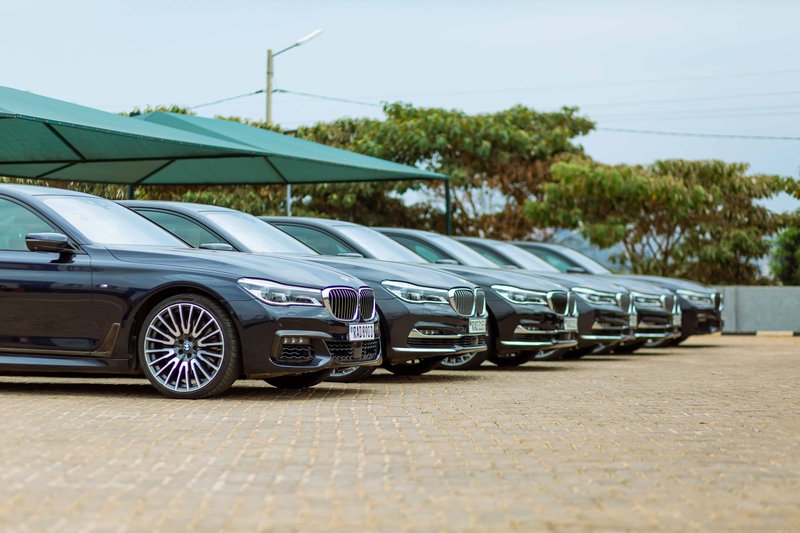
The 7 Series didn’t change much for 1998, and that’s the point — it was already BMW’s most technologically dense car, and with the 8 Series gone, it also became the brand’s undisputed flagship.
| Trim | Engine | Horsepower | 0–60 mph |
|---|---|---|---|
| 740i / 740iL | 4.4L V8 | 282 hp | ~6.8 sec |
| 750iL | 5.4L V12 | 322 hp | ~6.5 sec |
The 750iL’s V12 is the one people remember, but it’s also the one that scares off buyers today, and for good reason. Parts and labor costs for that engine run well above the V8 cars, and a neglected 750iL can turn into a five-figure repair bill fast. The 740i offers nearly all of the E38’s presence and comfort with a fraction of the ownership risk, which is why enthusiast forums steer first-time buyers toward it almost universally.
Both trims got a Sport Package option in 1998 as well, tightening the suspension without turning the car into something it was never meant to be — the E38 was built to waft, not corner hard, and buyers who wanted otherwise generally looked at the 5 Series instead.
Z3 Roadster and Coupe: The M Car Nobody Saw Coming
This is the section that makes 1998 matter. The standard Z3 had been around since 1996, competing against the Mazda Miata and Porsche Boxster with modest four- and six-cylinder power. It was fine. It wasn’t exciting.
Then BMW dropped the M Roadster into the range mid-1998, using the 3.2-liter S52 straight-six out of the M3 — 240 horsepower in a car that weighed roughly 400 pounds less than the sedan it borrowed the engine from.
| Trim | Engine | Horsepower | 0–60 mph |
|---|---|---|---|
| Z3 1.9 | 1.9L I4 | 138 hp | ~9.2 sec |
| Z3 2.8 | 2.8L I6 | 190 hp | ~6.8 sec |
| Z3 M Roadster | 3.2L I6 (S52) | 240 hp | ~5.4 sec |
By the end of 1998, the M Coupe joined the roadster — a shooting-brake-style hardtop built on the same platform, using the same engine, and immediately nicknamed the “clownshoe” for its polarizing rear end. The M Coupe ranks among the best coupes of its era, and fewer than 3,500 were built for the entire model run across all years, which is why unmodified examples now trade well above what the spec sheet alone would suggest.
The regular four-cylinder Z3 remains the least desirable of the bunch mechanically — it’s underpowered for the car’s weight and doesn’t reward the effort the way the six-cylinder cars do.
What Holds Value Today
Not every 1998 BMW aged the same way, and the split isn’t subtle.
The M cars — E36 M3 and both Z3 M variants — have appreciated steadily for a decade and show no sign of stopping, particularly the M Coupe given how few were built. The E39 540i Sport with a manual transmission sits in a similar category: a specific combination that was never common when new and is actively hunted now. On the other end, the 318ti and base four-cylinder Z3 are among the cheapest ways into a 1998 BMW badge, but they’re daily-driver buys, not future collectibles — mechanically sound, unremarkable to drive, and unlikely to move much in either direction.
The V12 750iL deserves a specific warning: buy one only with a full service history and a pre-purchase inspection from a shop that knows the M73 engine, because deferred maintenance on that car gets expensive in a hurry.
Across the board, the E36 and E39 platforms benefit from a simpler mechanical layout than what came after — fewer electronic systems to fail, and a larger pool of independent specialists who’ve worked on them for twenty-plus years. That’s less true of the E38 and its more elaborate electronics, which is worth factoring in regardless of which V8 or V12 trim you’re considering. For real-world fuel economy figures across these engines, the EPA’s historical ratings are a useful gut check before assuming a bigger engine costs proportionally more to run.
Buy the M3, the M Roadster, or the M Coupe for an investment. Buy the 328i, 528i, or 740i for a car you’ll actually enjoy owning without worrying about the resale spreadsheet. Either way, 1998 turns out to be a far more interesting year in BMW’s history than a spec directory lets on.

Marco Delantero
More from Marco DelanteroHow we reviewed this article
This article was researched against manufacturer records and editorially reviewed before publishing. We accept no payment for coverage. Some guides contain affiliate links; see our affiliate disclosure.