1987 was the year Ferrari turned 40, and Enzo Ferrari, then 89, signed off on one last car before he died. That car was the F40, and it would become the most worshipped Ferrari of its generation. But the F40 wasn’t the only thing rolling out of Maranello that year. The 1987 lineup was a snapshot of Ferrari mid-transition: pop-up headlights, sharp wedge profiles, and the last gasp of the analog supercar before electronics took over.
Here’s the full roster of Ferraris you could have bought new in 1987, what made each one matter, and what they fetch now that they’ve become some of the most collectible cars on the planet.
Table of Contents
- TLDR: The 1987 Ferrari lineup at a glance
- Ferrari F40
- Ferrari 328 GTB and GTS
- Ferrari Testarossa
- Ferrari Mondial 3.2
- Ferrari 412
- Which 1987 Ferrari should you actually buy?
TLDR: The 1987 Ferrari lineup at a glance
Five models, wildly different prices today:
| Model | Engine | Power | 0–60 mph | Top speed | Value today (good driver) |
|---|---|---|---|---|---|
| F40 | 2.9L twin-turbo V8 | 471 hp | 3.8 sec | 201 mph | $2.5M–$3.5M+ |
| 328 GTB/GTS | 3.2L V8 | 270 hp | 5.5 sec | 163 mph | $85k–$160k |
| Testarossa | 4.9L flat-12 | 380 hp | 5.2 sec | 180 mph | $130k–$200k |
| Mondial 3.2 | 3.2L V8 | 270 hp | 6.8 sec | 149 mph | $40k–$70k |
| 412 | 4.9L V12 | 340 hp | 6.7 sec | 155 mph | $50k–$90k |
If you want the icon and have the budget, it’s the F40. If you want the best Ferrari-per-dollar that still drives like a proper ’80s Ferrari, it’s the 328. The Mondial is the way in for people who want a prancing horse without a six-figure outlay.
Ferrari F40: the one everything else gets measured against
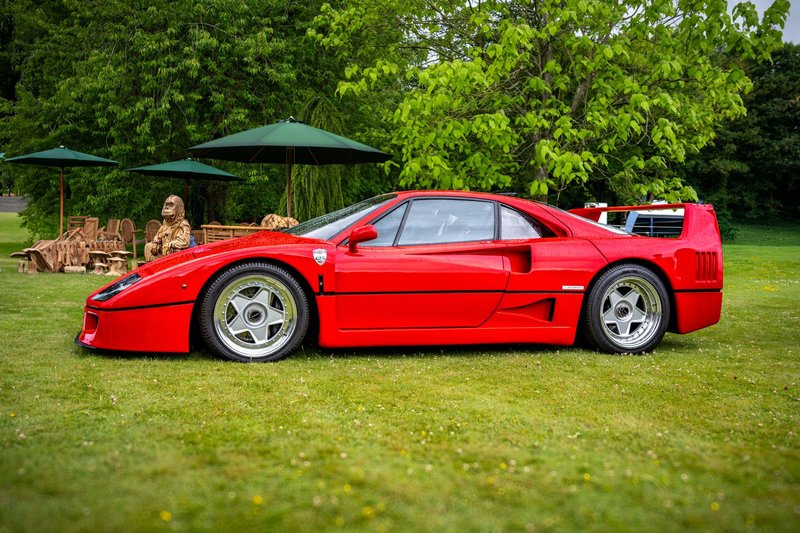
The F40 was built to celebrate Ferrari’s 40th anniversary, and it did something no road Ferrari had done before: it broke 200 mph. The official figure was 201 mph, which made it the fastest production car in the world when it launched.
The recipe was brutal by design. A 2.9-liter twin-turbocharged V8 making 471 horsepower, mounted in a tube-frame chassis wrapped in carbon fiber and Kevlar body panels. No ABS. No power steering. No power windows — early cars used a strap to pull the door shut. The interior was bare composite with cloth-pull door releases, because anything heavier was deleted.
It weighed roughly 2,400 pounds. That power-to-weight ratio is why the F40 still feels savage today, while plenty of newer, more powerful supercars feel insulated by comparison. The turbos arrive with a violence that modern engineers spend millions engineering out of their cars.
Ferrari planned to build 400. Demand was so absurd they made about 1,311 over the production run. Enzo Ferrari approved it personally, and it was the last car he signed off on before his death in 1988, which cemented its place as the spiritual end of an era. As Ferrari’s own history of the model notes on its corporate site, the F40 was conceived as a no-compromise tribute rather than a commercial product. Production carried over into the following year, so it also headlines the 1988 Ferrari lineup alongside the cars that would carry Maranello into the post-Enzo era.
Today a good F40 trades between $2.5 and $3.5 million, with low-mileage or significant-history cars pushing well past that. It’s the blue-chip Ferrari of the modern collector market.
Ferrari 328 GTB and GTS: the sweet-spot Ferrari
While the F40 grabbed the headlines, the 328 was the car that actually paid the bills. It was the evolution of the 308 — the wedge-shaped V8 Ferrari that, fairly or not, most people picture when they think “1980s Ferrari,” thanks in part to a certain Hawaiian-shirted TV detective.
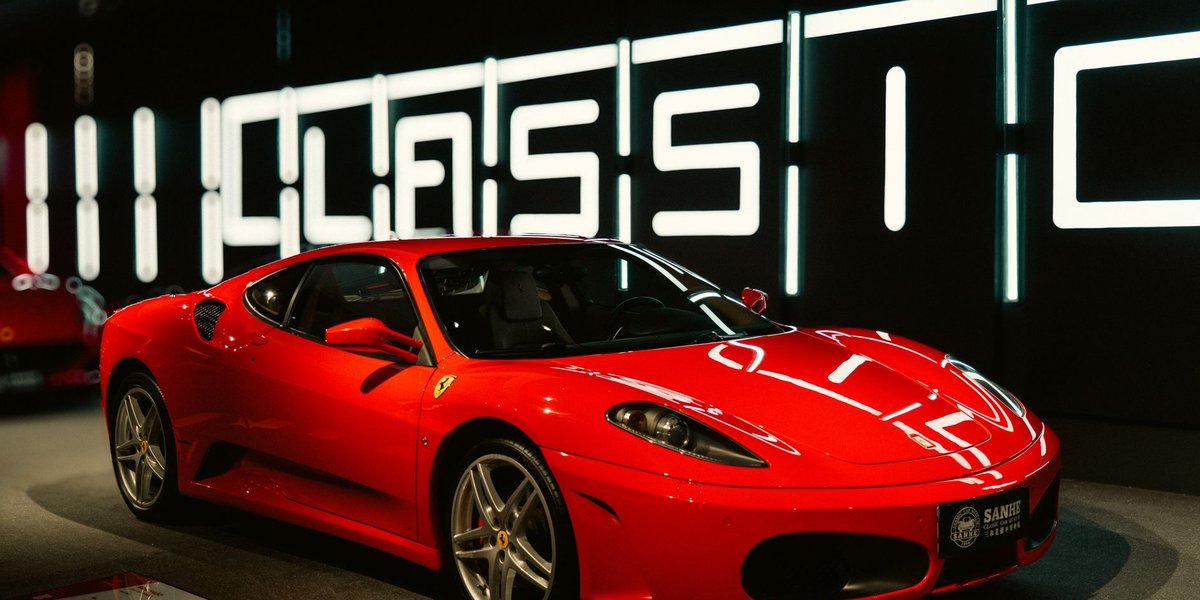
The 328 came in two flavors: the GTB with a fixed roof, and the more popular GTS with a removable targa top. Power came from a 3.2-liter V8 (hence “328” — 3.2 liters, 8 cylinders) making 270 horsepower, good for a 5.5-second sprint to 60 and a top speed of 163 mph.
What makes the 328 special is that it’s genuinely usable. The mechanicals are robust by Ferrari standards, parts are available, and it’s small and light enough to be a joy on a back road rather than an event you have to psych yourself up for. It has that perfectly weighted gated manual shifter and steering that talks to you — the analog Ferrari experience without the F40’s ransom or its terror. It’s also one of the cars that helps explain why the broader list of 1987 car models reads as a high point for driver-focused engineering across the industry, not just at Ferrari.
Values have climbed steadily. A clean 328 GTS sits in the $85,000 to $160,000 range depending on mileage, history, and whether it’s a later ABS car. The hardtop GTB is rarer and often commands a premium. For a lot of buyers, this is the most Ferrari you can get for the least pain.
Ferrari Testarossa: the poster on every bedroom wall
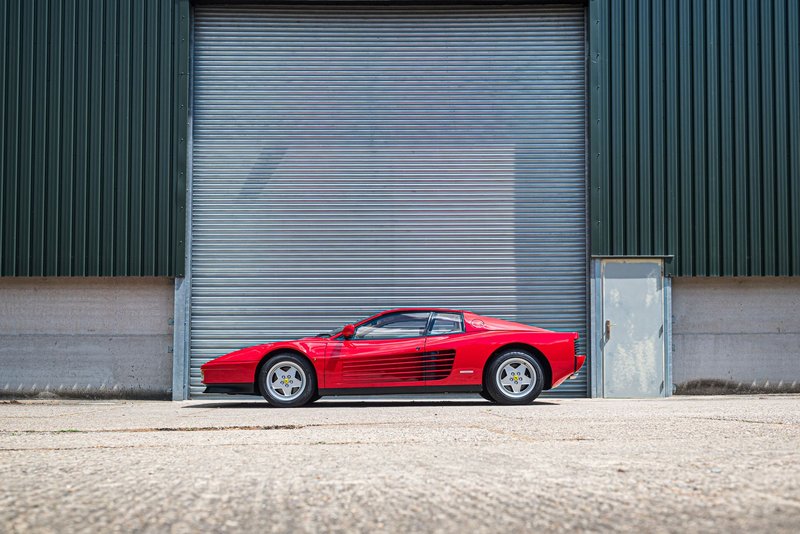
No car says “1980s excess” quite like the Testarossa. Those side strakes — the cheese-grater intakes running down the doors — weren’t just styling; they fed air to the radiators, which Ferrari moved to the rear to free up the cabin and improve weight distribution. They also made the car nearly six feet wide, which is part of why it looks so planted and so absurd at the same time.
Under that flat engine cover sits a 4.9-liter flat-12 making 380 horsepower. The “Testarossa” name — Italian for “redhead” — refers to the red-painted cam covers, a nod to Ferrari’s racing cars of the 1950s. It’ll do 180 mph and hit 60 in around 5.2 seconds, numbers that were genuinely exotic in 1987.
The Testarossa is a wide, planted, theatrical grand tourer rather than a knife-edge sports car. It’s happiest eating highway miles at speed, which suits its Miami Vice image perfectly. The flat-12 makes a glorious noise and the cabin, by Ferrari standards of the era, is almost civilized. It’s a defining entry in any roundup of 1980s sports cars, the one that fixed the decade’s idea of what an exotic should look like.
These were undervalued for years as “cheap exotic” cars, which means a lot of them got neglected — budget for a thorough pre-purchase inspection, because deferred maintenance on a flat-12 is expensive. A sorted Testarossa now runs $130,000 to $200,000, with the cleanest, lowest-mileage examples reaching higher.
Ferrari Mondial 3.2: the affordable way in
The Mondial is the Ferrari enthusiasts love to dunk on, and that reputation is exactly why it’s the smart buy for someone who wants a prancing horse on a real-world budget. The 1987 Mondial 3.2 used the same 3.2-liter V8 as the 328 — 270 horsepower — but wrapped it in a longer body with genuine 2+2 seating.
That extra length and weight cost it some sharpness. Zero to 60 takes about 6.8 seconds, slower than the 328 it shares an engine with. But the trade is practicality: you can actually put people (small ones) in the back, and it works as a car you could drive more than you baby.
For a long time the Mondial was the cheapest road into Ferrari ownership, and that’s still broadly true. A solid 3.2 coupe or cabriolet can be found in the $40,000 to $70,000 range. The catch is the same as any old Ferrari: the cheap purchase price means nothing if the timing belt service — which on these cars means dropping the engine — has been skipped. Buy on condition and service history, never on price alone.
Ferrari 412: the forgotten V12 grand tourer
The 412 is the model most people forget was even on sale in 1987, and that’s part of its quiet appeal. It was the final evolution of Ferrari’s long-running front-engined 2+2 line that started with the 365 GT4 back in the 1970s. The boxy, Pininfarina-designed three-box shape looks more like a luxury sedan than a supercar, which is exactly the point.
Under the hood sat a 4.9-liter V12 making 340 horsepower, driving the rear wheels through either a five-speed manual or — notably — an available automatic, a rarity for Ferrari at the time. It was a proper four-seat grand tourer built for crossing continents in comfort, with a top speed around 155 mph.
The 412 was also the first Ferrari offered with anti-lock brakes. It never had the glamour of its mid-engined siblings, which kept values low for decades and means survivors are scarce.
That obscurity is now its charm. A 412 offers a front-engined Ferrari V12 — a configuration that costs serious money in more celebrated models — for $50,000 to $90,000. It’s the connoisseur’s pick: the Ferrari nobody expects, with twelve cylinders and room for four.
Which 1987 Ferrari should you actually buy?
It comes down to budget and what you want out of the car.
If money is no object: The F40. It’s the headline, the investment, and one of the greatest driving experiences ever built. Just know it’s a car you’ll trailer more than you drive, both for value-preservation reasons and because it’s genuinely demanding.
If you want the best driver: The 328 GTB or GTS. It’s the most usable, most reliable, and most rewarding of the bunch to actually drive, and the gated manual is everything people romanticize about old Ferraris.
If you want presence and a soundtrack: The Testarossa. Nothing else here turns heads like it, and the flat-12 is a genuine event. Buy the best-maintained one you can find, not the cheapest.
If you want in for the least money: The Mondial 3.2. Same heart as the 328, real back seats, and the lowest entry price of any 1987 Ferrari. The enthusiast snobbery toward it works in your favor.
If you want something nobody else has: The 412. A front-engined V12 Ferrari for the price of a nice 328, and you’ll be the only person at the meet who brought one.
Across all of them, the rule is the same: a Ferrari is only cheap until the first service. The classic-car market has tracked these cars climbing steadily for years, and the gap between a properly maintained example and a neglected one is far wider than any difference in mileage or color. Buy the history, not the headline.

Marco Delantero
More from Marco DelanteroHow we reviewed this article
This article was researched against manufacturer records and editorially reviewed before publishing. We accept no payment for coverage.