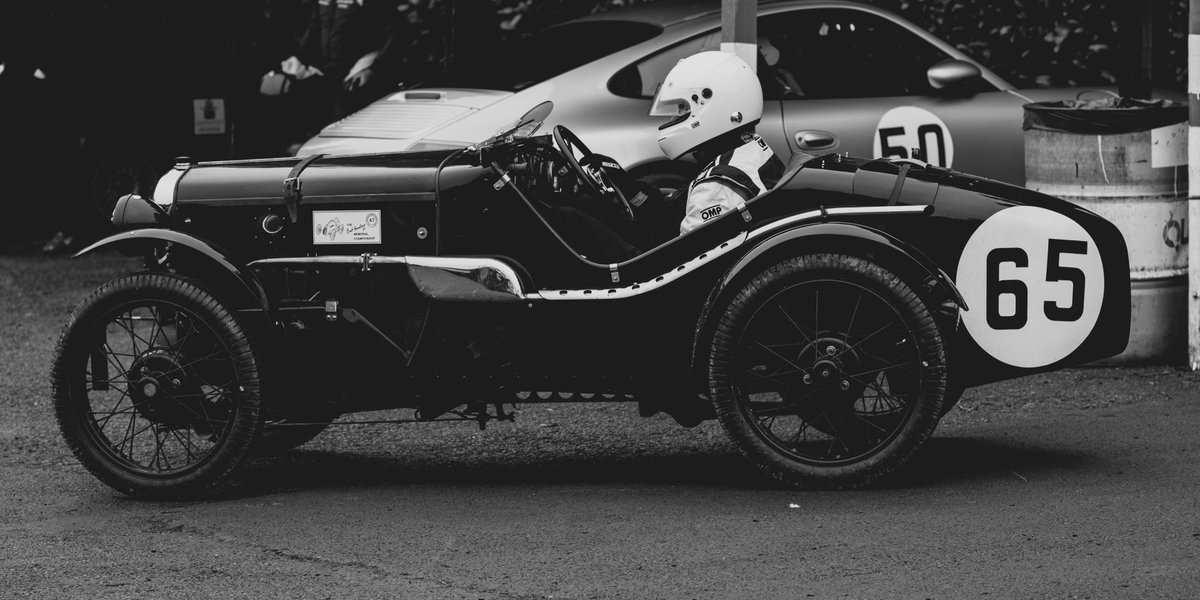
The story of Ferrari doesn’t begin with a prancing horse badge. It begins with a man who’d just been fired — or rather, forced out — and was prohibited by contract from using his own name on a car for two years.
That’s how the Auto Avio Costruzioni 815 came to exist in 1940. Not yet a Ferrari. But unmistakably the beginning of one.
Table of Contents
- Before Ferrari Was Ferrari
- The Auto Avio Costruzioni 815 (1940)
- The War Years: A Forced Pause
- The Ferrari Name Arrives: 125 S (1947)
- 125 S to 159 S: Iterating Fast
- The 166 MM: Where Ferrari Became Ferrari
- 1940s Ferrari Models at a Glance
Before Ferrari Was Ferrari
Enzo Ferrari spent more than a decade at Alfa Romeo — first as a racing driver, then running the Scuderia Ferrari racing team under the Alfa banner. By the late 1930s, the relationship had soured. Alfa Romeo wanted direct control of their racing program. Enzo wanted independence.
The split came in 1939. Enzo signed a settlement that let him leave but forbade him from competing under the Ferrari name or building racing cars for four years. He immediately set up a new company — Auto Avio Costruzioni (AAC) — ostensibly to make machine tools. Everyone knew what it was really for.
Within months, he was building cars.
The Auto Avio Costruzioni 815 (1940)
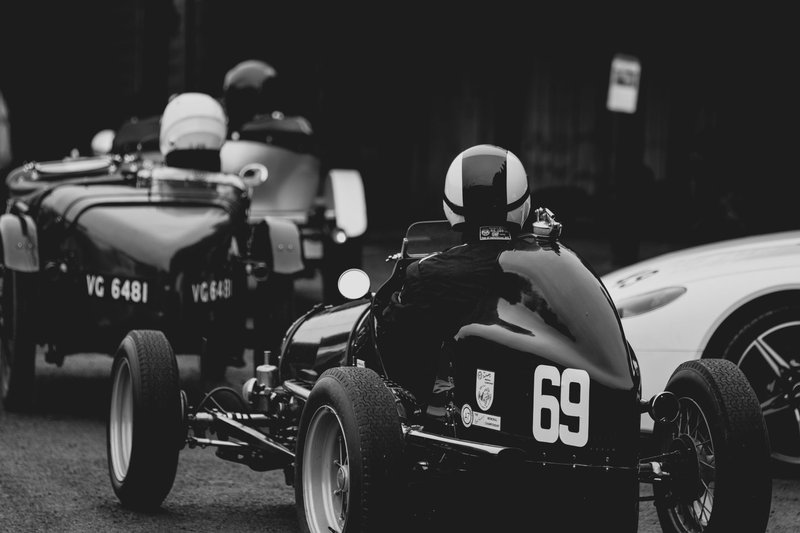
The 815 is Ferrari’s true first car, even if the lawyers said otherwise. Built in just a few months in early 1940, it was commissioned by two wealthy young Italians — Alberto Ascari’s cousin Lotario Rangoni and Enrico Nardi — for the 1940 Mille Miglia.
The name “815” comes from the engine: eight cylinders, 1.5 liters. Enzo sourced the cylinder block from Fiat’s 1100 parts bin and had his engineers create a twin-cam eight-cylinder by grafting two four-cylinder units together on a common crankshaft. It was exactly the kind of resourceful, make-it-work engineering that would define Ferrari for decades.
Key specs:
- Engine: 1,496 cc inline-eight, DOHC
- Power: approximately 72–75 hp
- Body: aerodynamic aluminum coachwork by Carrozzeria Touring
- Top speed: around 170 km/h (105 mph)
Two cars were built. Both entered the 1940 Mille Miglia — which ran as a closed-road race on a triangular circuit between Brescia, Cremona, and Mantua, since the traditional route couldn’t be used wartime. Both led their class at various points. Both retired with mechanical failures before the finish.
It was a debut that previewed almost everything about Ferrari’s future: beautiful cars, fast cars, and a frustrating habit of not quite finishing the race. The 815 also stands as one of the most remarkable 1940s sports cars to emerge from a decade that produced so few of them — a decade defined more by war than by racing.
The War Years: A Forced Pause
After 1940, production stopped entirely. Italy entered World War II in June of that year, and by 1943 the AAC factory in Modena had been bombed twice. Enzo moved operations to Maranello — a small town south of Modena — where the company would remain permanently.
The non-compete clause had also expired. Ferrari could now build cars under his own name. He just had to wait for the war to end.
The Ferrari Name Arrives: 125 S (1947)
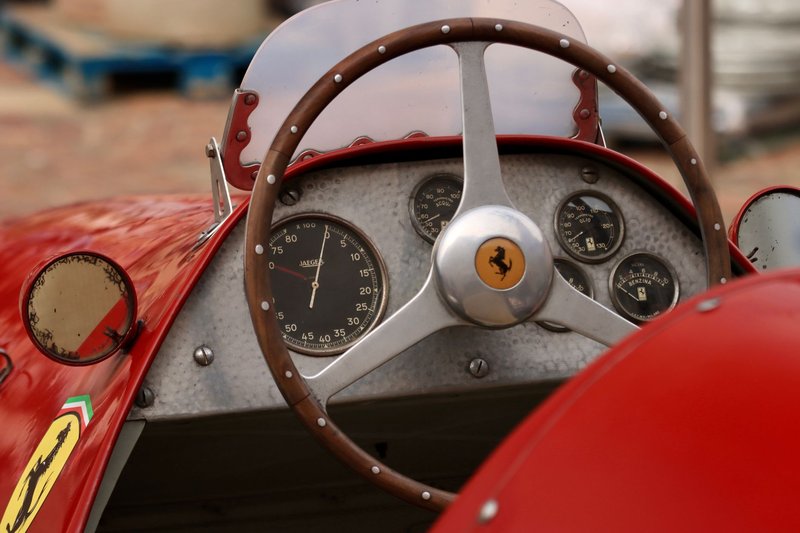
On March 12, 1947, a car bearing the Ferrari name ran under its own power for the first time. The 125 S was a genuine racing car — not a modified production chassis — and it introduced the engine architecture that would define Ferrari for the next half-century.
Gioacchino Colombo, a gifted engineer who’d worked at Alfa Romeo, designed a 1,497 cc V12. Not a makeshift twin-four like the 815 — a purpose-built V12, with a 60-degree bank angle, single overhead camshaft per bank, and a single carburetor producing around 118 hp. Light, compact, and free-revving.
Key specs:
- Engine: 1,497 cc V12, SOHC, single carburetor
- Power: ~118 hp
- Chassis: tubular steel ladder frame
- Body: open two-seat barchetta
The 125 S made its racing debut at Piacenza on May 11, 1947. Franco Cortese drove. He led convincingly until the fuel pump failed with two laps to go.
Two weeks later, at Rome’s Caracalla circuit, Cortese won. Ferrari’s first victory, fewer than three months after the first test run.
125 S to 159 S: Iterating Fast
Ferrari didn’t sit still. Later in 1947 and through 1948, the same basic car evolved rapidly. The 159 S arrived with a bored-out 1,902 cc version of the Colombo V12, pushing power closer to 125 hp. Ferrari also experimented with twin-carburetor setups on both the 125 and 159 variants.
These weren’t entirely new cars — think of them as the same chassis and basic architecture with updated engines, tuned for specific races and circuits. Ferrari’s approach in these years was essentially continuous iteration: race, break, understand why, fix it, race again. The result was a engineering culture that improved remarkably fast.
Raymond Sommer drove a 125 S at the 1947 Mille Miglia, becoming one of the first non-Italian drivers to campaign the car competitively. The 166 that followed owed everything to what those early races revealed.
The 166 MM: Where Ferrari Became Ferrari
The 166 MM — MM for Mille Miglia — is arguably the car that established Ferrari as a name to be taken seriously worldwide.
Introduced in 1948, the 166 used a further developed Colombo V12 at 1,995 cc and produced around 140 hp in its twin-carburetor Mille Miglia specification. Bodies varied by purpose: the open barchetta for racing, the more civilized Touring-bodied berlinetta for road use. Pininfarina also bodied early examples — the beginning of a partnership that lasted decades.
Key specs:
- Engine: 1,995 cc V12, SOHC, twin carburetors
- Power: ~140 hp (Mille Miglia spec)
- Weight: approximately 700 kg
- Notable body styles: barchetta, berlinetta, spyder corsa
The 166 MM won the 1948 Targa Florio and the 1949 Mille Miglia. It also won the 1949 24 Hours of Le Mans — Ferrari’s first Le Mans victory, just two years after the company’s first win anywhere. Luigi Chinetti drove the majority of the race virtually solo, handing the wheel to co-driver Lord Selsdon for only a handful of laps.
That Le Mans victory put Ferrari on the world map in a way that Italian race wins couldn’t. Chinetti immediately began importing Ferraris to the United States. The American market that would eventually sustain the company through its most difficult years started right there.
1940s Ferrari Models at a Glance
| Model | Year | Engine | Power | Notable Result |
|---|---|---|---|---|
| Auto Avio Costruzioni 815 | 1940 | 1.5L inline-8 | ~72 hp | DNF, 1940 Mille Miglia (x2) |
| Ferrari 125 S | 1947 | 1.5L V12 | ~118 hp | First Ferrari win, Rome 1947 |
| Ferrari 159 S | 1947–48 | 1.9L V12 | ~125 hp | Multiple Italian race victories |
| Ferrari 166 S / MM | 1948–53 | 2.0L V12 | ~140 hp | 1949 Le Mans, 1949 Mille Miglia |
The thread connecting all of these cars is thinner than it looks. The 815 was built under a different name by a company that officially made machine tools. The 125 and 159 were barely distinguishable variants of the same design. The 166 MM was the 159 with more displacement and better bodywork.
What they share is Enzo’s conviction that the fastest way to learn was to race, and the fastest way to improve was to race again. Every one of those early DNFs was data. Every win validated a decision made on a workbench in Maranello by engineers who were figuring it out in real time.
That’s how Ferrari went from a contractually-nameless prototype to a Le Mans winner in nine years. Not with a master plan — with iteration, obsession, and a willingness to race before they were ready.
Marco Delantero
More from Marco DelanteroHow we reviewed this article
This article was researched against manufacturer records and editorially reviewed before publishing. We accept no payment for coverage. Some guides contain affiliate links; see our affiliate disclosure.