In 1959 Honda was not yet the company that would bury the British motorcycle industry. But it was already building the bikes that would do it. This was the year Honda opened American Honda Motor Co. in Los Angeles and started shipping machines that confused everyone — electric starters, overhead cams, and oil-tight engines on bikes a college kid could afford.
The trouble is, nobody has assembled the 1959 lineup in one place. The marketplace listings give you a model name and a price and nothing else. The history articles bury 1959 inside a twenty-year timeline. So here’s the actual roster: every Honda model you could buy in 1959, what made each one matter, and what they go for now.
Contents
- TLDR: The 1959 Honda Lineup at a Glance
- The 250cc and 305cc Dream Twins (C72 / C76)
- The 125cc Benly (C92 and CB92)
- The Super Cub C100
- The Sports and Racing Variants (CE71 / CB71)
- Spec Comparison Table
- What These Bikes Are Worth Today
- Buying a 1959 Honda: What to Check
TLDR: The 1959 Honda Lineup at a Glance
If you just want the shortlist of 1959 Honda motorcycle models and don’t need the backstory:
- Honda C72 Dream (250cc) — the OHC parallel twin that launched Honda into European export. The collector’s choice for ride-and-keep.
- Honda C76 Dream (305cc) — the bigger-bore Dream aimed at the American market. Rarer, torquier, pricier.
- Honda C92 Benly (125cc) — pressed-steel-frame OHC twin, the practical commuter. Sweet engine, undervalued.
- Honda CB92 Benly Super Sport (125cc) — the hopped-up, tubular-frame sports version. The one everyone actually wants.
- Honda Super Cub C100 (50cc) — the step-through that became the best-selling vehicle in history. 1959 is the US launch year.
The CB92 is the enthusiast’s trophy. The C72 Dream is the most rewarding bike to actually own and ride. The Super Cub is the historically important one — and the only one you can still find cheap.
The 250cc and 305cc Dream Twins (C72 / C76)
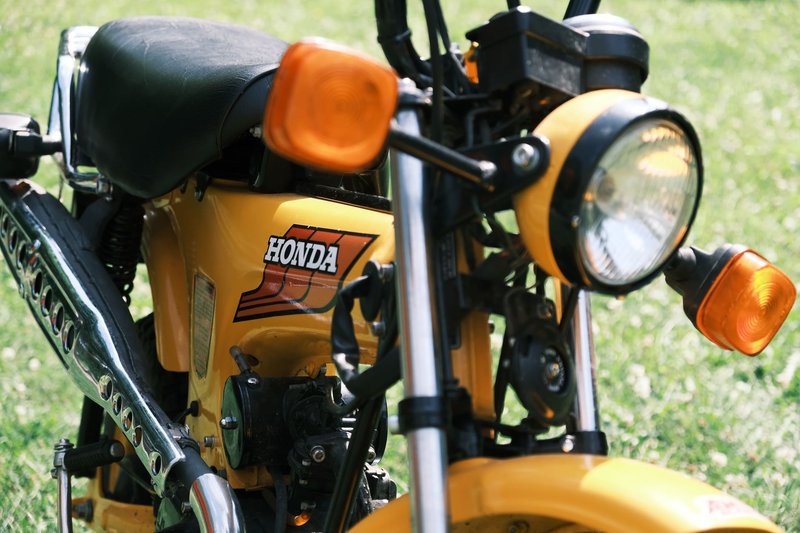
The Dream is where Honda planted its flag. The 1959 C72 ran a 247cc overhead-cam parallel twin — and “overhead cam” is the whole story. While Triumph and BSA were still pushing rods up to operate the valves — and most of the rest of the 1959 motorcycle field was doing the same — Honda put the camshaft on top of the head and spun the engine to redlines those British twins could only dream about. It made a modest 18-odd horsepower, but it made it cleanly, quietly, and without leaving a puddle on the garage floor.
The chassis is the part that throws people. The C72 uses a pressed-steel frame and a leading-link front fork instead of telescopic forks — it looks more like a scooter’s skeleton than a “real” motorcycle to Western eyes. That was deliberate. Honda was building for riders who wanted reliability and weather protection, not café-racer cred. A 12-volt electrical system and an electric starter sealed the deal. In 1959, an electric start on a 250 was close to science fiction.
The C76 is the same bike bored out to 305cc, built largely with the American buyer in mind, where bigger displacement sold better. It’s noticeably less common than the 250, partly because the 305 designation would soon shift to the more famous CA-series and CB72/CB77 sports bikes that defined Honda’s early-60s US image. If you find a genuine 1959 C76, you’ve found something the marketplace listings rarely have in stock.
One naming note that trips up buyers: Honda used the C71/C76 codes for the earlier 6-volt versions and the C72/C77 codes for the updated 12-volt versions. The Wikipedia entry on the Honda C71, C72, C76, C77 Dream is the cleanest reference for sorting out which code maps to which year and electrical spec, because vintage dealers get it wrong constantly.
The 125cc Benly (C92 and CB92)
If the Dream was Honda’s flagship, the Benly was its proof that the OHC-twin formula scaled down. The 1959 C92 packed a 124cc overhead-cam twin into the same pressed-steel philosophy as the Dream — leading-link fork, electric start, 12-volt electrics. For a 125 in 1959, a twin-cylinder engine was almost absurd; most bikes that size were single-cylinder two-strokes that buzzed and smoked. The Benly hummed.
Then there’s the one collectors actually chase: the CB92 Benly Super Sport. Honda took the 125 twin, gave it a hotter cam and higher compression, dropped it into a tubular steel frame (no more pressed steel), added a real telescopic-ish setup and a humpback tank, and turned a commuter into a giant-killer. The CB92 would rev past 10,000 rpm and embarrass much larger bikes on the right road. It became a club-racing weapon, and surviving examples — especially with the optional racing kit — are now among the most valuable small-displacement Hondas on earth.
The catch for buyers: CB92 parts are a different world from C92 parts. The sports model shares the engine architecture but little of the cycle parts, so a “Benly” listing tells you almost nothing until you confirm the exact model code. Plenty of sellers list a humble C92 with CB92 pricing optimism.
The Super Cub C100
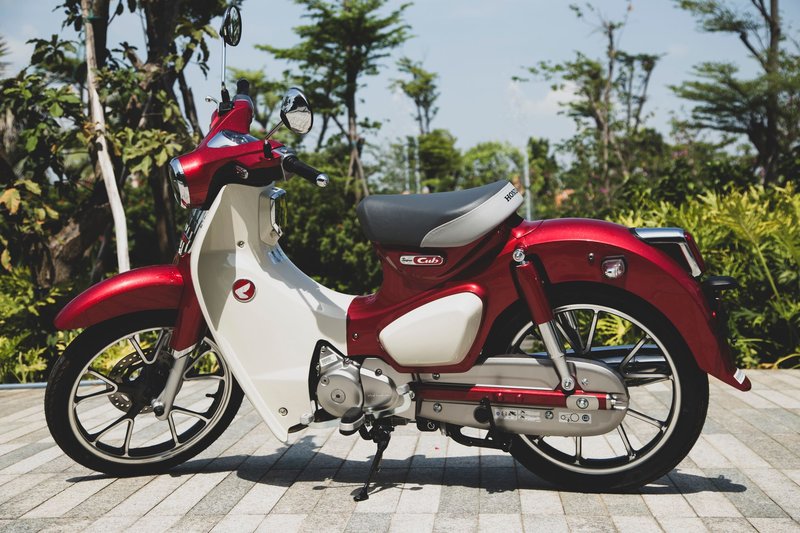
The Super Cub C100 is the most important motorcycle Honda has ever made, and in 1959 most Americans had never seen one. Launched in Japan in 1958, it arrived in the US in 1959 as American Honda opened its doors — and it rewrote the rules. A 49cc overhead-valve four-stroke single, a step-through frame so anyone in any clothing could ride it, an automatic clutch, and famous reliability. No oil leaks, no kickback, no grease under your fingernails.
This is the bike behind the “You Meet the Nicest People on a Honda” campaign that detonated a couple of years later, and it’s the reason Honda outsold every established brand in America by the early 60s — going on to anchor a decade that produced some of the best motorcycles of the 1960s. The Super Cub went on to become the best-selling motor vehicle in history, with production passing 100 million units decades later. The 1959 US-market examples are genuinely historic — the opening shot of Honda’s American invasion.
They’re also, paradoxically, the most attainable 1959 Honda. Because Honda built them by the millions, a Super Cub doesn’t carry the rarity premium of a Dream or a CB92. That makes a clean early C100 the smart entry point if you want a real 1959 Honda without remortgaging anything.
The Sports and Racing Variants (CE71 / CB71)
Beyond the mainstream catalog, 1959 sits at the tail end of Honda’s first sports experiments. The CB71 and CE71 were sportier, higher-output spins on the Dream twin platform — the “Dream Sport” idea that pointed directly toward the legendary CB72 and CB77 Super Hawks of 1960–61, part of the wave of new machines that made 1961 a turning point for the whole industry. These early sports variants were built in tiny numbers, and a verified survivor is museum-grade rather than ride-it-to-work grade.
Treat any CB71/CE71 listing with both excitement and suspicion. The real ones exist, but the model codes are obscure enough that misidentification — innocent or otherwise — is common. Documentation and frame/engine number matching matter more here than on any other 1959 Honda.
Spec Comparison Table
| Model | Displacement | Engine | Notable features | Role |
|---|---|---|---|---|
| Super Cub C100 | 49cc | OHV single, 4-stroke | Step-through, auto clutch | Commuter / US launch icon |
| C92 Benly | 124cc | OHC parallel twin | Pressed-steel frame, electric start | Compact commuter |
| CB92 Benly Super Sport | 124cc | OHC parallel twin (tuned) | Tubular frame, high-rpm | Sports / club racer |
| C72 Dream | 247cc | OHC parallel twin | 12V, electric start, leading-link fork | Flagship tourer |
| C76 Dream | 305cc | OHC parallel twin | 12V, US-oriented | Big-bore flagship |
| CB71 / CE71 | 247cc | OHC twin (sport) | Higher output, rare | Early sports / racing |
Specs reflect the 1959-spec versions; output figures varied through the production run.
What These Bikes Are Worth Today
Vintage Honda values have climbed steadily as the first-generation collectors who remember these bikes new have aged into buyers with money. Ranges below are broad on purpose — condition, originality, and documentation swing the number more than the model does. Listing aggregators like Classic.com track real sale prices if you want to sanity-check a specific model before you buy.
- Super Cub C100 — the affordable one. Tidy running examples often land in the low-to-mid four figures; rough but complete project bikes can be cheap. The best buy for a first vintage Honda.
- C92 Benly — undervalued relative to its engineering. Clean examples sit in the mid four figures, and they’re genuinely underappreciated.
- C72 / C76 Dream — solid, sorted Dreams typically run from the mid four figures into five figures for show-quality 305s with full documentation.
- CB92 Benly Super Sport — the blue chip. Verified, original CB92s — especially with the race kit — reach well into five figures and have set serious auction results.
- CB71 / CE71 — effectively price-on-application. So few exist that each sale is its own data point.
The pattern is consistent: rarity and sportiness drive value, not displacement. A 125cc CB92 routinely outsells a 305cc Dream because it’s far rarer and far more exciting.
Buying a 1959 Honda: What to Check
Sourcing a 1959 Honda is more about verification than negotiation. A few things that separate a good buy from a regret:
Confirm the model code, not just the name. “Benly” and “Dream” each cover multiple models and electrical generations. The frame and engine numbers tell the truth; the seller’s listing often doesn’t. A C92 wearing CB92 ambitions is the classic trap.
Check the electrics and the starter. The 12-volt system and electric start were Honda’s headline features, and they’re also the parts most likely to have been butchered by sixty years of well-meaning owners. Original, functioning electrics add real value.
Parts availability varies wildly by model. Super Cub and Dream consumables are reproduced and findable. CB92 and the sports variants are a specialist’s hunt — budget for slow, expensive sourcing before you commit to a restoration. Specialist vintage-Honda parts vendors exist, but the deeper into the rare models you go, the longer you’ll wait for the small stuff.
Originality beats shine. A bike with its correct leading-link fork, matching numbers, and honest patina is worth more to a serious collector than a glossy respray hiding the wrong parts.
The 1959 lineup is where Honda stopped being a curiosity and started being a threat. Six core models, three distinct ideas — the practical Super Cub, the clever Benly twins, and the flagship Dreams — and inside two years they’d reset what the rest of the world expected a motorcycle to be. Buy any one of them and you’re holding the opening chapter of that story.

Marco Delantero
More from Marco DelanteroHow we reviewed this article
This article was researched against manufacturer records and editorially reviewed before publishing. We accept no payment for coverage. Some guides contain affiliate links; see our affiliate disclosure.