Bentley sold three models in the 1970s: the T-series saloon (badged T1 until 1977 and T2 after), and the Corniche coupe and convertible, launched in 1971. That’s the whole catalog. Lists that show a fourth Bentley, the Camargue, have it wrong, and we’ll get to why below.
All three ran the same 6.75-litre Rolls-Royce V8, and all three were close cousins of a Rolls-Royce. Bentley’s decade was less about new models than about surviving a bankruptcy.
Contents
- The 1970s Bentley lineup at a glance
- Bentley T1 (1965-1977)
- Bentley Corniche (1971 onward)
- Bentley T2 (1977-1980)
- What about the Camargue?
- Bentley vs Rolls-Royce: what actually differed
- Why dates conflict between sources
- Buying a 1970s Bentley
- Summary
The 1970s Bentley lineup at a glance
| Model | Years on sale in the 1970s | Body styles | Engine | Rolls-Royce twin |
|---|---|---|---|---|
| Bentley T1 | 1970-1977 (built from 1965) | Four-door saloon, long-wheelbase from 1969 | 6,750 cc V8 (enlarged from 6,230 cc in 1970) | Silver Shadow |
| Bentley Corniche | 1971 onward (built to 1984) | Two-door coupe and convertible | 6,750 cc V8 | Rolls-Royce Corniche |
| Bentley T2 | 1977-1980 | Four-door saloon | 6,750 cc V8 | Silver Shadow II |
Bentley T1 (1965-1977)
The T-series was Bentley’s first unibody car. It arrived in 1965 as the Bentley version of the Rolls-Royce Silver Shadow, and for most of the 1970s it was the only Bentley most buyers could walk into a showroom and order. The name “T1” only appeared later, once the T2 existed and the older car needed a label to separate it.
The big mechanical change came in 1970, when the V8 grew from 6,230 cc to 6,750 cc. The extra displacement gave the heavy saloon more low-speed torque, which is the thing this car does best. Rolls-Royce never published a horsepower figure, preferring the word “adequate”.
A long-wheelbase version, with an extra four inches in the rear, came in 1969. Cars with the stretched cabin are the better choice if you plan to sit in the back.
The T1 also carried the Citroën-derived high-pressure hydraulic system that powered the brakes and the self-leveling rear suspension. It gives a ride that floats over bad road surfaces. It’s also the thing a good specialist will ask about first when you inspect one.
Bentley Corniche (1971 onward)
The Corniche was the glamorous one. Introduced in 1971, it replaced the two-door Mulliner Park Ward coupe and convertible built on the T-series platform, and it carried the same 6.75-litre V8 as the saloon. Coachwork came from Mulliner Park Ward in London, so each car was largely hand-finished.
Bentley-badged Corniches were rare. Most buyers wanting a two-door chose the Rolls-Royce version, so the Bentley variants sold in the low hundreds in the decade, and that scarcity is the reason they command a premium now. The convertible is the one collectors chase. Check the hood mechanism and the sills before you fall for the paint.
The Corniche stayed in production until 1984, which is why you’ll see it listed in the 1980s too. Only its first nine years belong here.
Bentley T2 (1977-1980)
The T2 arrived in 1977 as the first thorough update of the Shadow platform. The body looks nearly the same, but the changes underneath were substantial:
- Rack-and-pinion steering, replacing the older recirculating-ball set-up. The car feels noticeably more direct.
- Revised suspension geometry to improve handling.
- Updated air conditioning with a split-level system, so you could heat and cool different parts of the cabin.
- Rubber-faced bumpers and a front air dam, which replaced the chrome bumpers of the earlier car.
Production ended in 1980, when the T2 was replaced by the Mulsanne. Fewer than a thousand were built. Because the T2 is the most developed version of the platform, it’s usually the one buyers choose when they want a daily-usable 1970s Bentley, as long as they can accept the bumpers.
What about the Camargue?
Search for “Bentley Camargue” and you’ll find plenty of pages that list it as a Bentley. It wasn’t. The Camargue, a Pininfarina-styled two-door that launched in 1975, was sold only as a Rolls-Royce. Rolls-Royce marketed it as the most expensive production car in the world at the time.
If a dealer listing calls one a “Bentley Camargue,” treat that listing with suspicion. It’s either an error or a sign the seller doesn’t know the car.
Bentley vs Rolls-Royce: what actually differed
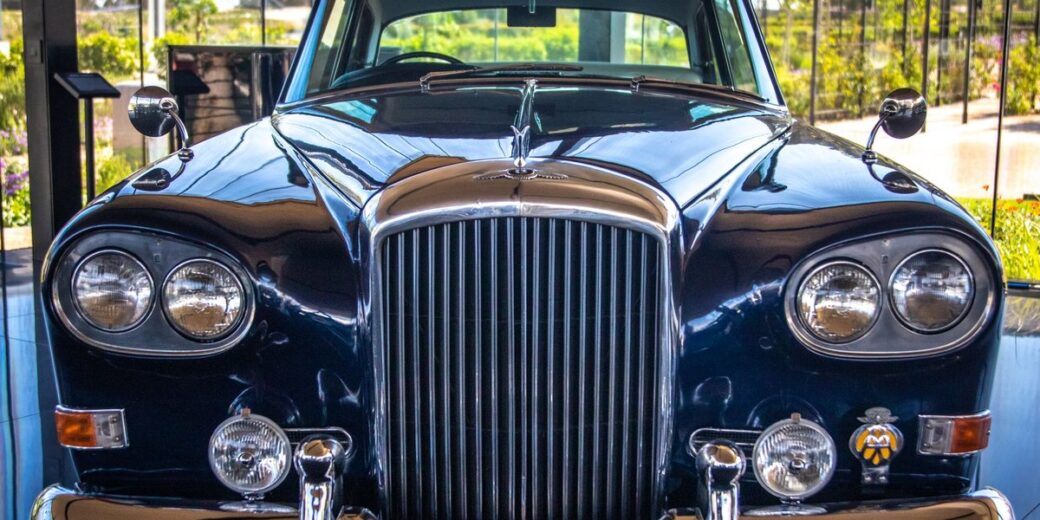
Short answer: not much. The Bentley T-series and the Rolls-Royce Silver Shadow shared the same body shell, engine, gearbox and suspension. The differences were cosmetic:
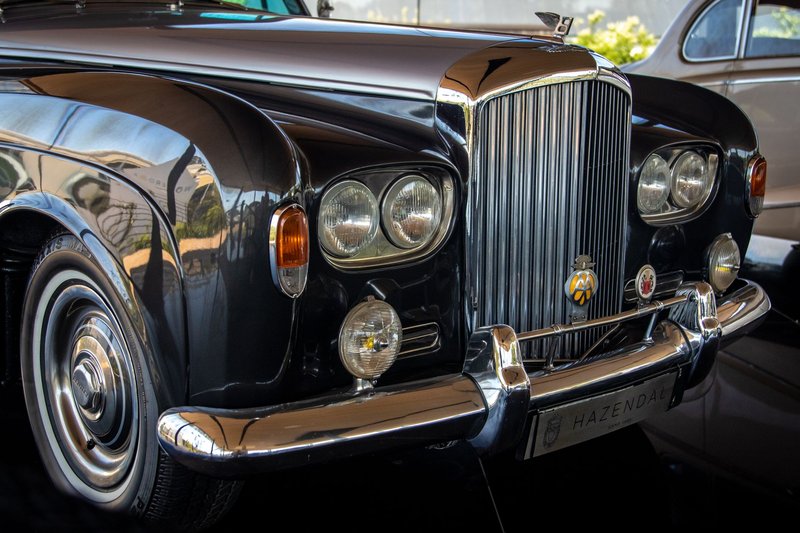
- Grille. Rolls-Royce used the upright Parthenon grille. Bentley used a lower, wider one with a winged “B” mascot.
- Badges. The wheel centers, hub caps and boot lid all carried different emblems.
- Price. The Bentley was slightly cheaper than the equivalent Rolls-Royce.
That similarity cost Bentley. In the 1970s Rolls-Royce outsold Bentley by a wide margin, and the badge became the thing buyers paid extra for. Today that has flipped in places: a Bentley is often the rarer car, and in some markets it now trades at a premium. For how these two marques sit among the other British makers of the period, see UK Car Brands: The Complete List.
Why dates conflict between sources
If you’ve compared lists, you’ve seen the problem. One source gives the T-series as 1965-1977, another as 1965-1980. Both are right:
- 1965-1977 covers the T1 only.
- 1965-1980 covers the T-series as a whole, including the T2 (1977-1980).
The Corniche has its own wrinkle. Some lists file it under the 1980s because production ended in 1984, but it launched in 1971. We’ve used launch dates for the table above.
Buying a 1970s Bentley
These cars are cheap to buy and expensive to fix. A T1 saloon in average condition can cost less than a new hatchback. A Corniche convertible in good order costs several times as much. A T2 sits between the two. Price ranges swing with condition and market, so check recent auction results before you trust any single figure.
What to check, in order:
- Hydraulics. Leaking accumulators, spheres and lines are the classic problem. A full overhaul is costly, and a car that has been sitting is the likeliest to need one.
- Rust. The unibody rots in the sills, the wheel arches, the floor, and around the rear screen. Surface rust on the paint is cosmetic. Rot in the structure is not.
- Service history. An engine that has been neglected will have a short life. Look for regular oil changes and proof of cooling system work.
- Cracked dashboards and tired leather. Fixable, but trimming a Bentley is not cheap.
- Provenance. Chassis numbers and build records tell you whether the car is really the model the seller claims.
Budget for running costs. Parts are available through specialists, but labor is the real expense, and a car that looks like a bargain on the purchase price often isn’t. If you’re weighing a Bentley against other British classics with similar running costs, Top 15 Classic British Cars is a useful starting point.
Summary
Bentley built three models in the 1970s: the T1, the Corniche, and the T2. The T1 covers the decade’s first seven years, the Corniche added a two-door option from 1971, and the T2 closed the era in 1977 with better steering, rubber bumpers and improved air conditioning. The Camargue is a Rolls-Royce only.
If you want the most usable one, pick a T2. If you want the rarest, find a Corniche convertible. If you want the cheapest way into the badge, a T1 saloon with a documented hydraulic overhaul is the sensible place to start.

Daniela Voss
More from Daniela VossHow we reviewed this article
This article was researched against manufacturer records and editorially reviewed before publishing. We accept no payment for coverage. Some guides contain affiliate links; see our affiliate disclosure.