Table of Contents
- BMW’s Postwar Restart: The R24
- The R25 Family: BMW’s Actual Bread and Butter
- The R51 and R67 Twins: Built for the Sidecar
- The R68: BMW’s First Real Flagship
- 1955: The Earles Fork Changes the Whole Lineup
- BMW’s Sidecar Racing Comeback
- 1950s BMW Motorcycles Compared
- Buying and Collecting 1950s BMWs Today
- What the Decade Actually Built
Wikipedia’s list of 1950s BMW models gives you sixteen names and not much else. Bikez.com gives you spec sheets. Neither tells you that the bike sitting at the top of most of those lists — the R68 — was so rare that BMW built fewer of them than most owners’ clubs have members. Or that the “boring” 250 next to it outsold everything else in the catalog combined, by a wide margin, for most of the decade.
Here’s the lineup in order, with the numbers that actually explain why each model mattered.
BMW’s Postwar Restart: The R24
BMW didn’t build a single motorcycle for three years after the war. The Potsdam Agreement between the Allied powers barred German manufacturers from motorcycle production entirely, and BMW’s Munich plant had been reduced to producing pots and pans and bicycle parts to stay solvent. When the restriction lifted, the company didn’t have the resources to design something new — so it didn’t. The R24, unveiled at the 1948 Geneva show, was essentially the prewar R23 with a four-speed gearbox bolted where a three-speed used to sit.
That conservatism was the right call. A 247cc single putting out 12 hp at 5,600 rpm, good for 95 km/h (59 mph) and weighing just 130 kg wet, wasn’t going to impress anyone on paper. But it was buildable with the tooling and steel Germany actually had in 1948, and BMW sold 12,020 of them before replacing it in 1950. The R24 wasn’t a statement. It was a company proving it could still make a motorcycle at all.
The R25 Family: BMW’s Actual Bread and Butter
If you only know BMW’s 1950s lineup by reputation, you know the R68. If you know it by sales figures, you know the R25 family — the R25, R25/2, and finally the R25/3 that ran from 1953 to 1956.
The R25/3 is the one worth understanding, because it explains BMW’s whole postwar strategy. It kept the 247cc single but added a hydraulically damped telescopic fork, full-width hub brakes, and 18-inch wheels — real upgrades, not cosmetic ones. BMW sold 47,700 of them, making it the best-selling model in the company’s history up to that point, a record it held into the 1990s. For years, the factory was reportedly building two 250s for every big twin that rolled off the line. The R68 got the magazine covers. The R25/3 paid the bills.
That’s the part the catalog listings never explain: BMW’s 1950s comeback wasn’t led by a halo bike. It was led by a cheap, reliable single that a mechanic, a postman, or a farmer could actually afford, at a moment when most of West Germany was still rebuilding from rubble.
The R51 and R67 Twins: Built for the Sidecar
Above the singles sat BMW’s flat-twins, and here the company again leaned on prewar engineering rather than starting fresh. The R51/2, reintroduced in 1950, was close to a direct carryover of the prewar R51 design. Its 1951 successor, the R51/3, kept the 494cc boxer twin and 24 hp output but modernized the running gear.
Parallel to the 500s ran the 594cc R67 line — R67, R67/2, and R67/3 — introduced in 1951 and built through 1956. These bigger twins made around 26 hp at 5,500 rpm and topped out near 145 km/h, but raw speed was never the point. The R67 was built to pull a sidecar, which was still a common family vehicle in a country where most households couldn’t afford a car. Combined production across the R67 variants ran to roughly 1,470 units — a fraction of the R25/3’s numbers, which tells you how much smaller the market for a big twin-with-sidecar actually was next to basic transportation.
The R68: BMW’s First Real Flagship
The R68, built from 1952 to 1954, was BMW’s answer to a question nobody in the domestic market was really asking: what if we built the fastest production motorcycle we could, sidecar be damned? It shared the R67’s 594cc OHV boxer bottom end but ran higher compression (8.0:1), bigger 26mm Bing carburetors, and a racing-derived magneto, pushing output to 35 hp at 7,000 rpm — enough for a genuine 169 km/h (105 mph), a claim few production bikes of any nationality could match in 1952.
BMW built exactly 1,452 of them. That scarcity wasn’t a marketing trick — the R68 was expensive to produce and expensive to buy, and it landed in a market still recovering economically. It’s also why the R68 anchors most serious collections today: it’s the one 1950s BMW that was genuinely engineered to be the best thing the company made, not the most affordable.
1955: The Earles Fork Changes the Whole Lineup
At the 1955 Brussels Motor Show, BMW replaced its entire twin-cylinder range in one move: the R50 (490cc, 26 hp), R60 (600cc, 28 hp), and R69 (600cc, 35 hp) all arrived with a new frame and, more importantly, a completely different front end. Gone was the telescopic fork every earlier BMW twin had used. In its place sat a leading-link Earles fork, paired with a swinging-arm rear end running dual hydraulic shocks instead of the old plunger suspension.
The fork was patented by Englishman Ernest Earles — GB patent 693,646, filed in December 1951 — and it behaves almost backward from a telescopic fork: the front end rises under hard braking instead of diving. That trait, plus a pivot point set well aft of the front wheel for rigidity, made it far better suited to sidecar use, which is exactly why BMW had already proven the design on its factory racers before putting it on customer bikes. From 1955 until 1969, every BMW twin used some version of it, even though the vast majority were sold as solo machines that never saw a sidecar.
The R69, the sportiest of the three, is generally the one collectors chase hardest today — it carried the same displacement as the R60 but with a compression bump and better breathing that closed most of the performance gap to the outgoing R68, in a bike that was actually still in production.
BMW’s Sidecar Racing Comeback
The R68’s engineering wasn’t just a road-going flex — it fed directly into BMW’s return to international racing, and that comeback landed almost entirely in the sidecar class. On September 12, 1954, Wilhelm Noll and passenger Fritz Cron crossed the line first at the Italian Grand Prix in Monza aboard a fully faired BMW outfit, giving BMW its first World Sidecar Championship and Germany its first world title in the class since before the war. Noll and Cron settled for runner-up in 1955, then took the title back in 1956 before retiring from competition.
That 1954 win opened a run that’s easy to undersell if you only know BMW as a road-bike company: by 1974, BMW sidecars had collected 19 riders’ world championships and 20 manufacturers’ titles. The Earles fork’s rigidity and sidecar manners, tested on the R68 platform and refined for the 1955 range, were a big part of why.
1950s BMW Motorcycles Compared
| Model | Years | Engine | Power | Top Speed | Units Built |
|---|---|---|---|---|---|
| R24 | 1948–1950 | 247cc single | 12 hp | 95 km/h (59 mph) | 12,020 |
| R25/3 | 1953–1956 | 247cc single | ~13 hp | ~100 km/h (62 mph) | 47,700 |
| R51/3 | 1951–1954 | 494cc flat-twin | 24 hp | ~130 km/h (81 mph) | Not separately published |
| R67 line | 1951–1956 | 594cc flat-twin | ~26 hp | 145 km/h (90 mph) | ~1,470 (combined) |
| R68 | 1952–1954 | 594cc flat-twin | 35 hp | 169 km/h (105 mph) | 1,452 |
| R50 | 1955–1960 | 490cc flat-twin | 26 hp | ~140 km/h (87 mph) | Not separately published |
| R60 | 1955–1960 | 600cc flat-twin | 28 hp | ~145 km/h (90 mph) | Not separately published |
| R69 | 1955–1960 | 600cc flat-twin | 35 hp | ~160 km/h (99 mph) | Not separately published |
The gap between the R25/3’s 47,700 units and the R68’s 1,452 is the whole story of BMW’s 1950s in one comparison: one model kept the factory open, the other kept the brand aspirational.
Buying and Collecting 1950s BMWs Today
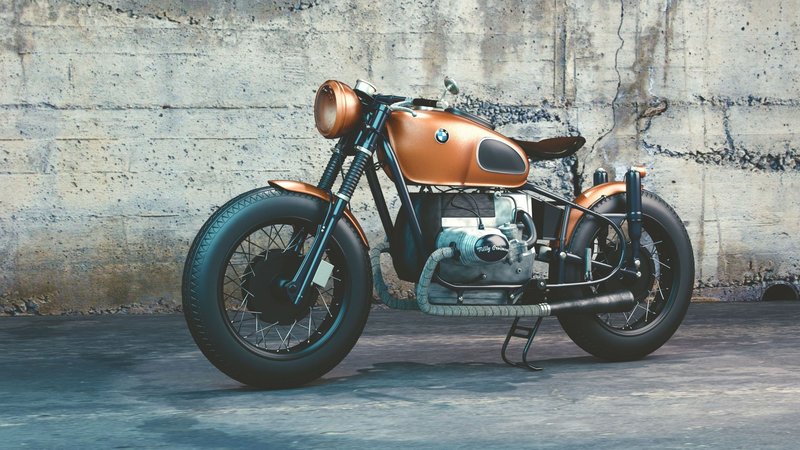
Condition and originality move these bikes’ values more than almost any other factor, and the spread proves it. R68s alone have changed hands anywhere from around $22,000 for a rougher, incomplete example up to $52,800 for a well-documented, numbers-matching machine at a US auction in recent years. That’s not a small range — it’s the difference between a bike with its original engine and frame numbers matching the factory ledger and one that’s been rebuilt with mismatched or replacement parts somewhere along the way.
A few things matter more than usual when you’re evaluating one of these:
- Matching numbers. BMW stamped frame and engine numbers that specialist archives and owners’ clubs can still cross-reference. A R68 or R25/3 with mismatched numbers is a different (cheaper) proposition than an original pairing, even if it runs identically.
- Shaft drive is a restoration advantage, not a liability. Unlike chain-drive rivals from the same era, these boxers don’t have a drive chain to source, stretch, or replace — the shaft final drive that BMW carried over from prewar design is one less wear item to chase parts for.
- Earles-fork bikes (R50/R60/R69) are mechanically simpler to source parts for than the earlier telescopic-fork R51/R67/R68 line, since the later design stayed in production through 1969 and shares components with later /2-series bikes.
- Magnetos and Bing carburetors are the usual failure points. Both are original-equipment on most of these models and both have healthy specialist rebuild markets, but budget for it before you budget for paint.
None of this makes a 1950s BMW a casual restoration project. It makes it a manageable one, provided you know which numbers on the bike need to match which numbers on paper before you agree on a price.
What the Decade Actually Built
Strip away the model names and the 1950s BMW story is a company using two different strategies at once: sell an enormous volume of an affordable single to fund the operation, and build a small run of an expensive flagship to prove what the operation was capable of. The R25/3 and the R68 sat at opposite ends of that plan, and both succeeded — one by outselling everything else in Germany, the other by being rare enough that finding one today still means something.
The Earles fork that arrived in 1955 wasn’t a styling update. It was racing technology, proven in sidecar competition, pushed down into the consumer lineup a year before Noll and Cron’s first world title made the connection obvious. That’s the throughline the spec-sheet databases miss: every 1950s BMW motorcycle, from the humble R24 to the R69, was one company rebuilding itself from a pots-and-pans factory into a racing name, one model at a time.
Sarah Thornton
More from Sarah ThorntonHow we reviewed this article
This article was researched against manufacturer records and editorially reviewed before publishing. We accept no payment for coverage. Some guides contain affiliate links; see our affiliate disclosure.