TLDR
- 1945 was a changeover year, not a model year. Almost every “1945 car” was a prewar design, restarted after V-J Day.
- In the US, Ford restarted first (July 1945). The cars were sold as 1946 models, mostly warmed-over 1942 designs.
- In Britain, the Austin, Morris, Ford, Standard, Vauxhall and Rootes lines came back, plus the all-new Armstrong Siddeley Lancaster.
- In Europe, the big 1945 story was the Volkswagen Type 1 at Wolfsburg, under British Army control.
- The Willys CJ-2A, the first civilian Jeep, went into production in July 1945.
Table of Contents
- Why 1945 is a strange year for cars
- United States: 1946 models announced in 1945
- United Kingdom: prewar designs back in the showroom
- Europe: the Beetle and the Traction Avant
- The Jeep goes civilian
- 1945 car models: quick-reference table
- Buying or restoring a 1945-era car
- FAQ
Why 1945 is a strange year for cars
Search for 1945 car models and you’ll mostly get pages about 1946. That isn’t a mistake. The industry had no real 1945 model year.
US carmakers stopped civilian production in early February 1942, when the government ceased manufacture and sale of civilian vehicles and rationed what was left on dealer lots. Detroit spent the next three and a half years building tanks, aircraft engines and Jeeps. Nobody was designing next year’s grille.
When the war ended, the quickest route back to the showroom was to dust off the 1941 and 1942 tooling. So the cars that appeared from the summer of 1945 are prewar designs with new trim, announced as 1946 models. Britain, France, Italy and Germany did the same, with less steel, less fuel and, in Germany’s case, a military government deciding what got built.
That makes 1945 a short list. It’s also a more interesting one than the year-by-year pages suggest.
United States: 1946 models announced in 1945
American civilian production restarted in the second half of 1945, in stages. Plants had to be unbolted from war work and retooled, and material allocations came from the War Production Board.
Ford went first. The first postwar Ford came off the line on July 3, 1945, a 1946 model with the flathead V8 (around 100 hp) or the 226 cubic inch six. Henry Ford II took over as company president that September, which is part of why Ford’s postwar story is so different from its prewar one.
Chevrolet followed in the autumn with the 1946 Stylemaster and Fleetmaster. Under the hood was the familiar 216.5 cubic inch overhead-valve six, nicknamed the Stovebolt. The bodies were mildly freshened 1942 Chevrolets.
Packard brought back the Clipper, a 1941 design that had been modern in its day and still looked it. It came with a straight-six or a straight-eight.
Studebaker restarted the Champion, a light, economical six built on a 1939 design. It was one of the few cars that sold on thrift rather than glamour.
Cadillac returned with the Series 62, powered by a 346 cubic inch flathead V8, again on prewar bodies.
Entire new makes were also forming. Kaiser-Frazer was set up in 1945 but didn’t deliver cars until 1946, and the Tucker 48 came later still. If a page tells you either one is a “1945 car,” it’s wrong.
United Kingdom: prewar designs back in the showroom
Britain emerged from the war with its factories largely intact and its economy exhausted. Petrol stayed rationed for private motorists until 1950, and the government pushed makers to export. A British buyer in 1945 could want a new car all they liked. They were lucky to get one.
What the factories made were small, cheap, prewar cars:
- Austin restarted the Eight and Ten (along with larger Twelve and Sixteen models). These were the bread-and-butter family cars of the late 1930s, with side-valve engines and upright bodies.
- Morris brought back the Eight (Series E, 918 cc) and the Ten (Series M, 1,140 cc), both launched in 1938.
- Ford of Britain restarted the Anglia (933 cc) and Prefect (1,172 cc). Both were tiny side-valve cars designed before the war, and both would stay in production until the end of the decade.
- Standard built the Fourteen from 1945 to 1948, a 1.8-litre four-door saloon. Around 22,000 were made, which makes it a useful marker of what an ordinary British family could buy at the time.
- Rootes Group revived Hillman, Humber and Singer models, including the Hillman Minx and the Humber Hawk.
Two names are worth singling out. First, Armstrong Siddeley announced the Lancaster in 1945, one of the few genuinely new British designs that year. The firm was part of the Hawker Siddeley group, which also owned Avro, and named its cars after aircraft: the Lancaster, the Hurricane and later the Typhoon.
Second, Jaguar. In March 1945, SS Cars Ltd renamed itself Jaguar Cars Ltd, dropping the SS initials for obvious reasons. The first cars to carry the new name, the 2½ Litre saloons, were still prewar designs, but the badge is the one every Jaguar enthusiast knows.
Europe: the Beetle and the Traction Avant
Continental production in 1945 ran on whatever survived. Many plants were bombed, dismantled or sat in the wrong occupation zone.
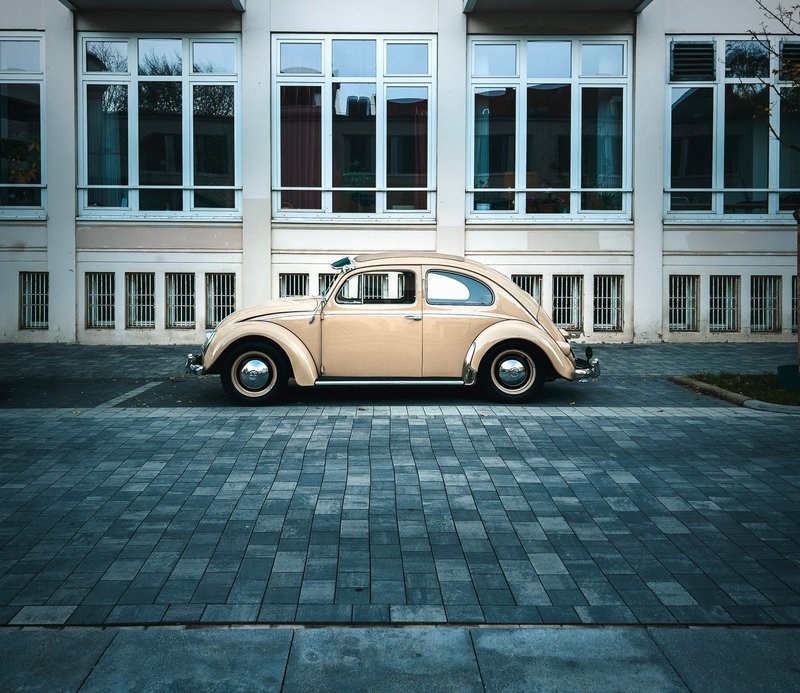
Volkswagen is the standout. The Wolfsburg factory sat in the British zone and survived the war in usable condition. Under British military control, Major Ivan Hirst got the plant making civilian-style Type 1 cars for the occupying forces. Volkswagen began turning out Beetles again in December 1945, using the prewar design with a roughly 1.1-litre air-cooled flat-four. Numbers for 1945 were tiny, a few dozen cars. The plant had a real chance of being scrapped as war reparations, and building cars for the British Army helped save it.
Citroën restarted the Traction Avant, the front-wheel-drive saloon that had debuted in 1934 and was ahead of its time even then. Its monocoque body and front-wheel drive set it apart from almost everything else on the road in 1945.
Fiat brought back the 500 “Topolino” in its 500 B form, a 569 cc car and one of the smallest practical cars of the era.
Other French and Italian firms were already working on the cars that would define 1946 and 1947, such as the Renault 4CV, which was developed in secret during the occupation and launched in 1946.
The Jeep goes civilian
The single most significant vehicle launched in 1945 isn’t a car in the traditional sense. Willys-Overland and Ford had built more than half a million military Jeeps during the war, and Willys saw an obvious opportunity in the peace.
The Willys CJ-2A, short for Civilian Jeep, went into production on July 17, 1945. It was close to the military MB, with a few changes aimed at farmers and tradesmen: a tailgate, an outside-mounted fuel filler, a side-mounted spare tire, a drawbar, and larger headlights. The engine was the same 134 cubic inch four-cylinder “Go Devil” rated around 60 hp.
It sold in the hundreds of thousands over its four-year run, and it created a vehicle category (the small, civilian four-wheel-drive utility vehicle) that Jeep still sells today.
Ford’s GPW, the Ford-built version of the military Jeep, ended production in 1945. Examples regularly show up at auction as “1945 Ford GPW” lots, which is why that search term sits next to 1945 car models.
1945 car models: quick-reference table
Dates here refer to when production restarted or began in 1945. Where a car went on sale as a 1946 model, that is noted.
| Make | Model | Engine | Body styles | Notes |
|---|---|---|---|---|
| Ford (US) | Super De Luxe / De Luxe | 239 cu in flathead V8; 226 cu in six | Coupe, sedan, convertible, station wagon | First US postwar car, July 1945; sold as 1946 model |
| Chevrolet | Stylemaster / Fleetmaster | 216.5 cu in OHV six | Coupe, sedan, convertible | Restarted autumn 1945; 1942 body, updated trim |
| Packard | Clipper | Six or eight, straight-cylinder | Sedan, club sedan | 1941 design restarted for 1946 |
| Studebaker | Champion | Side-valve six | Coupe, sedan | 1939 design, economy focus |
| Cadillac | Series 62 | 346 cu in V8 | Coupe, sedan, convertible | Prewar design, 1946 model |
| Willys | CJ-2A | 134 cu in four, about 60 hp | Open utility | First civilian Jeep; production from July 17, 1945 |
| Austin | Eight / Ten | Side-valve four | Saloon | Prewar family cars restarted |
| Morris | Eight (Series E) / Ten (Series M) | 918 cc / 1,140 cc side-valve four | Saloon | Launched 1938, back in production |
| Ford (UK) | Anglia / Prefect | 933 cc / 1,172 cc side-valve four | Saloon | Prewar designs |
| Standard | Fourteen | 1.8-litre four | Saloon | Built 1945-1948, about 22,000 made |
| Armstrong Siddeley | Lancaster | Six-cylinder | Saloon | New for 1945; named after the bomber |
| Volkswagen | Type 1 | About 1.1-litre air-cooled flat-four | Saloon | British-run Wolfsburg; series production from December 1945 |
| Citroën | Traction Avant | About 1.9-litre four (11CV) | Saloon | Front-wheel drive, 1934 design |
| Fiat | 500 B Topolino | 569 cc four | Two-seater saloon | Smallest car on this list |
Buying or restoring a 1945-era car
If you’re hunting for a “1945” car, expect to land on a 1946 model that was built in late 1945 or one of the British prewar cars. A few things to keep in mind.
Check the build date, not the model year. US cars built in late 1945 are titled as 1946 models. A “1945 Ford” listing is usually a GPW Jeep or a mislabeled 1946 car.
Expect compromises. Postwar quality was uneven. Materials were short, paint and chrome were substandard, and some cars shipped with painted trim where chrome had been before the war. Originality is worth a lot to collectors, so don’t automatically strip those details.
Parts availability varies widely. Ford flathead V8s, Chevrolet sixes and the Jeep’s Go Devil engine have strong aftermarket support. A Standard Fourteen or an Armstrong Siddeley Lancaster means talking to a marque club.
Rust is the real enemy. Cars from this period used thin, low-quality steel and were often driven hard through a period when maintenance was a luxury.
FAQ
Were any new cars made in 1945? Yes, but not many and mostly late in the year. The US restarted in July, with Ford first. British and European production resumed in stages through the second half of 1945.
Why are there so few new 1945 models? Because production was devoted to war work until the summer of 1945, and carmakers had no development time for new designs. They went back to their last prewar cars.
Is a 1945 Willys CJ-2A really a car? It’s a vehicle, and it counts as the first mass-produced civilian four-wheel-drive. Production began July 17, 1945.
Which 1945 car was the most important? The Volkswagen Type 1. It started on a very small scale, but it became the best-selling car of its era.
What replaced these cars? By 1947 and 1948, genuinely new designs arrived. In the US, Studebaker’s 1947 models and the Tucker 48 broke the prewar mold. In Europe, the Renault 4CV, Citroën 2CV and Standard Vanguard followed.

Marco Delantero
More from Marco DelanteroHow we reviewed this article
This article was researched against manufacturer records and editorially reviewed before publishing. We accept no payment for coverage. Some guides contain affiliate links; see our affiliate disclosure.