In 1945, Japan’s occupation government had banned domestic passenger car production outright. By 1959, Toyota was selling a Japanese-built sedan in American showrooms and had a four-wheel-drive truck climbing Mount Fuji for the cameras. That’s not gradual growth — that’s a company rebuilding itself from a truck-parts manufacturer into a genuine car company inside a single decade, model by model, engine by engine.
Most write-ups on this era cover one nameplate at a time — a deep dive on the Crown here, a Corona retrospective there — because that’s how the source material (mostly Wikipedia and Toyota’s own archives) is organized. None of them put the whole lineup next to each other. Here’s every model Toyota built or introduced during the 1950s, what made each one matter, and the specs that back it up.
Table of Contents
- The Car That Made the Decade Possible: Toyopet SA
- Toyopet Crown (1955)
- Toyota Corona (1957)
- Land Cruiser BJ (1951–1954)
- Toyota Stout (1954)
- Toyota Toyoace (1954/1956)
- Toyota Dyna (1956)
- How This Adds Up
Quick Rundown
If you just want the lineup: the Toyopet Crown (1955) was Japan’s first mass-produced passenger car and Toyota’s first US export. The Corona (1957) was the value-priced sedan sitting just below it. The Land Cruiser started life as the BJ prototype in 1951 and got its permanent name in 1954. The Stout, Toyoace, and Dyna rounded out the commercial side — pickup and light-truck bodies built to move a rebuilding country’s goods before its people had much money to spend on cars.
The Car That Made the Decade Possible: Toyopet SA
Technically, the SA predates the decade — it launched in October 1947. It belongs on this list anyway, because every 1950s Toyota traces its engineering DNA back to it.
Kiichiro Toyoda started developing the SA while the passenger-car ban was still in effect, betting that Occupation authorities would eventually lift it. He was right: according to Toyota’s own corporate history archive, GHQ began issuing limited production permits just six months after Toyota finished the prototype. The result was a genuinely odd-looking car for 1947 — a teardrop-shaped, aerodynamic body on a backbone frame, with independent suspension on all four wheels and a column-mounted gearshift, features that were advanced even by contemporary European standards. It was also the first Japanese car with a factory-installed radio.
Engine: 995 cc inline-four, side-valve (Type S) Output: 27 hp Production: October 1947 onward; only 215 units built in the run
Toyota didn’t sell many SAs — production caps under the Occupation kept output tiny — but the platform’s thinking (compact four-cylinder engines, independent front suspension, a focus on ride quality over brute size) is the throughline connecting it to the Crown, the Corona, and everything else on this list.
Toyopet Crown (1955)
The Crown is the model that actually kicks off Toyota’s decade. Production started January 1, 1955, and it was the first passenger car Toyota engineered entirely for Japanese roads and Japanese buyers, rather than adapting a foreign design.
Chief engineer Kenya Nakamura built the suspension around Japan’s poor road conditions specifically: independent double wishbones with coil springs up front, paired with three semi-elliptic leaf springs at the rear — a setup meant to survive potholed, half-paved streets rather than a smooth test track. That attention to local conditions is exactly the kind of decision a foreign-designed car wouldn’t have made.
Engine: 1.5-liter inline-four, OHV Output: 47 hp at 4,000 rpm Transmission: 3-speed manual Production start: January 1955
The Crown’s bigger significance came in 1958, when Toyota brought it to the United States as its first American export. Toyota’s own account of the launch notes the American press nicknamed it the “baby Cadillac” — not for its size, but for the amount of chrome trim and the standard equipment list, which included a radio, a heater, and whitewall tires at a time when those were still upsells on domestic cars. It sold poorly against underpowered American highway driving, but the point wasn’t the sales figures. It was the first time a Japanese-built car sat on a US dealer lot at all.
Toyota Corona (1957)
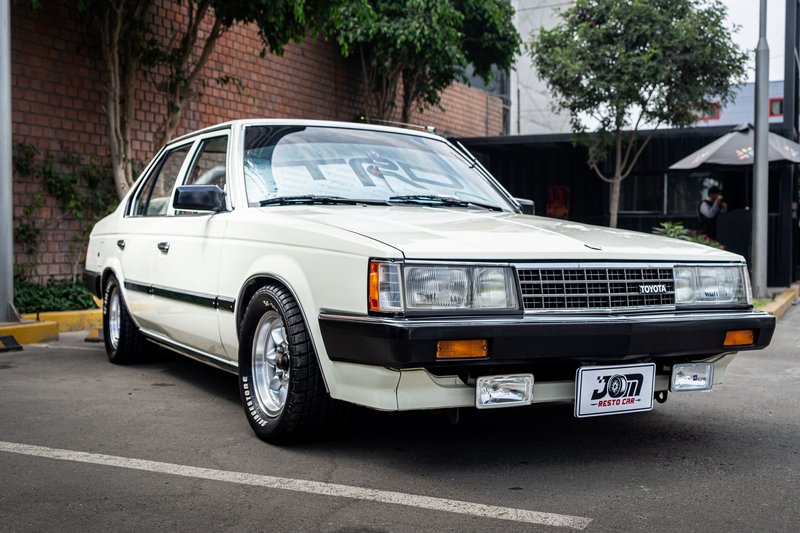
The Corona launched July 1, 1957, as the model that sat just below the Crown — Toyota’s second-tier passenger car, built to reach buyers who couldn’t stretch to the flagship. Toyota developed it with help from Kanto Auto Works, reusing the Crown’s chassis and drivetrain along with doors borrowed from the older Toyopet Master. It was also Toyota’s first passenger car with a monocoque body rather than a separate frame, a structural shift that would define nearly every mainstream sedan that followed it.
Engine: 995 cc inline-four, side-valve (Type S) Output: 33 hp at 4,500 rpm Dimensions: 3,912 mm long, 1,471 mm wide, 1,519 mm tall Curb weight: 960 kg
The naming convention tells you how methodical Toyota’s model system already was by 1957: “S” for the Type S engine, “T” for the body type, “10” marking it as the standard first-generation sedan. Toyota gave the Corona a light facelift in April 1958 — new bonnet ornament, new door handles — and added a three-door van variant, the Coronaline, in October 1958. A minor mechanical update in October 1959 swapped in the newer Type P engine, a 997 cc OHV unit making 45 PS, ahead of the bigger second-generation redesign that would follow in the 1960s.
Land Cruiser BJ (1951–1954)
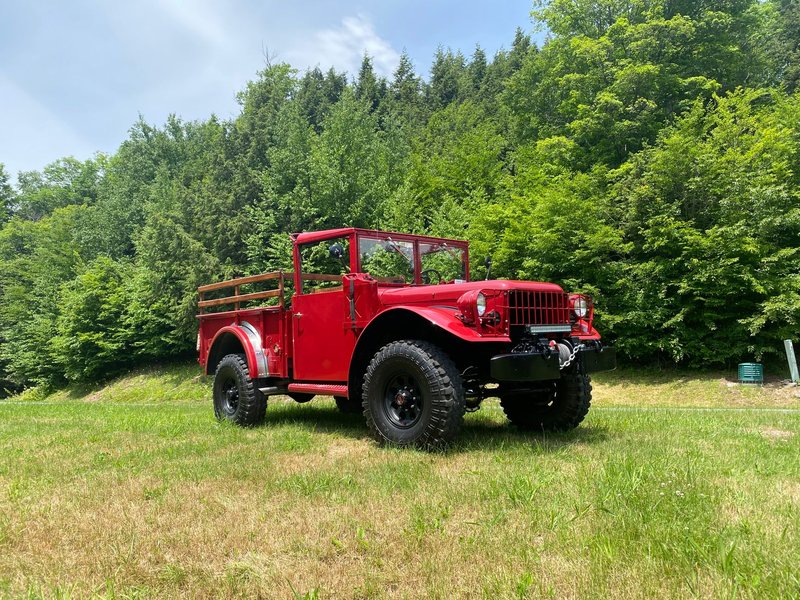
The vehicle that eventually became the Land Cruiser started as a military request, not a consumer product. Japan’s National Police Reserve — the precursor to the modern Self-Defense Forces — asked for a rugged, locally built four-wheel-drive vehicle, and Toyota answered with the BJ prototype in January 1951.
The BJ earned its reputation the hard way. In July 1951, Toyota test driver Ichiro Taira drove a BJ prototype up to the sixth stage of Mount Fuji — the first vehicle ever to reach that altitude on the mountain, and a stunt Toyota clearly staged to prove the truck could do what a Jeep could. It worked. Toyota moved the BJ from made-to-order production into full mass production in 1954, and that’s the same year it received the name it’s still sold under today: Land Cruiser.
Engine: 3.4-liter inline-six Output: 75 hp Drivetrain: Part-time four-wheel drive
The Land Cruiser followed the Crown to America in 1958 — and according to Toyota’s US newsroom, the company sold exactly one unit in the US that first year. It wasn’t a fast start. But the truck’s reputation for surviving conditions that killed other vehicles built momentum through the early 1960s, and by 1961 it was Toyota’s best-selling model in the American market, a position it held through 1965.
Toyota Stout (1954)
Toyota’s first real attempt at a pickup truck launched in April 1954—a landmark year for Toyota’s model expansion—under a name nobody remembers today: the Toyopet RK, rated to carry 1.25 tons. It sat in the middle of Toyota’s truck lineup — bigger than the SG light truck, smaller than the FA medium-duty — and Toyota bumped its capacity to 1.5 tons the following year as demand for postwar commercial hauling grew. It wasn’t renamed Stout until May 1959, right at the tail end of the decade, and the name stuck through three decades of production until 1989.
Engine: 1.5-liter inline-four (Type R) Output: roughly 48 hp Chassis: body-on-frame, rear-wheel drive Transmission: 3-speed manual
Toyota built the Stout on a genuinely versatile ladder frame — leaf springs, solid axles, four-wheel drum brakes — and offered it in body styles that go well past a standard pickup bed: a van, an ambulance, a double-cab coupe utility, a stake-side truck, even an ice cream van. That range says something about where Japan’s economy actually was in the mid-1950s — businesses needed one flexible chassis that could become whatever commercial vehicle they needed, not a wide model lineup to choose from.
Toyota Toyoace (1954/1956)
The Toyoace has one of the more unusual origin stories on this list: it started life in September 1954 with no real name at all, sold simply as the “Toyopet Light Truck SKB.” Toyota ran a public naming competition in 1956 that pulled in roughly 200,000 entries, and “Toyoace” — short for “Toyota Ace” — won.
Engine: 995 cc inline-four, side-valve (Type S) Output: 30 PS Top speed: roughly 70 km/h Length: 4.3 meters (the regulation limit for small trucks at the time)
The Toyoace’s defining feature was its semi-cab-over layout — the driver sat further forward than on a conventional hood-first truck, which opened up more cargo bed on the same overall footprint. That was a real advantage under Japan’s small-vehicle size regulations, where every centimeter of length not spent on the hood was a centimeter you could load cargo into instead.
Toyota Dyna (1956)
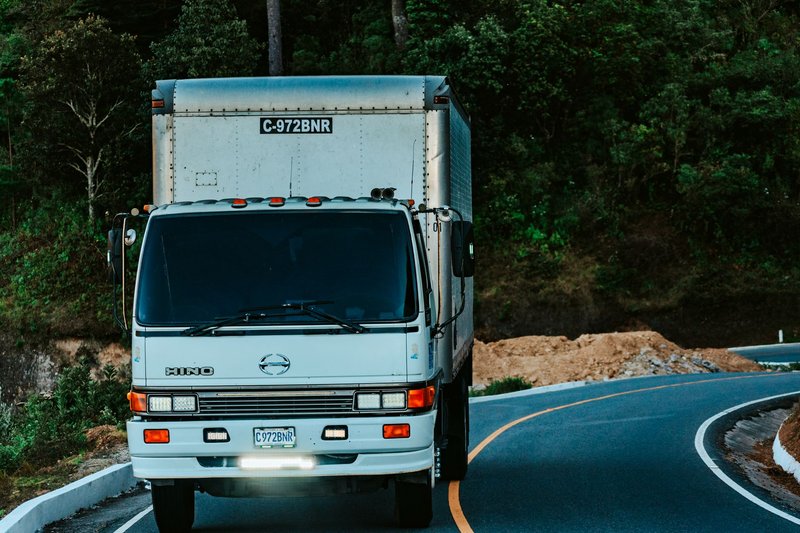
The Dyna arrived in 1956 as a step above the Toyoace in Toyota’s commercial lineup — a light-duty truck aimed at businesses that had outgrown a compact hauler but didn’t need a full medium-duty rig. The two trucks would go on to share platforms for decades, sold side by side as near-twins with different badges and trim, a strategy Toyota still runs today. Where the Toyoace and Stout were built to prove Toyota could make useful, affordable work vehicles, the Dyna is the model that shows Toyota already thinking about a structured commercial-vehicle range rather than one truck for every job.
How This Adds Up
Line these seven models up chronologically and the pattern is obvious: Toyota spent the first half of the decade building trucks — the Stout, the Toyoace — because that’s what a country rebuilding its infrastructure actually needed to buy. Only once that commercial base was solid did Toyota push hard into passenger cars, with the Crown in 1955 and the Corona in 1957 arriving within two years of each other. And by 1958, with both the Crown and the Land Cruiser landing on American shores in the same year, Toyota had gone from a company barred from making cars to one actively testing whether the US market would take a Japanese one.
It wouldn’t, not yet — the Crown flopped on American highways, and Toyota sold that single Land Cruiser its first year out. But the decade that started with 215 hand-built SA sedans ended with Toyota’s badge on two continents. Everything the Crown and the Corona proved about building for local conditions instead of copying foreign designs is the same instinct that turned the Corolla into the best-selling car nameplate in history a decade later, and turned the Land Cruiser into the vehicle armies and aid agencies still choose when a Jeep won’t cut it.

James Kowalski
More from James KowalskiHow we reviewed this article
This article was researched against manufacturer records and editorially reviewed before publishing. We accept no payment for coverage. Some guides contain affiliate links; see our affiliate disclosure.