The year 1972 was not a quiet moment for Ferrari. Four distinct models wore the prancing horse — ranging from the road-legal race car that scared Lamborghini’s accountants to a Pininfarina touring coupe that barely anyone ordered, yet both still command six-figure sums today. If you want to understand classic Ferraris, 1972 is an unusually dense single year to study.
Here’s every model Ferrari offered in 1972, what made each one worth building, and what collectors say about them now.
Table of Contents
- The Models at a Glance
- Ferrari 365 GTB/4 “Daytona”
- Ferrari 365 GTC/4
- Ferrari 365 GT4 2+2
- Dino 246 GTS
- Collector Values Today
The Models at a Glance
| Model | Engine | Power | Years in Production | Total Built |
|---|---|---|---|---|
| 365 GTB/4 Daytona | 4.4L V12 DOHC | 352 hp | 1968–1973 | ~1,383 |
| 365 GTC/4 | 4.4L V12 DOHC | 340 hp | 1971–1972 | 505 |
| 365 GT4 2+2 | 4.4L V12 DOHC | 320 hp | 1972–1976 | 524 |
| Dino 246 GTS | 2.4L V6 DOHC | 195 hp | 1969–1974 | ~1,274 (GTS variant) |
Ferrari 365 GTB/4 “Daytona”
The Daytona is the Ferrari that people who know Ferraris point to when they want to explain what a front-engined supercar can do. Ferrari never officially called it the Daytona — that was the press, responding to Ferrari’s 1-2-3 sweep at the 1967 24 Hours of Daytona. The name stuck harder than most factory designations ever do.
Under the long hood sits a 4.4-liter Colombo-derived V12 with four overhead camshafts, six Weber carburetors, and 352 horsepower at 7,500 rpm. In 1972, that was enough for a 174 mph top speed — a figure that no production road car from any manufacturer would seriously challenge for years. The Lamborghini Countach LP400, which showed up at Geneva in 1971 as a concept, was still years away from customer deliveries when the Daytona was already in people’s driveways.
Pininfarina designed the body, and the proportions are still instructive. The hood is as long as a dining table. The greenhouse is pulled back toward the tail. Plexiglas headlamps behind a full-width transparent panel give the nose a look that read as futuristic in 1968 and still holds up for reasons that are hard to articulate. Later production cars — including most 1972 examples — switched to exposed retractable headlamps after U.S. regulations pushed the change, which many purists prefer anyway.
Ferrari built roughly 1,383 examples across the full production run, with about 122 of those being the open Spyder version. The Spyder commands a significant premium now — partly scarcity, partly the fact that the open car with that exhaust note is a different sensory experience than the coupe.
Ferrari 365 GTC/4
The 365 GTC/4 is the 1972 Ferrari that tends to get undervalued, which is objectively odd given what it is. Ferrari introduced it at the Geneva Motor Show in 1971 as a gentler alternative to the Daytona: still a 4.4-liter V12, but detuned slightly to 340 hp and repackaged as a 2+2 coupe with a more usable cabin. Pininfarina’s design pulled the engine back further in the chassis for better weight distribution, and the driving position was more upright than the Daytona’s.
That “2+2” description comes with an asterisk. The rear seats were functional in the way that a studio apartment is functional — technically there, and your back seats will survive the ride if they’re not too tall. But compared to the GT4 2+2 that would replace it in the lineup, the GTC/4 wore the designation loosely.
Only 505 were built over two model years, making it one of the rarer V12 Ferraris of the period. The chassis is derived from the 365 GT4 2+2’s development work, and the car shares the transaxle layout that Ferrari was moving toward for balance. Road & Track at the time called it one of the easiest V12 Ferraris to drive quickly — a compliment that ages better than any horsepower figure.
Ferrari 365 GT4 2+2
Ferrari debuted the 365 GT4 2+2 at the Paris Motor Show in October 1972, which makes it the newest car in the 1972 lineup by a matter of weeks. It replaced the GTC/4 and the earlier 365 GT 2+2 (the “Queen Mother” car), and it marked a shift in what Ferrari considered a touring car.
Pininfarina designed the body with cleaner lines than its predecessors — less chrome, flatter surfaces, a shape that made more visual sense as the decade went on rather than less. The 4.4-liter V12 made 320 hp here, run through a five-speed transaxle at the rear for 50/50 weight distribution. Ferrari fitted it with independent rear suspension and proper rear seats that actually accommodated adult passengers on long trips.
The GT4 2+2 was the car you bought if you were a Ferrari owner with a family, or if you crossed Alpine passes regularly and wanted luggage space. It was not a driver’s car in the Daytona sense, and Ferrari was not pretending otherwise. Production ran to 524 units through 1976, and it later evolved into the 400 series.
Collectors have started paying more attention to the GT4 2+2 in recent years. Early examples with the original 365 designation are the ones to find. Among the best cars of 1972, the GT4 2+2 often goes overlooked in favor of its more dramatic siblings — which is exactly why the values are still reasonable.
Dino 246 GTS
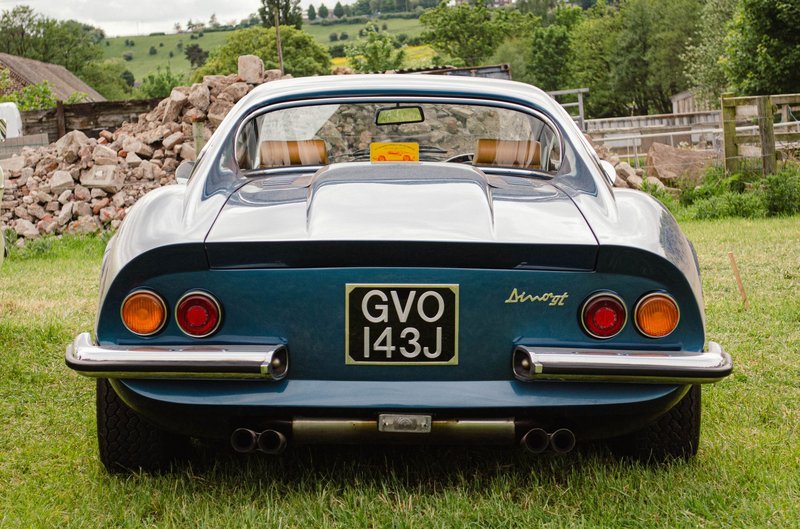
The Dino 246 GTS was not, technically, sold as a Ferrari in 1972. It carried the Dino badge — named for Enzo Ferrari’s son Alfredo, who died in 1956 and had contributed to the V6 engine’s early design. Ferrari kept the nameplate separate, officially, but everyone understood what it was.
The GTS — Gran Turismo Spider — variant appeared at the Geneva Motor Show in March 1972, adding a removable targa panel above the driver and passenger. This was distinct from the earlier GT coupe and the GTS (open) that had preceded it. The targa panel could be stored in a compartment behind the seats, turning the car into an open-air experience that the coupe version never offered.
The engine is a 2.4-liter DOHC V6, transversely mounted amidships, producing 195 hp. That’s less than half the Daytona’s output — but the Dino weighs less than 2,400 pounds, and the mid-engine layout gives it handling that the front-engined cars cannot replicate. The 246 is the Ferrari that driving journalists of the era consistently preferred over the Daytona to drive, even while admitting the Daytona was the more significant machine on paper.
The design is one of Pininfarina’s permanent accomplishments. The curves have a rightness about them that makes the car look like it was discovered rather than designed. Enzo Ferrari himself reportedly said the 246 GT was the most beautiful car Ferrari ever made, and it’s not a difficult case to argue.
About 1,274 GTS examples were built before production ended in 1974. They are now more valuable than the coupe versions, and demand has been rising steadily as buyers who grew up with the car reach collecting age.
Collector Values Today
As of recent auction results, these are the approximate ranges serious buyers should expect:
- 365 GTB/4 Daytona coupe: $350,000–$650,000 for good original examples; Spyder versions regularly exceed $2 million at auction
- 365 GTC/4: $250,000–$400,000, with clean driver-quality cars available below that ceiling
- 365 GT4 2+2: $100,000–$200,000, the most accessible V12 Ferrari from the period
- Dino 246 GTS: $350,000–$600,000; the targa version commands a premium over the earlier coupes
Values shift with provenance, matching numbers, and service history. The classic Ferrari market has been tracked closely by Hagerty and RM Sotheby’s for anyone who wants current auction comparables rather than estimates.
The 1972 lineup also rewards study beyond the price tags. Four cars, all from Pininfarina, all sharing a 4.4-liter V12 (except the Dino) — and each one aimed at a distinct buyer, a distinct use case. Ferrari was defining what a sports car manufacturer could offer across a full model range, and the 1972 catalog is the clearest snapshot of that ambition in action. Those curious how this lineup compared to what came next can find a detailed breakdown in the 1973 Ferrari models overview.

Daniela Voss
More from Daniela VossHow we reviewed this article
This article was researched against manufacturer records and editorially reviewed before publishing. We accept no payment for coverage.