
Today the Can-Am name sits on ATVs and three-wheeled Spyders. In the 1970s it sat on motocross bikes that won AMA national races, and the company behind them made snowmobiles. That’s the story: a Quebec snowmobile builder walked into the dirt bike business, borrowed an Austrian engine maker, and came close to rewriting the pecking order of American motocross before it walked away.
Contents
- How Bombardier Ended Up Building Motorcycles
- 1973: Production and the ISDT Debut
- 1974: The MX-2 Takes On the AMA 250 Class
- 1975: Ellis, Supercross and the TNT 250
- 1977: The MX-3 and the Budget Pivot
- Model-by-Model Comparison
- Why Bombardier Stepped Back
- Buying and Restoring a 1970s Can-Am Today
- Summary
How Bombardier Ended Up Building Motorcycles
Bombardier, based in Valcourt, Quebec, made its name on the Ski-Doo snowmobile. Snowmobiles sell in winter. A company with factory capacity sitting idle in summer has an obvious reason to look at products that sell in the other season, and Bombardier had already bought Rotax, the Austrian engine builder, in 1970. Rotax made compact, high-output two-stroke engines for Ski-Doos. Put one in a motorcycle frame and you have a dirt bike.
The decision came in 1971-72. The Bombardier museum’s history of its two-wheeled years and Rotax’s own company history both describe the same logic: Rotax supplies the engines, Valcourt builds and sells the bikes under the Can-Am name.
1973: Production and the ISDT Debut
Here the first date problem appears. Prototypes and early work date to 1971-72, but most sources put the start of production in Valcourt at 1973, and that’s the year used here. Some model-year lists blur the line by counting pre-production bikes. If you’re checking a serial number against a catalog, expect the earliest years to be fuzzy.
The first bikes went straight into competition. Can-Am made its International Six Days Trial debut in 1973, the sport’s brutal week-long off-road team event. Entering a new brand in the ISDT in its first production year says a lot about how seriously Bombardier took the project. The early lineup was motocross and enduro machines on Rotax single-cylinder two-stroke engines, in the small and mid-size classes.
1974: The MX-2 Takes On the AMA 250 Class
The bike most people mean by “vintage Can-Am” is the MX-2, a 250cc motocross machine that arrived in 1974. Some references list it as a 1973 introduction; 1974 is the year it showed up as a serious national-level race bike, which is why it’s given here.
Results followed fast. Can-Am riders, including Gary Jones, Marty Tripes and Jimmy Ellis, won AMA 250cc national rounds in that period, and the factory team made itself a fixture at the front of the field. For a company with no motorcycle history, that’s remarkable. Japanese and European factories had decades of development behind their motocross bikes. Can-Am showed up with a snowmobile engine builder’s experience in lightweight two-strokes and beat people with it.
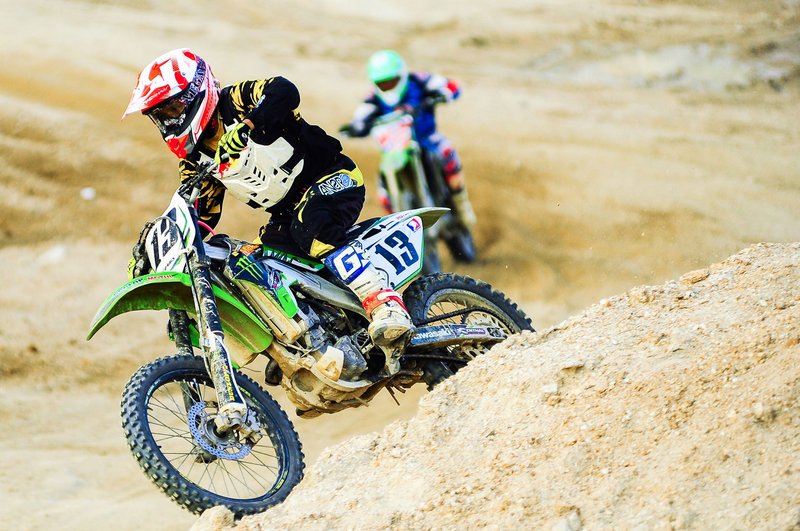
The MX-2’s appeal was straightforward: strong power from the Rotax engine, a bike light enough to race, and a team that knew how to win.
1975: Ellis, Supercross and the TNT 250
Jimmy Ellis won the 1975 AMA Supercross championship on a Can-Am. Supercross was only a couple of years old as a series then, and a championship on a brand this new was a loud statement. It remains the headline result of the marque’s whole run.
The same year brought a different kind of bike, the TNT 250. This was a dual-sport: a street-legal trail bike built on the same Rotax two-stroke philosophy. Dual-sports were a growing segment in the mid-1970s, and the TNT put the Can-Am badge in front of riders who would never enter a motocross race. It’s still one of the more collectible Can-Ams because it’s the one you can actually register and ride to a trailhead.
Alongside the MX and TNT models, Can-Am also sold enduro-oriented bikes, including the Qualifier line. These suited riders who wanted to compete in off-road endurance events rather than on a motocross track.
1977: The MX-3 and the Budget Pivot
The MX-3 arrived in 1977 and marks a shift. Earlier Can-Ams chased race results. The MX-3 was aimed at the private owner who wanted a competitive bike without paying factory-bike prices. Period reviews, including PulpMX’s classic-steel look at the MX-3, treat it as a rider’s bike: capable, simple, easier to live with than the racing specials that built the brand’s reputation.
It also reflects the economics. Racing programs are expensive, and by the late 1970s the Japanese brands were improving fast, with long-travel suspension arriving on their bikes. Our complete list of 1978 motorcycle models shows how crowded that market had become. A small-volume manufacturer could keep up only by spending money Bombardier increasingly didn’t want to spend on motorcycles.
Model-by-Model Comparison
Exact specs and model-year boundaries vary between sources, so treat the table as a guide and confirm against the frame and engine numbers of any bike you’re considering.
| Model | Years (approx.) | Engine | Type | Notable |
|---|---|---|---|---|
| Early MX (MX-1 and related) | 1973 | Rotax single-cylinder two-stroke | Motocross | First production bikes from Valcourt |
| Qualifier series | Mid-1970s | Rotax single-cylinder two-stroke | Enduro | ISDT-oriented off-road bikes |
| MX-2 | 1974-76 | Rotax 250cc two-stroke | Motocross | Basis of the AMA 250 national wins |
| TNT 250 | 1975 on | Rotax 250cc two-stroke | Dual-sport | Street-legal trail bike |
| MX-3 | 1977 on | Rotax two-stroke, multiple sizes | Motocross | Lower-cost private-owner bike |
| Later MX models | Late 1970s-early 1980s | Rotax two-stroke | Motocross | Final development before the decline |
The one claim that holds across every row: a single Rotax two-stroke cylinder, air-cooled in this era, sitting in a steel frame.
Why Bombardier Stepped Back
Bombardier’s real growth was elsewhere. In these same years the company was winning large contracts to build mass-transit vehicles, including subway cars, and that business needed money and management attention far more than a motorcycle line fighting Japanese factories. Resources moved to transit.
The wind-down was gradual. Bombardier licensed the Can-Am motorcycle line in 1983, and operations ended in 1987. Some sources give slightly different years for the licensing and for the last bikes, so treat 1983 and 1987 as the commonly cited milestones rather than a precise factory date.
Buying and Restoring a 1970s Can-Am Today
If you want one, here’s what matters.
- Parts are the main challenge. Rotax engines were used elsewhere, so some internal parts and gaskets can be cross-referenced, but Can-Am-specific bodywork, tanks and frame parts are scarce. Look for owner clubs and vintage motocross forums before you buy.
- Originality drives value. A complete, unmolested MX-2 or TNT is worth more than a restored bike built from pieces. Expect prices in the low-to-mid thousands of dollars for decent examples, with clean TNTs and race-history bikes at the higher end. Values move, so check recent sales rather than trusting any single figure.
- Inspect the usual weak points. Look for cracked frames near the swingarm pivot and steering head, worn crankshaft seals, and signs the engine has been run lean. Two-strokes that overheated tell you so with seized-piston scoring in the cylinder.
- Pick your purpose. The TNT is the one to buy if you want to ride on the street. The MX-2 and MX-3 are for vintage motocross events, where Can-Am has a loyal following.
Summary
The 1970s Can-Am story compresses into about a decade: a snowmobile company and an Austrian engine builder pooled their skills in 1971-72, started production in 1973, entered the ISDT, then won AMA 250 national races with the MX-2 and a Supercross title with Jimmy Ellis in 1975. The TNT 250 added a street-legal option, the MX-3 pivoted toward budget-minded owners in 1977, and Bombardier then shifted its money to transit, licensing the line in 1983 and ending operations in 1987.
For anyone researching 1970s Can-Am motorcycles, the best approach is to verify dates against more than one source. The sources disagree on some years, and the bikes were made in small numbers. They’re worth the trouble: very few brands went from zero to AMA winners in the span of two seasons.

Tyler Bridges
More from Tyler BridgesHow we reviewed this article
This article was researched against manufacturer records and editorially reviewed before publishing. We accept no payment for coverage. Some guides contain affiliate links; see our affiliate disclosure.