Ask “what was the most popular car in 1934” and you get two different answers depending on who you ask. The classic-car crowd will point you at the Duesenberg Model J and the Hispano-Suiza J12 — coachbuilt monsters that cost more than a house. The sales charts tell a blunter story: people bought Chevrolets and Fords, because in the middle of the Great Depression that was what a working family could swing.
Both answers are right. So this covers both. First the cars that actually moved off lots in 1934, market by market, then the handful of models that defined the year even if they never topped a sales chart. With real numbers and real period prices, because most pages on this either skip the data or skip the icons.
Table of Contents
- TLDR: The Short Version
- Best-Sellers by Market
- The American Volume Kings
- The Cars That Defined 1934
- What a Car Cost in 1934
- The Depression Backdrop
TLDR: The Short Version
In the United States, the Chevrolet Master and Standard were the volume leaders, with the Ford V-8 right on their heels. In Britain it was the Ford Model Y (“the £100 car”), and Austin and Morris small cars. In Germany, Opel dominated. If you want the cars that mattered historically rather than commercially, the list is the Ford V-8 DeLuxe, the Chrysler Airflow, the Citroën Traction Avant, the Packard Twelve, and the Duesenberg Model J. The Airflow flopped at the time and got nearly everything right anyway.
Best-Sellers by Market
1934 wasn’t one market — it was several, each with its own winner. There was no global best-seller, because tariffs, fuel taxes, and income levels meant an American family and a British family were shopping for completely different cars.
| Market | Top sellers | Why |
|---|---|---|
| United States | Chevrolet Master/Standard, Ford V-8 | Cheap six and a cheap V-8 in a price war |
| United Kingdom | Ford Model Y, Austin Seven, Morris Eight | Small engines dodged the per-horsepower road tax |
| Germany | Opel (P4 and 1.3-litre) | GM-owned, mass-produced, cheap to run |
| Czechoslovakia | Škoda, Tatra | Domestic brands behind protective tariffs |
The pattern across all four: the winners were cheap, simple, and locally built or locally cheap to tax. Luxury didn’t sell in volume anywhere in 1934 — there wasn’t the money for it. In Czechoslovakia that meant home-grown brands like Škoda, whose long run of discontinued Škoda models traces how a protected domestic maker kept pace with the wider European market.
The British case is the clearest example of a tax shaping a whole market. Britain taxed cars by RAC horsepower, a formula based on cylinder bore, so manufacturers built small-bore engines to keep the annual bill down. That’s why the American V-8 was a curiosity in Britain and a best-seller in America, where fuel was cheap and the road tax didn’t punish a big engine.
The American Volume Kings
Chevrolet Master and Standard
Chevrolet led US sales in 1934 with a refreshed lineup split into the upmarket Master and the budget Standard. The Master got “Knee-Action” independent front suspension — a genuine ride improvement, even if early versions were fussy to keep sealed. The engine was the 206-cubic-inch “Stovebolt” overhead-valve six, a design Chevy leaned on for decades because it was durable and forgiving of neglect.
The pitch was simple: a smooth six-cylinder for roughly the price of Ford’s bargain models. For a buyer who wanted refinement over outright power, the Chevy six was the easy pick, and the sales numbers showed it.
Ford V-8
Ford’s counterpunch was cylinders. The flathead V-8, introduced in 1932, put eight cylinders and around 85 horsepower into a car a regular person could afford — something no rival could match at the price. By 1934 the design had its early bugs sorted, and it was quick for its day. Quick enough that it became the getaway car of choice for Depression-era bank robbers; the letter John Dillinger supposedly sent Henry Ford praising the V-8’s getaway performance is part of the car’s lore, genuine or not.
The 1934 Ford V-8 came as the base Standard or the better-trimmed DeLuxe, the DeLuxe adding twin horns, better upholstery, and brightwork. It’s the DeLuxe that collectors chase now — that low, purposeful early-flathead shape is one of the most recognizable in American car design.
The Cars That Defined 1934
Sales charts and significance don’t always agree. These five didn’t all sell in huge numbers, but each one shaped where cars went next.
1. Ford V-8 DeLuxe
The volume seller that was also historically important — affordable V-8 power put performance in ordinary driveways and set the template for the American performance car. Roughly 85 hp, a clean steel body, and a price within reach of a working household. It’s on this list because it democratized the V-8, full stop.
2. Chrysler Airflow
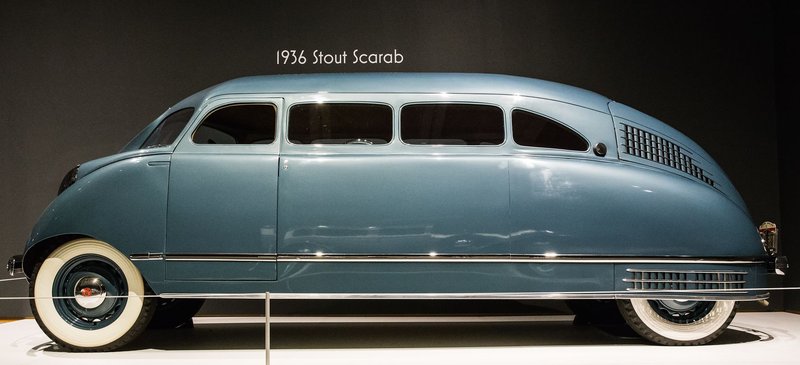
The Airflow is the most important failure on this list. Chrysler ran wind-tunnel tests and built a car shaped by aerodynamics rather than carriage tradition: a smooth, rounded nose, the engine pushed forward over the front axle, and passengers seated between the axles for a better ride. It was streamlined years before the rest of the industry caught up.
Buyers hated the looks. The styling was too strange for 1934, early production stumbled, and sales were poor enough that Chrysler quietly pulled back to conventional shapes. But the engineering logic — aerodynamics, weight distribution, unitized-leaning construction — became standard within a decade. The Smithsonian and design historians regularly cite it as a landmark in automotive streamlining. A commercial flop and a design milestone at the same time.
3. Citroën Traction Avant
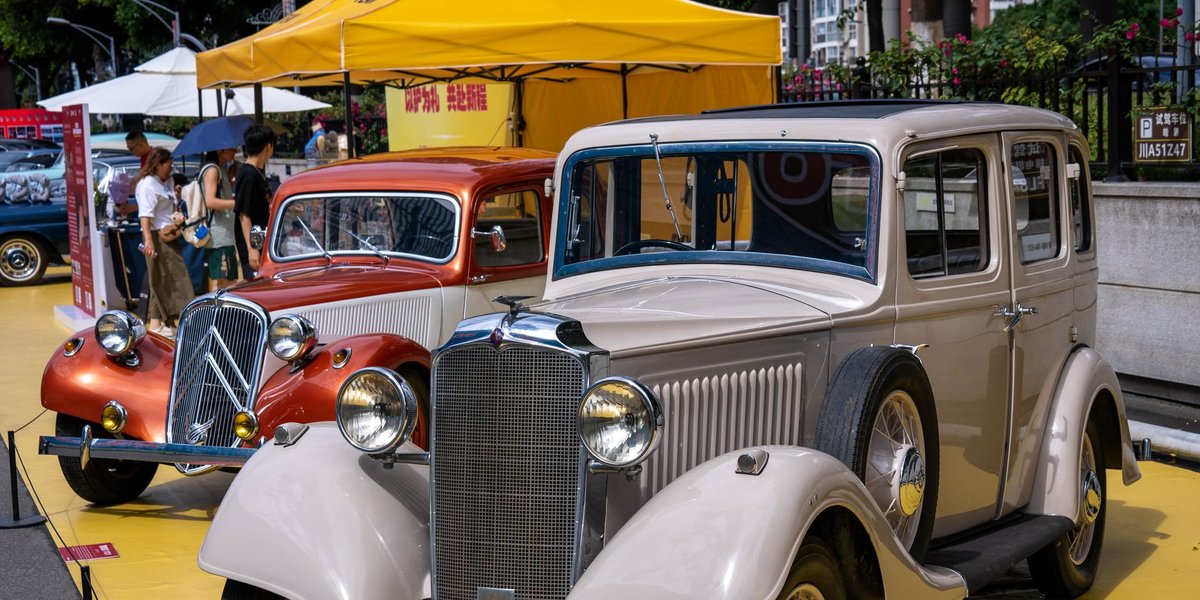
France’s contribution, launched in 1934, was arguably the most advanced mass-produced car in the world. Front-wheel drive, a unitary (monocoque) body with no separate chassis, and four-wheel independent suspension — a combination that wouldn’t become mainstream for thirty years. It handled and rode better than nearly anything else on the road and stayed in production until 1957, earning it a permanent place among the classic French cars enthusiasts still seek out today.
The development cost nearly bankrupted Citroën; André Citroën lost control of the company to Michelin over the bills. The car was right. The timing, in a depression, was brutal. It’s one of many milestones in the brand’s long history, which the full run of Citroën old models lays out from the early streamliners to the 2CV and DS that followed.
4. Packard Twelve
American luxury at its peak. The Packard Twelve carried a 7.3-litre V12 making around 160 hp, in long, dignified bodies that signalled old money without shouting. While the multi-cylinder luxury market was shrinking fast — twelves and sixteens were a pre-crash idea selling into a post-crash world — Packard built the Twelve with a quality of engineering and finish that still anchors it among the great American classics.
5. Duesenberg Model J
The most extravagant American car of the era, and it knew it. The Model J’s straight-eight made around 265 hp — the supercharged SJ pushed past 300 — at a time when a Ford made 85. With coachbuilt bodywork it could cost ten to twenty times the price of a mass-market car, which is why “it’s a Duesy” entered the language as shorthand for the best of something.
By 1934 the company was running on fumes; the Depression had gutted the market for cars this expensive, and Duesenberg folded a few years later. But for sheer ambition, nothing else came close.
What a Car Cost in 1934
Prices are where 1934 stops being abstract. These are approximate US list prices, with the spread that defined the market.
| Car | Approx. 1934 price (USD) |
|---|---|
| Ford Model Y (UK) | £100 (~$500) |
| Chevrolet Standard | ~$465 |
| Ford V-8 Standard | ~$505 |
| Ford V-8 DeLuxe | ~$575 |
| Chevrolet Master | ~$580 |
| Chrysler Airflow | ~$1,345 |
| Packard Twelve | ~$3,800+ |
| Duesenberg Model J | ~$13,000–20,000 (with coachwork) |
The gap tells the story. A Duesenberg cost more than thirty Chevrolets. With US median household income running around $1,500 a year, even a $500 Chevy was a serious commitment — and the Duesenberg was pure fantasy for all but a few thousand buyers. For inflation context, $500 in 1934 is roughly $11,000–12,000 in today’s money per the U.S. Bureau of Labor Statistics consumer price index — and that bought a brand-new car, which says a lot about how the math has changed.
The Depression Backdrop
You can’t read the 1934 sales charts without the Depression. US car production had collapsed from roughly 4.5 million units in 1929 to around 1.3 million by 1932. 1934 was the recovery — output climbed back, but buyers had been scared cheap. They wanted reliable, affordable, economical to run. Anything else was a luxury most couldn’t justify.
That’s why the icons and the best-sellers split so cleanly. The cars that sold — Chevrolet, Ford, Opel, the Model Y — were the cars that fit a tight budget. The cars we remember as great — the Airflow, the Traction Avant, the Twelve, the Duesenberg — were either too strange, too expensive, or too far ahead for a market that just wanted to get to work and back without trouble.
The fascinating part is how often those two lists eventually merged. The aerodynamics Chrysler couldn’t sell in 1934 became the norm. The front-wheel-drive monocoque nobody else dared build became how most cars are made today. 1934 was a year when the future was already on the road — it just couldn’t get anyone to buy it yet.

Daniela Voss
More from Daniela VossHow we reviewed this article
This article was researched against manufacturer records and editorially reviewed before publishing. We accept no payment for coverage.