Search “1953 Corvette models” and you’re probably hunting for a trim chart, a list of variants, maybe a hardtop-versus-convertible breakdown. Here’s the short version: there weren’t any variants. Chevrolet built exactly one 1953 Corvette configuration. One body style, one paint color, one interior color, one engine, one transmission. If you special-ordered a 1953 Corvette hoping to check some option boxes, the dealer handed you a form with almost nothing on it.
That single-spec reality is the whole story of the first-year car, and it’s more interesting than any options list. This was a hand-built show car that GM rushed into production, and the “one of everything” simplicity is exactly why survivors now trade for the price of a house.
Table of Contents
- The One-Model Answer
- Quick Facts
- How the Corvette Went From Show Car to Showroom
- Full 1953 Corvette Specs
- The Blue Flame Six: Not the Engine It Deserved
- Production Numbers and How Many Survive
- What a 1953 Corvette Is Worth Today
- Buying or Restoring One: What to Watch
The One-Model Answer
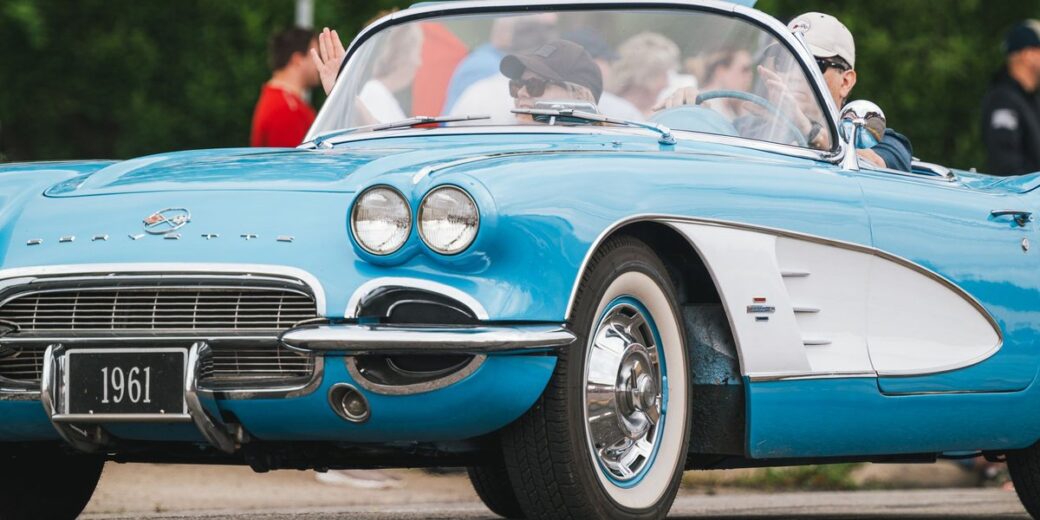
Every 1953 Corvette left the factory as a two-seat roadster painted Polo White over a Sportsman Red interior, with a black canvas soft top. No hardtop. No other colors. No V8 (that didn’t arrive until 1955). No manual gearbox — every single one got a two-speed Powerglide automatic.
There were technically two “options” on the order sheet: a signal-seeking AM radio and a recirculating heater. Both cost extra on paper. In practice, essentially every car got both, so calling them options is generous. The realistic way to think about it: the 1953 Corvette is a single model with two accessories that came standard in all but name.
So if you came here for a trim comparison, that’s it — there’s nothing to compare. The variety in the C1 line shows up later, when 1954 opened up more colors and 1955 dropped in the small-block V8. The 1953 car is the pure, uncut first attempt.
Quick Facts
- Model years covered here: 1953 only (first-year C1)
- Body style: Two-seat convertible roadster, fiberglass body
- Color: Polo White exterior, red interior, black soft top — all 300 cars
- Engine: 235 cubic inch “Blue Flame” inline-six, 150 hp
- Transmission: Two-speed Powerglide automatic (no manual offered)
- 0–60 mph: Roughly 11 seconds
- Top speed: About 108 mph
- Base price new: $3,498
- Total built: 300 units
- Estimated survivors: Around 225
How the Corvette Went From Show Car to Showroom
The Corvette started as a display piece, not a product. GM design chief Harley Earl wanted an affordable American sports car to answer the British roadsters — MGs and Jaguars — that returning servicemen were buying. The result was EX-122, a concept car unveiled at the GM Motorama show at the Waldorf-Astoria in New York in January 1953.
The public reaction was strong enough that GM greenlit production almost immediately, which is a problem when you’ve designed a fantasy show car and now have to actually build it. The tooling for stamped-steel body panels takes many months and serious money. GM didn’t have either. So they made a decision that defined the Corvette forever: they built the body out of fiberglass.
Production started June 30, 1953, in a makeshift line in Flint, Michigan. These first cars were hand-assembled — closer to coachbuilding than mass production. Fit and finish varied car to car because humans were fitting panels by hand. That’s why originality and documentation matter so much on a 1953 today; no two were quite identical off the line.
Full 1953 Corvette Specs
| Specification | Detail |
|---|---|
| Body | Fiberglass, two-seat roadster |
| Engine | 235 cu in (3.9L) Blue Flame inline-six |
| Horsepower | 150 hp @ 4,200 rpm |
| Torque | 223 lb-ft @ 2,400 rpm |
| Induction | Three Carter side-draft carburetors |
| Transmission | Two-speed Powerglide automatic |
| 0–60 mph | ~11.0–11.5 seconds |
| Top speed | ~108 mph |
| Wheelbase | 102 inches |
| Curb weight | ~2,900 lbs |
| Base price (1953) | $3,498 |
For context, the Chevrolet Corvette C1 rode on a 102-inch wheelbase — short, light, and low. The fiberglass body kept weight down to around 2,900 pounds, which is part of why a straight-six could move it respectably despite modest power.
The Blue Flame Six: Not the Engine It Deserved
Here’s the part enthusiasts love to argue about. A sports car in 1953 should have had a serious engine. The Corvette got a truck-and-sedan straight-six.
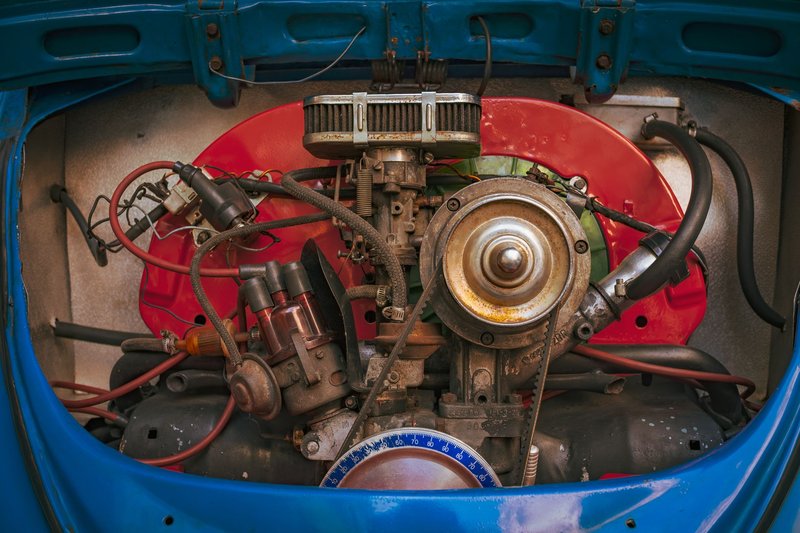
Chevrolet’s engineers did what they could with what they had. They took the existing 235 cubic inch “Stovebolt” six, added a higher-lift camshaft, bumped the compression, fitted a trio of side-draft Carter carburetors, and painted the block blue — hence “Blue Flame.” That work pulled 150 horsepower out of an engine that made 115 or so in a Bel Air. Respectable engineering. Wrong character for a sports car.
The bigger sin, to purists, was the transmission. Every 1953 Corvette came with a two-speed Powerglide automatic because Chevrolet didn’t yet have a manual that could handle the tuned six’s output cleanly. A two-seat roadster with an automatic and a six felt like a contradiction, and the automotive press said so at the time. Sales in the first two years were soft partly because of it.
That criticism is exactly what forced the fix. By 1955 the small-block V8 and a manual gearbox arrived, and the Corvette finally drove like it looked. The underwhelming 1953 drivetrain is the reason the car got good.
Production Numbers and How Many Survive
Chevrolet built 300 Corvettes in 1953 — a rounding error against the hundreds of thousands of other cars that rolled out of American factories that year. That’s the number to remember, and it’s small enough to make every surviving car a documented individual.
Of those 300, roughly 225 are believed to still exist, tracked through owner registries that specialize in first-year cars. That survival rate — about 75% — is remarkably high for a 70-year-old car, and it tells you something: almost nobody used a 1953 Corvette as a daily driver into the ground. Owners recognized what they had fairly early, and the cars got preserved rather than beaten.
The flip side is that 300 cars spread across a continent means real ones rarely come up for sale, and when they do, provenance is everything. A car with a known chassis number and a paper trail back through its owners is worth substantially more than one with a murky history.
What a 1953 Corvette Is Worth Today
This is where the “only one model” story pays off. Because every 1953 is mechanically identical, value comes down almost entirely to condition, originality, and documentation rather than spec.
Valuation data from Hagerty puts driver-quality 1953 Corvettes solidly into six figures, with concours-level, well-documented, numbers-matching examples reaching into the mid-to-high hundreds of thousands at auction. Early low-VIN cars — the first few dozen off that Flint line — command a premium beyond that because of their place in the sequence.
What moves the number:
- Numbers-matching drivetrain — original engine and transmission block casting numbers matching the chassis
- Documentation — build records, registry listing, ownership chain
- Originality vs. restoration quality — a correctly restored car can rival an original, but incorrect parts hurt fast
- VIN sequence — the earliest cars carry extra weight with collectors
A 1953 Corvette is not a car you buy to drive to work. It’s a blue-chip collectible where the money follows the paperwork as much as the metal.
Buying or Restoring One: What to Watch
If you’re seriously shopping, the fiberglass body is your first inspection point. Early 1953 fiberglass was hand-laid and can hide cracks, past repairs, and filler under fresh paint. A body scan or an experienced eye matters more here than on a steel car.
Then check the details that separate a real survivor from a rebody or a parts-bin recreation:
- Chassis and drivetrain numbers should agree with each other and with any documentation.
- The three Carter carburetors are correct — a two-carb or four-barrel setup means someone changed it.
- Interior trim should be red; a repaint or retrim to another color kills originality points.
- Registry status — the first-year Corvette community tracks these cars closely, so a car that’s unknown to the registry deserves extra scrutiny.
The good news for a restorer is simplicity. With one spec, there’s no guessing what “correct” looks like — the factory built them all the same way. Getting a 1953 back to original is expensive and slow, but at least the target never moves.
That’s the real appeal of the first-year car. There was only ever one 1953 Corvette model, and 70 years later that single, hand-built, Polo White roadster is where the whole story of America’s sports car begins.

Marco Delantero
More from Marco DelanteroHow we reviewed this article
This article was researched against manufacturer records and editorially reviewed before publishing. We accept no payment for coverage. Some guides contain affiliate links; see our affiliate disclosure.