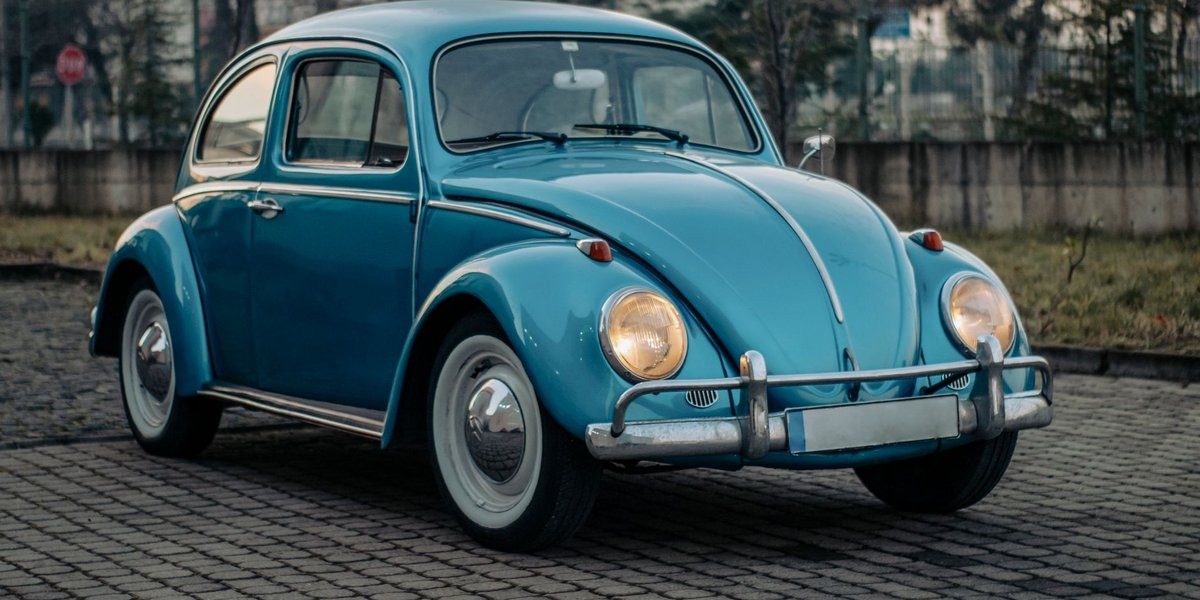
On February 17, 1972, a Beetle rolled off the line in Wolfsburg and quietly made history. It was unit number 15,007,034 — one more than the Ford Model T’s all-time production record, a number that had stood since 1927. Volkswagen had built the most-produced single car design on the planet, and they did it with a rear-engined, air-cooled design that was already pushing 40 years old.
That milestone tells you most of what you need to know about VW in 1972. The Beetle was still the empire. But Volkswagen knew the air-cooled formula was running out of road, and the 1972 lineup is a fascinating snapshot of a company hedging its bets: a record-breaking dinosaur, a hot-selling sporty coupe, and a couple of front-engined experiments that hinted at the water-cooled future the Golf would deliver two years later.
Here’s the full roster of what Volkswagen sold in 1972, what each one packed under the hood, and what they’re worth now.
Table of Contents
- The 1972 Beetle (Type 1)
- Super Beetle 1302 and 1302S
- Karmann Ghia
- Type 3: Notchback, Fastback, Variant
- Type 4: 411 and 411E
- The K70: VW’s Front-Wheel-Drive Outlier
- Type 2 Transporter (The Bus)
- Which 1972 VW Is Most Collectible Today?
The 1972 Beetle (Type 1)
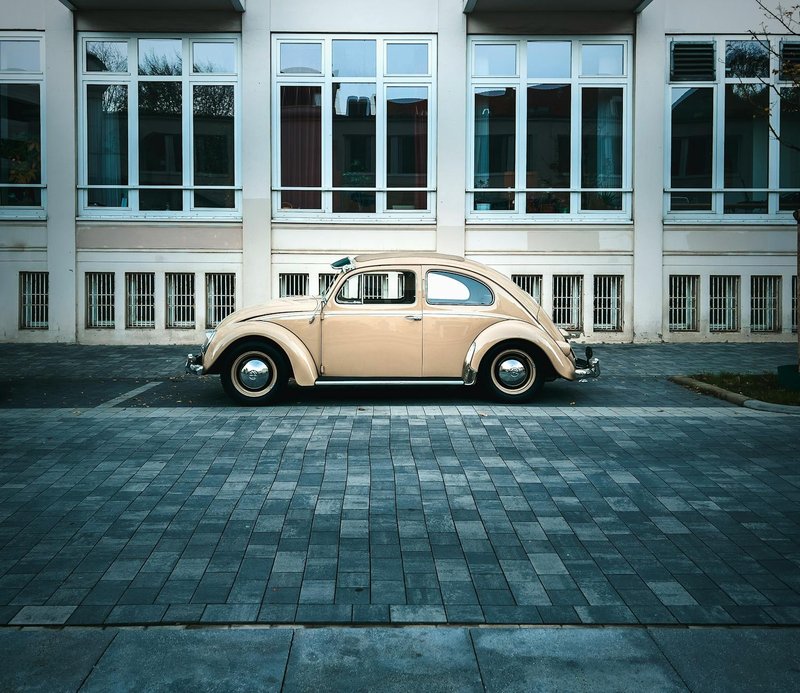
The standard Beetle in 1972 was, mechanically, the car the world already knew by heart. The base “1200” used the 1,192cc flat-four making around 34 horsepower, while export and US-market cars ran the 1,300cc and 1,600cc engines — the 1600 dual-port unit putting out roughly 50 hp. Torsion-bar front suspension, swing-axle or IRS rear, four-speed manual. The recipe hadn’t changed much.
What did change in 1972 were the details collectors now use to date a car at a glance. The rear window grew larger. The engine lid gained two rows of cooling louvers (earlier cars had fewer). Inside, you got a four-spoke “safety” steering wheel and a redesigned dash. These are the tells that separate a ’72 from a ’71 or ’73 at a swap meet.
This was the high-water mark for total Beetle production — global output peaked around this era before the long decline. In the US, the Beetle was already feeling pressure from tightening emissions and safety rules, which is exactly why VW was pushing the Super Beetle and developing water-cooled replacements. It’s worth remembering that the Beetle didn’t make this record in isolation, either; it shared showrooms and roads with a remarkable cohort of other cars built that same year, from European saloons to American iron.
What it’s worth today: A clean, running standard 1972 Beetle typically trades between $9,000 and $18,000, with show-quality restorations pushing past $25,000. Rust-free survivors from dry states command the premium. Project cars still surface under $5,000.
Super Beetle 1302 and 1302S
The Super Beetle is where 1972 gets interesting. Introduced for 1971, the 1302 (and the bigger-engined 1302S) ditched the standard car’s torsion-bar front end for a MacPherson strut setup. That single change moved the spare tire flat under the front trunk floor and nearly doubled luggage space — a genuine practical upgrade for a car that had never been known for cargo room.
The 1302S ran the 1,584cc engine making about 50 hp, paired with the front disc brakes the standard Beetle still lacked. You also got the curved, “pregnant” front fenders and a more bulbous nose that give the Super Beetle its distinctive profile.
Here’s the detail that trips up buyers: the famous panoramic curved windshield — the one most people picture when they think “Super Beetle” — belongs to the 1303, which arrived in August 1972 as a 1973 model. So a genuine 1972-built Super Beetle still wears the flatter windshield. If a seller calls a flat-screen car a “1973,” check the build date; the model-year cutover happened mid-year.
What it’s worth today: Super Beetles run slightly below standard Beetles in some markets because purists prefer the simpler torsion-bar cars, but a tidy 1302S sits comfortably in the $8,000–$16,000 range. The improved brakes and ride make them arguably better drivers.
Karmann Ghia
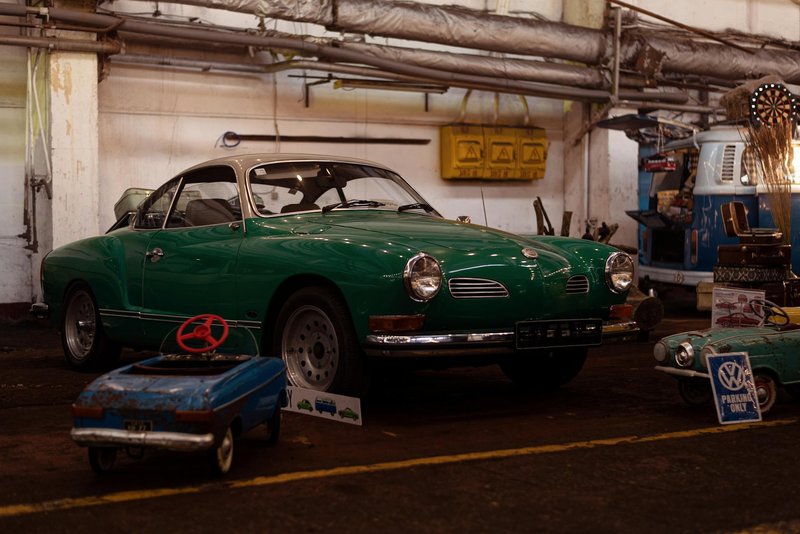
The Karmann Ghia was Volkswagen’s answer to a fair question: what if the Beetle’s bulletproof mechanicals wore a body designed by an Italian carrozzeria? Ghia styled it, Karmann built it in Osnabrück, and the result was a 2+2 that looked like it cost three times what it did.
For 1972 the Type 14 Ghia rode on Beetle running gear — the 1,584cc 50-hp flat-four, four-speed manual, all-independent suspension. It was never quick (0–60 took a leisurely 18-plus seconds), and nobody bought one for the numbers. You bought it because of the hand-formed body, the absence of a single straight panel line, and the way it drew a crowd. Both the coupe and the cabriolet were available, with the convertible always the rarer, more desirable variant.
The flowing fenders and frenched headlights came from an era when “aerodynamic” meant “drawn by an artist,” and that’s exactly the appeal. It’s a sports car silhouette wrapped around economy-car bones, which is also why it’s cheap to keep running — every mechanical part is shared Beetle hardware. In an age when most of the memorable cars of the 1970s were chasing horsepower or fighting emissions rules, the Ghia got by entirely on its looks.
What it’s worth today: Coupes generally land between $20,000 and $35,000 for good examples. Cabriolets are the prize, frequently clearing $40,000 and reaching $60,000-plus for concours cars. The Ghia has appreciated steadily as Beetle-based collectibles go mainstream.
Type 3: Notchback, Fastback, and Variant
The Type 3 was VW’s attempt to build something a little more grown-up while keeping the air-cooled flat-four. The trick was the “pancake” engine — a flattened 1,584cc unit that sat low enough to leave usable luggage space both front and rear. Genuinely clever packaging for a rear-engined car.
In 1972 the Type 3 came in three body styles. The Notchback was the conventional three-box sedan (never officially sold in the US, which makes it a curiosity stateside). The Fastback was the sloping-roof coupe-sedan that was the US-market Type 3. And the Variant — sold in America as the “Squareback” — was the small estate/wagon, and the most practical of the bunch.
The Type 3 also earns a footnote in automotive history: earlier versions pioneered the Bosch D-Jetronic electronic fuel injection, one of the first mass-production EFI systems anywhere. By 1972 this technology was maturing, and it’s a real point of interest for anyone who likes their classics with a side of engineering nerdery.
What it’s worth today: Squarebacks (Variants) are the value play, often $10,000–$20,000 for solid cars. Fastbacks run similar. The rarely-seen Notchback commands a premium in the US precisely because it was never sold here new — clean imports can exceed $25,000.
Type 4: 411 and 411E
The Type 4 — sold as the 411 and the fuel-injected 411E — was Volkswagen’s swing at a larger, more comfortable family car while clinging to the air-cooled layout. It was the first VW with a unibody, the first with available four-door practicality in this class, and it carried a 1,679cc (later 1,795cc) flat-four.
It’s also, by most enthusiast accounts, the least loved car VW built in this period. The styling was awkward, the air-cooled engine struggled to deliver the refinement buyers expected at this price point, and sales never matched ambitions. The 411 quietly proved that stretching the air-cooled formula upmarket had limits.
The interesting part is what the Type 4 left behind. Its larger 1.7-liter engine went on to power the Porsche 914 and the later “Bay Window” buses, giving this unloved sedan a mechanical legacy far more respected than the car itself.
What it’s worth today: Type 4s are rare survivors and a niche taste. Values are modest — typically $6,000–$14,000 — though rarity means a genuinely nice one can be hard to find at any price. Buy one because you appreciate the oddball, not as an investment.
The K70: VW’s Front-Wheel-Drive Outlier
The K70 is the strangest entry on this list, because it wasn’t really a Volkswagen at all — at least not by birth. It was designed by NSU as a water-cooled, front-wheel-drive sedan and was nearly ready for launch when VW absorbed NSU into the Audi-NSU group in 1969. VW killed the NSU branding, badged it a Volkswagen, and built it in a purpose-built factory in Salzgitter. Tellingly, the front-wheel-drive, water-cooled thinking it inherited was already shaping the Audi models of the era that now sat alongside VW in the same corporate family.
That makes the K70 a genuine landmark: VW’s first front-wheel-drive car and its first water-cooled production model, both arriving before the Passat (1973) and Golf (1974) made that layout the company’s entire future. The 1,605cc inline-four sat longitudinally up front, driving the front wheels — about as far from the Beetle’s philosophy as you could get while still wearing a VW roundel.
Commercially it flopped. It was thirsty, the price climbed during development, and it sat awkwardly between Audi models in the new corporate structure. But as a piece of history, the K70 is the bridge between old Volkswagen and modern Volkswagen, sold for one brief moment alongside the very Beetle it was meant to replace.
What it’s worth today: Genuinely scarce, especially outside Europe. Values are hard to pin down because so few trade hands, but expect $5,000–$15,000 for a running example. The K70 is a collector’s car for the historically minded rather than a blue-chip appreciator.
Type 2 Transporter (The Bus)
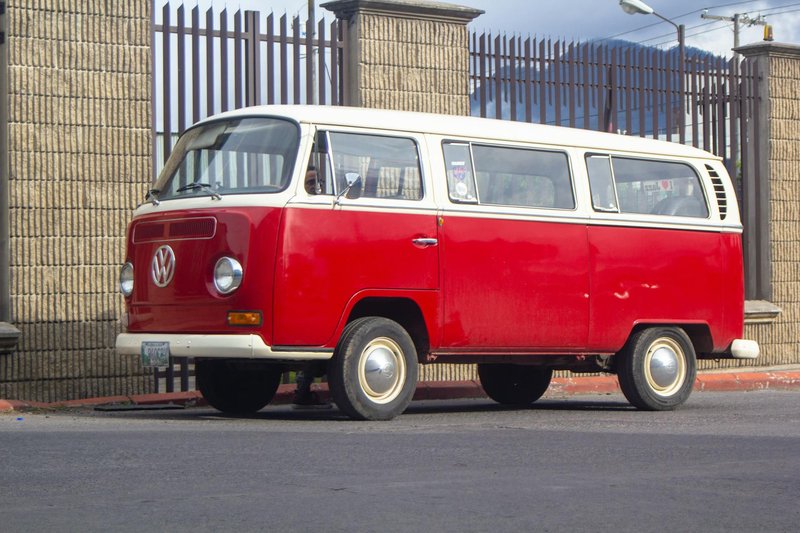
No 1972 VW lineup is complete without the Bus. The 1972 Type 2 was a “Bay Window” model (the second-generation T2), and it sat at an important crossroads. For 1972 specifically, the Transporter received a significant engine upgrade — the 1,700cc flat-four borrowed from the Type 4, bringing more usable power to a vehicle that had always been gloriously, comically slow.
The 1972 model year is a sweet spot for bus collectors. You get the more durable Bay Window body, the bigger 1.7-liter engine, and the early styling cues — small, low-mounted taillights and the cleaner front end — before later revisions added the bigger taillights and revised bumpers of the mid-70s “low-light” debate that obsesses VW bus people.
Body styles ran the full range: the Kombi, the windowed Microbus, the upmarket Deluxe with its skylight windows, the Westfalia camper conversions, and the workhorse panel vans and single/double-cab pickups. The camper variants are the holy grail.
What it’s worth today: This is where the money is. A standard 1972 Microbus in good condition runs $25,000–$45,000. Westfalia campers regularly clear $50,000, and concours or rare-spec examples have broken $80,000–$100,000. The VW bus has become one of the most reliably appreciating classics of the air-cooled world.
Which 1972 VW Is Most Collectible Today?
If you’re buying to enjoy and appreciate, the hierarchy is fairly clear:
| Model | Condition Sweet Spot | Typical Value | Collectibility |
|---|---|---|---|
| Type 2 Bus (Westfalia) | Driver to restored | $50,000–$100,000+ | Highest |
| Karmann Ghia Cabriolet | Restored | $40,000–$60,000+ | High |
| Karmann Ghia Coupe | Good driver | $20,000–$35,000 | High |
| Beetle (standard) | Survivor/restored | $9,000–$25,000 | Strong & liquid |
| Super Beetle 1302S | Good driver | $8,000–$16,000 | Steady |
| Type 3 Squareback | Solid driver | $10,000–$20,000 | Moderate |
| Type 4 411 | Any clean example | $6,000–$14,000 | Niche |
| K70 | Running | $5,000–$15,000 | Historical curiosity |
The Bus is the blue-chip pick — broad demand, strong appreciation, and the camper variants are practically furniture in the vintage-lifestyle world. The Karmann Ghia cabriolet is the connoisseur’s choice: rarer than the Bus, drop-dead gorgeous, and cheap to maintain on Beetle parts.
The standard Beetle remains the smart-money entry point. It’s the most liquid classic on this list — parts are everywhere, every shop knows them, and the 1972 record-year story gives a clean original car a genuine talking point. You can buy, drive, and sell a Beetle without the anxiety attached to a six-figure bus.
The K70 and Type 4 are for collectors who care about the story — the moment Volkswagen started walking away from the air-cooled rear-engine formula it had ridden for four decades. They’re not investments. They’re history you can park in your garage.
That tension is what makes the 1972 lineup so compelling. In a single model year, you can see the company at its absolute peak with the Beetle, and quietly building the front-engined, water-cooled escape hatch that would save it. Two years later the Golf arrived and everything changed. But in 1972, for one record-breaking moment, both Volkswagens lived under the same roof.

Marco Delantero
More from Marco DelanteroHow we reviewed this article
This article was researched against manufacturer records and editorially reviewed before publishing. We accept no payment for coverage.