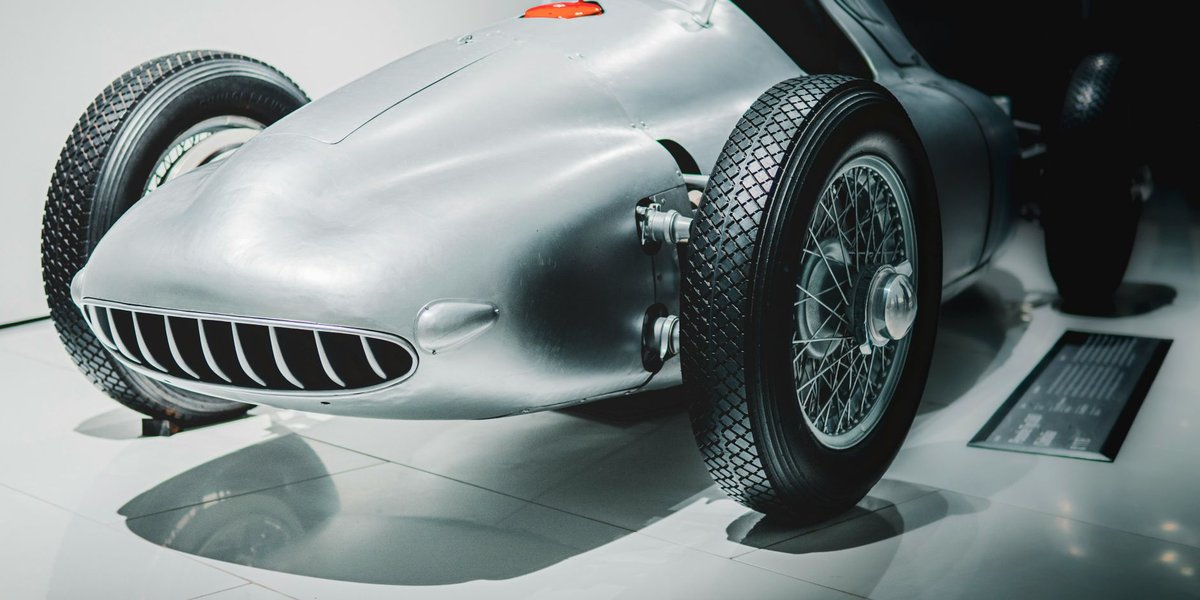
Ask how many Porsche models came out in the 1940s and most lists will pad the answer. The honest count is small. One car wears a Porsche badge and a registration plate as a road-legal production model: the 356, signed off in June 1948. Everything else from the decade is either a pre-war one-off or a hand-beaten coupé built in a converted Austrian sawmill.
That’s the whole story right there. But the gaps between those three cars — the Type 64, the 356/1 “No. 1,” and the Gmünd coupés — are where the marque actually got born. So let’s lay them out properly, with the numbers and the context that the thin generalist roundups skip.
Table of Contents
- The quick-reference list
- Type 64 (1939): the car before the company
- Why there were no Porsches for most of the 1940s
- 356/1 “No. 1” (1948): the first real Porsche
- 356/2 Gmünd coupé and cabriolet (1948–1950)
- The mechanical recipe
- So how many 1940s Porsches were there?
The quick-reference list {#the-quick-reference-list}
If you only want the bottom line, here it is.
| Model | Year | What it was | How many built |
|---|---|---|---|
| Type 64 | 1939 | Aerodynamic record-car coupé on Beetle parts; not badged “Porsche” | 3 (one rebuilt postwar) |
| 356/1 “No. 1” | 1948 | Mid-engined aluminium roadster, the first car titled as a Porsche | 1 prototype |
| 356/2 Gmünd Coupé | 1948–1950 | Rear-engined hand-built aluminium coupé | ~50 |
| 356/2 Gmünd Cabriolet | 1948–1949 | Open version of the Gmünd | ~6 |
One prototype roadster, a handful of hand-formed coupés, and a pre-war oddity that wasn’t even called a Porsche. That’s the decade. Now the detail.
Type 64 (1939): the car before the company {#type-64-the-car-before-the-company}
The Type 64 — also called the Type 60K10 — predates the Porsche car company by nearly a decade, which is exactly why people argue about whether it counts. Ferdinand Porsche’s design office built it to run the 1939 Berlin–Rome road race, a propaganda event that never happened because the war started first. It’s one of the few genuine 1940s sports cars to come out of a decade when almost nothing was being built for the road.
It sat on the platform of the KdF-Wagen, the car the world would later know as the Volkswagen Beetle. The Porsche office had designed that too, so the parts bin was right there: the chassis, the 1131cc air-cooled flat-four, the suspension. What went on top was the new part. Erwin Komenda shaped a low aluminium body with covered wheels and a teardrop tail, tuned in a wind tunnel to chase speed on the autobahn-style course. Period figures put it around 80 horsepower and roughly 90 mph — fast for a Beetle-derived machine in 1939.
Three were built. One was wrecked, one was wrecked and rebuilt, and the survivors had a rough war: American soldiers reportedly cut the roof off one and used it as a runabout until it died. The reason the Type 64 matters isn’t the race it never ran. It’s that the body language — the rounded nose, the faired-in wheels, the fastback — reads as a direct ancestor of the 356. You can see the family resemblance from across a parking lot.
Whether it’s “a Porsche” depends on your definition. It carried “Porsche” script on the nose. It did not carry a Porsche company badge, because there was no Porsche company building cars yet.
Why there were no Porsches for most of the 1940s {#why-there-were-no-porsches}
For the first eight years of the decade, the Porsche design office wasn’t making sports cars at all. It was a wartime engineering bureau working for the German military. The same drawing boards that sketched the Beetle produced the Kübelwagen and Schwimmwagen military utility vehicles, plus work on heavy armour, including the Tiger tank programme and the Elefant tank destroyer. Sports-car production was not on anyone’s agenda.
When the war ended, things got worse before they got better. Ferdinand Porsche was detained by French authorities and held for around twenty months. The company’s Stuttgart facilities had been bombed and were in the American occupation zone, partly requisitioned. With Stuttgart unavailable, the operation relocated to a former sawmill in Gmünd, in the Austrian region of Carinthia, where part of the firm had already moved during the war.
A bombed factory, no founder, and a sawmill in the Alps. That’s the launchpad. It explains why the cars that finally emerged were hand-built in tiny numbers — there was no production line to speak of, just sheet aluminium and people who knew how to shape it.
356/1 “No. 1” (1948): the first real Porsche {#the-first-real-porsche}
The car that gets the title — literally, the Austrian registration document — is the 356/1, the prototype usually called “No. 1.” It received its certificate of roadworthiness on 8 June 1948, and Porsche treats that date as the company’s birthday as a carmaker.
No. 1 is the odd one out in the whole 356 story because of where its engine sits. It’s a mid-engined open roadster: the flat-four was mounted ahead of the rear axle, in the middle of a tubular spaceframe, with a hand-formed aluminium body over the top. Ferry Porsche and his team built it as a lightweight two-seater, and at roughly 585 kg it barely weighed anything. The 1131cc boxer was tuned to about 35 horsepower, which doesn’t sound like much until you remember how little it had to push.
Here’s the catch that trips up casual histories: mid-engined No. 1 was a one-off. The packaging was clean but impractical — there was no room behind the seats. So for the cars Porsche actually meant to sell, the engine moved behind the rear axle. The roadster is the symbolic first Porsche; the coupés that followed are the ones that set the template for the next fifty years. The original No. 1 survives and lives in the Porsche Museum in Stuttgart.
356/2 Gmünd coupé and cabriolet (1948–1950) {#the-gmund-cars}
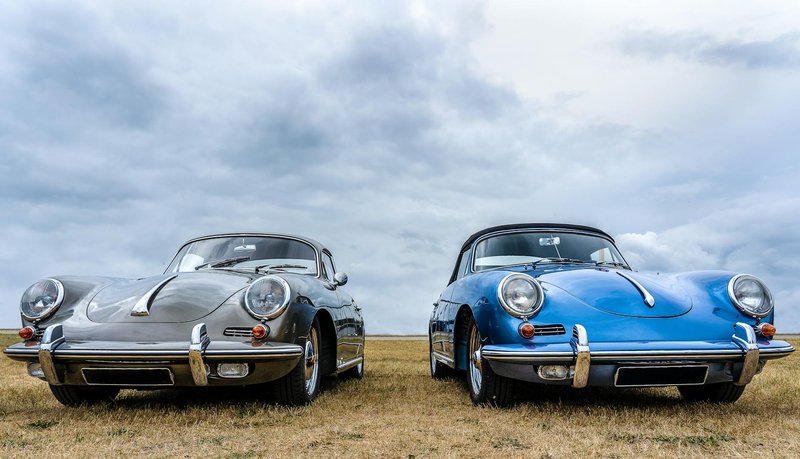
The 356/2 is where Porsche stopped being a prototype and became a product, however small the production run. These are the “Gmünd cars,” named for the Austrian sawmill where they were hammered out by hand. Komenda’s design put the engine in the tail — rear-mounted, not mid — which freed up cabin space and locked in the rear-engine layout that defined Porsche for decades and still echoes in the 911.
Every panel was shaped by hand over a wooden buck, which is why no two Gmünd coupés are exactly identical and why the build rate was glacial. Sources put the Gmünd coupé run at around 50 cars between 1948 and 1950, plus a small batch of cabriolets, commonly cited at roughly six. Engines stayed in the 1086–1131cc range, making something like 40 horsepower in this period — enough for a featherweight aluminium body to feel genuinely quick.
These hand-built Austrian 356s are a different animal from the steel-bodied cars that came later. In 1950 the company moved back to Stuttgart and began building 356s in steel at Reutter, and volume finally arrived. But that’s a 1950s story. The aluminium Gmünd cars are the rare, fragile, expensive originals — the ones that turn up at auctions like the 356 SL competition coupés derived from them and command numbers that make collectors wince. The history of those early cars is documented in detail at the Porsche Museum.
The mechanical recipe {#the-mechanical-recipe}
Strip away the bodies and all three cars share a spine, and that spine is the Volkswagen Beetle the same office designed.
- Engine: an air-cooled horizontally-opposed four, the “boxer,” displacing 1131cc in its original form. Beetle-derived, then massaged for more power as the years went on.
- Layout: the Type 64 and the Beetle put it in the rear; No. 1 moved it to the middle; the production Gmünd 356 put it back behind the axle, where it stayed.
- Construction: aluminium bodywork, hand-formed, over a tubular or platform structure. Light enough that modest power numbers — 35 to 40 horsepower — produced a car that actually moved.
The through-line is using a cheap people’s-car engine as the foundation for something sporting. The Beetle’s flat-four, designed for economy and reliability, became the seed of a sports-car dynasty because it was light, simple, and tunable. That same KdF-Wagen architecture spun off a whole family of 1940s Volkswagen car models, and Porsche’s engineers simply pulled from it. The 356 spent the next decade extracting more and more from that basic architecture. You can trace the air-cooled flat-four’s lineage straight from the Beetle to the 911.
So how many 1940s Porsches were there? {#how-many-1940s-porsches}
Depends on how strict you want to be.
If you count only road-legal production cars badged and titled as Porsches, the 1940s gave you exactly one model — the 356 — first as the mid-engined No. 1 prototype, then as the rear-engined Gmünd coupés and cabriolets. If you count the pre-war record car, add the Type 64, with the caveat that it wore the name but not the company. Total physical cars built in the decade still number under sixty.
That scarcity is the point. The 1940s weren’t Porsche’s golden age of production — they were the years a tank-engineering office, run out of a sawmill with its founder in a French jail, hand-beat a few dozen aluminium coupés and accidentally invented one of the most enduring sports-car companies on earth. One prototype roadster. Around fifty Gmünd coupés. A pre-war ghost. From that, everything.
Marco Delantero
More from Marco DelanteroHow we reviewed this article
This article was researched against manufacturer records and editorially reviewed before publishing. We accept no payment for coverage.