
The 2018 Corvette is the sweet spot of the C7 generation — the last full model year before the “final year” 2019 hype inflated prices, and the year Chevy dropped the Carbon 65 Edition to mark 65 years of the nameplate. If you’re shopping a used C7 right now, this is the year that gives you the most car for the money.
But “2018 Corvette” isn’t one car. It’s three distinct models, a stack of trim packages with confusingly similar names, and one package (the Z51) that matters more than most people realize. Here’s how the whole lineup breaks down, what each version actually costs today, and which one you should buy.
Table of Contents
- TLDR: The 2018 Corvette lineup at a glance
- The three models: Stingray, Grand Sport, Z06
- The Stingray (and why the Z51 package matters)
- The Grand Sport: the enthusiast’s pick
- The Z06: 650 hp of too much
- Trim levels decoded: 1LT, 2LT, 3LT (and the Z versions)
- The Carbon 65 Edition
- Which 2018 Corvette should you buy used in 2026?
- Reliability and common problems
TLDR: The 2018 Corvette lineup at a glance
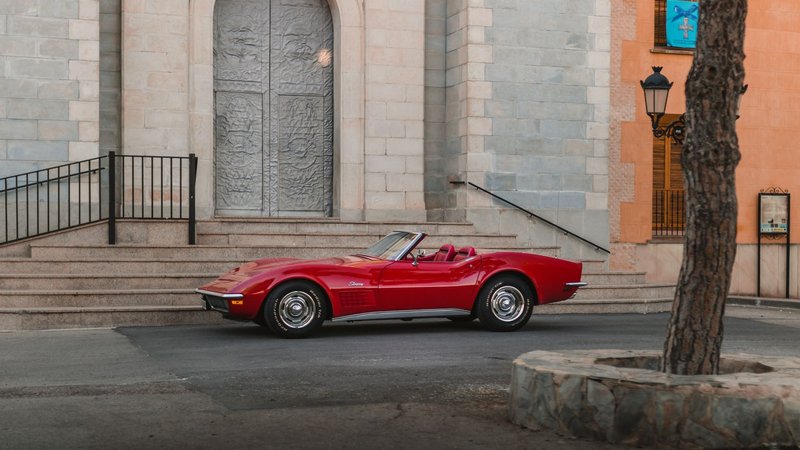
Three models, one shared 6.2L V8 as the starting point:
| Model | Engine | Horsepower | Base MSRP (2018) | Body styles |
|---|---|---|---|---|
| Stingray | 6.2L LT1 V8 | 455 hp (460 w/ perf. exhaust) | $55,495 (coupe) | Coupe, Convertible |
| Grand Sport | 6.2L LT1 V8 | 460 hp | $65,495 (coupe) | Coupe, Convertible |
| Z06 | 6.2L LT4 supercharged V8 | 650 hp | $79,495 (coupe) | Coupe, Convertible |
Convertibles added roughly $4,000 across the board, and the Z06 topped out at $83,495. If you want the honest recommendation: the Grand Sport is the one to buy. It puts the Z06’s wide body and track hardware under the naturally aspirated engine that doesn’t cook itself on a hot lap. More on that below.
The three models: Stingray, Grand Sport, Z06
Chevy structured the 2018 Corvette as a clear performance ladder. All three share the same aluminum chassis and the same basic 6.2-liter small-block architecture, but they diverge sharply in how much rubber they put down and how hard they push the engine.
The Stingray is the base car — and “base” here means 455 horsepower and a 0–60 in the high threes. The Grand Sport takes the Stingray’s naturally aspirated engine and bolts it into the Z06’s wider body, with the Z07-derived aero and the bigger tires. The Z06 is the supercharged monster: 650 horsepower, 650 lb-ft of torque, and a chassis that can genuinely run with cars costing twice as much.
That’s the shape of it. Now the details that actually change which one you’d want.
The Stingray (and why the Z51 package matters)
The Stingray is where every 2018 Corvette conversation should start, because it’s the car most people should buy and the one that anchors the whole lineup at $55,495 for the coupe.
The 6.2L LT1 makes 455 horsepower standard, or 460 with the optional performance exhaust — a $1,195 box you should always want to see checked. Paired with the eight-speed automatic or the seven-speed manual (yes, seven, with rev-matching that’s genuinely good), it’ll run 0–60 in about 3.7 seconds. That’s supercar territory from 2005, sold for the price of a loaded pickup. It’s the kind of acceleration that would have put it right alongside the fastest sports cars of the 1990s when they were brand new — now available for used-C7 money.
The thing to hunt for on a used Stingray is the Z51 Performance Package. This isn’t a cosmetic trim — it’s the option that turns a fast cruiser into a real driver’s car. Z51 adds an electronic limited-slip differential, dry-sump oiling (so the engine won’t starve in hard cornering), bigger brakes, an aero package, and additional cooling for the diff and transmission. A Stingray with Z51 and the manual is, pound for pound, one of the best-value performance cars of the decade. A Stingray without Z51 is still quick, but you’re leaving the good stuff on the table.
The Grand Sport: the enthusiast’s pick
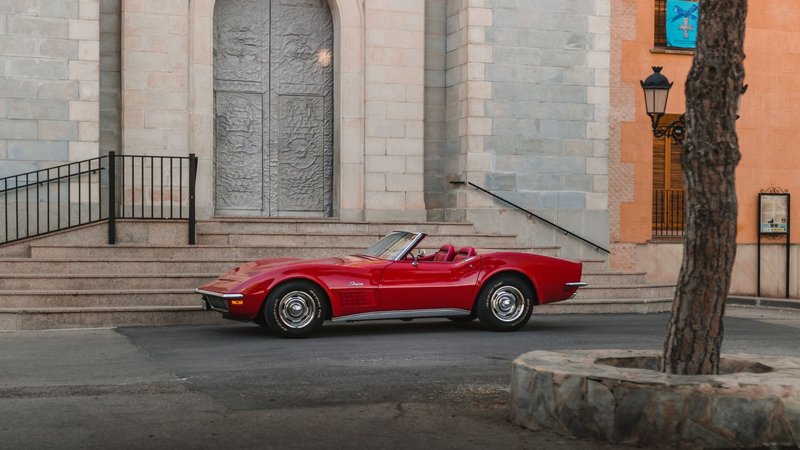
Here’s the Corvette that keeps showing up on “should have bought that” lists. The 2018 Grand Sport slots between the Stingray and the Z06 at $65,495, and it’s arguably smarter than both. The name isn’t new marketing, either — it revives one of the great sports cars of the 1960s, the handful of lightweight Grand Sport racers Chevy built in 1963 to go after Ferrari.
The recipe: take the Z06’s wider body, its bigger wheels and tires (Michelin Pilot Super Sport, or Sport Cup 2s if you check the Z07 box), its bigger brakes and aggressive aero — then drop in the Stingray’s naturally aspirated 460-hp LT1 instead of the supercharged engine. What you get is a car with nearly all of the Z06’s grip and none of its heat-soak problems. On a track, a Grand Sport will lap consistently all day while a Z06 is backing off to save its coolant temps.
The Grand Sport also came standard with the eLSD, the dry-sump system, and Magnetic Ride Control on the higher trims. It’s the driver’s Corvette — enough power to be genuinely fast, enough chassis to use all of it, and a naturally aspirated engine that revs cleanly to 6,600 rpm and sounds like a Corvette should. If you’re buying a C7 to actually drive hard, this is the answer.
The Z06: 650 hp of too much
The 2018 Z06 is the headline act: a 6.2L LT4 with an Eaton supercharger making 650 horsepower and 650 lb-ft, launching to 60 in about 2.95 seconds and through the quarter-mile in the low elevens. On paper and on the drag strip, nothing else in the lineup is close.
The catch is well-documented, and you should know it before you buy: the C7 Z06 has a reputation for heat soak. Push it hard on a hot track and the supercharged engine can pull power to protect itself as intake and coolant temps climb. Chevy improved the cooling over the C7’s run, and the 2018 cars are better than the early 2015s, but the fundamental physics of a supercharged V8 in a tightly packaged engine bay didn’t change. As a street car and occasional canyon weapon, the Z06 is spectacular. As a dedicated track car, the Grand Sport is often the more usable tool despite giving up 190 horsepower.
Base MSRP was $79,495 for the coupe, $83,495 for the convertible — and a Z07-optioned Z06 with the carbon-ceramic brakes and the aggressive aero could push well past $90,000 new.
Trim levels decoded: 1LT, 2LT, 3LT (and the Z versions)
This is where the 2018 Corvette gets confusing, so let’s make it simple. Within each model, Chevy offered three equipment tiers. On the Stingray and Grand Sport they’re badged 1LT, 2LT, 3LT. On the Z06, the exact same ladder is badged 1LZ, 2LZ, 3LZ. The number is the content level; the letter just tells you which model you’re in.
Here’s what each tier actually adds:
- 1LT / 1LZ — The base equipment group. You still get the full performance hardware, the 8-inch touchscreen, and a proper interior. Nothing feels stripped. This is the value play.
- 2LT / 2LZ — Adds the head-up display, the Bose premium audio, heated and ventilated seats, memory settings, and the front-facing “curb view” camera. The most popular tier for a reason — it’s the comfort sweet spot.
- 3LT / 3LZ — Piles on the Napa leather-wrapped interior, extra trim, and additional creature comforts. Nice, but you’re paying for cabin materials, not speed.
Critical point for used buyers: the trim level does not change the performance. A 1LT Stingray with the Z51 package is faster and more capable than a 3LT without it. Don’t let a fancy interior code distract you from the mechanical options that actually matter — Z51, the differential, the magnetic dampers. Buy the hardware, not the leather.
The Carbon 65 Edition
The 2018 hook, and the reason collectors single out this model year, is the Carbon 65 Edition — a limited run of just 650 cars built to mark the Corvette’s 65th anniversary.
It was offered as an appearance-and-materials package on top of the 3LT Grand Sport and the 3LZ Z06, finished exclusively in Ceramic Matrix Gray with blue accents and a carbon flash-tinted aluminum wheel. The real content was the carbon fiber: a visible carbon fiber hood section, ground effects, spoiler, and a carbon fiber steering wheel rim inside, plus unique badging and an individually numbered plaque. Because only 650 were made and it was tied to a milestone anniversary, the Carbon 65 has held its value better than the standard cars — expect a meaningful premium if you find one for sale, and verify the numbered plaque and documentation before paying it.
Which 2018 Corvette should you buy used in 2026?
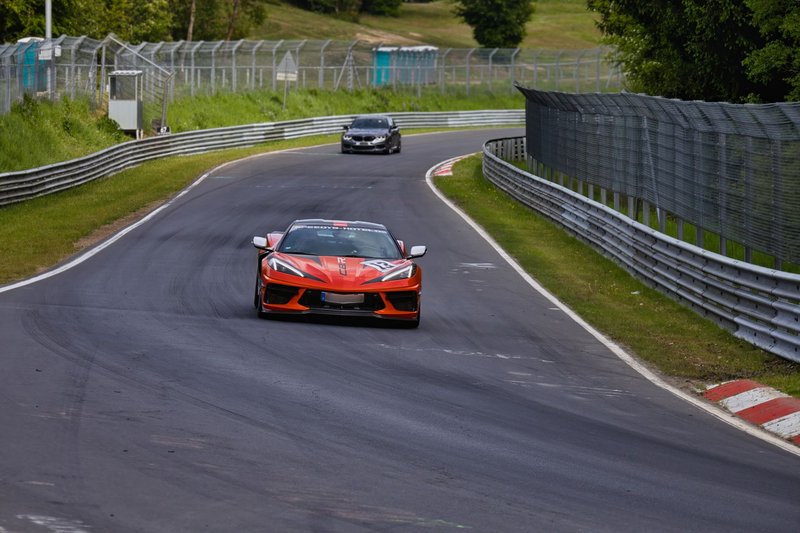
The spec sheets will tell you the Z06 is the best because it has the most power. The spec sheets are missing the point. Here’s the practical breakdown for a used buyer today:
Buy the Stingray Z51 (manual) if: you want the most car for the least money and you’re honest that you’ll drive it on the street 95% of the time. A clean 2018 Stingray Z51 is the C7 value champion. According to Kelley Blue Book valuations, C7 Stingray coupes have settled into a stable used band that undercuts the Grand Sport by several thousand dollars for very similar real-world performance.
Buy the Grand Sport if: you want to do track days, autocross, or spirited canyon runs and you want a car that won’t get hot and sulk. This is the enthusiast’s pick and my recommendation for most buyers who care about driving. It’s the best-balanced C7 Chevrolet built.
Buy the Z06 if: you want maximum straight-line drama and bragging rights, you’ll drive it mostly on the street, and you’ve made peace with the heat-soak reputation. Get one with a documented cooling history and preferably some of the aftermarket cooling fixes owners have developed. Values on clean, low-mile Z06s are climbing as the C7 becomes a modern classic.
Buy the Carbon 65 if: you’re a collector and you want a numbered, appreciating C7. It’s not a driver’s decision, it’s an investment one.
Reliability and common problems
The C7 is, broadly, a reliable platform — the LT1 and LT4 engines are stout, and the eight-speed automatic and seven-speed manual are both durable. But a used 2018 Corvette isn’t a blank check, so check for these:
- Wheel and tire condition — the Grand Sport and Z06’s staggered wide tires are expensive to replace, and Sport Cup 2s wear fast. Budget accordingly.
- Z06 cooling — on any Z06, ask about track use and confirm the car isn’t logging heat-related codes. It’s the single most important thing to verify.
- Fuel pump and lifter concerns — the small-block Chevy V8 family has had scattered lifter noise complaints; listen for a cold-start tick and get a compression check on higher-mileage cars.
- Interior wear — early C7 seat bolsters and some trim pieces scuff easily. Cosmetic, but factor it into the price.
- Automatic vs. manual — the 8L90 automatic in early C7s had some torque-converter shudder complaints; a fluid service history is a good sign. The U.S. Department of Transportation’s NHTSA database lets you check any specific VIN against recalls and reported complaints before you buy — do it for every car on your shortlist.
Buy on condition and documentation over color and trim badge. A well-maintained 1LT Grand Sport with the Z51-derived hardware and clean records is a far better purchase than a neglected 3LZ Z06 with an unknown track history. The 2018 Corvette is one of the great performance-per-dollar buys on the used market right now — just make sure you’re buying the right one for how you’ll actually drive it.

Marco Delantero
More from Marco DelanteroHow we reviewed this article
This article was researched against manufacturer records and editorially reviewed before publishing. We accept no payment for coverage.