You’ve seen the argument a thousand times in forums, YouTube comments, and parking lot debates. Someone says “Supra,” someone else fires back “GT-R,” and within minutes the whole thread is on fire. But here’s the thing most of those arguments get wrong: these two cars aren’t really trying to do the same thing.
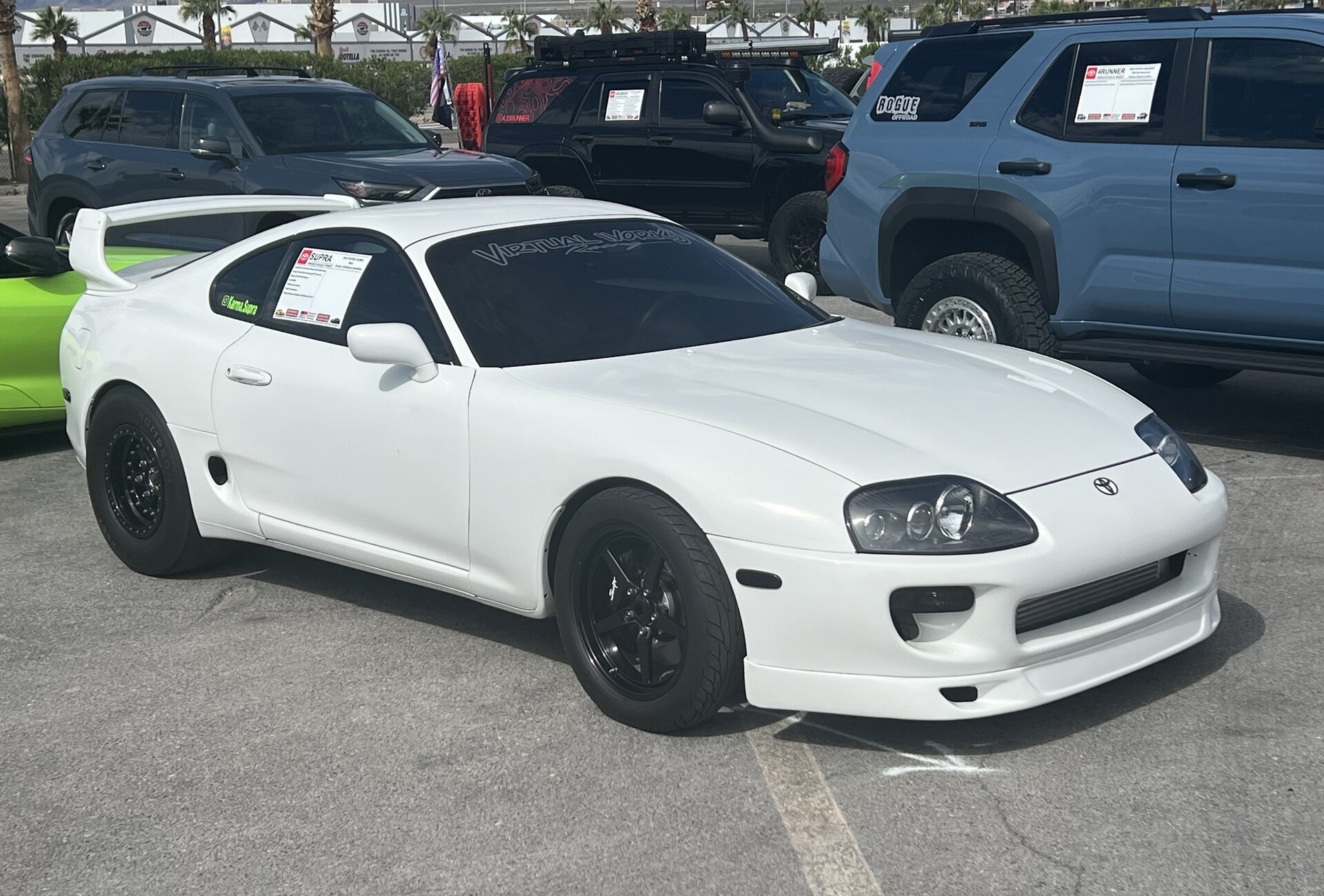
The MK4 Toyota Supra is a grand tourer that happens to be absurdly tuneable. The R34 Nissan Skyline GT-R is a technology demonstrator that Nissan built to dominate racetracks. Same era, same country, completely different philosophies. And that difference is exactly what makes this comparison worth having.
The Quick Verdict
Buy the Supra if you want the ultimate tuning platform, prefer rear-wheel drive feel, and care more about straight-line potential than lap times. Buy the GT-R if you want a car that’s devastatingly fast out of the box, love all-wheel-drive grip, and want technology that was 20 years ahead of its time. Neither is the wrong choice. But one is probably more right for you.
What’s Under the Hood
Both cars run inline-six engines with twin turbochargers. Both were built in the late 1990s. That’s roughly where the similarities end.
The Supra’s 2JZ-GTE is a 3.0-liter iron-block straight-six producing 321 horsepower at 5,600 rpm and 315 lb-ft of torque at 4,000 rpm in US-spec form. Japanese models were officially rated at 280 hp — a fiction maintained by the gentlemen’s agreement between Japanese automakers that fooled absolutely nobody. The real number was always north of 320.
The GT-R’s RB26DETT is a 2.6-liter unit, also twin-turbocharged, also officially rated at 276 hp under the same gentleman’s agreement. Real-world output sits around 320 hp with 289 lb-ft of torque. Smaller displacement, but that higher-revving character gives the RB26 a completely different personality on the street.
Here’s where it gets interesting. The 2JZ’s cast-iron block and forged internals from the factory mean the bottom end can handle absurd amounts of boost without so much as a head gasket complaint. There are documented 2JZ builds pushing past 1,200 horsepower on stock internals. That’s not an exaggeration — it’s one of the most overbuilt engines ever mass-produced.
The RB26 is no slouch in the tuning department either, but it tends to need bottom-end work sooner. Most builders recommend forged internals above 600 hp. It’ll get there, but the 2JZ just shrugs at power levels that would turn most engines into expensive paperweights.
On the Road: Two Very Different Experiences
Drive a Supra and you immediately notice two things: it’s comfortable, and it’s heavy. At 3,560 lbs, the MK4 is a grand tourer first. The seats are supportive, the ride is compliant, and the twin-turbo six pulls with smooth, relentless force from about 3,500 rpm all the way to redline. Point it down a highway on-ramp and the Supra feels like it could cruise at 150 mph all day without breaking a sweat. Because it literally can.
The steering is hydraulic and nicely weighted, but it doesn’t talk to you the way the GT-R’s does. Through a fast sweeper, the Supra feels planted but slightly disconnected — you’re aware of the car’s mass shifting around, and you learn to trust the rear end rather than feel it.
The GT-R is a different animal entirely. At 3,400 lbs it’s not exactly light, but the ATTESA E-TS Pro all-wheel-drive system makes it feel lighter than it is. The system defaults to rear-wheel drive and sends up to 50% of torque to the front wheels only when it detects slip — which means you get rear-drive feel in normal driving and all-wheel-drive security when you push it. The transition is nearly seamless.
Add in Super-HICAS four-wheel steering and you have a car that corners with a precision the Supra simply can’t match. The R34 dives into apexes with a directness that borders on telepathic. I’ve talked to owners who tracked both back-to-back, and the consensus is always the same: the GT-R makes you feel like a better driver than you actually are.
The Supra makes you work for it. Which, honestly, some people prefer.
Specs Comparison
| Spec | MK4 Supra Turbo | R34 GT-R V-Spec |
|---|---|---|
| Engine | 2JZ-GTE 3.0L I6 Twin-Turbo | RB26DETT 2.6L I6 Twin-Turbo |
| Power (real-world) | ~320 hp | ~320 hp |
| Torque | 315 lb-ft | 289 lb-ft |
| Transmission | 6-speed manual / 4-speed auto | 6-speed Getrag manual |
| Drivetrain | RWD | AWD (ATTESA E-TS Pro) |
| Curb Weight | 3,560 lbs (1,615 kg) | 3,400 lbs (1,542 kg) |
| 0-60 mph | 4.6 seconds | 4.0 seconds |
| Top Speed | 155 mph (limited) | 155 mph (limited) |
| Production Years | 1993–2002 | 1999–2002 |
| Approx. Market Price (2025) | $60,000–$120,000+ | $150,000–$350,000+ |
The Tuning Question
This is where the Supra pulls ahead decisively. Not because the GT-R can’t be tuned — it absolutely can — but because the 2JZ platform makes big power easier, cheaper, and more reliably than almost anything else ever built.
A single turbo conversion on a 2JZ can get you to 600 hp for around $5,000-8,000 in parts. The same power level on an RB26 typically costs more and requires more supporting modifications. And when you start chasing four-digit horsepower numbers, the 2JZ’s iron block is simply more forgiving than the RB26’s.
But here’s a counterpoint that doesn’t get enough attention: the GT-R doesn’t need as much power to be fast. Its all-wheel-drive system puts power down more effectively, especially from a launch. A 500 hp GT-R will eat a 500 hp Supra alive from a dig. The Supra needs to overcome traction limitations that the GT-R simply doesn’t have. So the question isn’t just “how much power can you make?” — it’s “how much power can you actually use?”
Reliability: What Actually Breaks
The 2JZ is famously bulletproof. Common issues are minor: valve stem seals that cause smoky cold starts, EGR valve clogging, and coil pack failures. Nothing that’ll strand you. The Getrag V160 six-speed manual is the weak link in the Supra drivetrain — it doesn’t love sustained abuse above 700 hp, and replacements aren’t cheap.
The RB26 is reliable too, but it’s a more complex car with more things that can go wrong. The ATTESA transfer case pump is a known failure point around 80,000 miles, and replacement runs north of $3,000. The oil pump on pre-N1 engines is another concern — not a ticking time bomb, but something to check. Ignition coils and timing belts need attention every 50,000-60,000 miles.
The GT-R’s complexity is both its greatest strength and its Achilles’ heel. More technology means more that can fail. The Supra, by comparison, is mechanically simpler — which is part of why it’s become the go-to platform for extreme builds.
The Market Reality
This is the part that might make up your mind for you.
A decent MK4 Supra Turbo with a manual transmission currently trades between $60,000 and $120,000 depending on mileage and condition. Low-mile, unmodified examples have crossed $200,000 at auction, but those are collector-grade unicorns. For a driver-quality car, $70,000-90,000 is realistic.
R34 GT-Rs are in a different stratosphere. Clean examples start around $150,000 and V-Spec models routinely exceed $250,000. The R34 became legal for US import in 2024 (under the 25-year rule for 1999 models), which briefly dipped prices — but demand quickly absorbed the supply. If you want one, budget accordingly.
Side note: the R34’s price premium has less to do with it being objectively “better” and more to do with scarcity. Nissan built far fewer R34 GT-Rs than Toyota built MK4 Supras. Limited supply plus massive global demand equals eye-watering prices.
The Verdict: Pick Your Fighter
The GT-R wins this comparison. But barely, and with caveats.
As a complete performance package straight from the factory, the R34 GT-R is the better car. The ATTESA system, the chassis balance, the way it deploys its power — it’s a more sophisticated machine that delivers a more thrilling driving experience without requiring modification. Nissan built a car that was genuinely ahead of its time, and driving one today still feels like that.
But the Supra isn’t trying to be a GT-R. It’s a grand tourer with one of the most tuneable engines ever made, a simpler mechanical layout, and a price point that — while not cheap — is half what a comparable GT-R costs. If your plan involves boost, big power, and weekend drag racing, the Supra is the smarter buy by a wide margin.
And honestly? Both of these cars have earned their legends. The fact that we’re still arguing about them 25 years later says more about their quality than any spec sheet ever could. You can’t really lose here. You can only choose which flavor of iconic you prefer.
If you’re interested in exploring more from this era, check out our best JDM cars roundup or browse the full Toyota JDM lineup. And for more from the golden age of Japanese performance, our 1980s sports cars guide covers the decade that set the stage for everything the Supra and GT-R became.

Marco Delantero
More from Marco DelanteroHow we reviewed this article
This article was researched against manufacturer records and editorially reviewed before publishing. We accept no payment for coverage. Some guides contain affiliate links; see our affiliate disclosure.